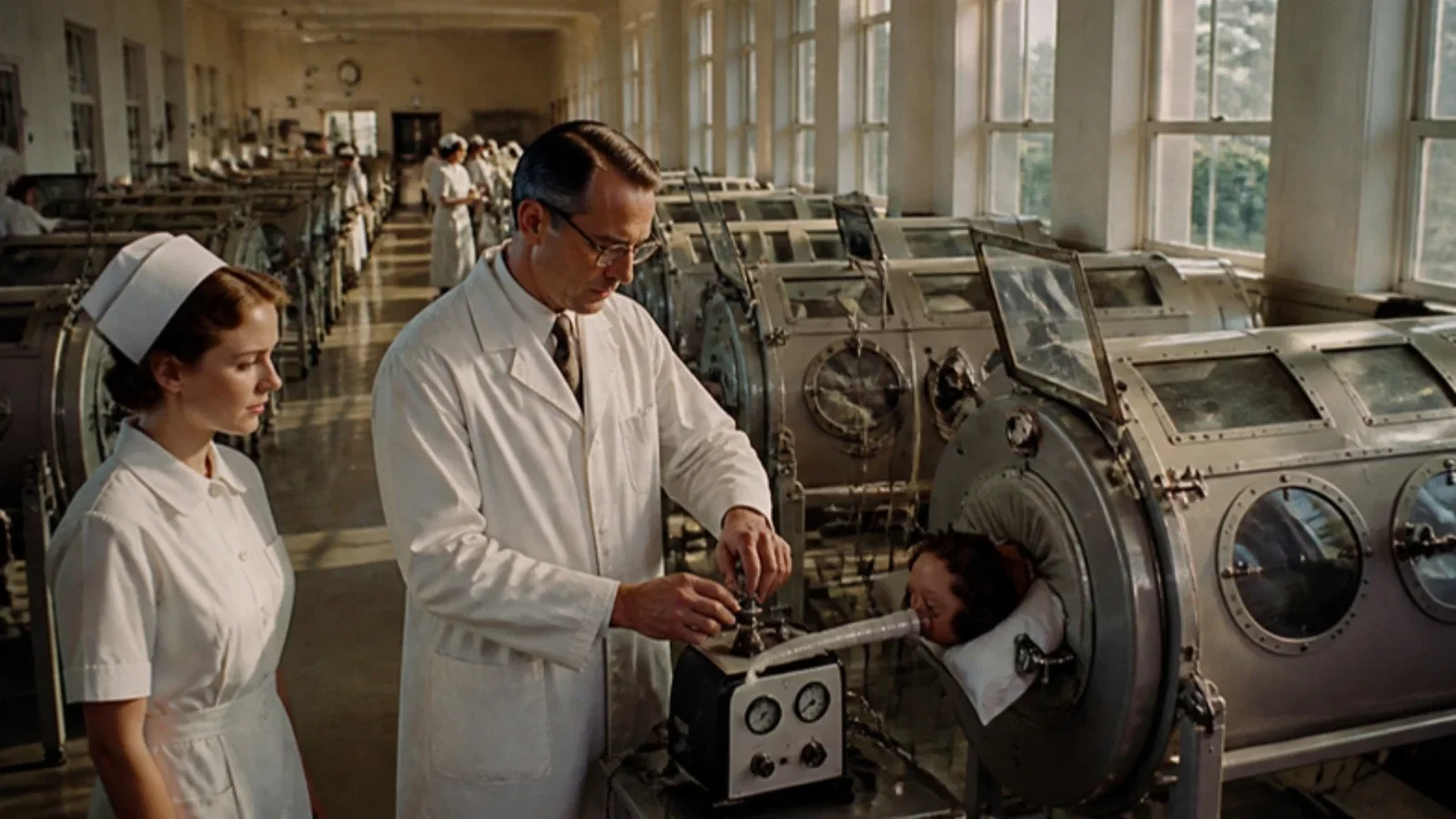
Bower, Bennett and colleagues' 1950 report in the Annals of Western Medicine and Surgery could not be obtained; this article reads a contemporary record from the same hospital, Miller and Buck's 'Tracheotomy in Bulbar Poliomyelitis' in California Medicine, January 1950: in the 1948 Los Angeles epidemic many tracheotomised respirator patients got too little air, so a consulting engineer built a machine that delivered gas under positive pressure through the tracheotomy tube during inspiration and shut off on expiration, linked to the respirator, with a portable flow-sensitive model for mask or tube; the authors reported a lower mortality after its routine use, and the ward chiefs Bower and West judged that early tracheotomy saved at least half of a type of patient who previously died.
Reading Library · Anesthesia Epochs · 中文版
Watch the education video (for clinicians)
1950: The Iron Lung Gets a Second Breath — Positive Pressure · Anesthesia Epochs Education Series
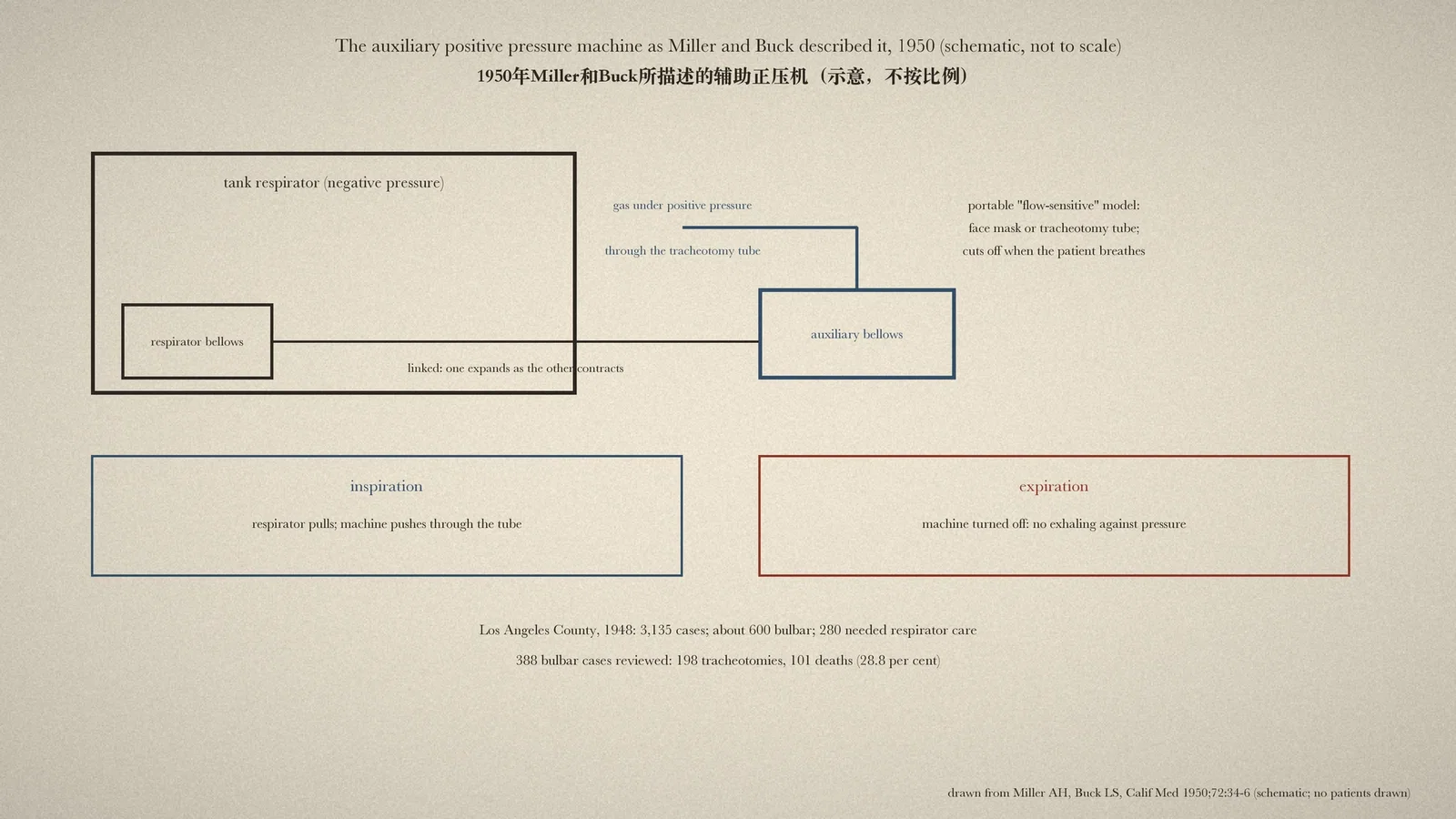
In the poliomyelitis epidemics of the mid-twentieth century, the tank respirator, or iron lung, kept paralysed patients breathing by lowering the pressure around the body. The work of Albert G. Bower's communicable disease unit at the Los Angeles County General Hospital, with the engineer V. Ray Bennett, is usually cited from a long report of 1950: Bower, Bennett, Dillon and Axelrod, "Investigation on the care and treatment of poliomyelitis patients", Annals of Western Medicine and Surgery. That report could not be obtained for this article. A 1952 paper in the Journal of the Kansas Medical Society gives the citation. [2]
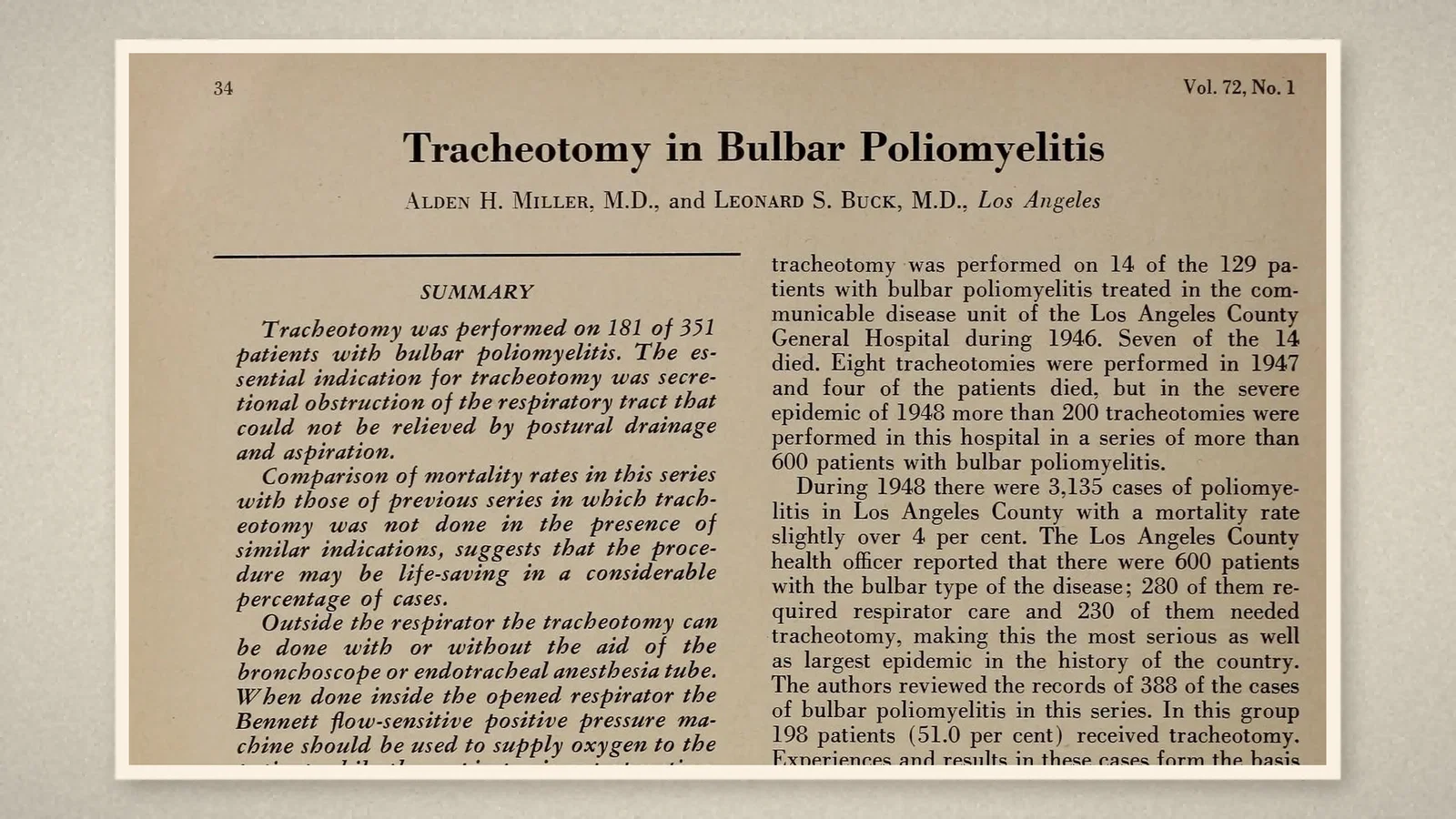
What can be read is a paper from the same hospital, written while the work was under way: Alden H. Miller and Leonard S. Buck, "Tracheotomy in Bulbar Poliomyelitis", California Medicine, January 1950, presented to the California Medical Association in May 1949. [1, p. 34]
The epidemic of 1948
"During 1948 there were 3,135 cases of poliomyelitis in Los Angeles County." About 600 were of the bulbar type; 280 required respirator care and 230 needed tracheotomy, "making this the most serious as well as largest epidemic in the history of the country", in the authors' words. Miller and Buck reviewed 388 bulbar cases, of whom 198 (51.0 per cent) received tracheotomy. Patients already in a respirator often needed it, because "the negative pressure created by the respirator in its inspiratory phase tends to pull the secretions downward from the larynx". [1, pp. 34-5]
Tracheotomy in a patient who could not breathe outside the respirator was a problem in itself. Of the 198 operations, 44 "were performed in the opened respirator with a Bennett flow-sensitive positive pressure machine being substituted for breathing". [1, p. 35]
The auxiliary machine
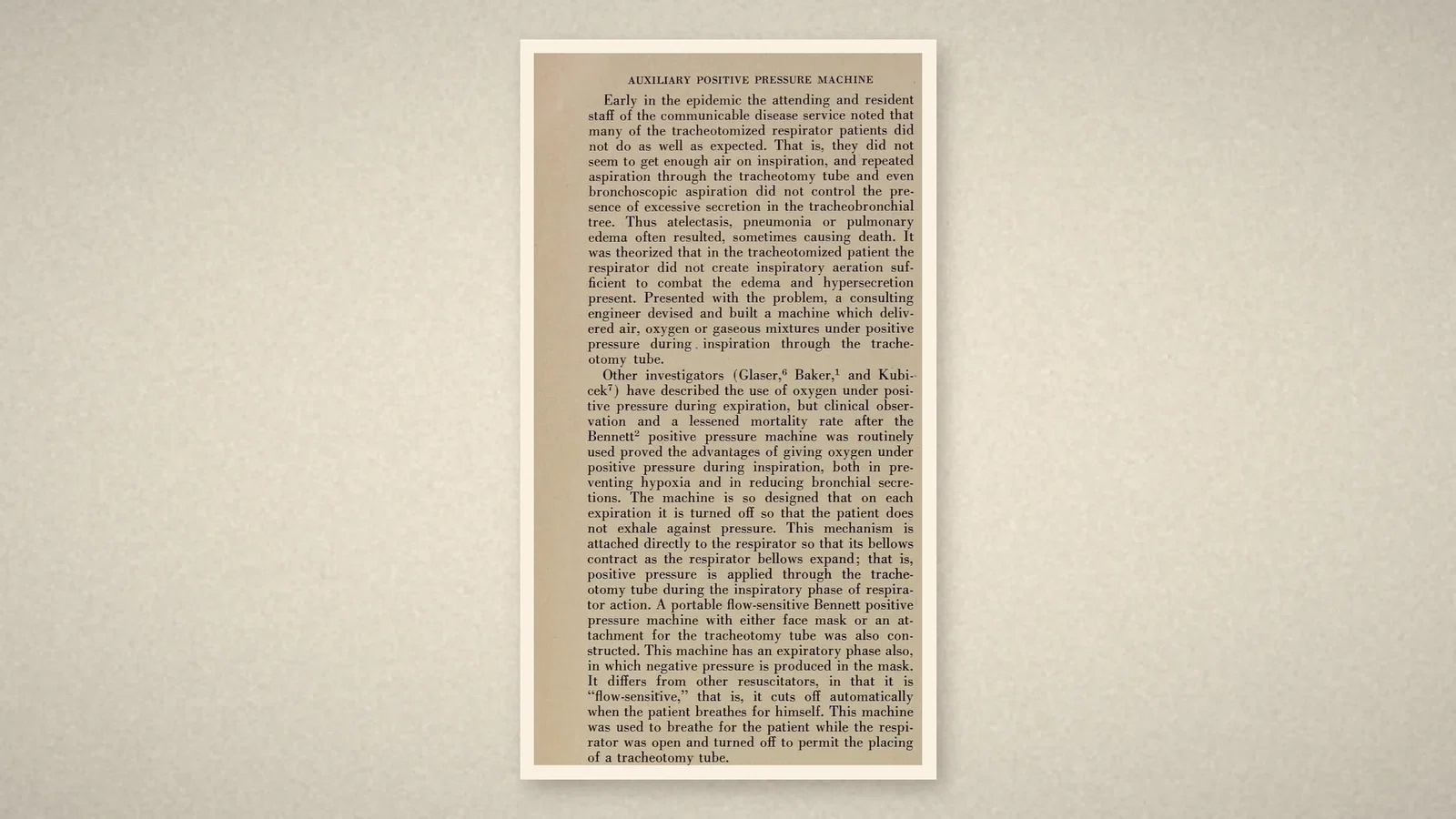
A section headed "Auxiliary positive pressure machine" tells how the device came about. "Early in the epidemic the attending and resident staff of the communicable disease service noted that many of the tracheotomized respirator patients did not do as well as expected. That is, they did not seem to get enough air on inspiration", and aspiration, even through a bronchoscope, did not control the secretions; atelectasis, pneumonia or pulmonary oedema followed, sometimes fatally. "Presented with the problem, a consulting engineer devised and built a machine which delivered air, oxygen or gaseous mixtures under positive pressure during inspiration through the tracheotomy tube." The reference list gives the name: "Bennett, V., Consulting Engineering, Los Angeles County General Hospital". [1, p. 36]
The machine was "attached directly to the respirator so that its bellows contract as the respirator bellows expand", so that positive pressure through the tube coincided with the respirator's inspiratory phase, and "on each expiration it is turned off so that the patient does not exhale against pressure". A portable "flow-sensitive" Bennett machine, for a face mask or the tracheotomy tube, "cuts off automatically when the patient breathes" on their own; it was used to breathe for patients while the respirator was open. Others had given oxygen under positive pressure during expiration, the authors wrote, but "clinical observation and a lessened mortality rate after the Bennett positive pressure machine was routinely used proved the advantages of giving oxygen under positive pressure during inspiration". [1, p. 36]
Results and judgement
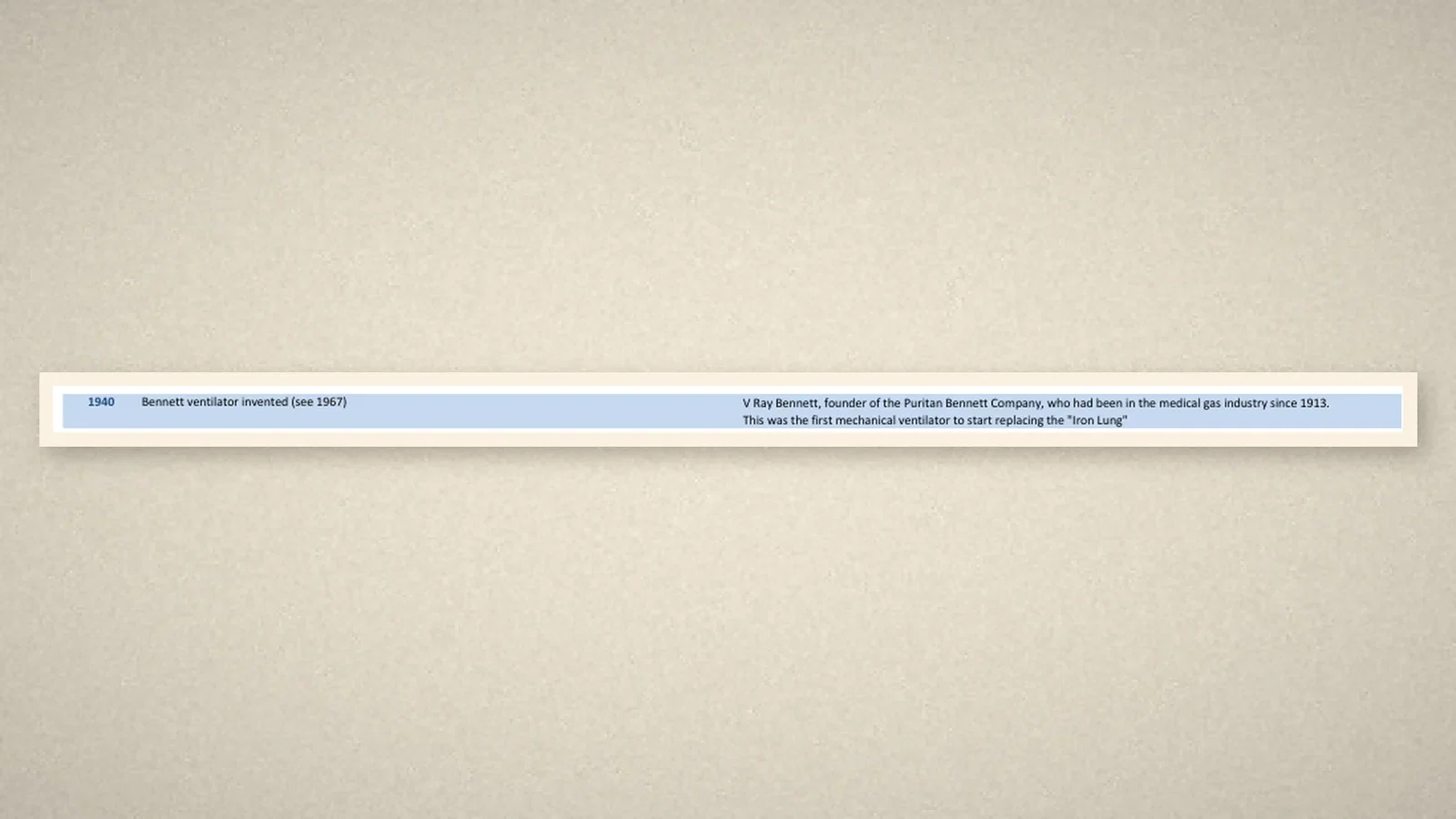
Of the 388 bulbar patients, 101 died (28.8 per cent); among those tracheotomised the rate was 38.8 per cent. The authors thought the overall rate "gratifyingly small" compared with earlier epidemics, and recorded the view of the two staff members who saw every case: "Bower and West" concluded that early tracheotomy "cannot be over-stressed" and saved "at least half of the patients of a type who previously died". The programme of the California Medical Association's 1950 session shows Bower and Harold E. West speaking on bulbar and respiratory poliomyelitis. In 1952 the Kansas paper called intermittent positive pressure "the method of choice in combating pulmonary edema", with "the advantage of making expiration a passive affair". The ASA timeline, for its part, dates a "Bennett ventilator" to 1940 and attributes it to V Ray Bennett. [1, p. 36][2][3, p. 50]
What the record shows
The Los Angeles record shows positive pressure entering the polio ward not as a replacement for the iron lung but as an addition to it, timed to the respirator's own breath and delivered through the tracheotomy. It came from a ward's observation that patients were not getting enough air and from an engineer's answer, and it was judged by mortality in an epidemic rather than by a trial.
Sources and reading limits
Read: Miller and Buck, California Medicine 1950;72:34-6, in full, from the Internet Archive scan of the bound volume; the programme of the 1950 CMA session in the same volume; the relevant passages and bibliography of a 1952 paper in the Journal of the Kansas Medical Society; the ASA timeline entry for 1940, which dates a "Bennett ventilator" to that year and attributes it to V Ray Bennett.
Not covered: Bower, Bennett, Dillon and Axelrod in the Annals of Western Medicine and Surgery 1950, which could not be obtained; West and Bower on the respirator patient, 1949; other papers from the unit. Bower's and Bennett's own account of the machine therefore does not appear; it is described as Miller and Buck describe it. Miller and Buck's summary gives 181 tracheotomies in 351 patients, while their text gives 198 in 388; this article uses the text. The mortality comparison is the authors', with earlier epidemics, not a controlled study. The ASA's statements about the 1940 ventilator are the ASA's. Oxygen flows and case details are not repeated. Quotations are from the English originals.
Three illustrations are crops of California Medicine (pp. 34 and 36) and of the ASA timeline (p. 50); one is drawn from Miller and Buck.
- Miller AH, Buck LS. Tracheotomy in bulbar poliomyelitis. Calif Med. 1950;72(1):34-6. Internet Archive
- J Kansas Med Soc. 1952;53: paper on children with acute poliomyelitis, citing Bower AG, Bennett VR, Dillon JB, Axelrod B. Investigation on the care and treatment of poliomyelitis patients. Ann West Med Surg. 1950;4:561. Internet Archive
- Australian Society of Anaesthetists. Anaesthesia history timeline. 2024. ASA
Continue exploring
Related reading connects shared questions and contexts; it does not by itself establish historical influence.
- 1936: Rovenstine's Anaesthesia for Chest Surgery
- 1887: Fell Uses Bellows to Breathe for a Morphine-Poisoned Patient
Anesthesia Epochs · The Source Room · About & Editorial Method
Published November 2, 2026. Sources and reading limits are stated above. Illustrations are labelled as original source images or AI-made. Historical accounts are educational; they are not current treatment instructions.