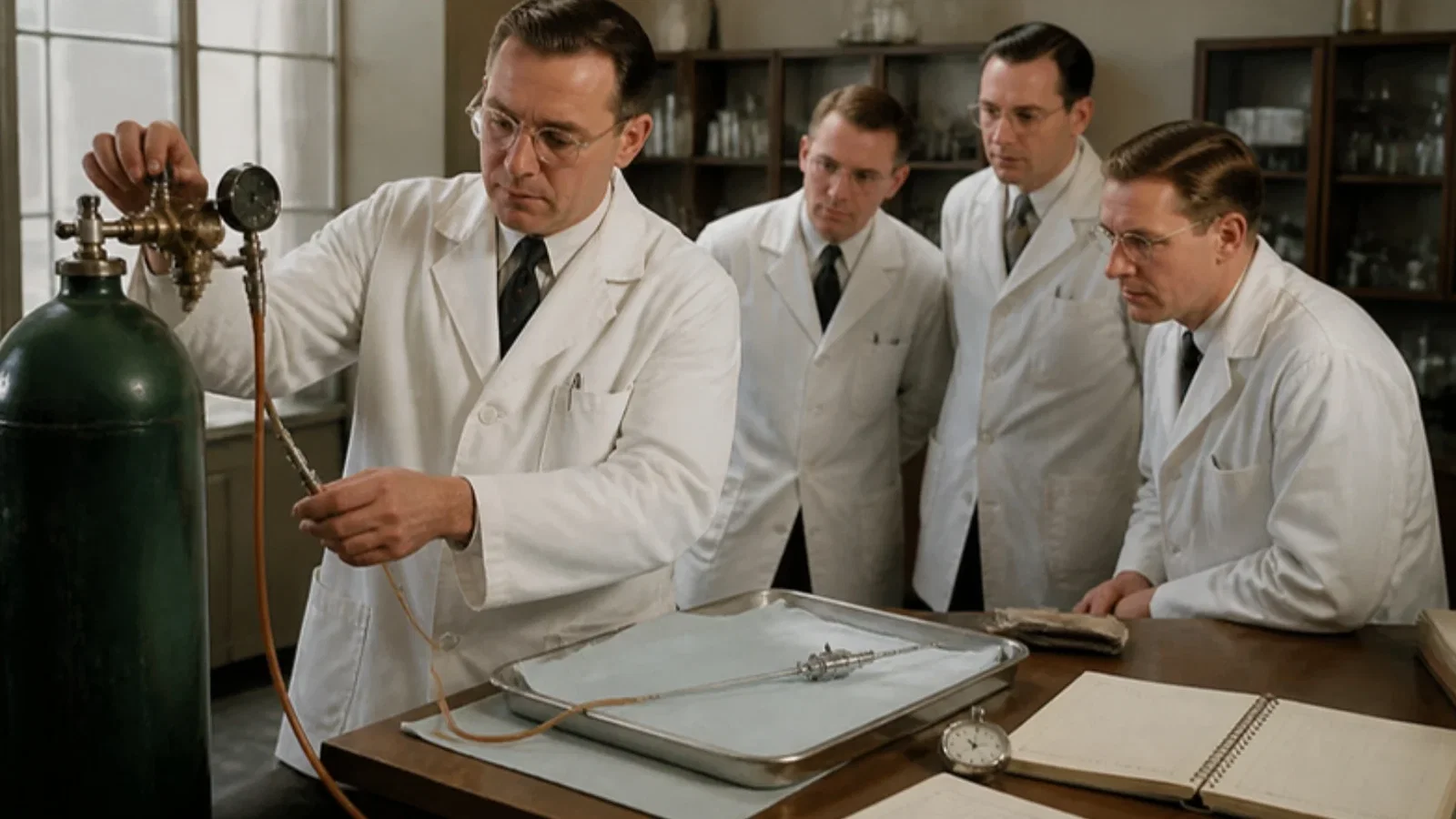
At Ohio State University, Jacoby, Reed, Hamelberg, Gillespie and Hitchcock reported in 1951 that oxygen insufflated through a 13-gauge needle in the trachea kept apnoeic dogs alive for thirty minutes with full recovery, mortality rising quickly beyond that, while air through the same needle could not sustain life; their 1954 follow-up showed oxygenation maintained but carbon dioxide rising to dangerous levels, corrected by intermittent air insufflation through a wider tapered steel cannula, which they proposed in place of emergency tracheotomy.
Reading Library · Anesthesia Epochs · 中文版
Watch the education video (for clinicians)
1951: Apnoeic Oxygenation — Oxygen Without Breathing · Anesthesia Epochs Education Series
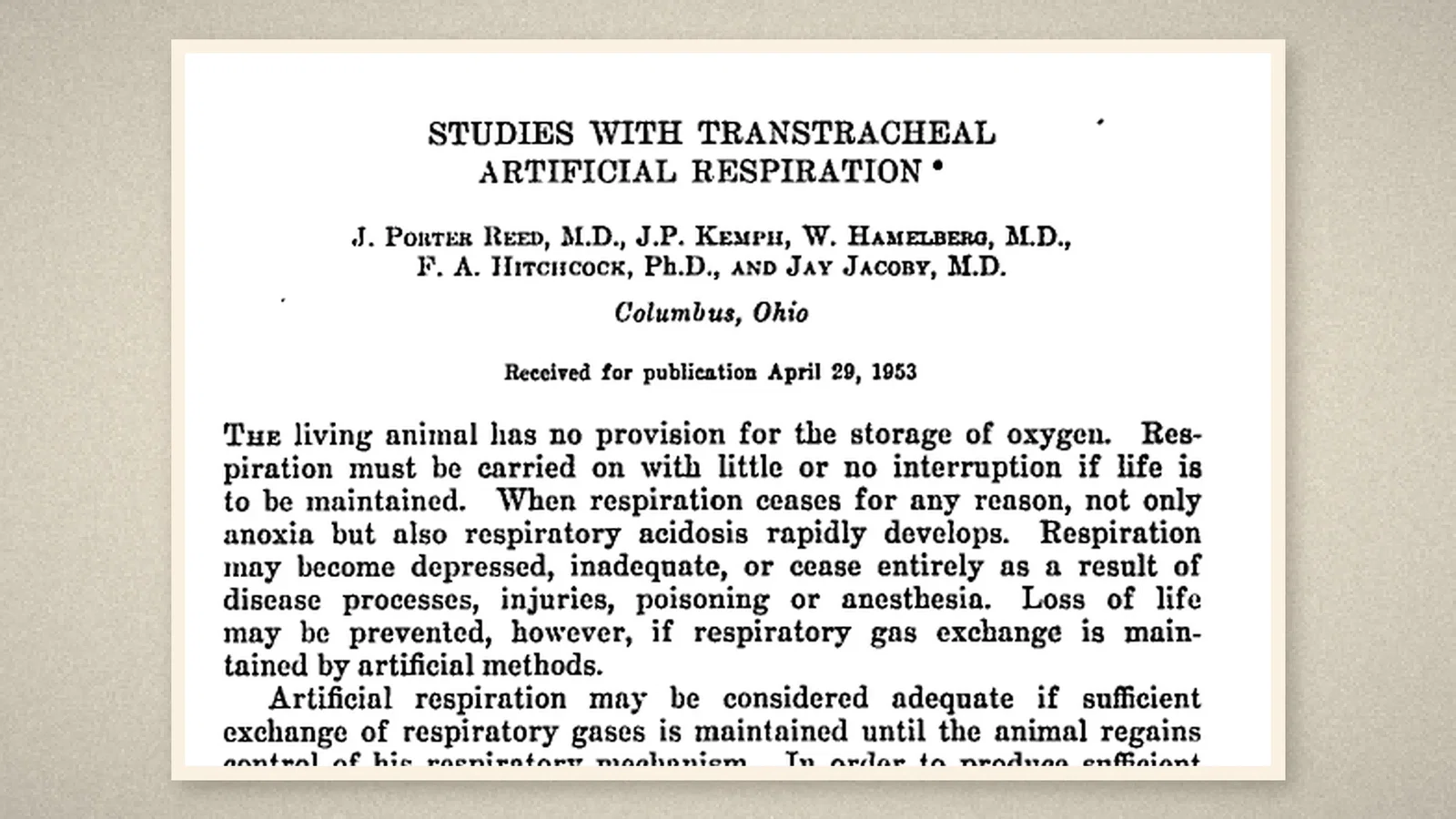
Oxygen given into a non-breathing airway can keep the blood oxygenated for a while, but it does not remove carbon dioxide. Apnoeic oxygenation rests on that distinction. The Australian Society of Anaesthetists (ASA) timeline dates the "introduction of technique of 'apnoeic oxygenation'" to 1951, to J. J. Jacoby, William Hamelberg, J. P. Reid [sic], B. Gillespie and F. A. Hitchcock in the United States, using "a percutaneous, trans-tracheal approach". Their 1951 report, a short abstract in the American Journal of Physiology, is not covered here. What follows reads the group's full paper, "Studies with transtracheal artificial respiration", by J. Porter Reed, J. P. Kemph, W. Hamelberg, F. A. Hitchcock and Jay Jacoby of Ohio State University, received by Anesthesiology on 29 April 1953 and published in January 1954. [1][2]
The problem: an obstructed airway
The paper begins plainly: "The living animal has no provision for the storage of oxygen." When breathing stops, "not only anoxia but also respiratory acidosis rapidly develops". The authors called obstruction "one of the principal obstacles confronting the resuscitator", from the tongue and teeth to secretions and laryngospasm, and noted that securing an airway "may be difficult even for a skilled anesthesiologist". They also had a darker scenario in mind: the anticholinesterase poisons had raised the prospect of "mass artificial respiration by relatively unskilled personnel with a minimum of equipment", perhaps with air from compressors or even bicycle pumps. A needle or cannula pushed through the skin into the trachea would bypass obstruction above the larynx without a surgical tracheotomy. [1]
What came before
"The concept of transtracheal artificial respiration is not new." The authors cited Robert Hooke's demonstration of 1667, keeping dogs alive by pumping air into their lungs; Meltzer and Auer's insufflation of 1909 in curarized dogs; and, since 1944, the "diffusion respiration" of Draper, Whitehead and others, in which oxygen was not forced in but allowed to diffuse into the lungs of completely apnoeic dogs, provided they were first denitrogenated by breathing pure oxygen. In those experiments the carbon dioxide "rose continually". [1]
In 1951 Jacoby, Reed, Hamelberg, Gillespie and Hitchcock had reported preliminary results. Oxygen insufflated through a 13-gauge transtracheal needle could keep apnoeic dogs alive "for thirty minutes with an expected recovery rate of 100 per cent", but mortality rose rapidly if apnoea went on longer; and compressed air through the same needle "would not support life for even a short period". [1]
The 1954 experiments
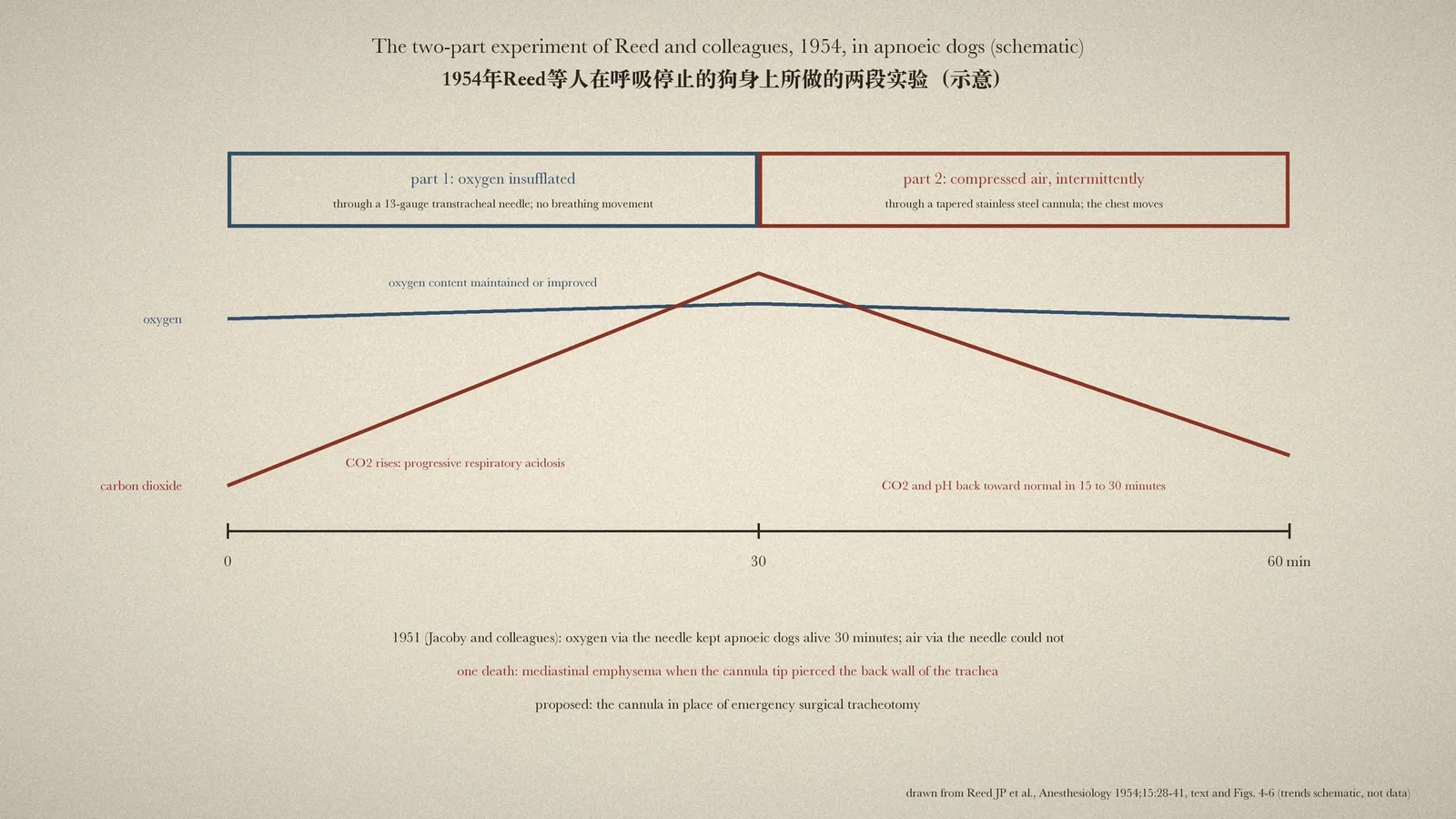
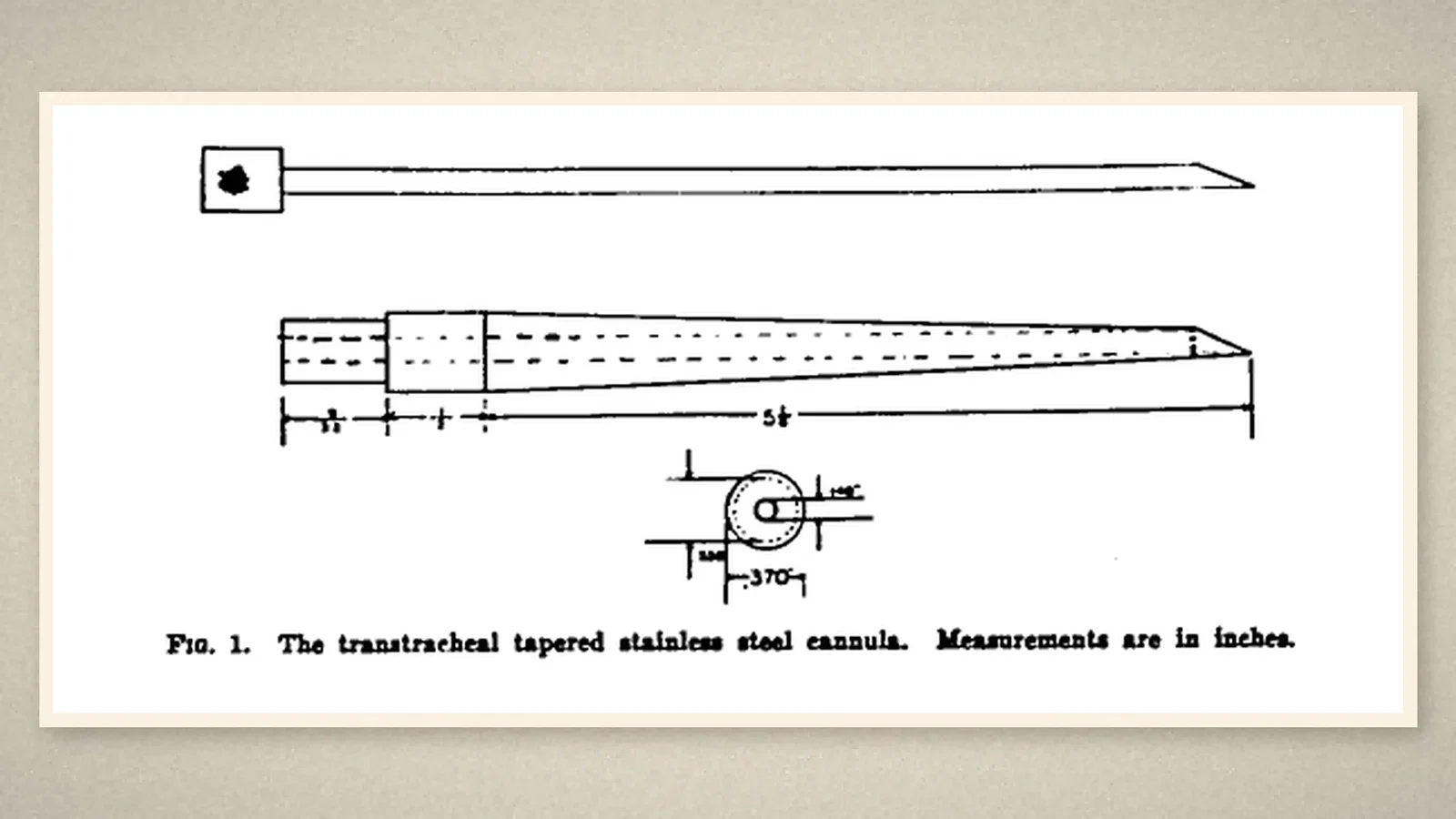
Sixteen dogs went through two half-hour stages. First, oxygen was insufflated through a 13-gauge needle into the trachea of the apnoeic dog. Then compressed air was blown in intermittently through a tapered stainless steel cannula, which had seven small holes near its sharpened point. [1]
The results separated oxygen from carbon dioxide. During oxygen insufflation the dogs were held "in a state of complete respiratory arrest for a period of thirty minutes", and the oxygen content of the blood "can be adequately maintained and, in fact, improved". But with no breathing movement, carbon dioxide content and tension rose, "a progressive respiratory acidosis which would become uncompensated and would eventually lead to the death of the animal"; blood pressure fell and venous pressure rose. Once intermittent air insufflation moved the chest, blood pH was normal within fifteen minutes and carbon dioxide within thirty. [1]
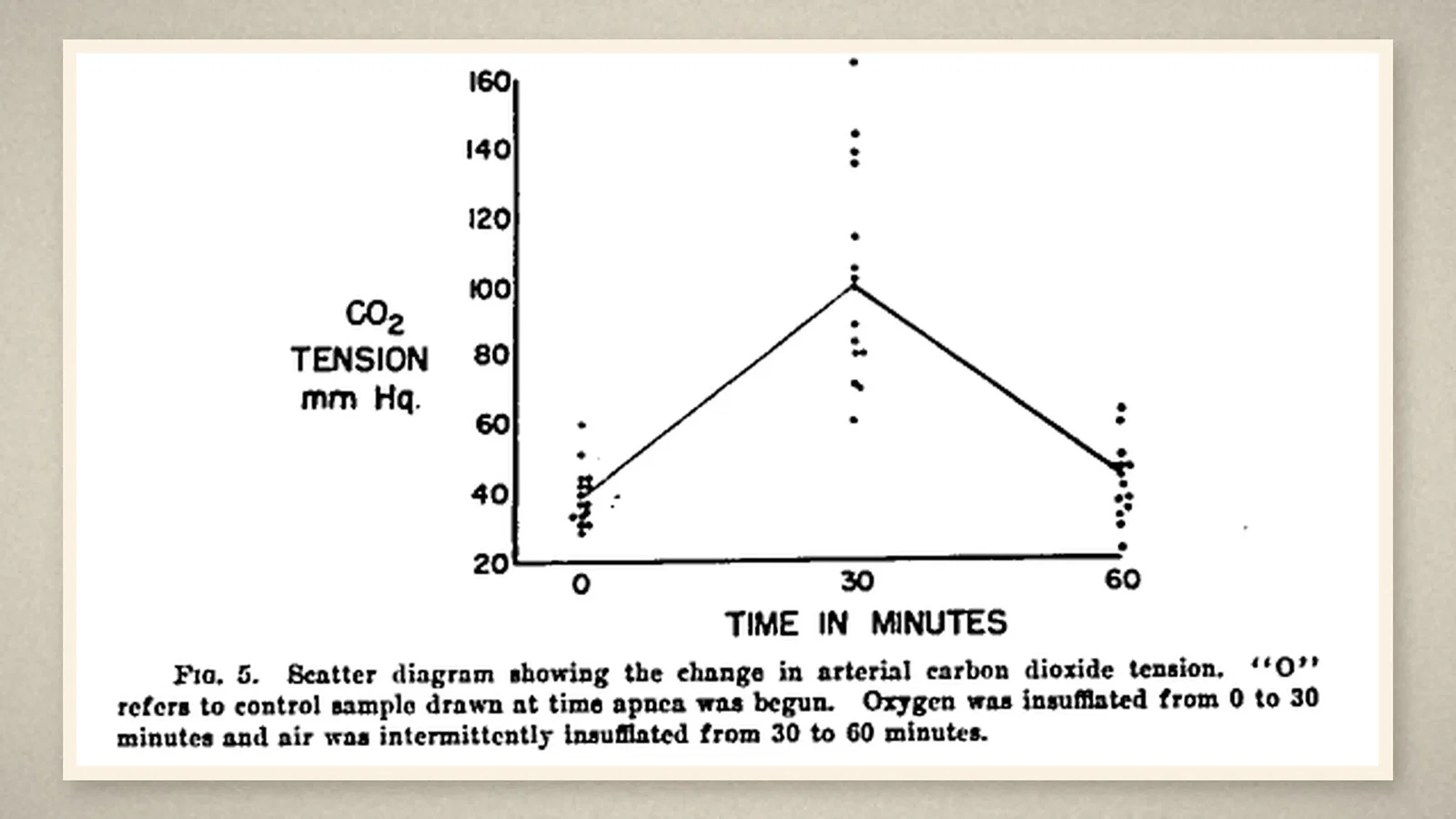
There were two deaths, both after oxygen insufflation had stopped. One was from an anaesthetic overdose. In the other, the cannula tip had pierced the soft back wall of the trachea and forced air into the mediastinum. The authors concluded that intermittent air was "far superior" to continuous oxygen, that "the cannula might well replace the surgical tracheotomy in emergency resuscitation", and that, without a cannula, oxygen through a needle "will support life for a sufficient length of time to secure further and more effective methods". [1]
The ASA's later entry under 2013 shows the same principle in a different form: the high-flow nasal technique called THRIVE, which it says "has allowed apnoeic oxygenation of patients for longer than 1 hour". [2]
What the record shows
The Ohio work states the core of apnoeic oxygenation that clinicians still have to respect: insufflated oxygen can hold saturation during apnoea, but carbon dioxide keeps accumulating, so the method buys time rather than replacing ventilation. It also records the hazards of the transtracheal route, including a cannula driven through the back wall of the trachea.
Sources and reading limits
Read: Reed JP, Kemph JP, Hamelberg W, Hitchcock FA, Jacoby J, Anesthesiology 1954;15:28-41, in full. The ASA timeline entries for 1951 and 2013.
Not covered: the 1951 abstract of Jacoby and colleagues (Am J Physiol 1951;167:798); the diffusion-respiration papers; Patel and Nouraei's THRIVE paper. The 1951 findings are given as the 1954 paper summarises them. The ASA's needle size (14 gauge) and oxygen flow differ from those described in the 1954 paper (13 gauge); flows are not repeated here. The ASA spells one author "Reid"; the paper prints Reed. All results are in anaesthetized dogs; drug doses are not repeated. The authors themselves trace the idea back to Hooke. Quotations are from the English original.
Three illustrations are crops of pp. 28, 31 and 37, including Figs. 1 and 5; one is drawn from the text and figures.
- Reed JP, Kemph JP, Hamelberg W, Hitchcock FA, Jacoby J. Studies with transtracheal artificial respiration. Anesthesiology. 1954;15(1):28-41. Anesthesiology
- Australian Society of Anaesthetists. Anaesthesia history timeline. 2024. ASA
Continue exploring
Related reading connects shared questions and contexts; it does not by itself establish historical influence.
- 1887: Fell Uses Bellows to Breathe for a Morphine-Poisoned Patient
- 1949: Carlens's Double-Lumen Catheter Separates the Two Lungs
Anesthesia Epochs · The Source Room · About & Editorial Method
Published November 2, 2026. Sources and reading limits are stated above. Illustrations are labelled as original source images or AI-made. Historical accounts are educational; they are not current treatment instructions.