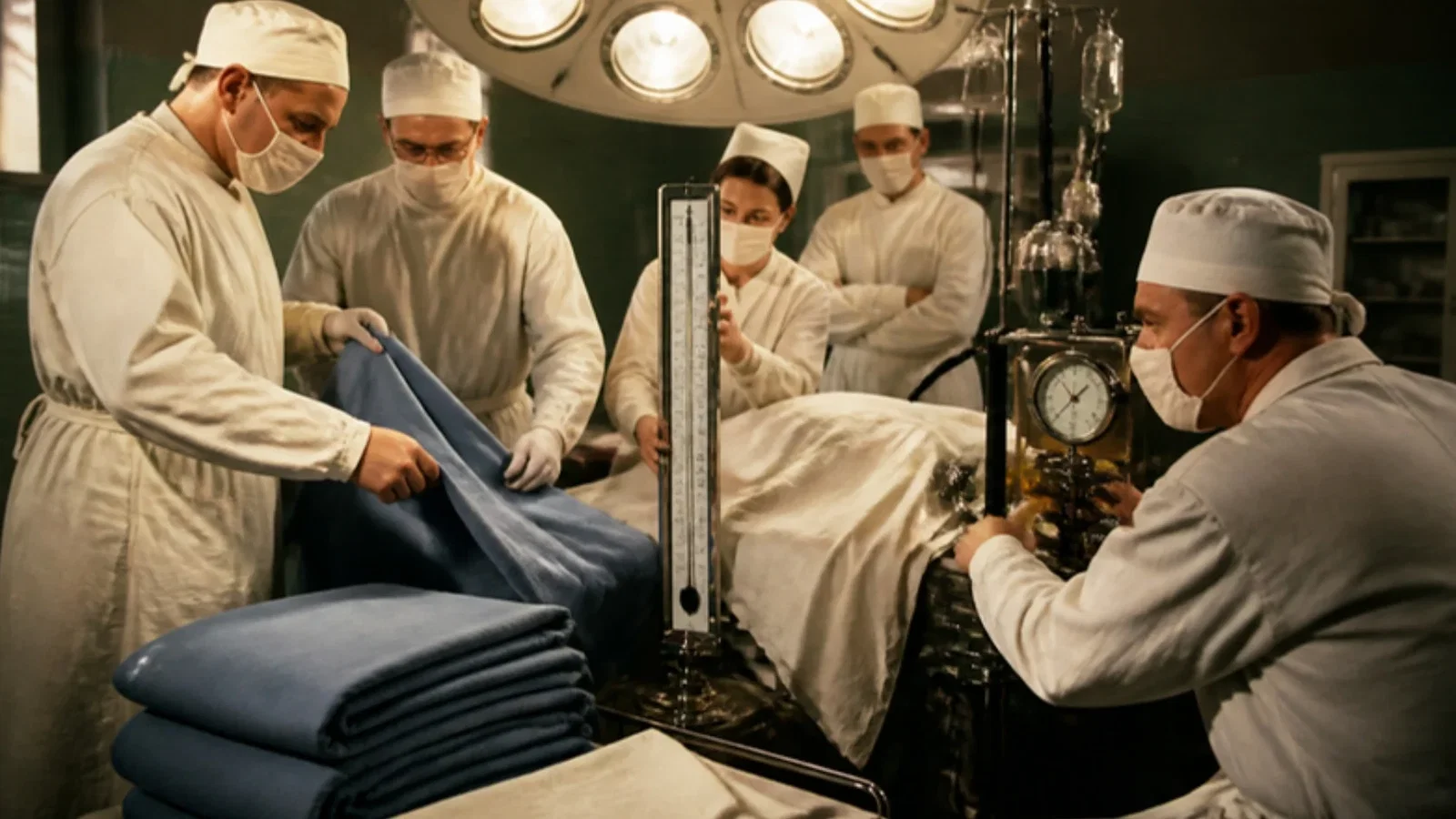
Surgery for January 1953 printed 'Closure of atrial septal defects with the aid of hypothermia; experimental accomplishments and the report of one successful case' by F. John Lewis and Mansur Taufic of the University of Minnesota. Following Bigelow's hypothermia experiments in dogs, they anaesthetised animals with thiopentone, intubated and ventilated them, cooled them in rubber blankets carrying a cold alcohol solution, then opened the chest, briefly occluded the venae cavae and worked in a dry right atrium, first making and later closing septal defects. Ventricular fibrillation was the worst problem; the authors blamed coronary air embolism, and survival improved once the outflow was clamped and residual air flushed out with saline. On 2 September 1952 they used the same method in a 5-year-old girl with a catheter-proven defect: thiopentone and curare, intubation, two hours of blanket cooling, five and a half minutes of inflow occlusion, closure under direct vision, and rewarming in hot water. Recovery was uneventful; the child went home on the eleventh day and the murmur was gone.
Reading Library · Anesthesia Epochs · 中文版
Watch the education video (for clinicians)
1952: Lewis and Taufic — Hypothermia for an Atrial Septal Defect · Anesthesia Epochs Education Series
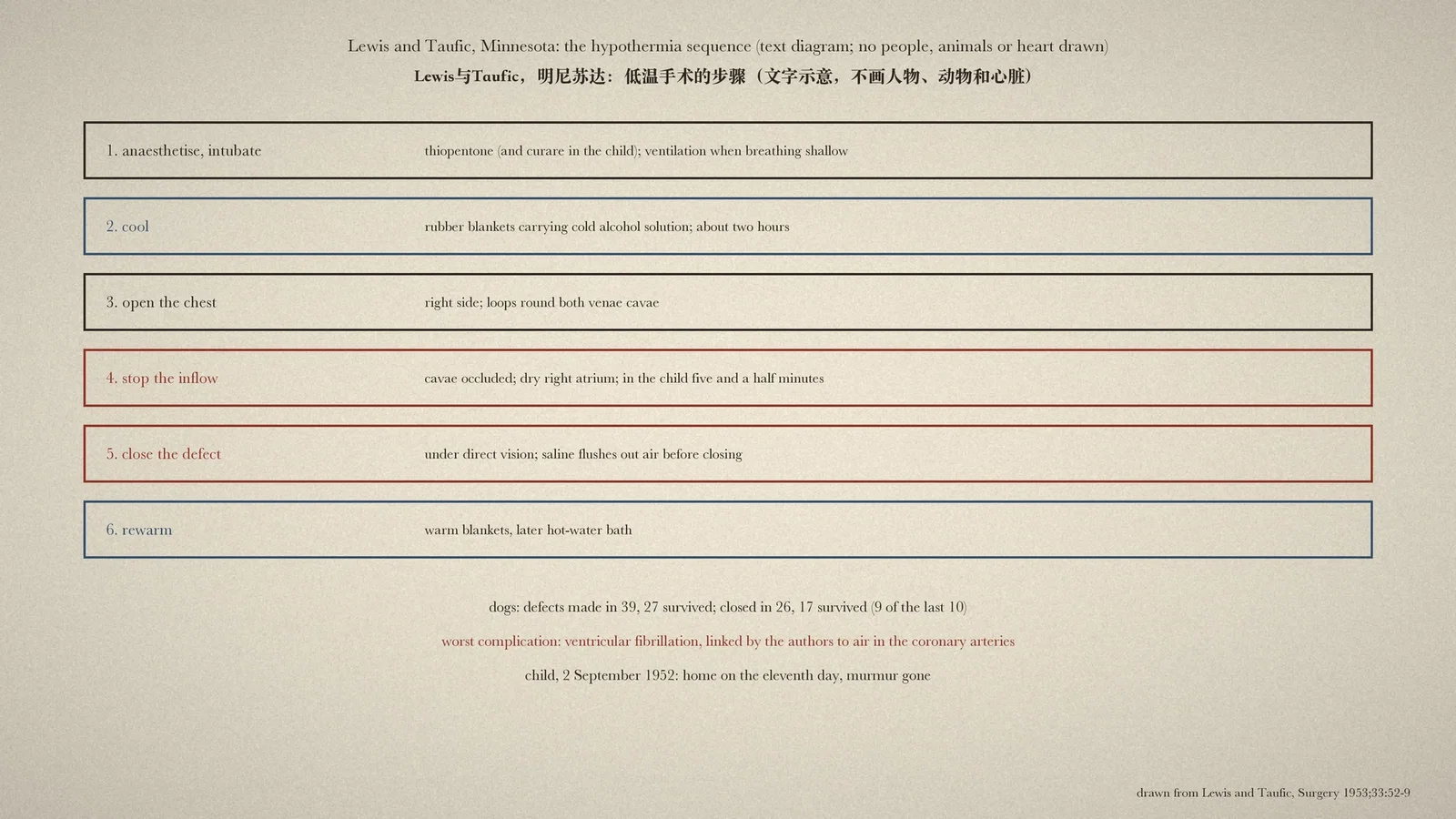
To operate inside a beating heart, blood has to stop flowing into it for a while; but when blood stops, the brain and body go short of oxygen. Around 1950 one answer was a machine to replace heart and lungs; another, simpler one was to cool the body so that its tissues needed less oxygen, buying a few minutes. Two Minnesota surgeons took the second approach from dogs to a child. [1, p. 52][1, p. 58]
The paper
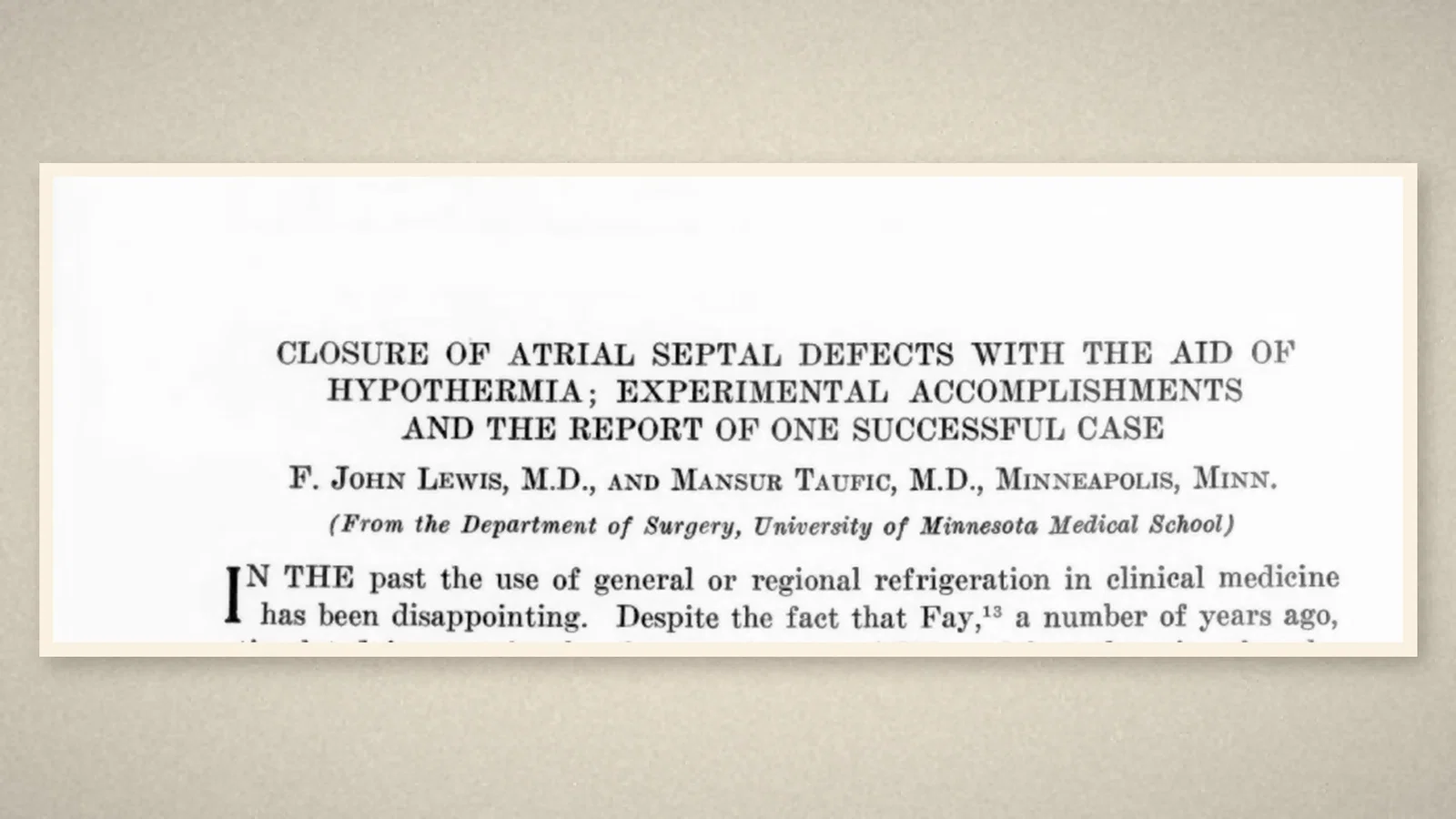
Surgery for January 1953 (vol. 33, no. 1, pp. 52-59) printed "Closure of atrial septal defects with the aid of hypothermia; experimental accomplishments and the report of one successful case" by F. John Lewis and Mansur Taufic of the Department of Surgery, University of Minnesota Medical School, received on 15 September 1952. [1, p. 52]
The authors begin with a look back: general or regional refrigeration had been disappointing in clinical medicine, but the much lowered metabolic rate of hibernation or artificial hypothermia opened possibilities for operations needing long interruption of blood flow. Bigelow had shown in dogs that under profound hypothermia cardiac inflow could be occluded for longer than at normal temperature, so that the heart could be opened in a dry field without complicated pumps or shunts; Boerema had also cooled dogs for intracardiac operations. At the authors' own hospital an attempt to close an atrial septal defect under direct vision with a heart-lung apparatus had failed, and the patient had not survived. [1, p. 52][1, p. 53]
In dogs
Each adult dog had two operations: a large atrial septal defect was made under direct vision and, a week or more later, the heart was re-entered and the defect closed. The dog was anaesthetised with thiopentone, intubated, ventilated with an automatic respirator once breathing became shallow, and cooled by wrapping it in rubberized blankets through which a cold alcohol solution flowed; temperature and pulse fell over one to two hours. The chest was opened on the right and silk loops were placed round both venae cavae; later in the series a Satinsky clamp also occluded the great arteries and coronary origins at the base of the heart before the right atrium was opened. [1, p. 53]
The authors stressed getting rid of air. As the atrium was closed, saline was injected quickly through a polythene catheter to wash the air out, because even a very small amount left in the left atrium seemed to find its way into the coronary arteries when circulation restarted, and "the result of that accident was usually fatal". The animals were rewarmed in the same blankets carrying heated solution, and later by immersion in hot water. [1, p. 54]
The summary gives the results: defects were attempted in 39 dogs, with 27 survivors; 26 had closure operations, and in 17 the defect was closed and the animal survived, nine of the last ten. Ventricular fibrillation was the most harassing complication, and its incidence fell once measures against coronary air embolism were adopted. [1, p. 58][1, p. 59]
A child
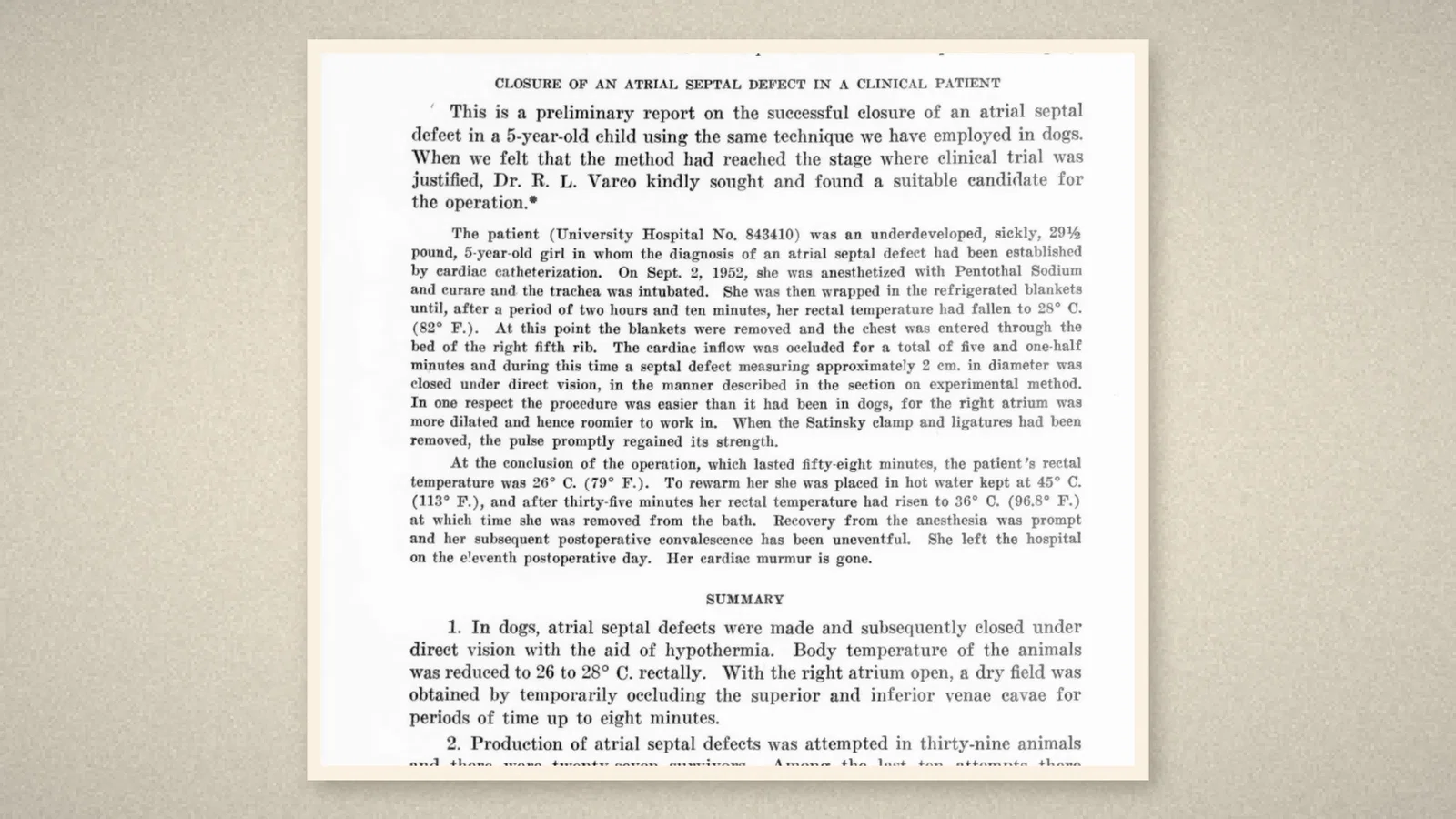
When the authors felt the method was ready for clinical trial, they wrote, R. L. Varco found a suitable patient: an underdeveloped, sickly 5-year-old girl with an atrial septal defect confirmed by cardiac catheterization. [1, p. 58]
On 2 September 1952 the child was anaesthetised with thiopentone and curare, intubated, and wrapped in the refrigerated blankets for two hours and ten minutes, until the rectal temperature had fallen to 28 °C. The blankets were removed and the chest entered through the bed of the right fifth rib; cardiac inflow was occluded for a total of five and a half minutes, and in that time a defect about 2 cm across was closed under direct vision. In one respect, the authors wrote, it was easier than in dogs: the right atrium was more dilated and roomier to work in. When the clamp and ligatures were released, the pulse promptly regained its strength. [1, p. 58]
The operation lasted 58 minutes. The child was rewarmed in hot water, recovered promptly from the anaesthetic, convalesced without incident, and left hospital on the eleventh postoperative day; the cardiac murmur, the authors wrote, was gone. [1, p. 58]
What the record shows
A plan that tied anaesthesia, cooling, ventilation and surgery together: anaesthetise, intubate and control breathing, then cool, then do the intracardiac work in a window of minutes, then rewarm. It was refined step by step in dozens of dogs, and the hard part was not the stitching but the air and the ventricular fibrillation.
Sources and reading limits
Read: F. John Lewis and Mansur Taufic, "Closure of atrial septal defects with the aid of hypothermia; experimental accomplishments and the report of one successful case", Surgery January 1953;33(1):52-9, in full, including Table I, the figure captions, the clinical case and the summary.
Not covered: Bigelow's 1950 papers in the Annals of Surgery cited by the authors; Boerema's experimental reports; any anaesthetic record of the operation of 2 September 1952; later follow-up of the patient; the later grading of hypothermia and later related events.
Limits: this is the operating team's own report; the clinical part is a single case with short follow-up. The paper identifies the patient only by a hospital number, which this text does not repeat (it is visible on the reproduced page). The anaesthetic agents are named without detail; temperatures are given as reported, and drug doses are not repeated.
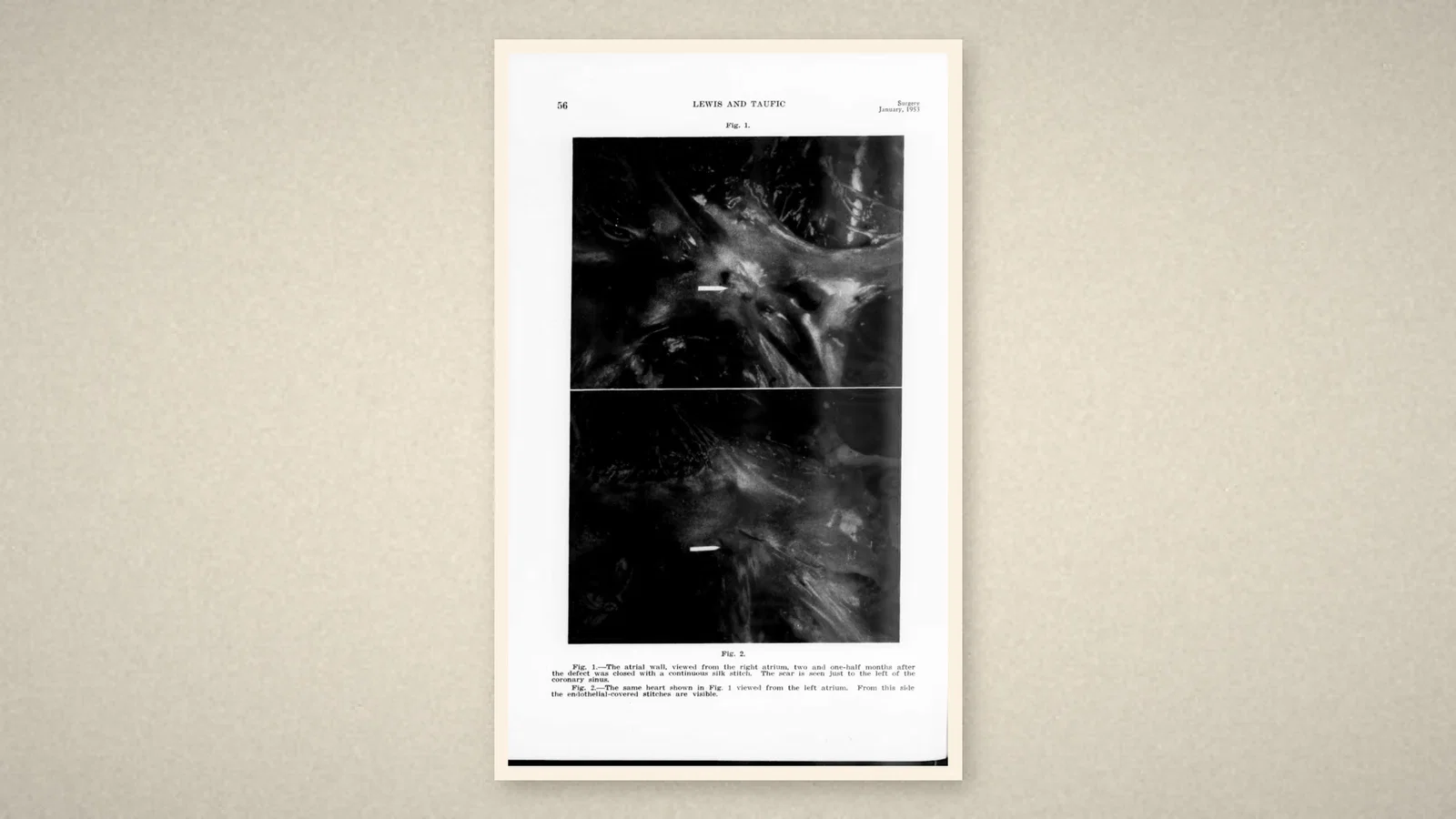
Three illustrations are crops of Surgery, January 1953 (pp. 52, 56 and 58), the p. 56 photographs of dog hearts being the paper's own; one is a text diagram drawn from the paper, with no people, animals or heart drawn.
- Lewis FJ, Taufic M. Closure of atrial septal defects with the aid of hypothermia; experimental accomplishments and the report of one successful case. Surgery. 1953;33(1):52-9. Internet Archive
Continue exploring
Related reading connects shared questions and contexts; it does not by itself establish historical influence.
- 1940: Bennett Uses Curare to Prevent Fractures in Shock Therapy
- 1946: Prescott, Organe and Rowbotham Report Pure Tubocurarine in 180 Cases
Anesthesia Epochs · The Source Room · About & Editorial Method
Published November 3, 2026. Sources and reading limits are stated above. Illustrations are labelled as original source images or AI-made. Historical accounts are educational; they are not current treatment instructions.