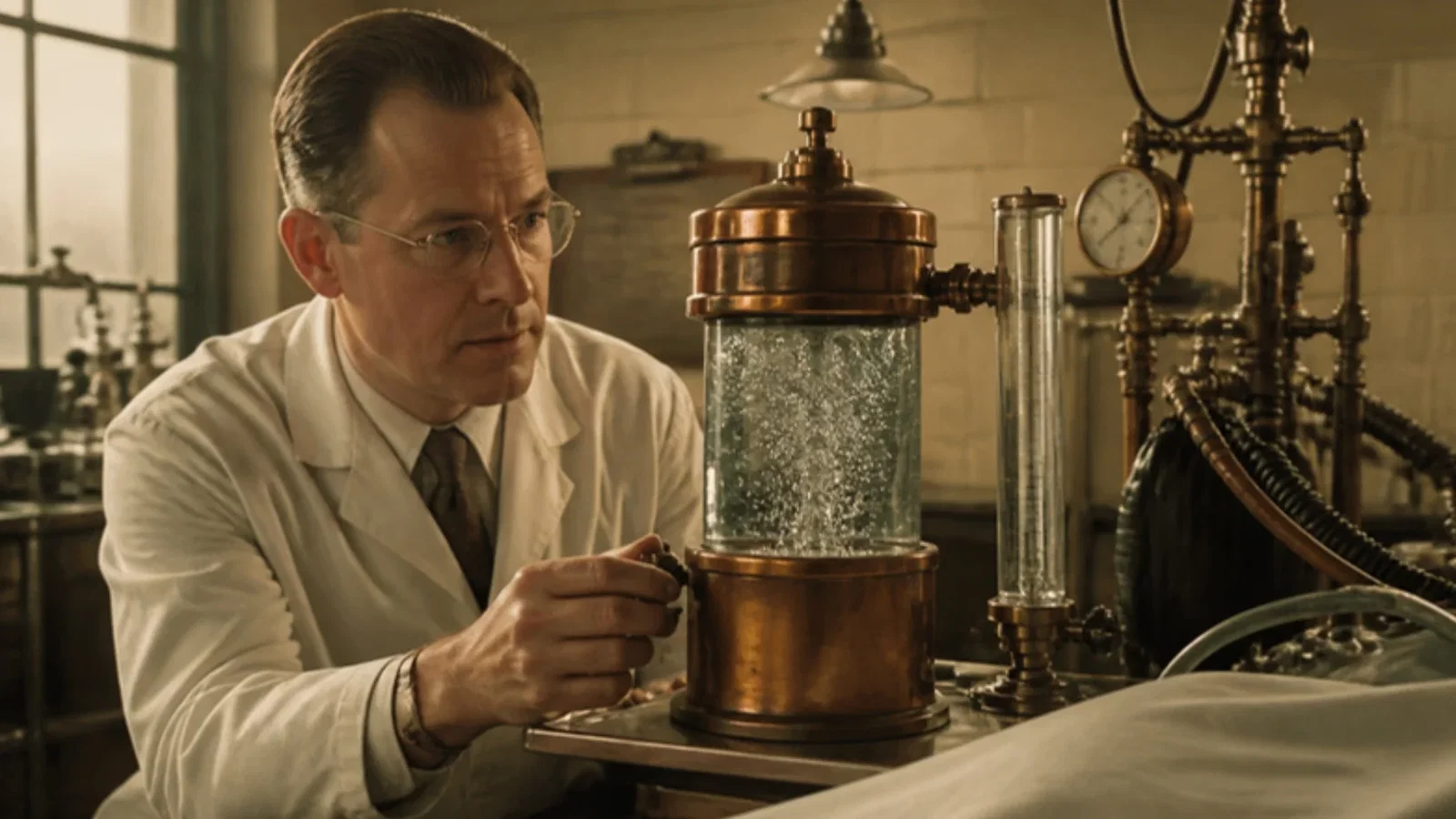
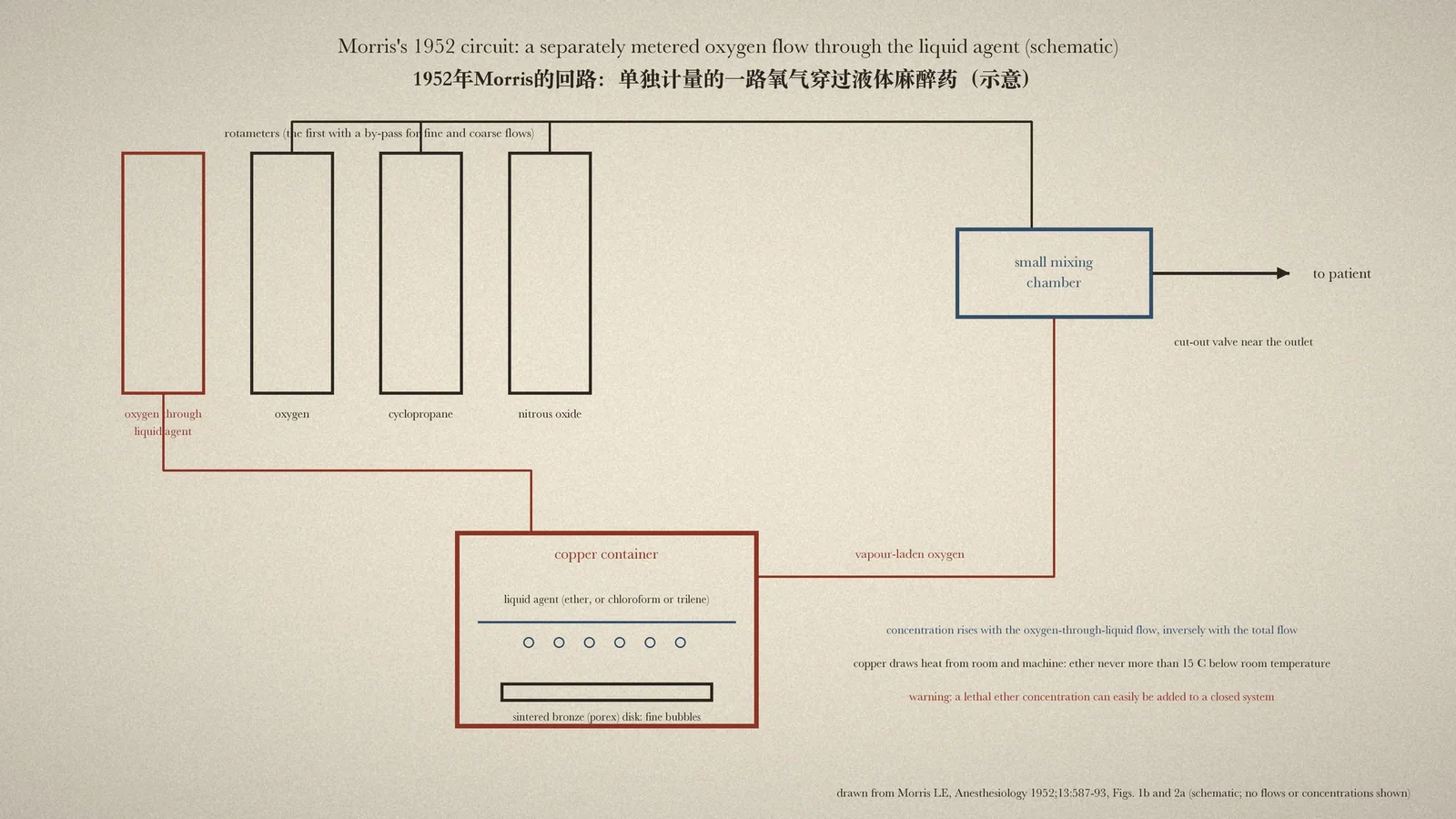
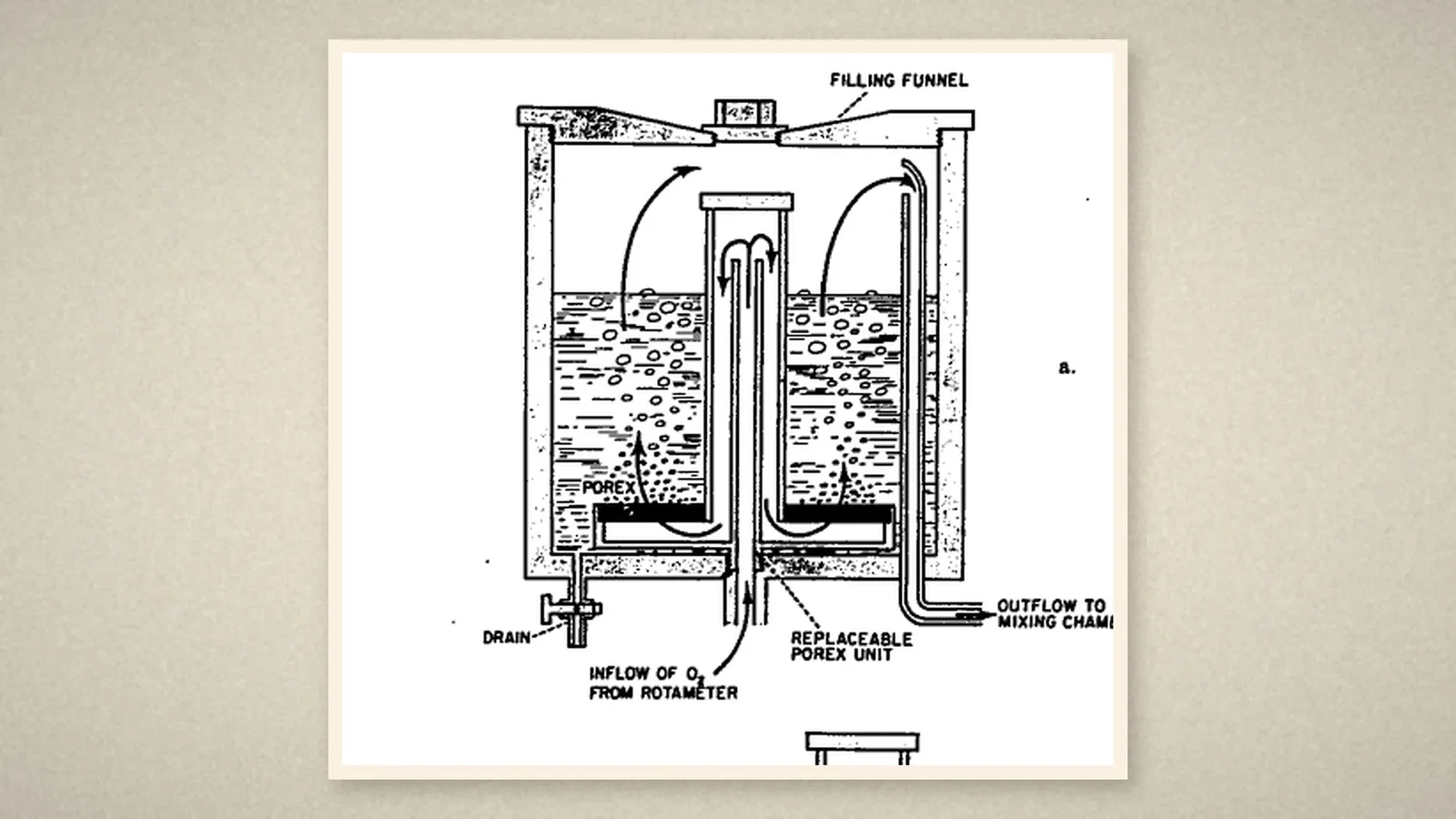
Lucien E. Morris of Wisconsin described in Anesthesiology a vaporizer in which a completely separate, rotameter-metered stream of oxygen was dispersed by a sintered bronze disk into fine bubbles through the liquid agent and then joined the main gas flow in a small mixing chamber, so that vapour concentration rose smoothly with that flow; the copper container drew heat from the room and the machine, keeping ether within 15 C of room temperature; Morris warned that a lethal concentration of ether could easily be introduced into a closed system.
Reading Library · Anesthesia Epochs · 中文版
Watch the education video (for clinicians)
1952: Morris's Copper Kettle — University of Wisconsin · Anesthesia Epochs Education Series
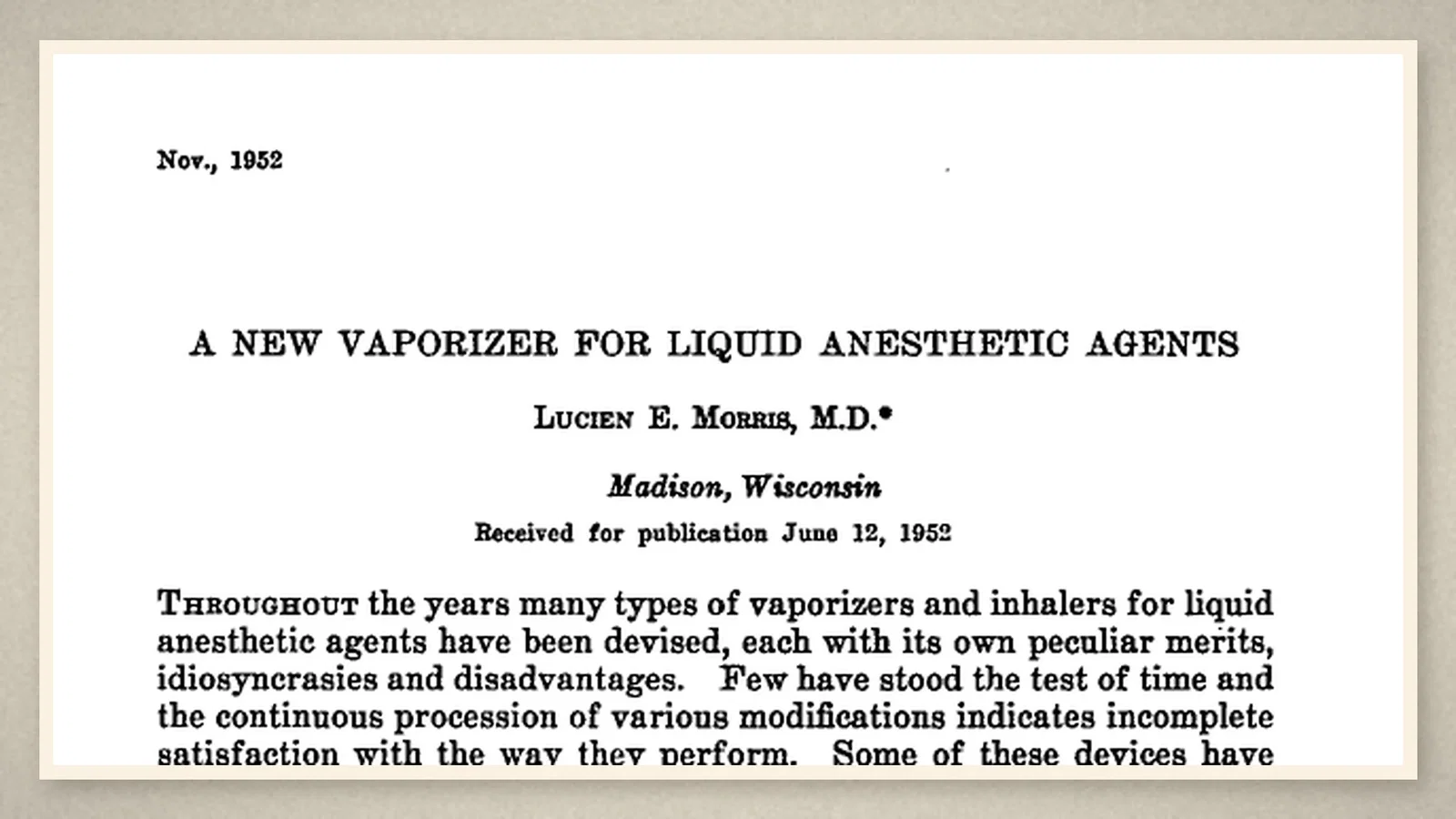
A vaporizer should turn a liquid anaesthetic into a known, adjustable concentration of vapour. Around 1952, Morris argued, most did not do this well. The Australian Society of Anaesthetists (ASA) timeline records under 1952 the "Copper Kettle" vaporizer of Dr Lucien E. Morris of the University of Wisconsin, which it calls "the first vaporizer to allow fine control of agent concentrations". This article reads Morris's own description, "A new vaporizer for liquid anesthetic agents", received by Anesthesiology on 12 June 1952 and published in November. [1][2]
The trouble with existing vaporizers
Morris described two families of apparatus: "draw-over" devices, driven by the patient's breathing, and "ad plenum" machines, in which gases come from a pressure tank. Both varied the vapour concentration "by diverting a varying portion of the total flow of gases over or through the liquid". Such a vaporizer "lacks vernier control", and its changes in concentration were "quite likely to be sudden, gross and irritant", making smooth anaesthesia difficult. The aim was "a simple vernier control of concentration" and efficient vaporization, so that a predictable concentration was always available. The new vaporizer changed three things: circuit design, liquid container and vaporizing surface. [1]
The circuit
"The distinguishing feature of the circuit is the additional and completely separate flow of oxygen which is bubbled through the liquid anesthetic agent." That oxygen was metered on its own rotameter, fitted with a by-pass so that fine and coarse flows could be read on the same tube. The vapour-laden stream then joined the main stream of gases in "a special small mixing chamber" just before the outlet. The result was that the increase in concentration delivered to the patient could be "gradual and steadily progressive", in proportion to the oxygen through the liquid and in inverse relation to the total flow of the other gases. In effect, the metered oxygen added vapour "as though it were itself being metered as a separate gas". Morris noted that Lyons had earlier led a separate oxygen flow through ether bottles but had still used the variable key on the bottles to control the ether. [1]
Copper and bubbles
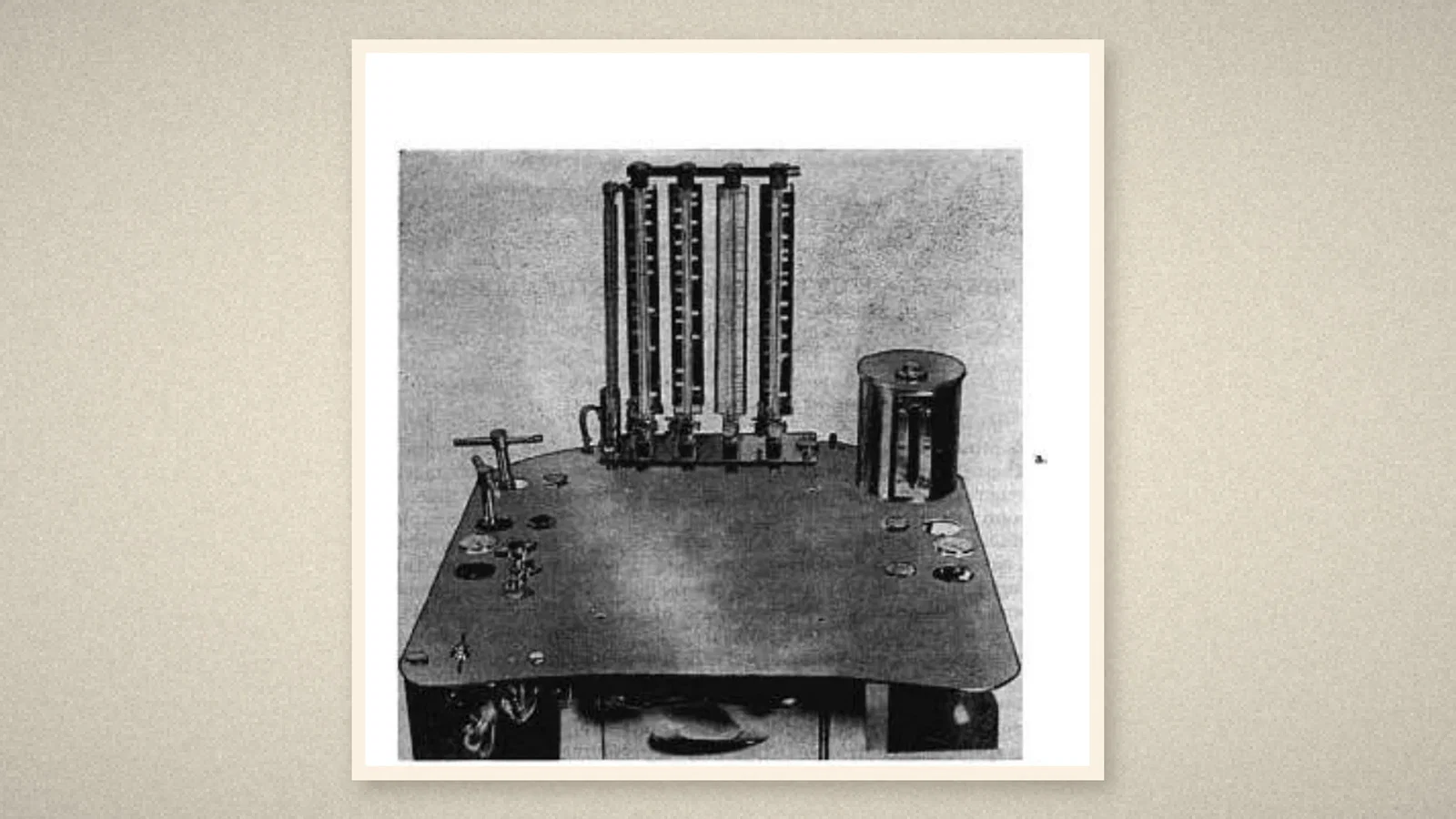
"Copper, because of its high specific heat, is the material from which the container is made." Evaporation takes heat from the liquid, and as the liquid cools its vapour pressure falls. The copper served "as a source of heat and in the transfer of heat from the room air and all the metal parts of the machine"; in use with ether the liquid was never more than 15 C below room temperature. The gas passed through "a sintered bronze disk (porex)", and "the multitude of tiny bubbles" gave a large liquid-gas surface while the disk conducted heat to the liquid. A smaller cup could be fitted for chloroform or trichloroethylene. [1]
Benefits and a warning
With fine control, Morris wrote, the irritant effects of sudden high ether concentrations could be avoided, and "an induction with ether-oxygen becomes nearly as pleasant as one with nitrous oxide-oxygen". Measured ether concentrations closely approached the theoretical values for saturated vapour at the working temperature. The paper also carried a warning: "Potentially, a lethal concentration of ether can be easily introduced into the bag of a closed system", and caution "equal to that used when adding cyclopropane" was needed. A cut-out valve near the outlet allowed the vaporizer to be excluded instantly. Morris valued compressed air as a diluent, because with oxygen alone "hypoventilation may be overlooked" and hypercarbia develop. [1]
How it came about
Morris's "Genesis" section credits "the oft repeated desire of Ralph Waters for meticulous vernier control over increments in chloroform concentration". Two laboratory models were built with the help of Fred McConkey and Evan Frederickson; "six weeks of laboratory trial was followed by clinical usage in the spring of 1948". The first models stood in a water bath; on a suggestion of Warren Gilson and Waters, copper replaced it, a metal John Snow had also used in 1847. Glass bubbling disks gave way to porex, which Morris learned of from Charles Boyd of the Naval Research Laboratory. Morris made "no brief for resurgence of the use of liquid anesthetic agents", only for discrete control when they were chosen. [1]
The ASA tells a livelier origin story: Morris, while a resident under Waters, remarked that "any fool could make a better device" than a chloroform vaporizer of the time, and Waters later sent a postcard asking "Has Morris made a new vaporizer yet?". That account is the ASA's. The ASA also lists, under 1956, a dedicated halothane vaporizer, the Fluotec Mark I. [2]
What the record shows
Morris separated two tasks that earlier vaporizers mixed together: making saturated vapour, and diluting it. By saturating a small, metered stream and then diluting it in the total flow, the anaesthetist could set concentration with a flowmeter. The copper mass kept the temperature steady. The same paper that made ether easier to give also warned how easily the method could deliver too much.
Sources and reading limits
Read: Morris LE, Anesthesiology 1952;13:587-93, in full, including Figs. 1-3; the ASA timeline entries for 1952 and 1956.
Not covered: Lyons's circuit and Pask's flowmeter paper cited by Morris; manufacturers' records; later evaluations. The name "Copper Kettle" is the ASA's and does not appear in Morris's paper. The ASA's anecdote and its "first vaporizer to allow fine control" are quoted as its own. Flows, increments and concentrations are not repeated. Quotations are from the English original.
Three illustrations are crops of pp. 587-9, including Figs. 1a and 2a; one is drawn from Figs. 1b and 2a and the text.
- Morris LE. A new vaporizer for liquid anesthetic agents. Anesthesiology. 1952;13(6):587-93. Anesthesiology
- Australian Society of Anaesthetists. Anaesthesia history timeline. 2024. ASA
Continue exploring
Related reading connects shared questions and contexts; it does not by itself establish historical influence.
- 1952: The EMO Ether Inhaler Needs No Heat Source
- 1941: The Oxford Ether Vaporizer Keeps Ether at Constant Temperature
Anesthesia Epochs · The Source Room · About & Editorial Method
Published November 2, 2026. Sources and reading limits are stated above. Illustrations are labelled as original source images or AI-made. Historical accounts are educational; they are not current treatment instructions.