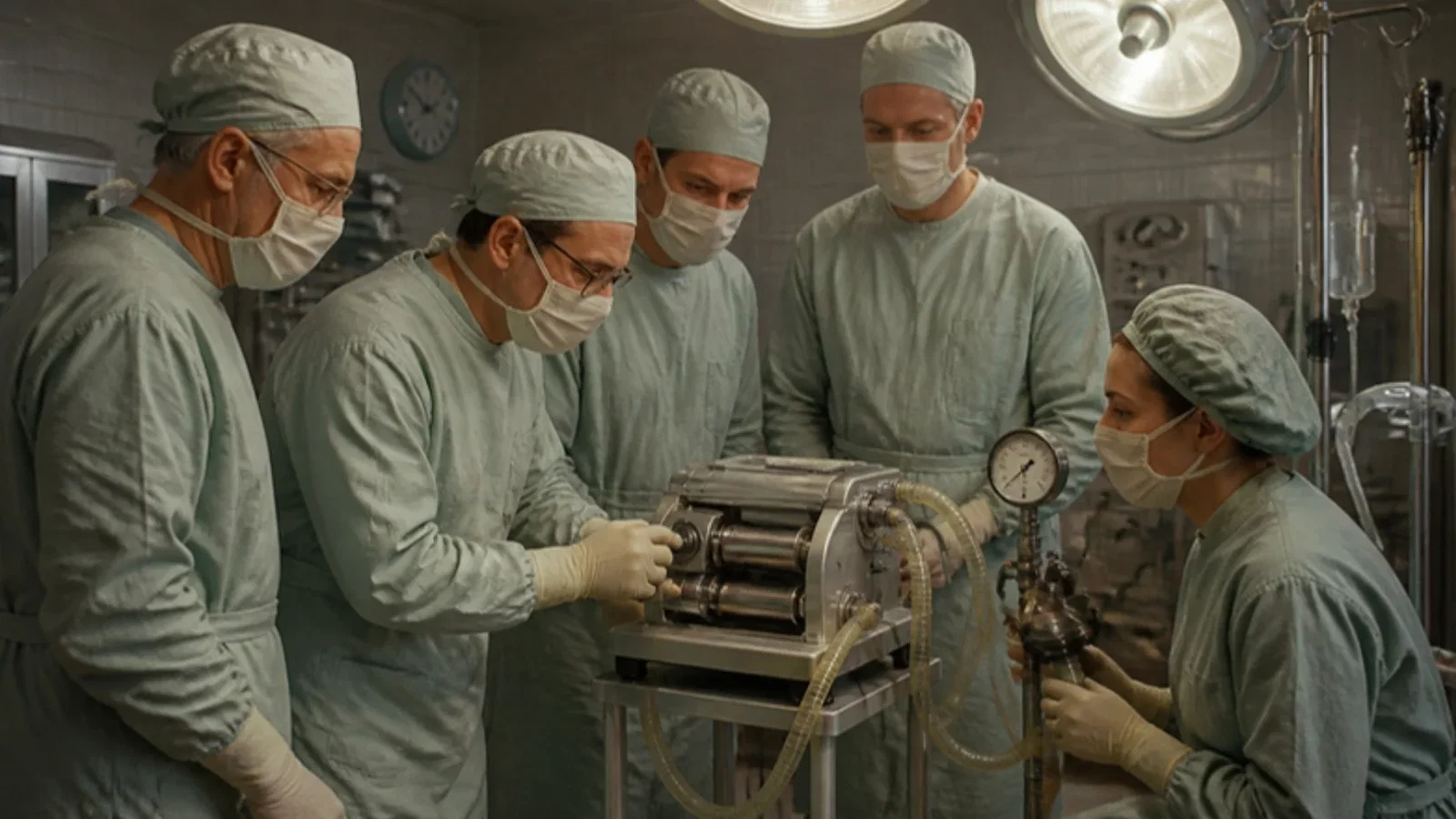
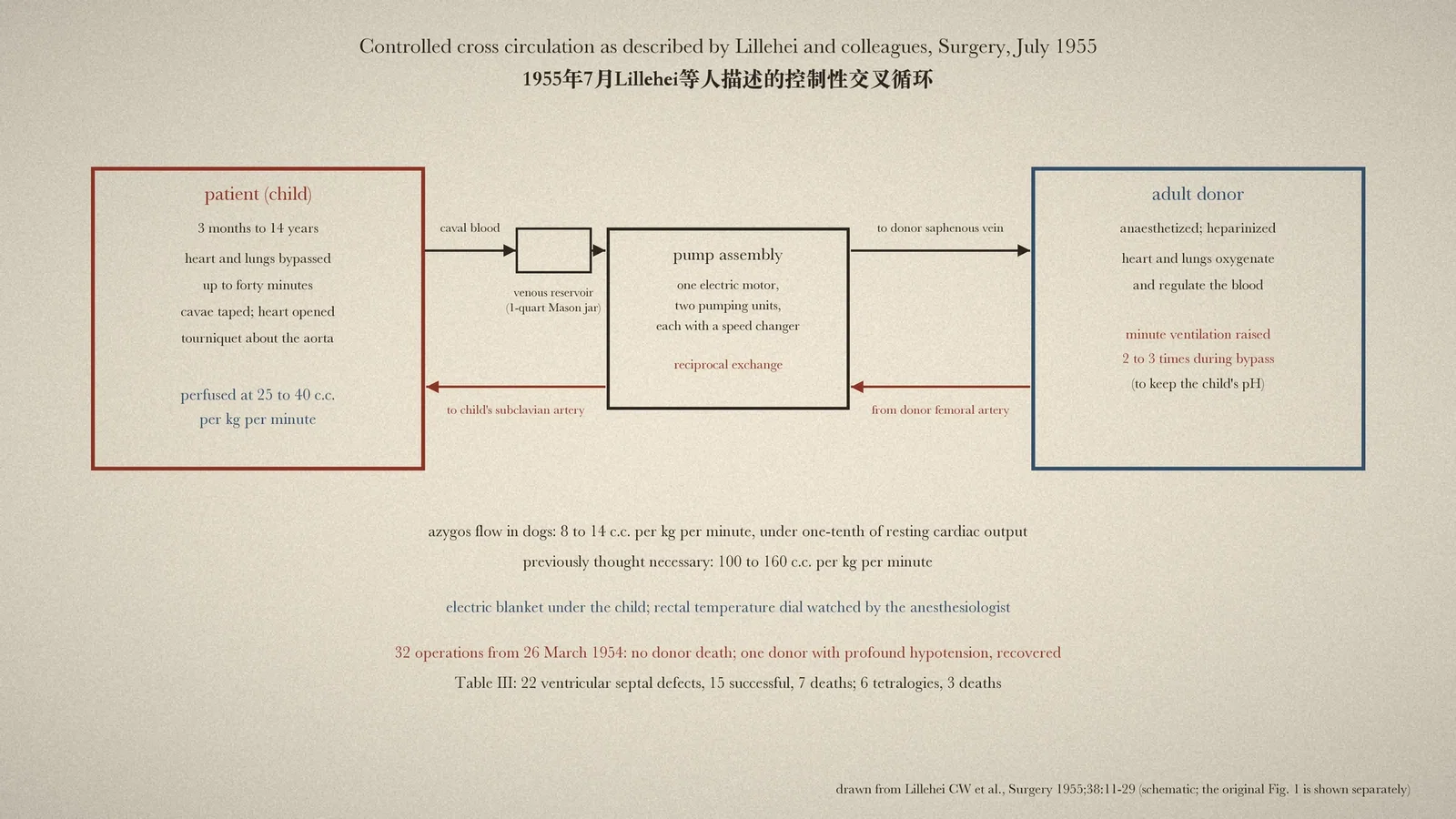
From 26 March 1954 C. Walton Lillehei and colleagues at the University of Minnesota linked a child's circulation to that of a compatible adult donor: one electric pump exchanged blood reciprocally, the child perfused at only 25 to 40 c.c. per kilogram per minute on the 'azygos flow' principle, while the donor's heart and lungs oxygenated and regulated the blood during up to forty minutes of total bypass for direct-vision repair; by the 1955 report, 32 operations without a donor death.
Reading Library · Anesthesia Epochs · 中文版
Watch the education video (for clinicians)
1954: Controlled Cross Circulation — University of Minnesota · Anesthesia Epochs Education Series
To repair a hole inside a beating heart, the surgeon has to stop blood flowing through it, and something else has to keep the body alive in the meantime. The Australian Society of Anaesthetists (ASA) timeline traces the early attempts: Bryukhonenko's "autojektor" pump in Soviet animal experiments in 1925, Clarence Dennis's pump-oxygenator at the University of Minnesota in 1951, whose patient died, and Gibbon's heart-lung machine in 1953. For 1954 it lists "cross-circulation technique first used", by C. Walton Lillehei at the University of Minnesota, with adults "volunteering to act as live cardiopulmonary bypass machines". This article reads the report in which Lillehei, Morley Cohen, Herbert E. Warden and Richard L. Varco described the method and their first thirty-two operations, published in Surgery in July 1955. [1][2]
Less blood than anyone thought
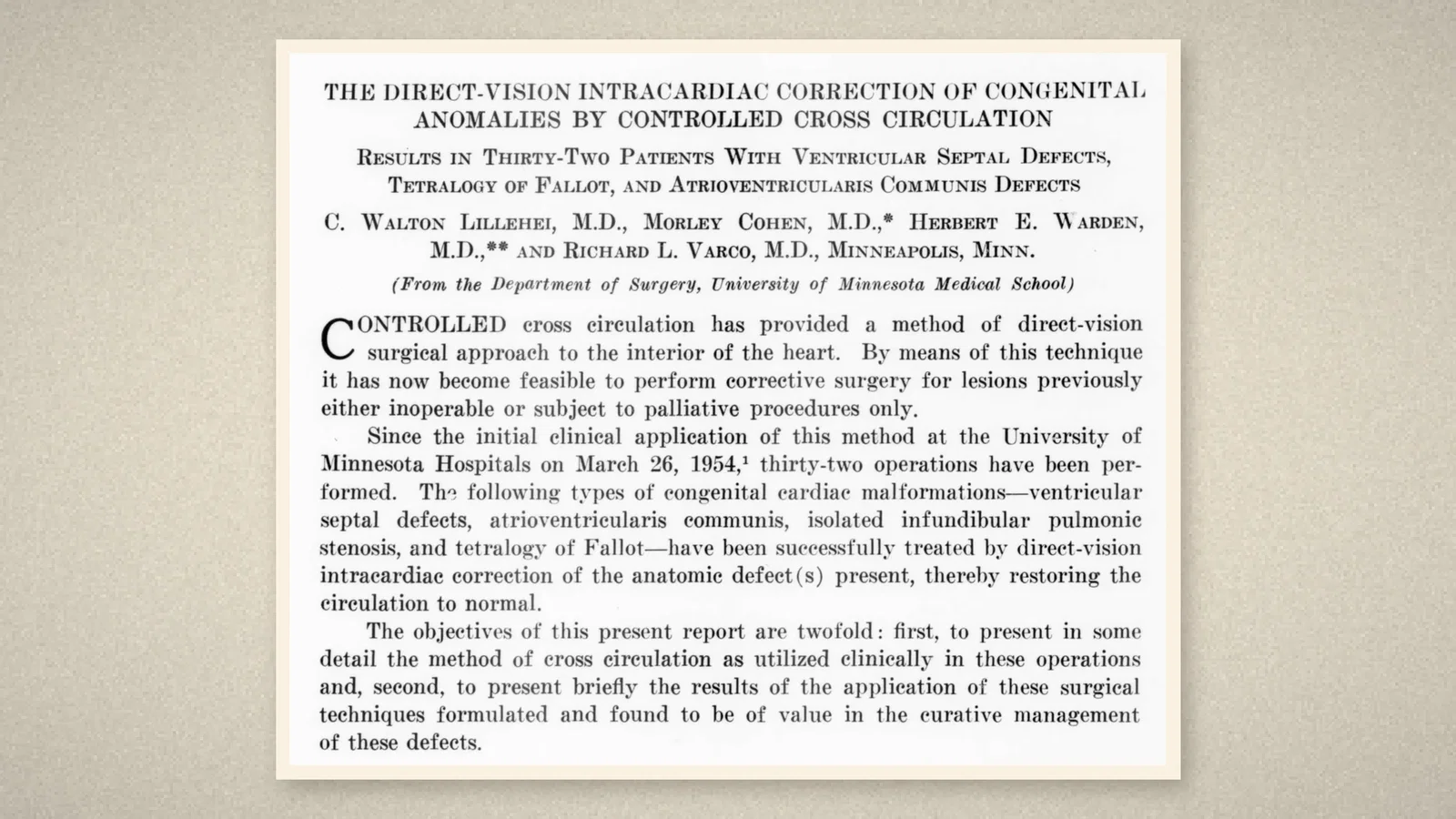
"Controlled cross circulation has provided a method of direct-vision surgical approach to the interior of the heart." Since "the initial clinical application of this method at the University of Minnesota Hospitals on March 26, 1954", thirty-two operations had been performed for ventricular septal defects, atrioventricularis communis, isolated infundibular pulmonic stenosis and tetralogy of Fallot. [1]
The physiological basis came from the laboratory. It had been generally believed that safe bypass needed the basal or resting cardiac output, "100 to 160 c.c. per kilogram of body weight per minute". Experiments in the authors' laboratory showed that dogs survived long periods of complete occlusion of the venae cavae when only the blood returning through the azygos vein reached the heart, a flow of 8 to 14 c.c. per kilogram per minute, "less than one-tenth of the resting or basal cardiac output". Operations inside the ventricles needed somewhat more, so the children were perfused at 25 to 40 c.c. per kilogram per minute at normal body temperature, with no detectable ill effects. A low flow made a much simpler kind of bypass possible: another person's circulation. [1]
Linking two circulations
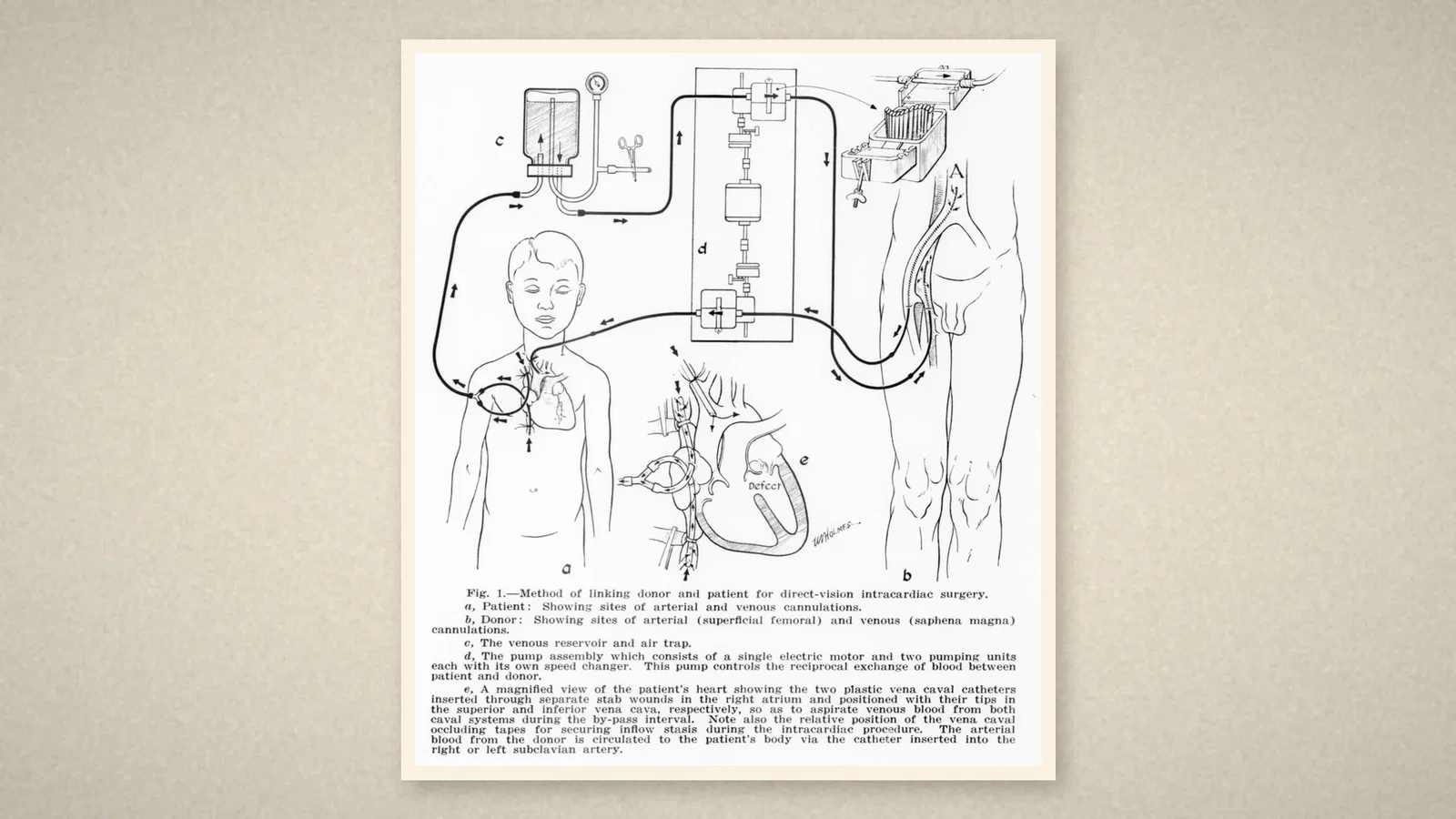
Fig. 1 shows the arrangement. In the child, two plastic catheters were passed into the superior and inferior venae cavae through separate stab wounds in the right atrium and joined by a steel Y. The venous blood ran through a reservoir and air trap, a one-quart Mason jar with a stainless steel top, monitored "full time by an assistant", and then to "a single electric motor and two pumping units each with its own speed changer", which "controls the reciprocal exchange of blood between patient and donor". The donor's saphenous vein received the child's venous blood; the donor's superficial femoral artery supplied oxygenated blood, which returned to the child through a catheter in the subclavian artery. The patients ranged from 3 months to 14 years and from 4.6 to 38 kilograms; catheters of 12 to 16 French were "always discarded after being used once". A tourniquet about the base of the aorta gave a bloodless field. [1]
The anaesthetic side
The paper notes that the anaesthetic principles had been published separately, but gives two points. During bypass the child developed an acidosis, chiefly from fixed acid metabolites; by raising the donor's respiratory minute volume "2 to 3 times above its control figure during the by-pass interval", the team kept the child's arterial pH within normal limits, possibly helping explain why conduction disturbances were rare. And because small children under anaesthesia with both sides of the chest open could cool by 3 to 5 degrees an hour in an air-conditioned theatre, an electric heating blanket was placed under them and a rectal temperature catheter was connected "to a dial at the head of the table where it may be monitored by the anesthesiologist". Blood aspirated from the open heart was discarded rather than returned, because laboratory work had shown it to be toxic. [1]
Donors and results
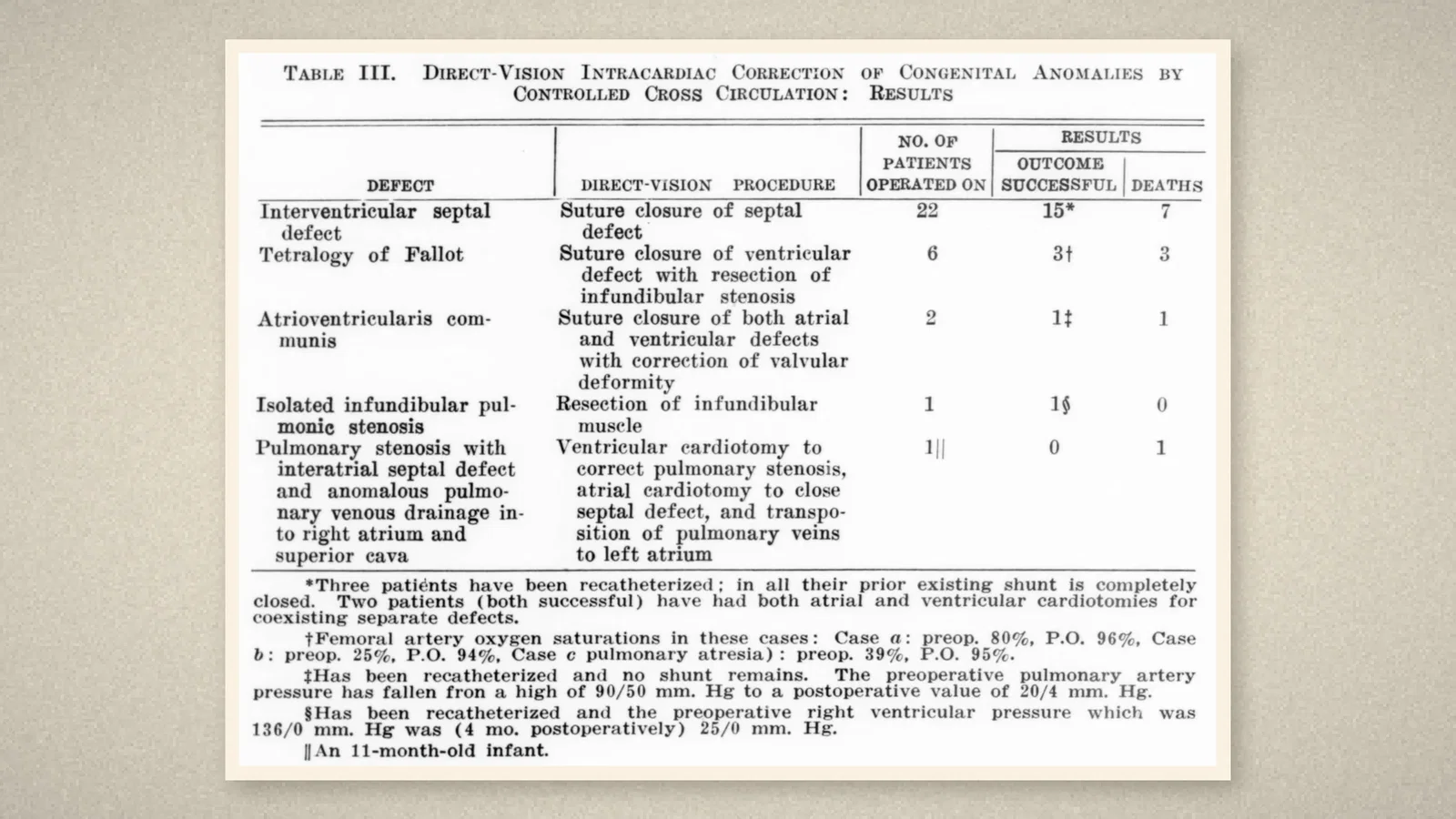
"There has been no donor mortality." One donor, a mother, developed profound hypotension from an imbalance in the exchange of blood and needed a thoracotomy and cardiac massage; recovery was complete, and the venous reservoir was used routinely afterwards. A prospective donor suffered air embolism when air was forced into an intravenous line during anaesthesia; the anesthesiologist turned the patient onto the left side, the blood pressure recovered, and the neurological effects resolved. Table III lists the outcomes: of 22 ventricular septal defects, 15 successful and 7 deaths; of 6 tetralogies, 3 deaths; one of two atrioventricularis communis defects and one complex pulmonary stenosis also died. The authors attributed the deaths not to the method but to incomplete repairs and postoperative errors in very ill children, and an addendum reported only one death in the last thirteen consecutive operations. [1]
What the record shows
Cross circulation was soon replaced by machines, but it left lasting lessons for cardiac anaesthesia: low-flow perfusion can sustain the body; acid-base balance during bypass must be actively managed; temperature must be monitored and defended; and air in any line can be catastrophic. It also set the ethical stakes of a technique that put a healthy volunteer at risk for a patient.
Sources and reading limits
Read: Lillehei CW, Cohen M, Warden HE, Varco RL, Surgery 1955;38:11-29, in full; the ASA timeline entries for 1925, 1951, 1953 and 1954.
Not covered: the authors' first report on eight patients and their separate papers on anaesthesia for cross circulation; Bryukhonenko and Tchetchuline's 1929 papers on the autojektor (not found in open sources); Dennis's 1951 report. The earlier devices appear here only as the ASA records them. The results and the attribution of deaths are the authors'. Donors and patients are not named. The ASA's "first" is quoted as its own.
Three illustrations are crops of the July 1955 issue, including Fig. 1 and Table III; one is drawn from the text.
- Lillehei CW, Cohen M, Warden HE, Varco RL. The direct-vision intracardiac correction of congenital anomalies by controlled cross circulation: results in thirty-two patients with ventricular septal defects, tetralogy of Fallot, and atrioventricularis communis defects. Surgery. 1955;38:11-29. Internet Archive
- Australian Society of Anaesthetists. Anaesthesia history timeline. 2024. ASA
Continue exploring
Related reading connects shared questions and contexts; it does not by itself establish historical influence.
Anesthesia Epochs · The Source Room · About & Editorial Method
Published November 2, 2026. Sources and reading limits are stated above. Illustrations are labelled as original source images or AI-made. Historical accounts are educational; they are not current treatment instructions.