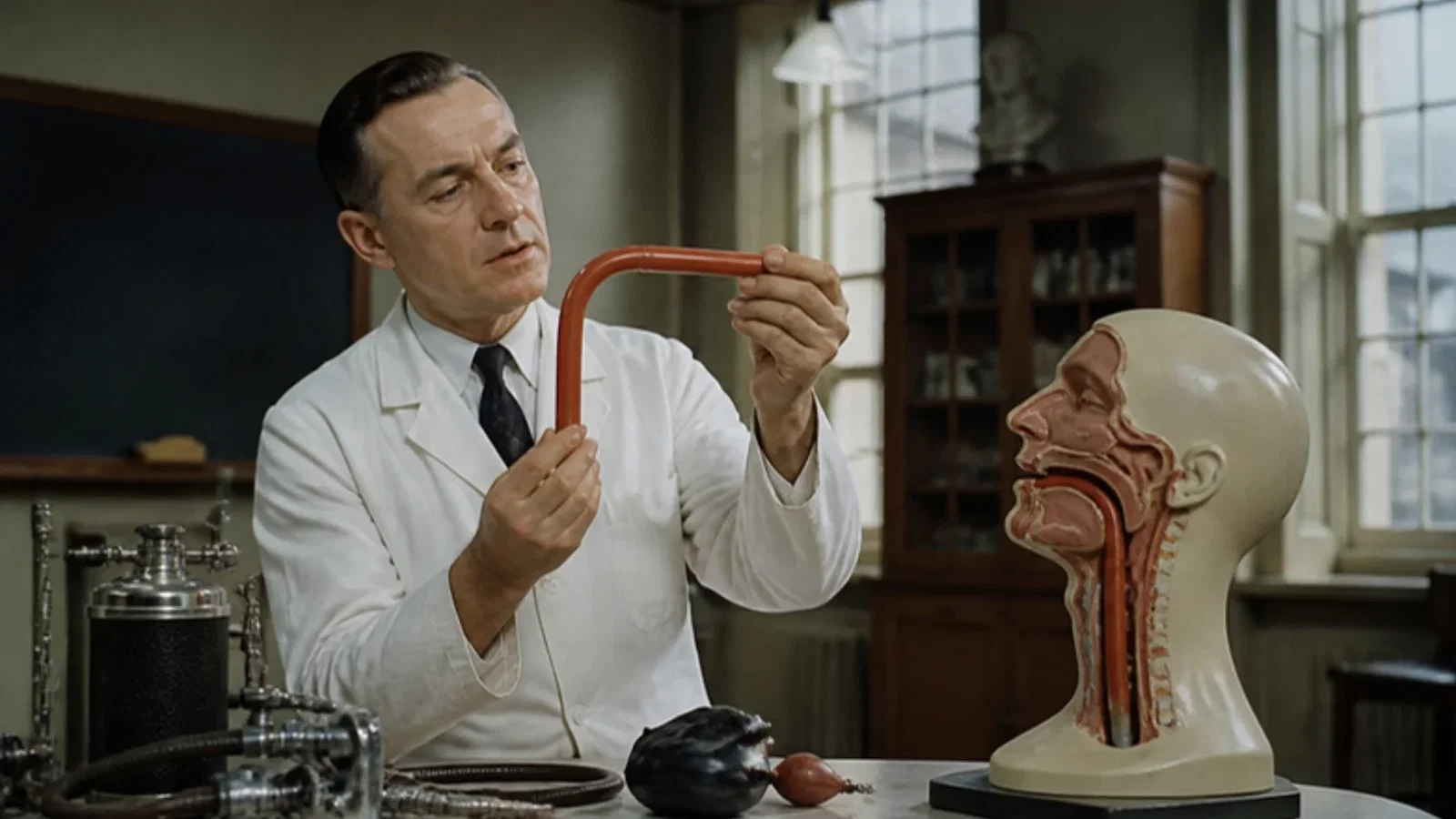
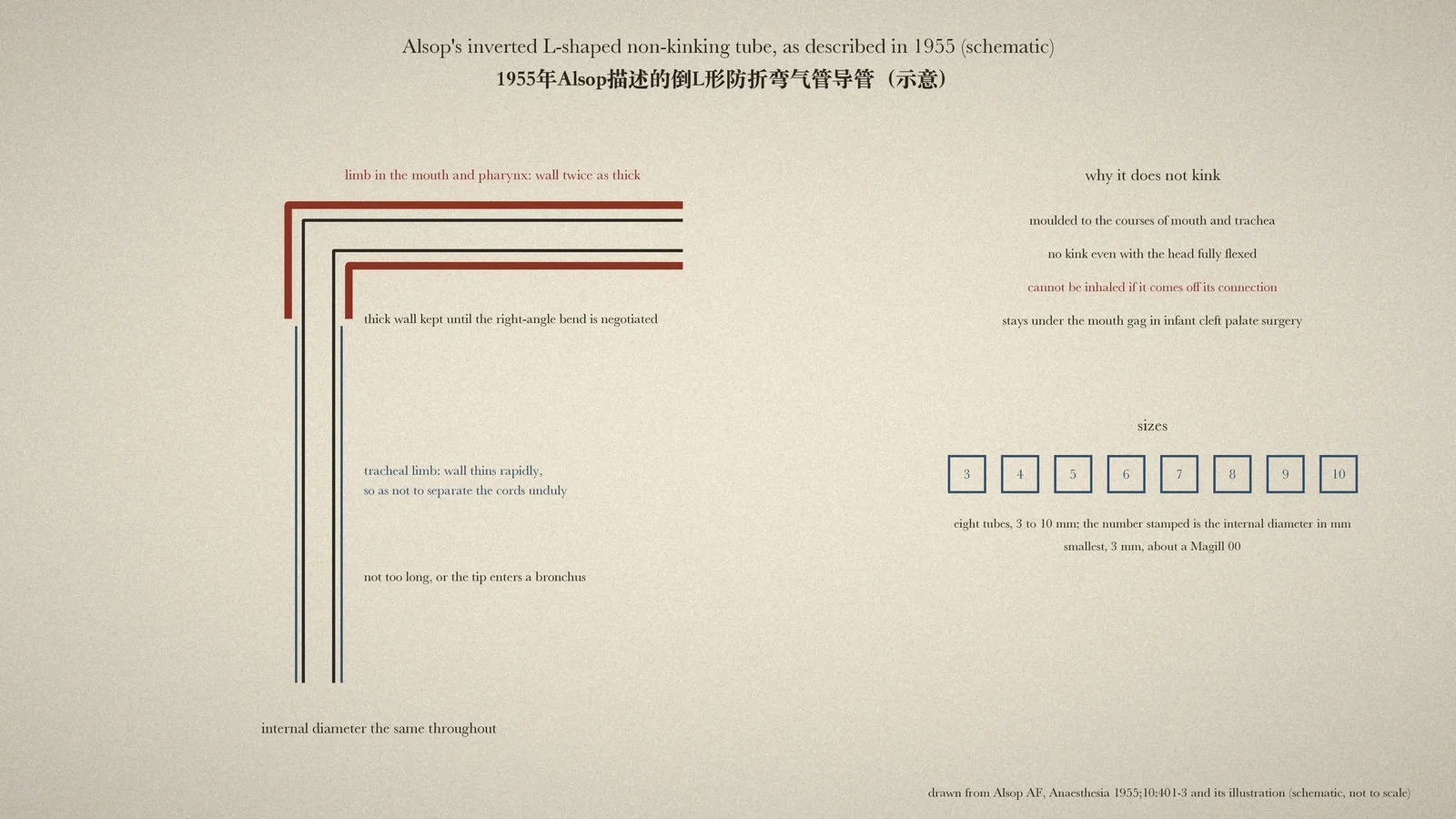
A. F. Alsop of the Nuffield Department of Anaesthetics, Oxford, described in the New inventions section of Anaesthesia an inverted L-shaped rubber tube whose two limbs follow the mouth and trachea, with a uniform internal diameter, an oral and pharyngeal wall twice as thick and thinning rapidly beyond the bend so as not to separate the cords; it would not kink even with the head fully flexed, could not be inhaled if it came off its connector, and suited cleft palate surgery in infants; eight sizes from 3 to 10 mm were stamped with their internal diameter.
Reading Library · Anesthesia Epochs · 中文版
Watch the education video (for clinicians)
1955: The Oxford Non-Kinking Tube · Anesthesia Epochs Education Series
A tracheal tube is a soft pipe that must stay open while the surgeon moves the head, presses on the mouth or works around it. Its design was changed one detail at a time. The Australian Society of Anaesthetists (ASA) timeline lists several such details: "Murphy's eye" in 1941; the "Oxford endotracheal tubes" of A. Alsop and colleagues in 1955, made of red rubber with a right angle "to reduce the incidence of kinking"; David S. Sheridan's disposable plastic tubes, length markings and radiopaque strip in 1959; and high-volume low-pressure cuffs, designed by Joel D. Cooper and colleagues, in 1971. Only one of these originals could be obtained for this article: A. F. Alsop's "Non-kinking endotracheal tubes", in Anaesthesia of October 1955. [1][2]
Earlier answers to kinking
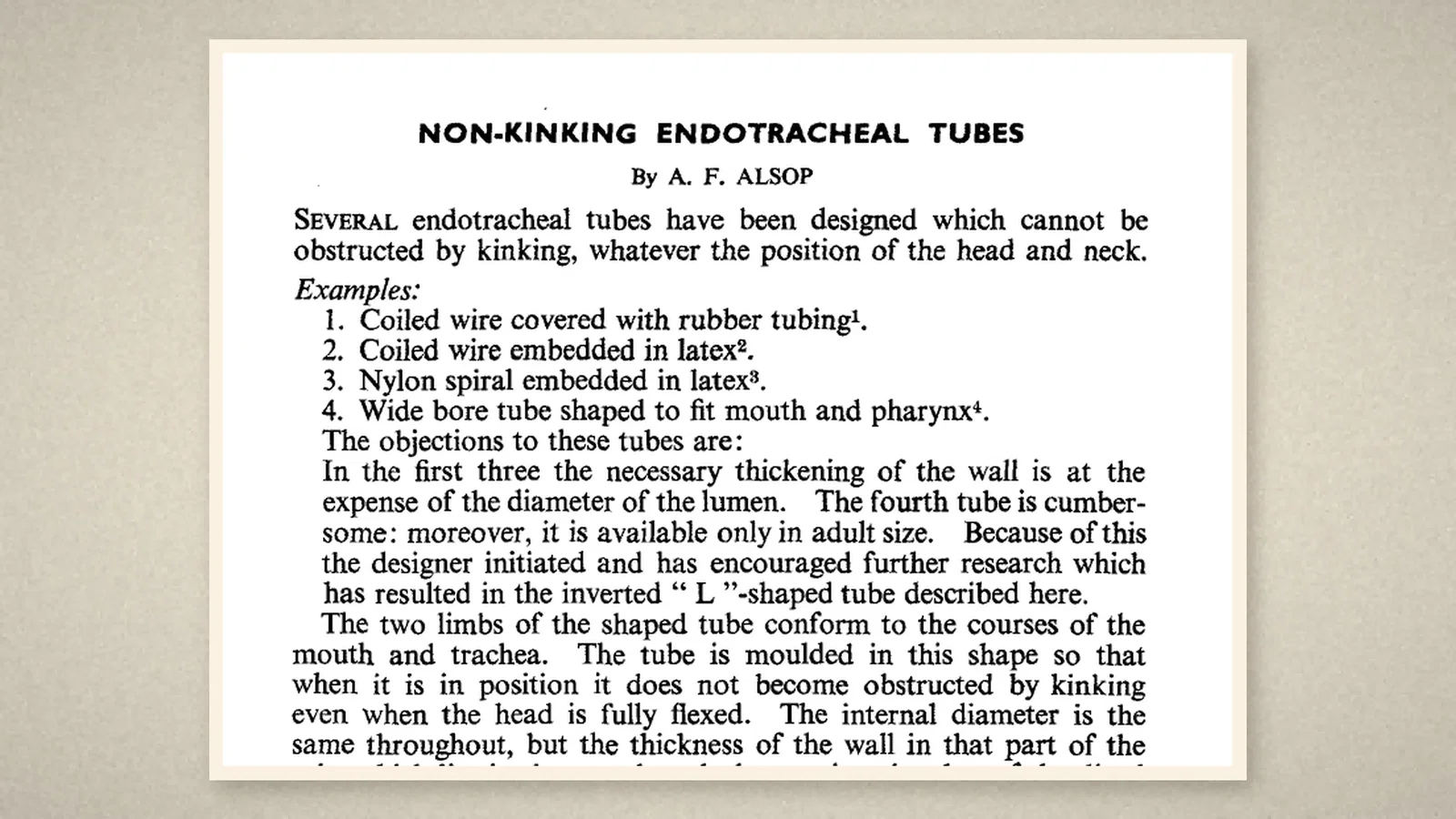
The article appeared in the journal's "New inventions" section, under the editor's note that "no claim to originality or priority is made" unless the authors state one. Alsop began with what already existed. "Several endotracheal tubes have been designed which cannot be obstructed by kinking": coiled wire covered with rubber tubing, coiled wire embedded in latex, a nylon spiral embedded in latex, and a wide-bore tube shaped to fit the mouth and pharynx. The first three thickened the wall "at the expense of the diameter of the lumen"; the fourth was cumbersome and "available only in adult size". Its designer had therefore encouraged further work, which produced "the inverted 'L'-shaped tube described here". [1]
The shape
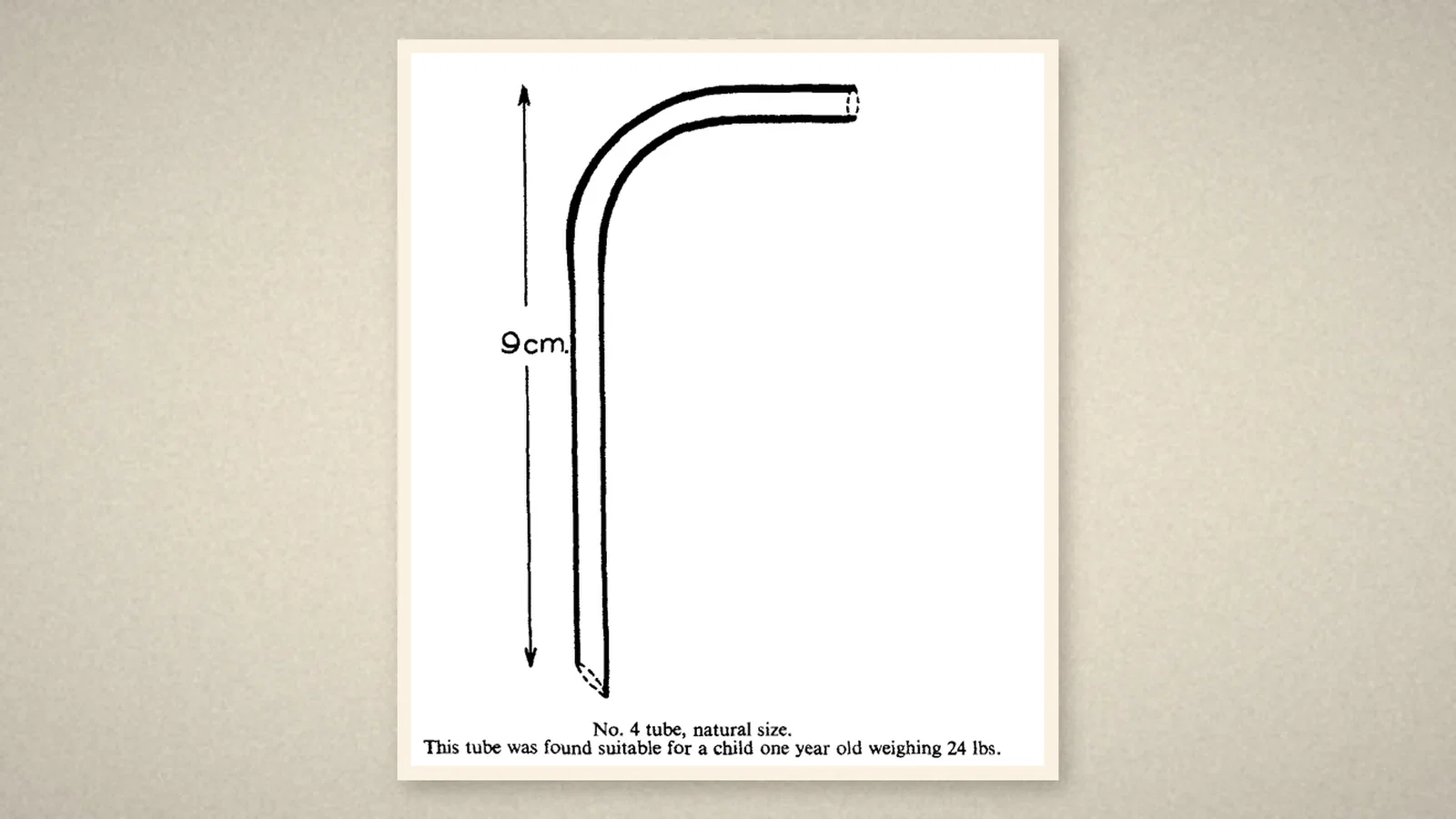
"The two limbs of the shaped tube conform to the courses of the mouth and trachea." Moulded in that shape, the tube in position "does not become obstructed by kinking even when the head is fully flexed". The internal diameter was the same throughout, but the wall of the part lying in the mouth and pharynx was twice as thick as the distal part; the thick wall continued until the right-angle bend had been negotiated, "a further insurance against kinking", and then "rapidly becomes thinner so as not to separate the cords unduly". [1]
The shape had consequences for intubation. In a well-relaxed patient the tube passed easily with a curved-blade laryngoscope, but a straight blade let the tube block the view of the cords; a gum elastic catheter could be used as a guide, as Macintosh had suggested. The distal limb must not be too long, or the tip would pass into a bronchus, and that "cannot be corrected by withdrawing the tube slightly", because the bend would no longer sit in the pharynx; "the only remedy is to withdraw the tube completely and shorten the distal end". [1]
Infants and sizes
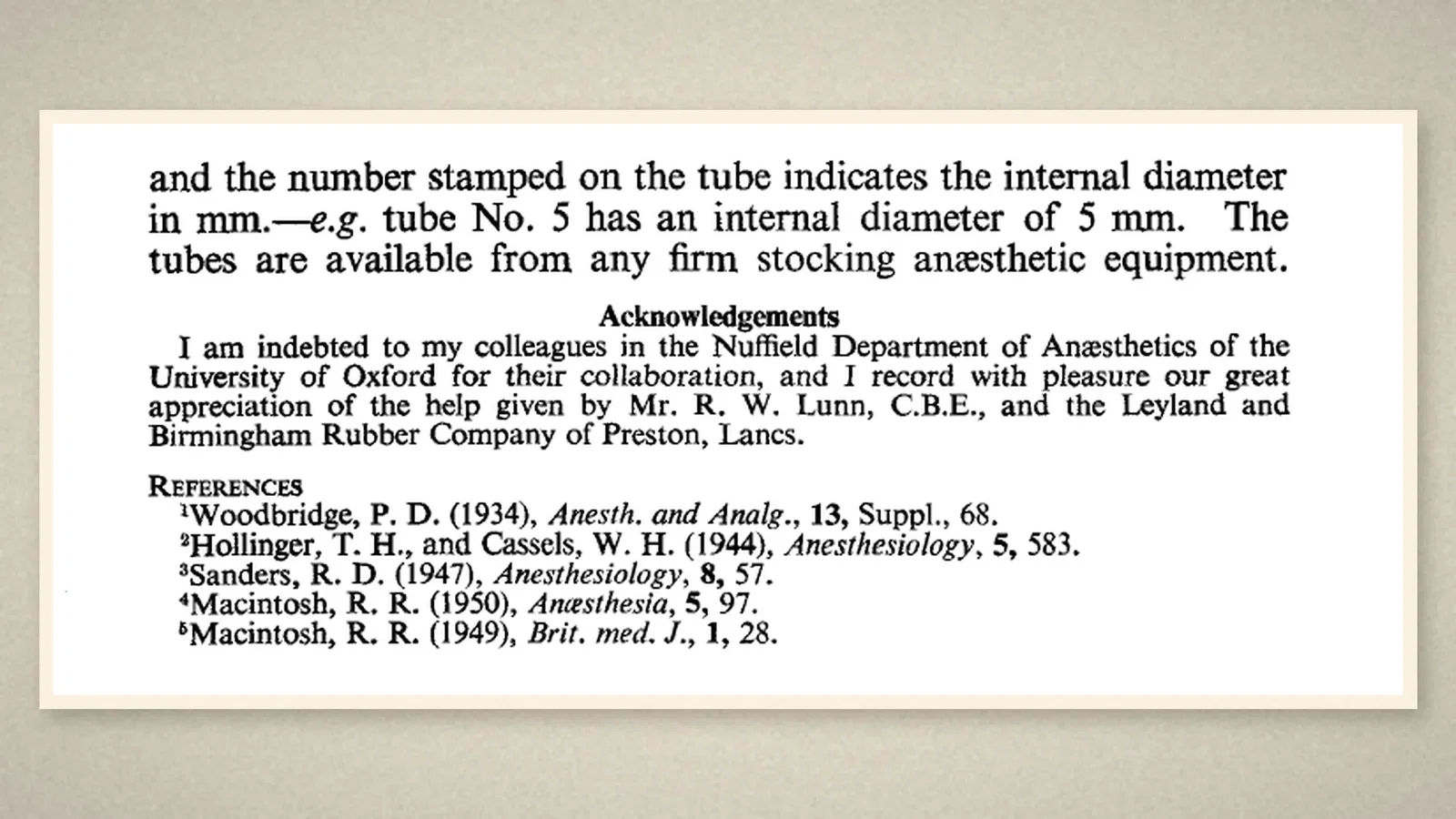
Alsop saw a further advantage: the tube "cannot be inhaled or slip into the trachea should it become detached from its metal connection", an emergency that could be "alarming in infants". Alsop was "particularly impressed" by its use in cleft palate surgery in infants, where it stayed in place under the blade of the mouth gag without kinking. The illustrated No. 4 tube was "found suitable for a child one year old". The smallest size had an internal diameter of 3 mm, "approximately a Magill 00", and sizes rose by 1 mm to 10 mm, eight tubes in all; "the number stamped on the tube indicates the internal diameter in mm". The tubes were made with the help of the Leyland and Birmingham Rubber Company. [1]
What the record shows
Alsop's short note shows how a tube was designed around specific failure points. Shape kept the lumen open where kinking happens, and the wall was thick in the mouth but thin at the cords. The fixed bend made the tube impossible to inhale, and the size number gave the internal diameter directly. The ASA's later entries take the same path into new materials and features: plastic tubes extruded to accurate dimensions, markings for length, a radiopaque line, and cuffs that seal at low pressure. Those later steps are not documented here beyond the ASA's one-line entries.
Sources and reading limits
Read: Alsop AF, Anaesthesia 1955;10:401-3, in full; the ASA timeline entries for 1941, 1955, 1959 and 1971.
Not covered: Murphy FJ, "Two improved intratracheal catheters", Anesth Analg 1941;20:102-5, which could not be obtained; Sheridan's patents and papers; the cuffed-tube papers of Cooper, Grillo and colleagues (only the volume indexes are on the Internet Archive); the earlier non-kinking tubes Alsop cites. The 1941, 1959 and 1971 steps are therefore given only as the ASA states them, without further detail. The ASA names "A Alsop et al"; the paper is signed by A. F. Alsop alone, with thanks to colleagues in the Nuffield Department. This article makes no "first" or priority claim, in line with the journal's own note. Quotations are from the English original.
Three illustrations are crops of pp. 401-3, including the original drawing of the tube; one is drawn from the text.
- Alsop AF. Non-kinking endotracheal tubes. Anaesthesia. 1955;10(4):401-3. Wiley
- Australian Society of Anaesthetists. Anaesthesia history timeline. 2024. ASA
Continue exploring
Related reading connects shared questions and contexts; it does not by itself establish historical influence.
- 1931: Guedel and Waters' Cuffed Endotracheal Tube
- 1949: Carlens's Double-Lumen Catheter Separates the Two Lungs
Anesthesia Epochs · The Source Room · About & Editorial Method
Published November 2, 2026. Sources and reading limits are stated above. Illustrations are labelled as original source images or AI-made. Historical accounts are educational; they are not current treatment instructions.