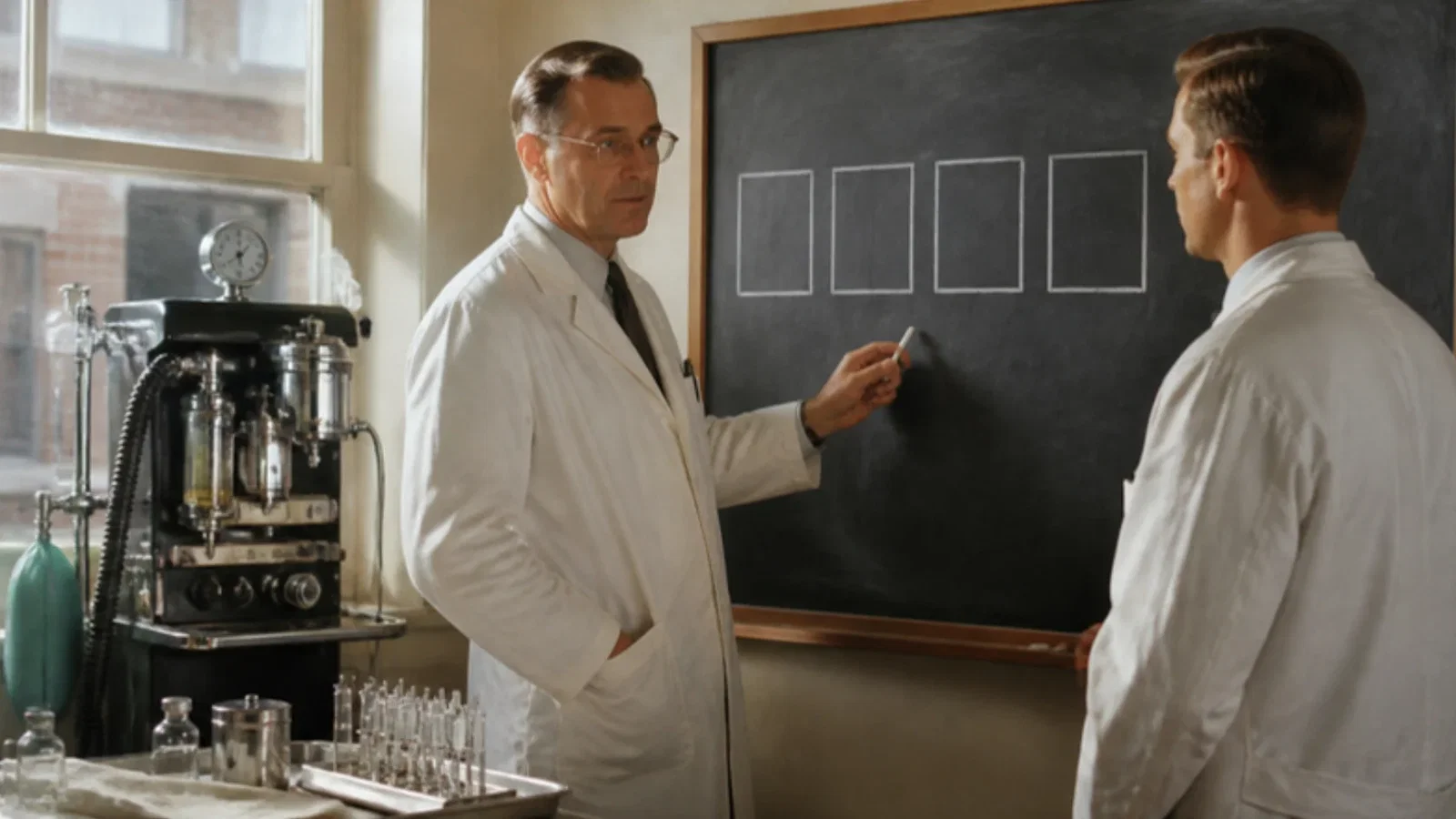
Philip D. Woodbridge argued in Anesthesiology that the stages Guedel and others had drawn up for ether no longer worked with barbiturates and relaxants: patients apparently deeply asleep moved on incision, and paralysed patients could be conscious and in pain; Woodbridge proposed judging four components separately, sensory, motor, reflex and mental block, and adopted the word nothria, suggested by the classicist Herbert M. Howe, restricting anesthesia to sensory block.
Reading Library · Anesthesia Epochs · 中文版
Watch the education video (for clinicians)
1957: Woodbridge's Four Blocks — Depth of Anesthesia · Anesthesia Epochs Education Series
Sleep, pain relief, stillness and the control of reflexes can be treated as separate aims of an anaesthetic. The Australian Society of Anaesthetists (ASA) timeline records under 1957 a concept that set out such a division: "nothria", suggested by Dr P. D. Woodbridge and colleagues, based on four components of anaesthesia. This article reads the paper itself: Philip D. Woodbridge, "Changing concepts concerning depth of anesthesia", in Anesthesiology for July-August 1957. [1][2]
A question that had become puzzling
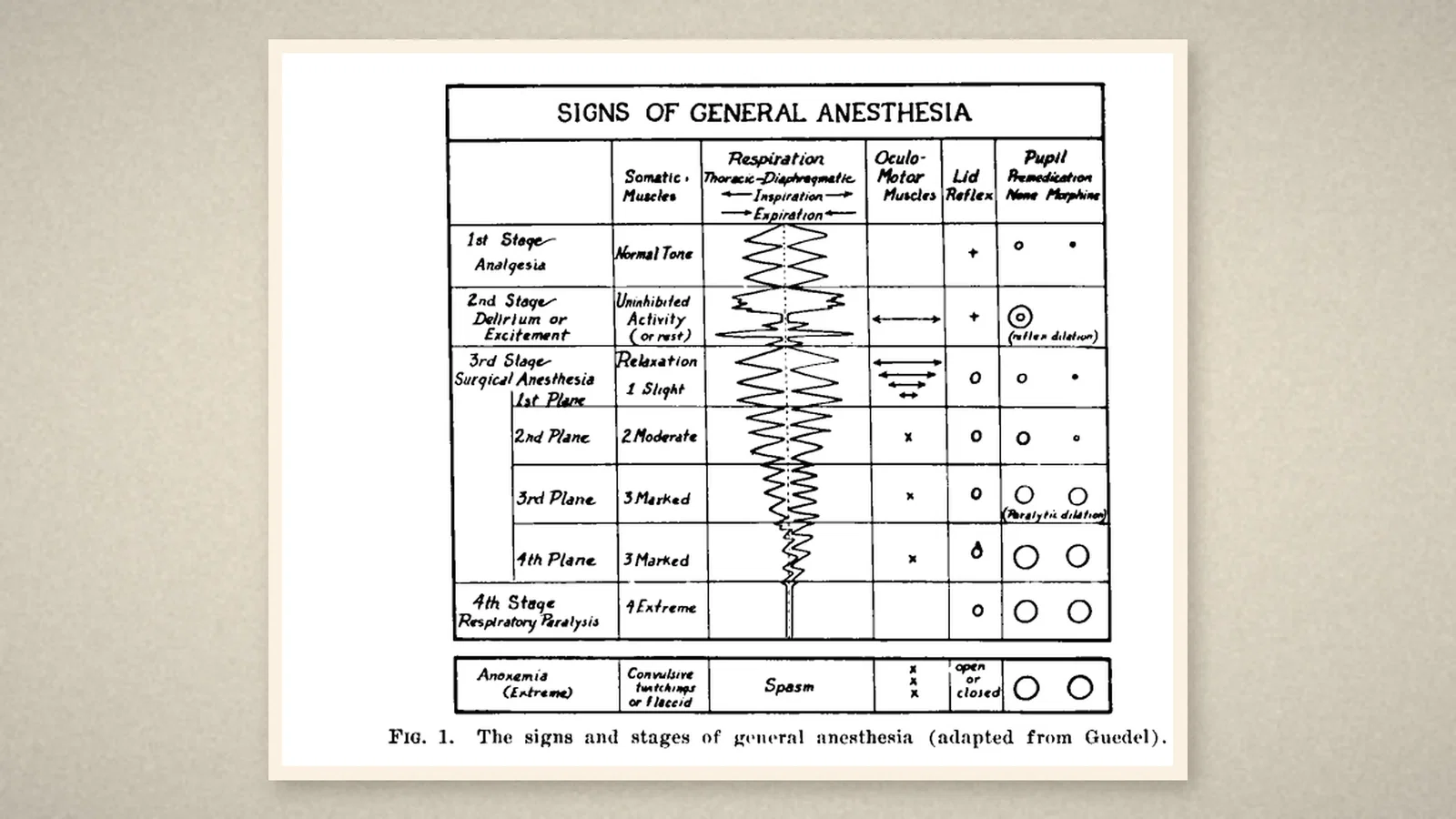
"'How deep is this patient?' That question has become more puzzling as time goes by." Woodbridge recalled the scheme that Guedel, Miller, Waters and others had developed for judging the depth of general anaesthesia: stages from analgesia through delirium and surgical anaesthesia to respiratory paralysis, with signs from breathing, reflexes and the eye. Guedel had said these signs had "a constancy of about 90 per cent". [1]
New drugs broke the scheme. Patients apparently deeply asleep from hexabarbitone (Evipal) "moved on incision as if they were unanesthetized"; moderately deep thiopental sleep went "hand in hand with laryngospasm and lack of relaxation". The worst case was the patient in an intrathoracic operation whose muscles were paralysed, whose pain pathways were not blocked and whose consciousness was not abolished, unable to signal distress until the anaesthetist let muscular activity return. The picture had become confused, Woodbridge wrote, "largely because the relaxants mimic the traditional signs". [1]
Four components
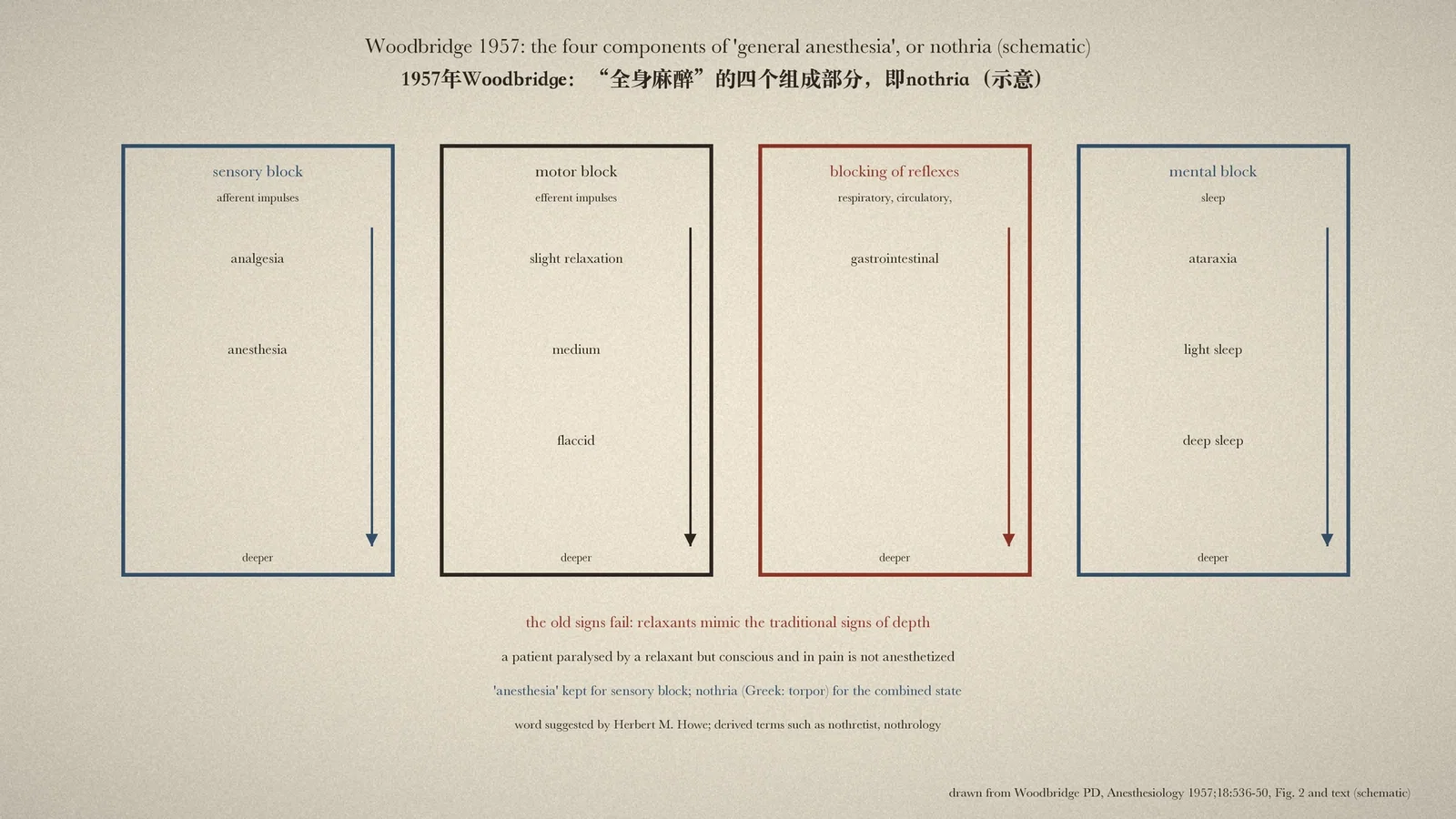
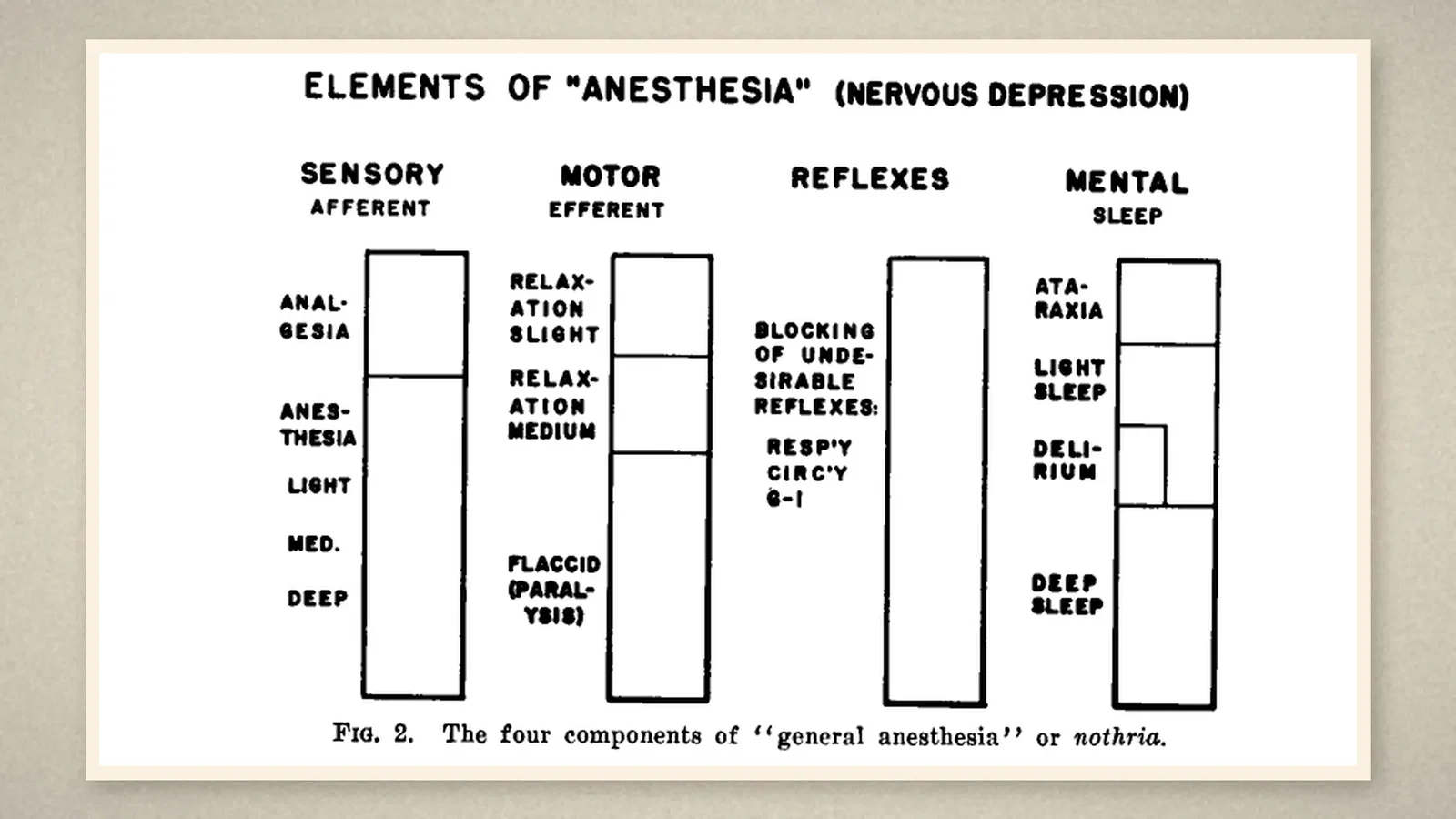
Woodbridge therefore proposed that satisfactory "general anesthesia" includes four components, each with its own depth. Sensory block, of afferent impulses, ranged from analgesia, "absence of pain", to true anaesthesia, absence of all sensation. Motor block, of efferent impulses, ranged from slight relaxation to flaccidity. Blocking of reflexes covered undesirable respiratory, circulatory and gastrointestinal responses, from laryngospasm and arrhythmias to vomiting. Mental block, the production of sleep, ran from calmness, or ataraxia, through drowsiness and light sleep to deep sleep. The components could be produced by different drugs and charted separately, and different operations needed different mixtures: "with few exceptions sensory block is needed in every case", while relaxation was needed for some operations and not others. [1]
A new word
The paper's most unusual proposal concerned language. "The word anesthesia by derivation and usage means loss or absence of feeling or sensation." Strictly, then, "the patient who is paralyzed by a relaxing drug but who is conscious and in pain, is not anesthetized". A word other than anaesthesia was needed for the combined sensory, mental and motor block of the operating room. Professor Herbert M. Howe, a classicist, recommended "nothria", from the Greek for torpor, and supplied a family of derived words: nothregen for a drug that produces it, nothretist for "one who produces nothria", nothrology for its study. Using them, and restricting anaesthesia to sensory block, would "help us to clarify our thinking". [1]
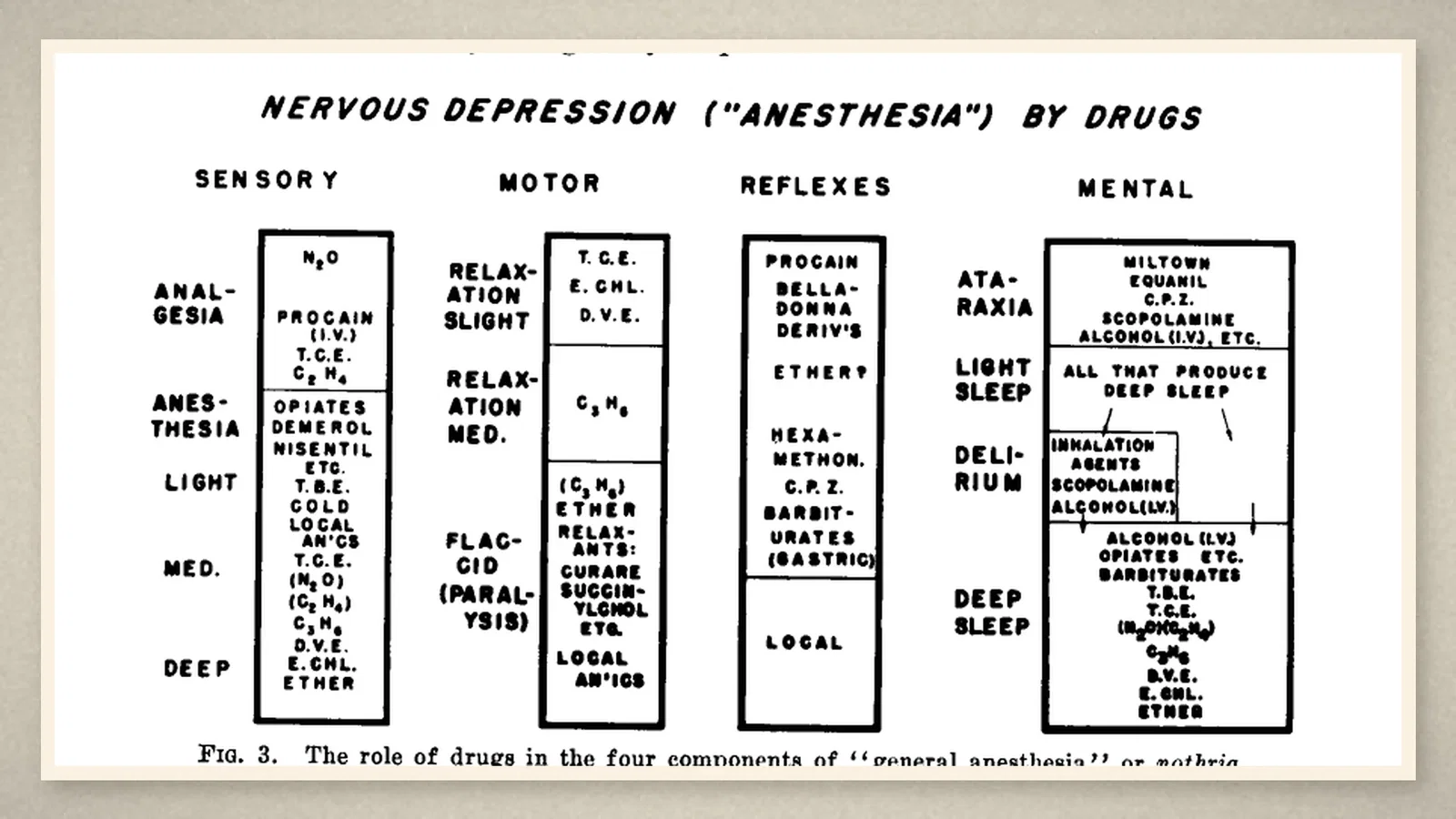
Woodbridge closed with open questions: whether the reflex component belonged in the scheme at all, how the depths of the four components related to electroencephalographic patterns, and whether "ready-made packages such as ether and cyclopropane" were as good as combinations of drugs with specific actions, or whether "our powers of observation and control" were "too uncertain to let us use 'polypharmacy' successfully". [1]
The ASA notes that had "nothria" caught on, it would have replaced the word anaesthesia. [2]
What the record shows
Whatever became of the word, Woodbridge's paper responded to the problem relaxants had created, a patient who looks deep but may be awake and in pain. It answered by separating what is being depressed and by measuring each part on its own terms. The paper also states the danger that came with the new drugs: a still patient is not necessarily an anaesthetized one.
Sources and reading limits
Read: Woodbridge PD, Anesthesiology 1957;18:536-50, in full, including Figs. 1-3. The ASA timeline entry for 1957.
Not covered: Guedel's Inhalation Anesthesia; Agard and Howe's Medical Greek and Latin at a Glance; later work on components of anaesthesia and on depth monitoring; evidence about later use of the word nothria. The ASA calls the reflex component "autonomic reflex blockade"; Woodbridge lists respiratory, circulatory and gastrointestinal reflexes. The ASA's comment on what nothria would have replaced is quoted as its own. Woodbridge's descriptions of patients are paraphrased. Drug doses are not repeated. Quotations are from the English original.
Three illustrations are crops of pp. 536, 537 and 542, Figs. 1-3; one is drawn from Fig. 2 and the text.
- Woodbridge PD. Changing concepts concerning depth of anesthesia. Anesthesiology. 1957;18(4):536-50. Anesthesiology
- Australian Society of Anaesthetists. Anaesthesia history timeline. 2024. ASA
Continue exploring
Related reading connects shared questions and contexts; it does not by itself establish historical influence.
- 1920: Guedel Divides Ether's Third Stage into Four Strata
- 1950: 'I Woke Up in the Theatre', a Curarized Patient and the Letters That Followed
Anesthesia Epochs · The Source Room · About & Editorial Method
Published November 2, 2026. Sources and reading limits are stated above. Illustrations are labelled as original source images or AI-made. Historical accounts are educational; they are not current treatment instructions.