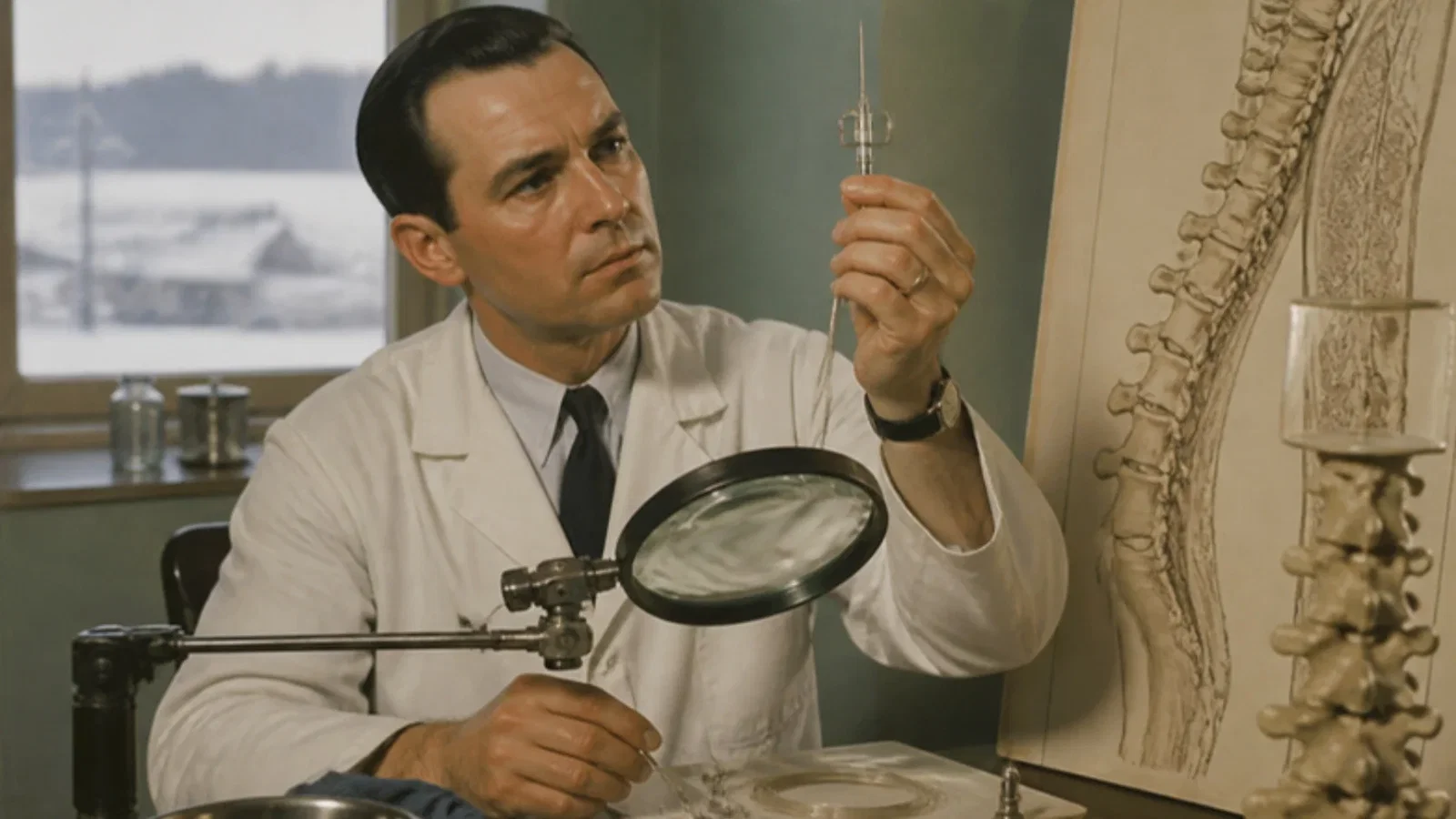
A Current comment in Anesthesiology for November-December 1961 reported that Philip R. Bromage of the Royal Victoria Hospital, Montreal, valued the Huber tip of the Tuohy needle for guiding catheters up the canal and reducing dural puncture, and argued that the other end should suit the method used to find the epidural space: the loss-of-resistance test needed only the standard hub, but Gutierrez's hanging drop needed a needle held firmly without fingers near the orifice, so a Huber-tipped Crawford needle was made for thoracic and cervical punctures; the original description of Weiss's winged needle could not be obtained.
Reading Library · Anesthesia Epochs · 中文版
Watch the education video (for clinicians)
1961: Bromage's Thoracic Epidural Needle — A Grip for the Hanging Drop · Anesthesia Epochs Education Series
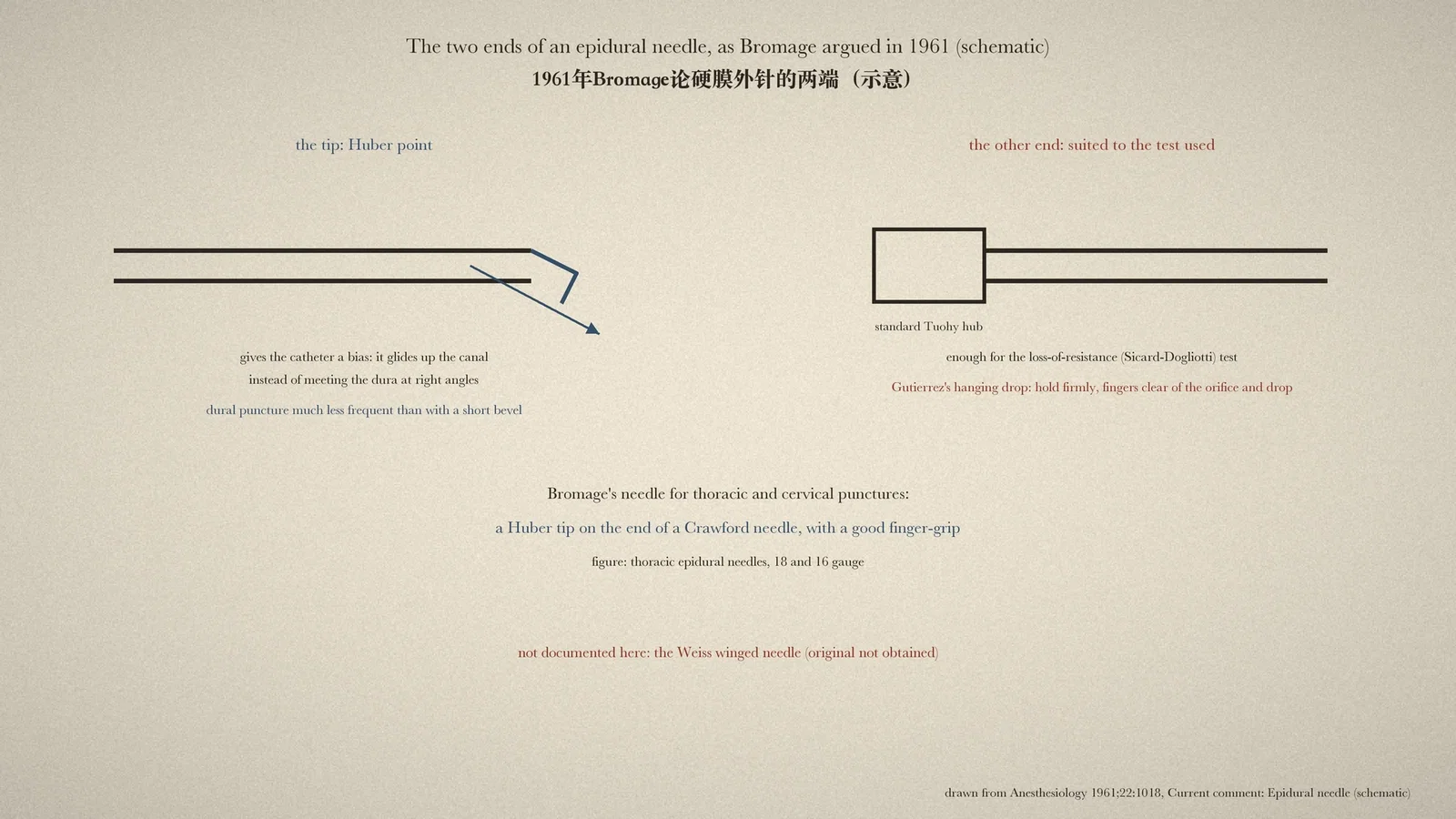
An epidural needle has two ends, and in 1961 each was a design problem: the tip must enter the epidural space without puncturing the dura, and the hub must suit the method used to recognise the space. This article set out to document the Weiss winged epidural needle, usually dated to 1961. The original description of that needle could not be obtained, so this article reads instead a short report from the same year, the "Current comment" headed "Epidural needle" in Anesthesiology for November-December 1961, about a needle made for Philip R. Bromage. [1]
The tip
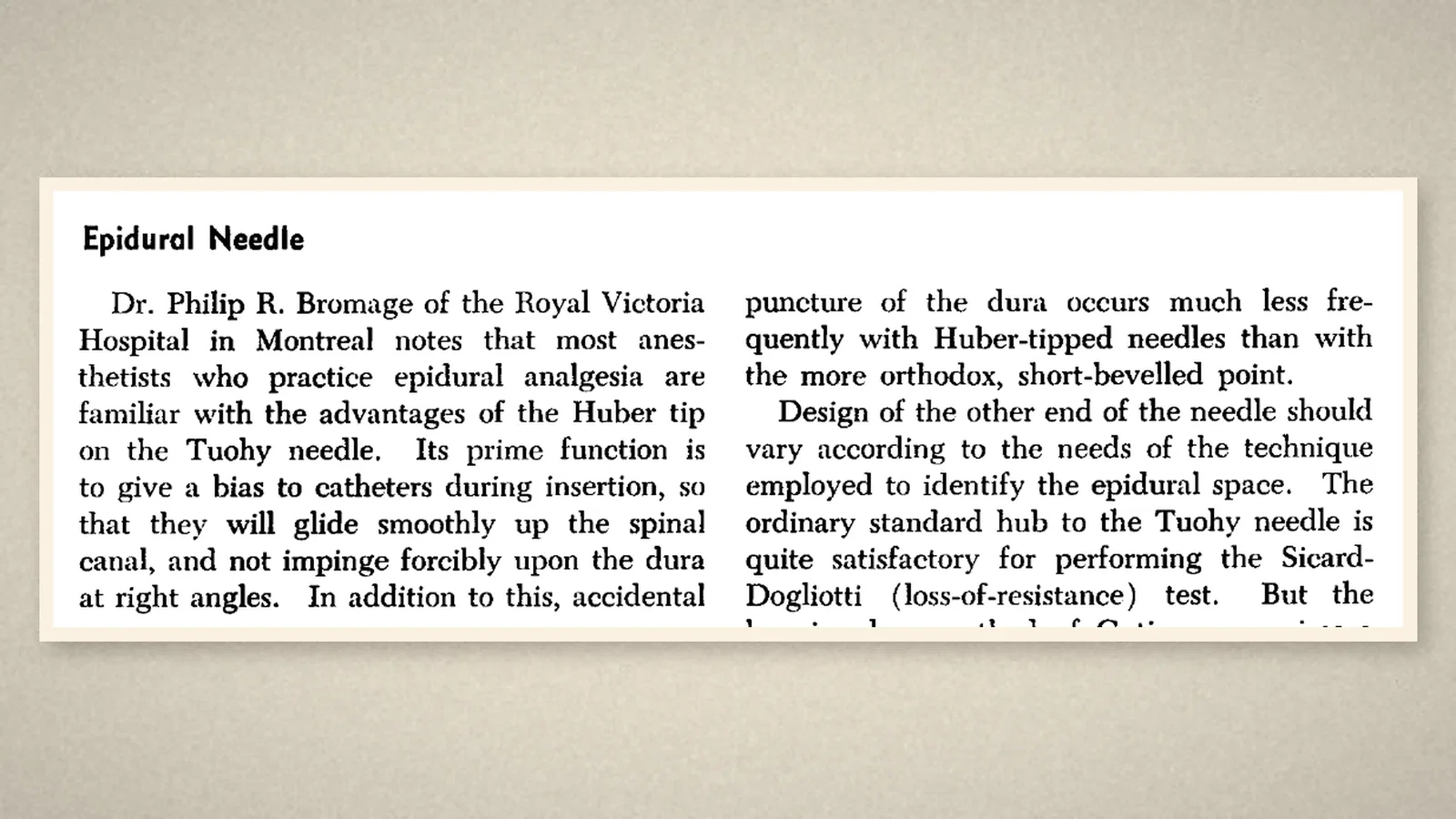
The note reports that Bromage, of the Royal Victoria Hospital in Montreal, found that most anaesthetists who practised epidural analgesia were "familiar with the advantages of the Huber tip on the Tuohy needle". "Its prime function is to give a bias to catheters during insertion, so that they will glide smoothly up the spinal canal, and not impinge forcibly upon the dura at right angles." In addition, accidental puncture of the dura "occurs much less frequently with Huber-tipped needles than with the more orthodox, short-bevelled point". [1]
The other end
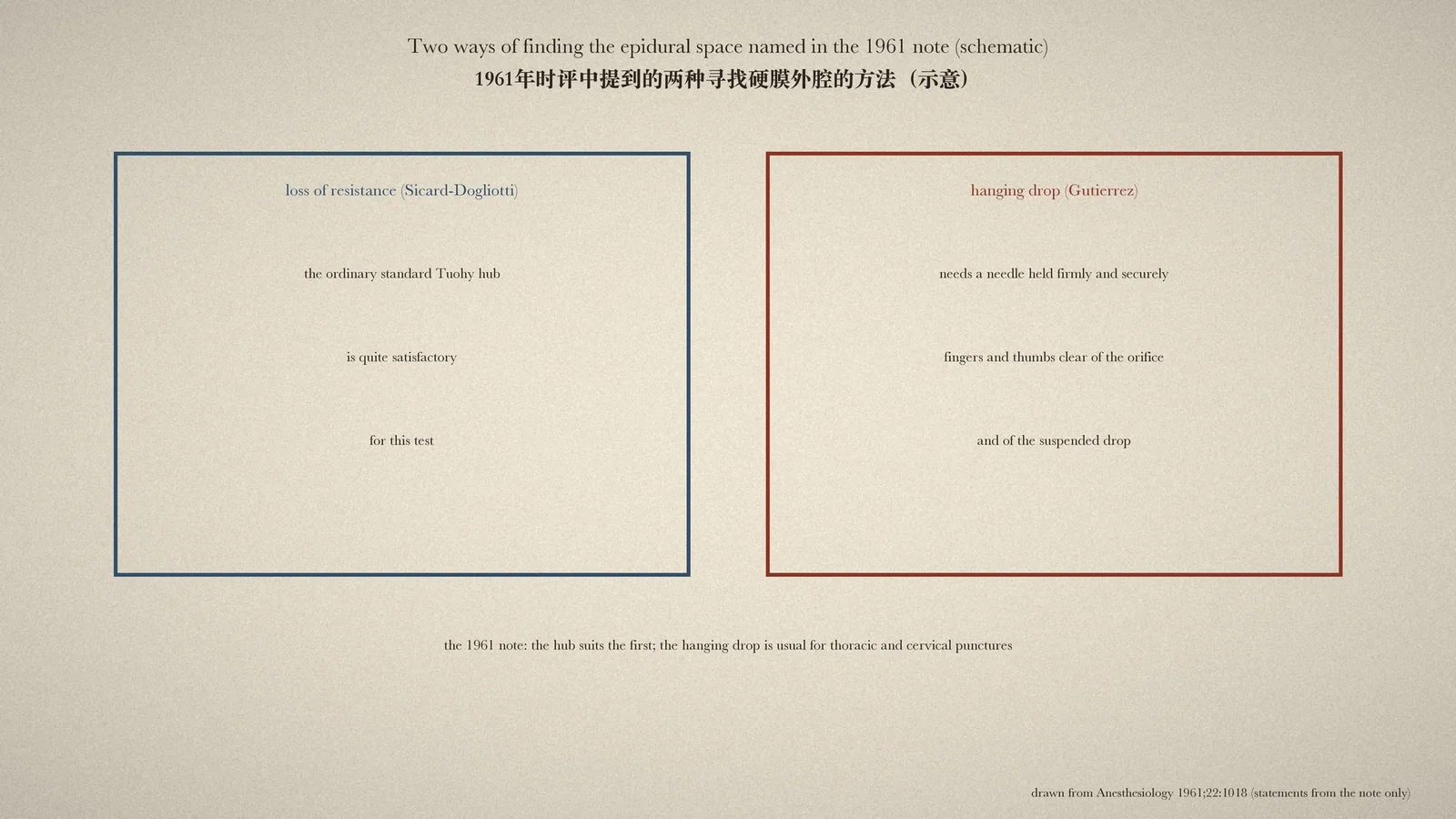
"Design of the other end of the needle should vary according to the needs of the technique employed to identify the epidural space." For the Sicard-Dogliotti loss-of-resistance test, "the ordinary standard hub to the Tuohy needle is quite satisfactory". But "the hanging-drop method of Gutierrez requires a needle which can be held firmly and securely, without fingers and thumbs encroaching on the orifice and the suspended drop". [1]
Bromage's needle
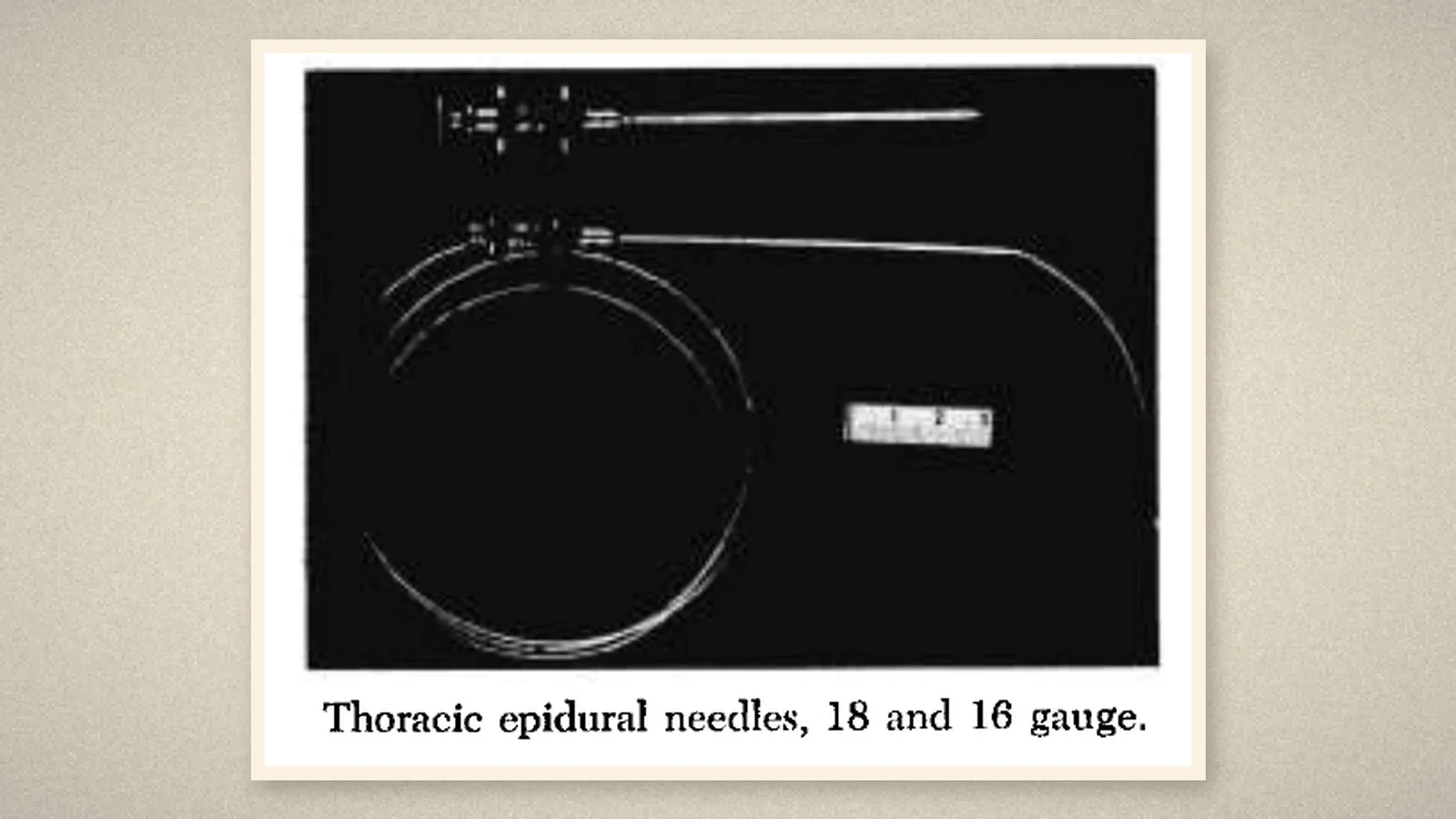
Because the hanging-drop technique was usually employed for thoracic and cervical punctures, "Dr. Bromage recommends a needle which combines the advantages of both a Huber point and a good finger-grip". Such a needle "has been developed for Dr. Bromage, with a Huber tip on the end of a Crawford needle", and "it has proved extremely satisfactory". The accompanying photograph shows "thoracic epidural needles, 18 and 16 gauge". [1]
What this article keeps, and what it cannot
The 1961 note shows the reasoning behind epidural needle design at that time. The tip was shaped for safe entry and catheter guidance. The hub and grip were shaped around the test the anaesthetist relied on, and for the hanging drop, the hands had to hold the needle steady without touching the drop. [1] The Weiss needle's wings are commonly linked with the hanging-drop method. The needle's own design, author and date are not documented here, because its original description was not available.
Sources and reading limits
Read: the Current comment "Epidural needle", Anesthesiology 1961;22:1018, in full. The same page also carries an unrelated note on a cardiac arrest board, not used.
Not covered: the original description of the Weiss winged epidural needle, which could not be obtained; a CSA article on the needle, which could not be accessed; an obstetric anaesthesia manual on the Internet Archive that illustrates a "Weiss needle" but is lending-restricted and was not opened; the original papers of Tuohy, Huber, Crawford and Gutierrez. The article therefore makes no statement about the Weiss needle's design, author's initials or exact date, beyond its name. The note is unsigned; the statements about dural puncture and performance are presented as Bromage's. This article makes no "first" claim. Quotations are from the English original.
Two illustrations are crops of p. 1018; two are drawn from the note.
- Epidural needle [Current comment]. Anesthesiology. 1961;22(6):1018. Anesthesiology
Continue exploring
Related reading connects shared questions and contexts; it does not by itself establish historical influence.
- 1933: Gutiérrez's Hanging Drop, a Sign Known Through Others
- 1954: Hustead Sands Down the Point of the Tuohy-Flowers Needle
Anesthesia Epochs · The Source Room · About & Editorial Method
Published November 2, 2026. Sources and reading limits are stated above. Illustrations are labelled as original source images or AI-made. Historical accounts are educational; they are not current treatment instructions.