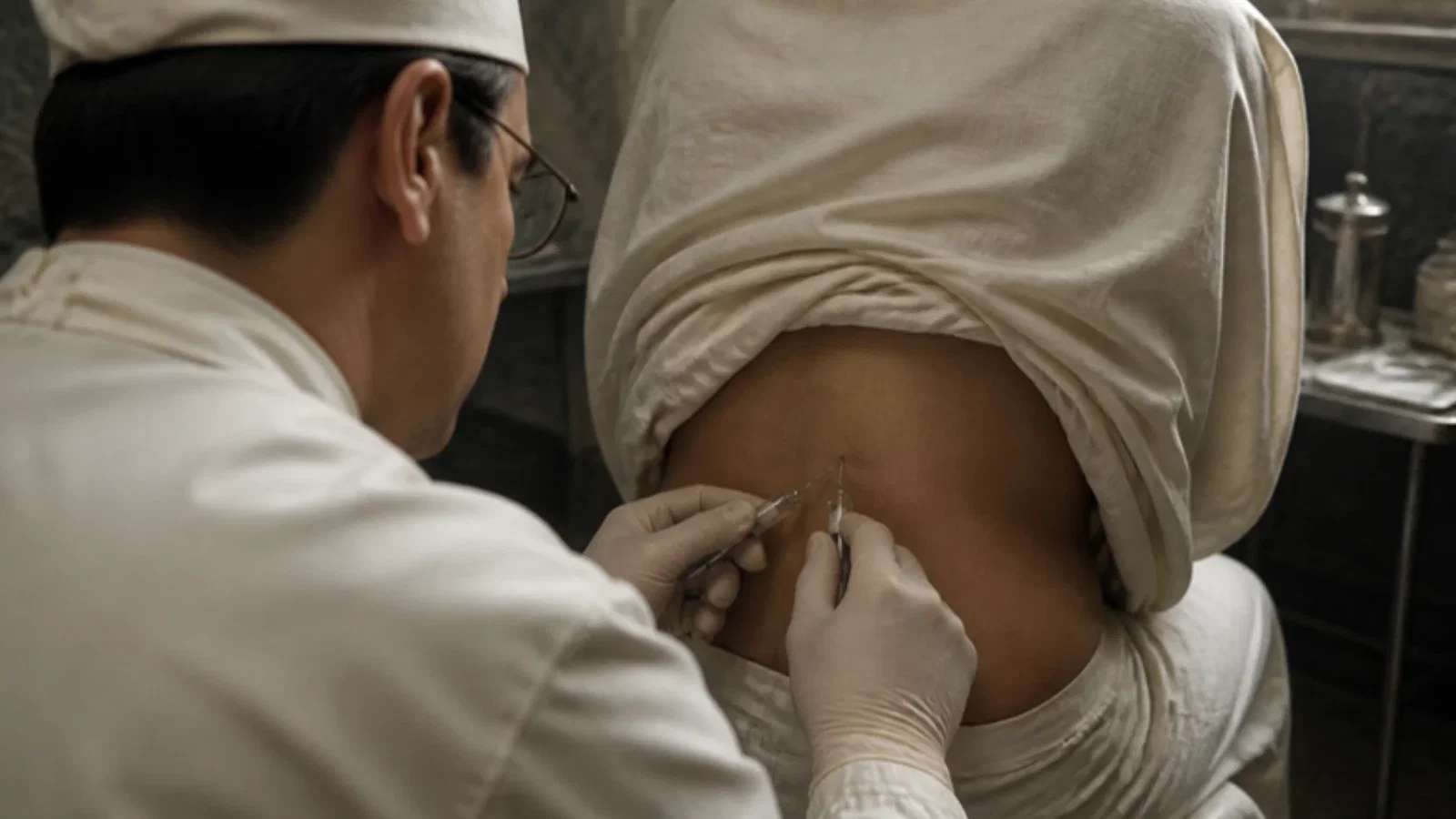
The hanging drop sign for finding the epidural space is credited to Alberto Gutiérrez of Buenos Aires in 1933, but his papers could not be read; theses of 1936 and 1943, a 1951 abstract and a 2014 review show the sign, its rivals and the long argument about 'negative pressure'.
Reading Library · Anesthesia Epochs · 中文版
Watch the education video (for clinicians)
1933: Gutiérrez's Hanging Drop — A Sign Known Through Others · Anesthesia Epochs Education Series
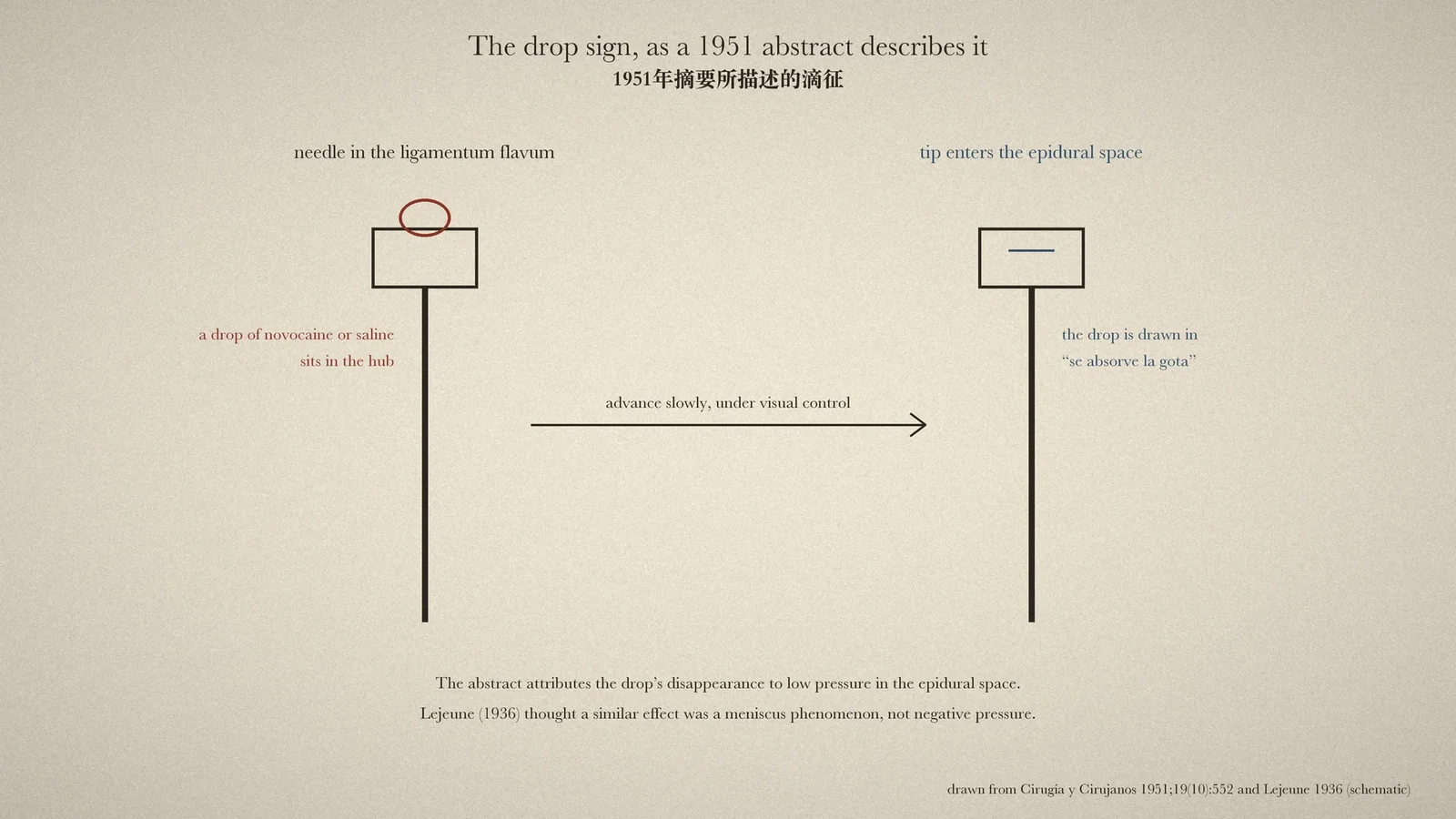
Fill the hub of an epidural needle with saline until a drop stands at the opening, advance slowly, and watch: when the tip enters the epidural space the drop vanishes into the needle. This "hanging drop" sign is credited to Alberto Gutiérrez of Buenos Aires in 1933. This article set out to read Gutiérrez's own account and could not. The papers Gutiérrez published in the Revista de Cirugía de Buenos Aires in 1933 were not found in any open copy, and neither was Gutiérrez's later book. What can be read are accounts by others: two French theses of 1936 and 1943, a Latin American abstract of 1951, and a 2014 review. This article is built from them, and says so throughout. [1] [2] [3] [4]
The attribution
The 2014 review by L. Todorov and T. VadeBoncouer states: "In 1933, Guttierez described the sign of the 'hanging drop,' whereby a drop of saline hanging in the hub of a needle was 'aspirated' when the needle entered the epidural space." The source it cites for this is a 2005 historical article, "Alberto Gutierrez and the hanging drop", by J. A. Aldrete and colleagues, which was not available here beyond its title. A 2008 letter in the same journal is titled "The search for the originator of the hanging drop technique", which suggests that the attribution has been debated. [1] [5] [6]
Before 1943: drops, bubbles and manometers
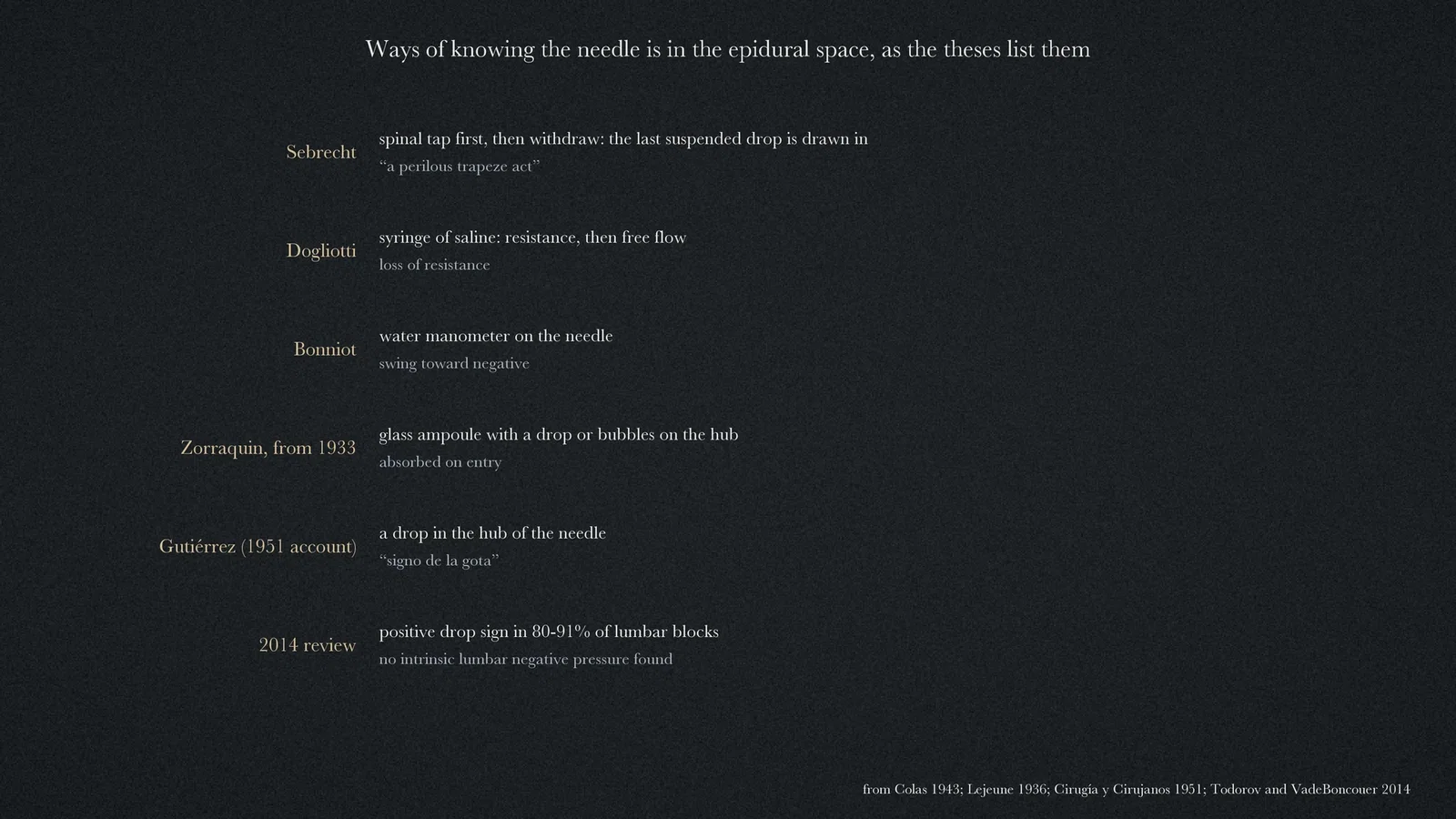
The French theses show that, between 1936 and 1943, Gutiérrez appears as one name among several. R.-M. Lejeune's 1936 Paris thesis on segmental peridural anaesthesia lists, among its references, Gutiérrez, López and Rubido's 1933 paper on results with epidural anaesthesia, and notes that Pagès's 1921 article had recently been summarized by Gutiérrez. [2] A. Colas's 1943 thesis compares the methods then used to find the epidural space. Sebrecht made a real spinal puncture and withdrew the needle until the spinal fluid stopped: "the last drop suspended from the needle is then aspirated", showing that the tip was epidural. Colas thought it imprecise and dangerous, quoting R. Monod, who had watched Sebrecht at work: "one has the impression of watching a perilous trapeze act." Dogliotti used a syringe of saline and the loss of resistance; Bonniot a water manometer on the needle; and Zorraquin, "from 1933", a small glass ampoule fitted to the hub and charged with a drop of saline, whose contents were drawn in on entering the space. [3]
What draws the drop in?
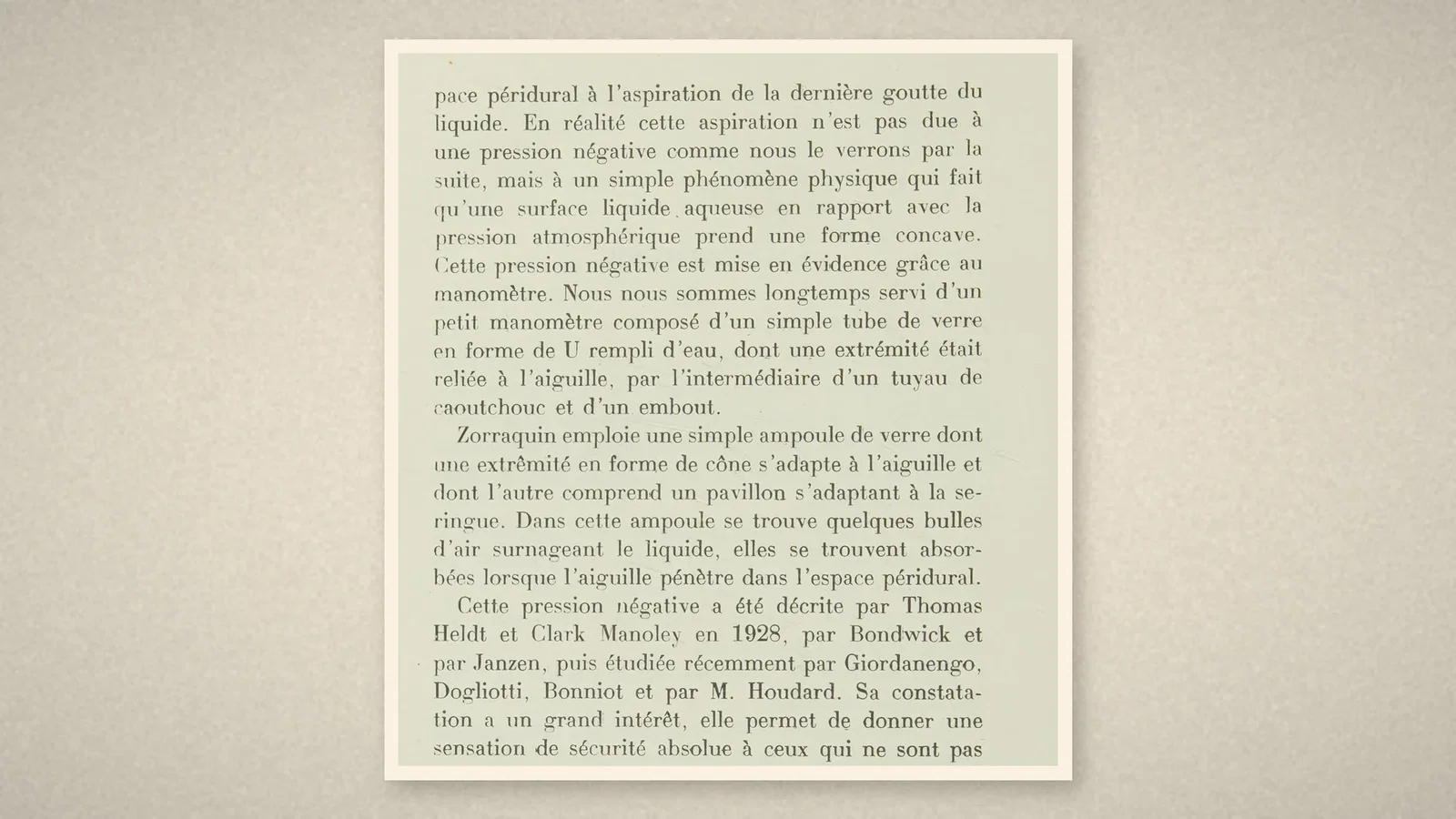
Lejeune devoted a chapter to "the negative pressure of the peridural space". The pressure, Lejeune wrote, had been described by Heldt and "Clark Manoley" in 1928 and by Janzen, and its observation gave "a sense of absolute safety" to those not yet practised in the method. But Lejeune also argued that the familiar aspiration of the last drop as a needle came back from the spinal fluid was "not due to negative pressure", only to the physics of a water surface open to the air, which takes a concave form. [2]
The sign named
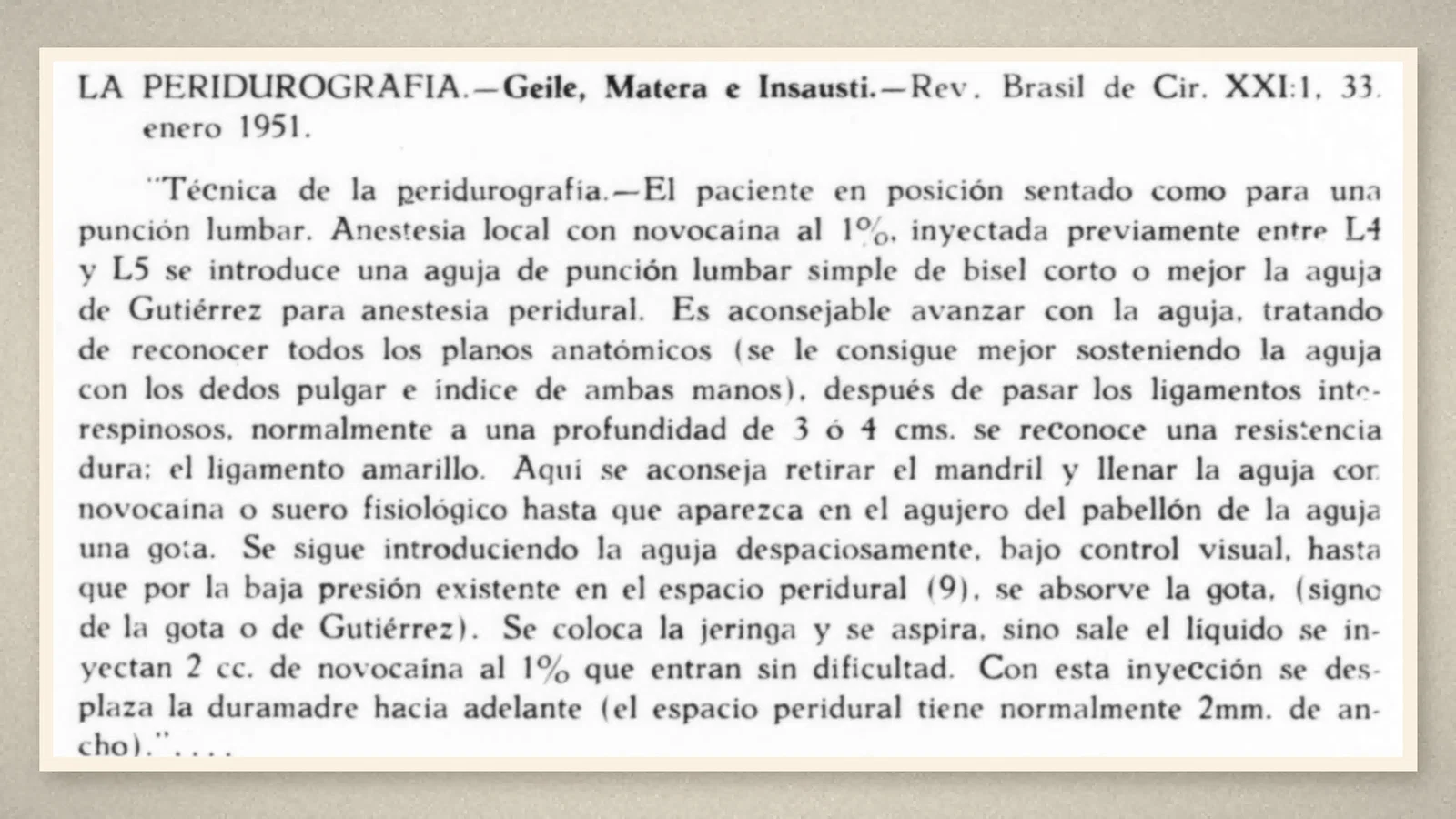
By 1951 the sign had Gutiérrez's name. An abstract in the Mexican journal Cirugía y Cirujanos, summarizing a Brazilian paper on peridurography, describes it step by step: after passing the interspinous ligaments, at three or four centimetres, the hard resistance of the ligamentum flavum is felt; the stylet is removed and the needle filled with novocaine or saline "until a drop appears at the opening of the hub"; the needle is advanced slowly "under visual control" until, because of the low pressure in the epidural space, "the drop is absorbed (sign of the drop, or of Gutiérrez)". The abstract also mentions "the needle of Gutiérrez for peridural anaesthesia". [4]
What the sign means now
The 2014 review takes up Lejeune's question. Ernst Janzen first described subatmospheric epidural pressure in 1926, but whether the pressure is intrinsic or an artefact of the advancing needle has long been argued. The reviewers found "no evidence of intrinsic subatmospheric pressure in the lumbar epidural space that can be measured after needle stabilization"; the negative pressure at entry is attributed to the ligament springing back or the dura being tented by the needle. In lumbar epidurals the sign was positive in 80 per cent of cases in one series and 91 per cent of 1,002 blocks in another, and in one comparison the needle tip ended 2.8 mm closer to the subarachnoid space than with loss of resistance. [1]
What the record shows
The drop sign entered practice in the same years as the loss-of-resistance method, alongside manometers and glass ampoules, and was later named after Gutiérrez. Gutiérrez's own words are missing from this record, so the details of the 1933 description, and its priority, rest on later accounts; what can be traced is the sign itself and the long argument about why the drop moves.
Sources and reading limits
Read: Todorov and VadeBoncouer's 2014 review in full; Lejeune's 1936 thesis (history, negative-pressure chapter, bibliography); Colas's 1943 thesis (methods, bibliography); the 1951 abstract in Cirugía y Cirujanos; the PubMed records of Aldrete et al. 2005 and Neruda 2008.
Not covered: every paper by Gutiérrez, including those of 1933; the full texts of Aldrete et al. and Neruda; Janzen, Heldt and Zorraquin's own papers. The core original is missing, and this article makes no claim about what Gutiérrez wrote in 1933. Names are as printed; French and Spanish quotations are translated for this article.
Two illustrations are page crops from the 1951 abstract and the 1936 thesis; two are drawn from the sources.
- Todorov L, VadeBoncouer T. Etiology and use of the "hanging drop" technique: a review. Pain Res Treat. 2014;2014:146750. DOI
- Lejeune R-M. L'anesthésie péridurale segmentaire [thèse]. Paris; 1936. Internet Archive
- Colas A. L'anesthésie péridurale en chirurgie urinaire [thèse]. 1943. Internet Archive
- [Revista de prensa] Geile, Matera e Insausti. La peridurografía (Rev Brasil Cir 1951;21:33). Cir Cir. 1951;19(10):552. Internet Archive
- Aldrete JA, Auad OA, Gutierrez VP, Wright AJ. Alberto Gutierrez and the hanging drop. Reg Anesth Pain Med. 2005;30(4):397-404. PubMed
- Neruda B. The search for the originator of the hanging drop technique. Reg Anesth Pain Med. 2008;33(3):276-7. PubMed
Continue exploring
Related reading connects shared questions and contexts; it does not by itself establish historical influence.
- 1933: Dogliotti Teaches the Hand to Feel the Epidural Space
- 1921: Pagés Achieves Surgical Anesthesia Outside the Dura
Anesthesia Epochs · The Source Room · About & Editorial Method
Published November 2, 2026. Sources and reading limits are stated above. Illustrations are labelled as original source images or AI-made. Historical accounts are educational; they are not current treatment instructions.