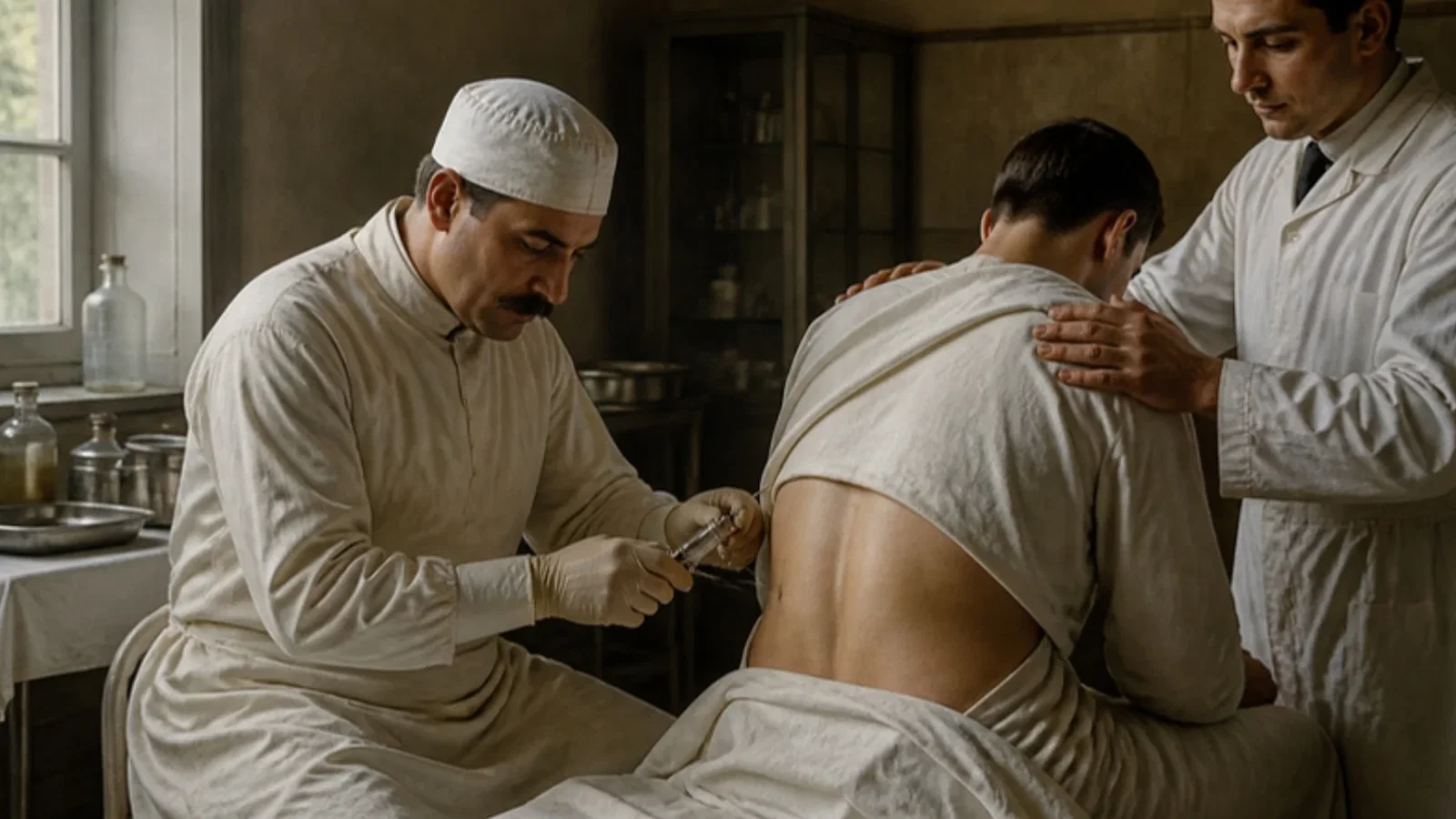
A Turin surgeon described single-injection 'segmental peridural' anaesthesia and a way of knowing when the needle had passed the ligamentum flavum: steady pressure on the plunger until the resistance suddenly gives way.
Reading Library · Anesthesia Epochs · 中文版
Watch the education video (for clinicians)
1933: Dogliotti's Loss of Resistance — Finding the Epidural Space · Anesthesia Epochs Education Series
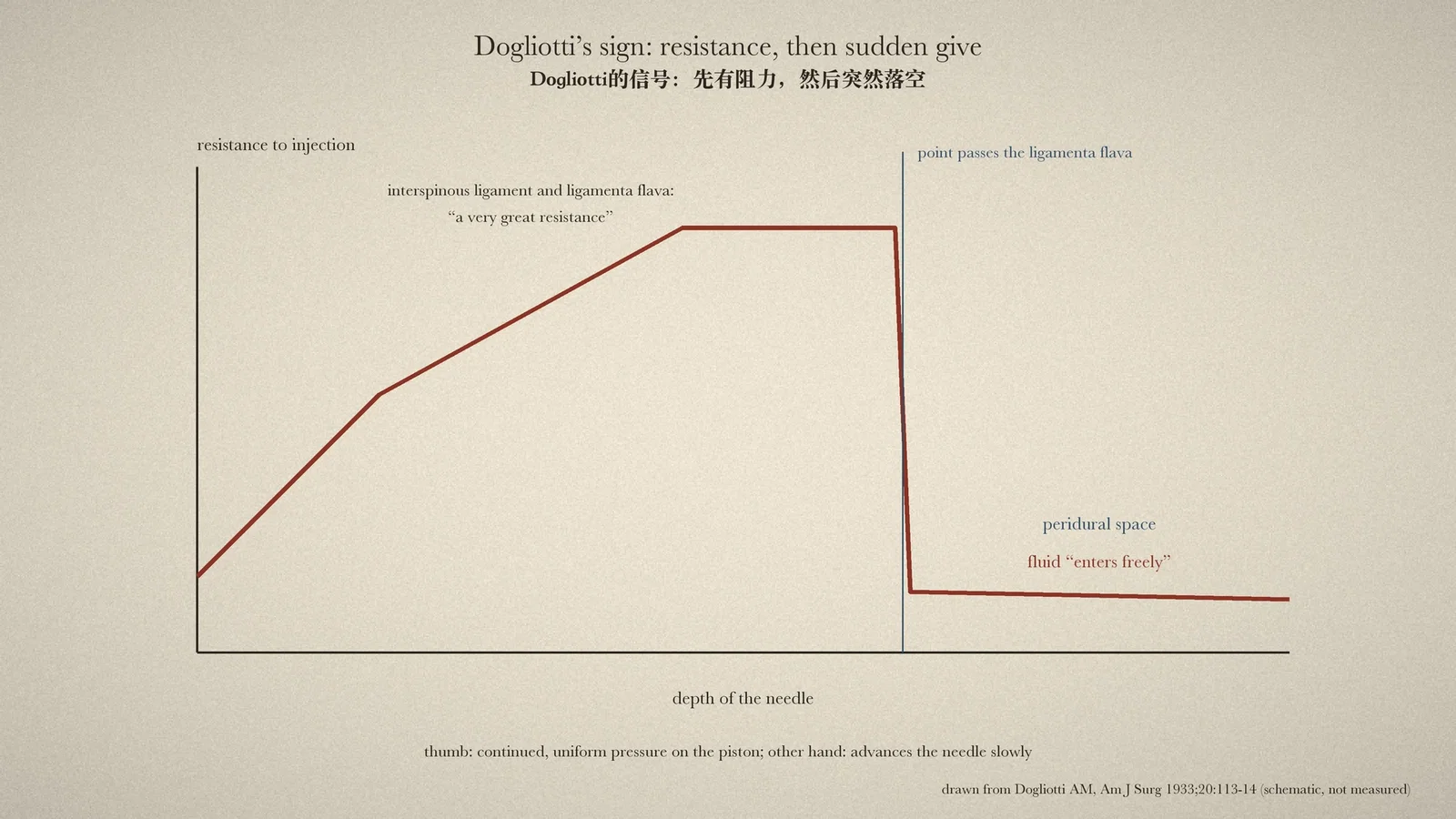
Every lumbar epidural begins with the same small act of judgement: knowing when the needle tip has left the ligament and entered the epidural space, a few millimetres short of the dura. One of the clearest early descriptions of how to feel that moment came from A. M. Dogliotti of the Institute of Pathological Surgery at the Royal University of Turin, in an Italian paper of 1931 and an English one in the American Journal of Surgery in April 1933. This article reads both. [1] [2]
A single injection outside the dura
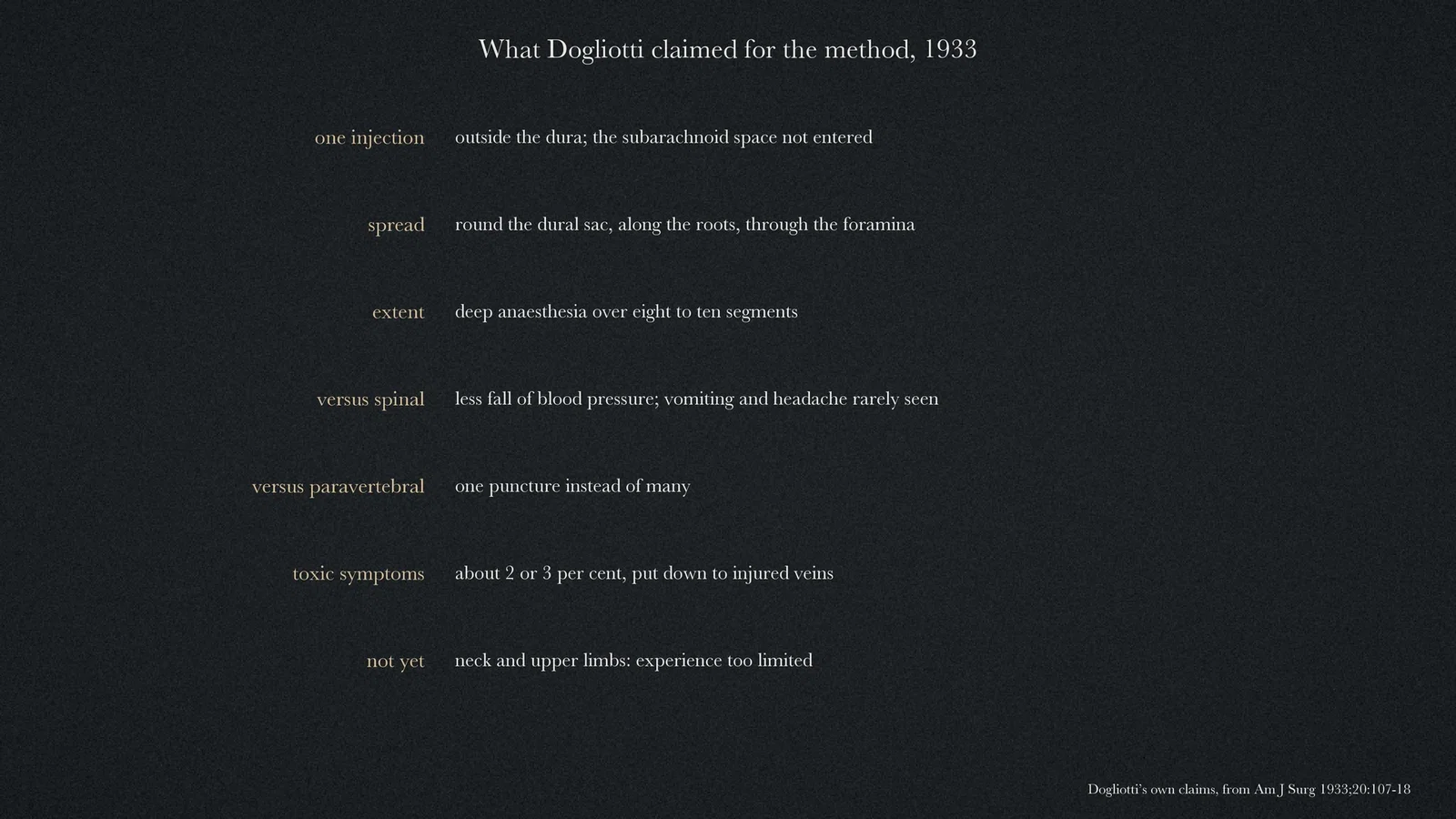
The 1933 paper opens with its aim. The method, "worked out by me", had "been in use for three years with increasing success", and was meant to give "as a result of a single injection which does not involve the subarachnoid space" a complete, deep and lasting anaesthesia in any part of the body. Dogliotti wanted the safety of local anaesthesia with the power of spinal anaesthesia, and results in the upper body as good as sacral extradural anaesthesia gave in the lower. [1]
The basis was anatomical. Citing the work of Sterzi, who had described the peridural tissues in 1905, and studies of frozen sections and dye injections, Dogliotti described the loose fatty tissue round the dural sac continuing through the intervertebral foramina. A solution injected into the peridural space spread round the dura, along the sheaths of the nerve roots and out through the foramina, so that, given in "sufficient quantity (50-60 c.c.)" and under pressure, it bathed the spinal nerves over a long stretch. Lipiodol X-rays showed the spread. As a rule, Dogliotti wrote, deep and complete anaesthesia could be obtained over eight to ten spinal segments. [1]
The feel of the space
Dogliotti admitted that an operator used to lumbar puncture could usually tell when the needle had just entered the peridural space, "in 9 out of 10 cases", but that this was not the most certain method, especially where the dura lay close to the bone and was easily pierced. The answer was to let a syringe of saline do the judging. Once the needle was in the interspinous ligament, injection met "a very great resistance", which was "most certain evidence that the needle is still in the posterior fibers of these tissues". Then:
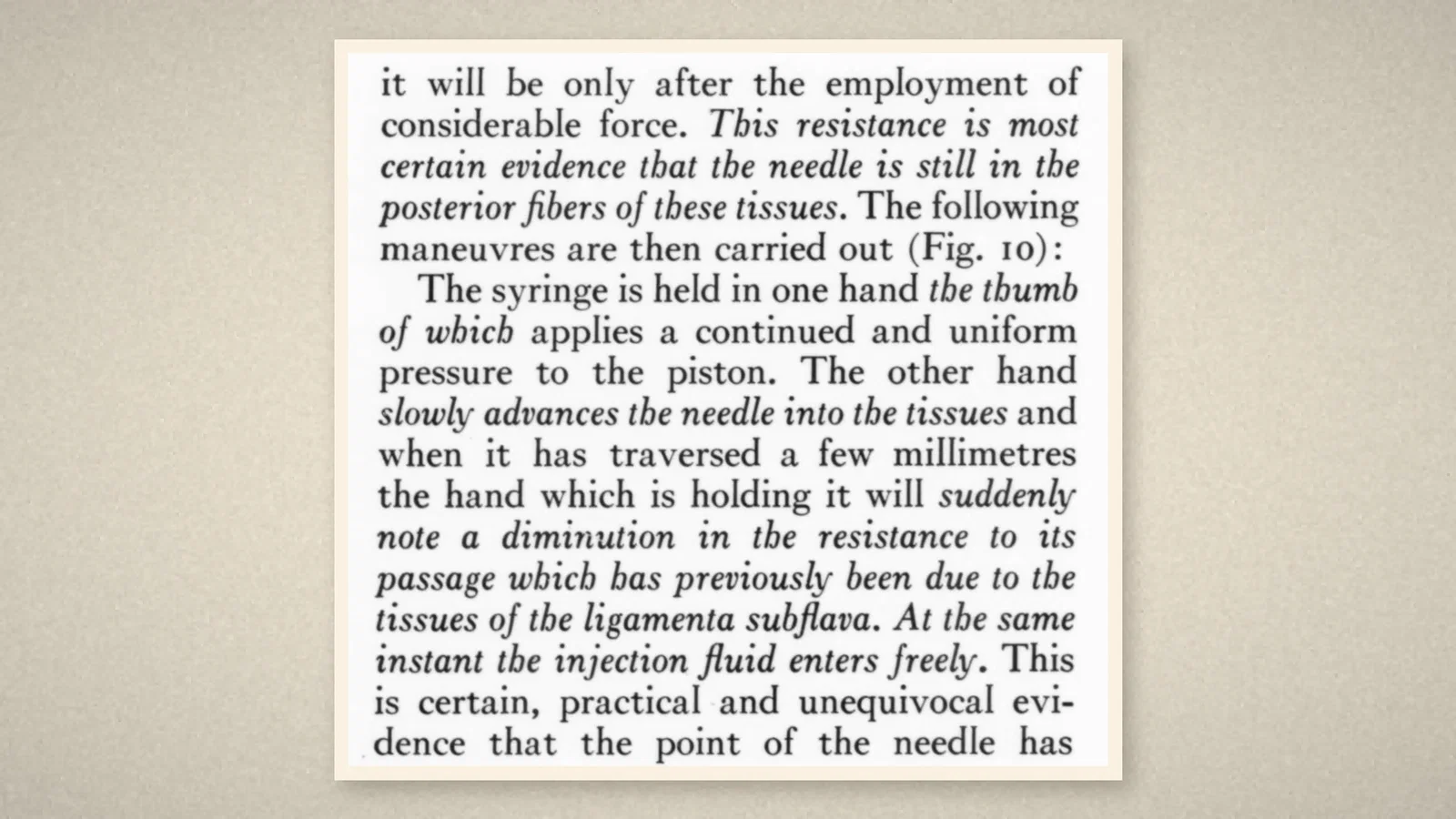
"The syringe is held in one hand the thumb of which applies a continued and uniform pressure to the piston. The other hand slowly advances the needle into the tissues and when it has traversed a few millimetres the hand which is holding it will suddenly note a diminution in the resistance to its passage which has previously been due to the tissues of the ligamenta subflava. At the same instant the injection fluid enters freely." That, Dogliotti wrote, was "certain, practical and unequivocal evidence" that the point was in the peridural space; the fluid also pushed the dura away from the needle. [1]
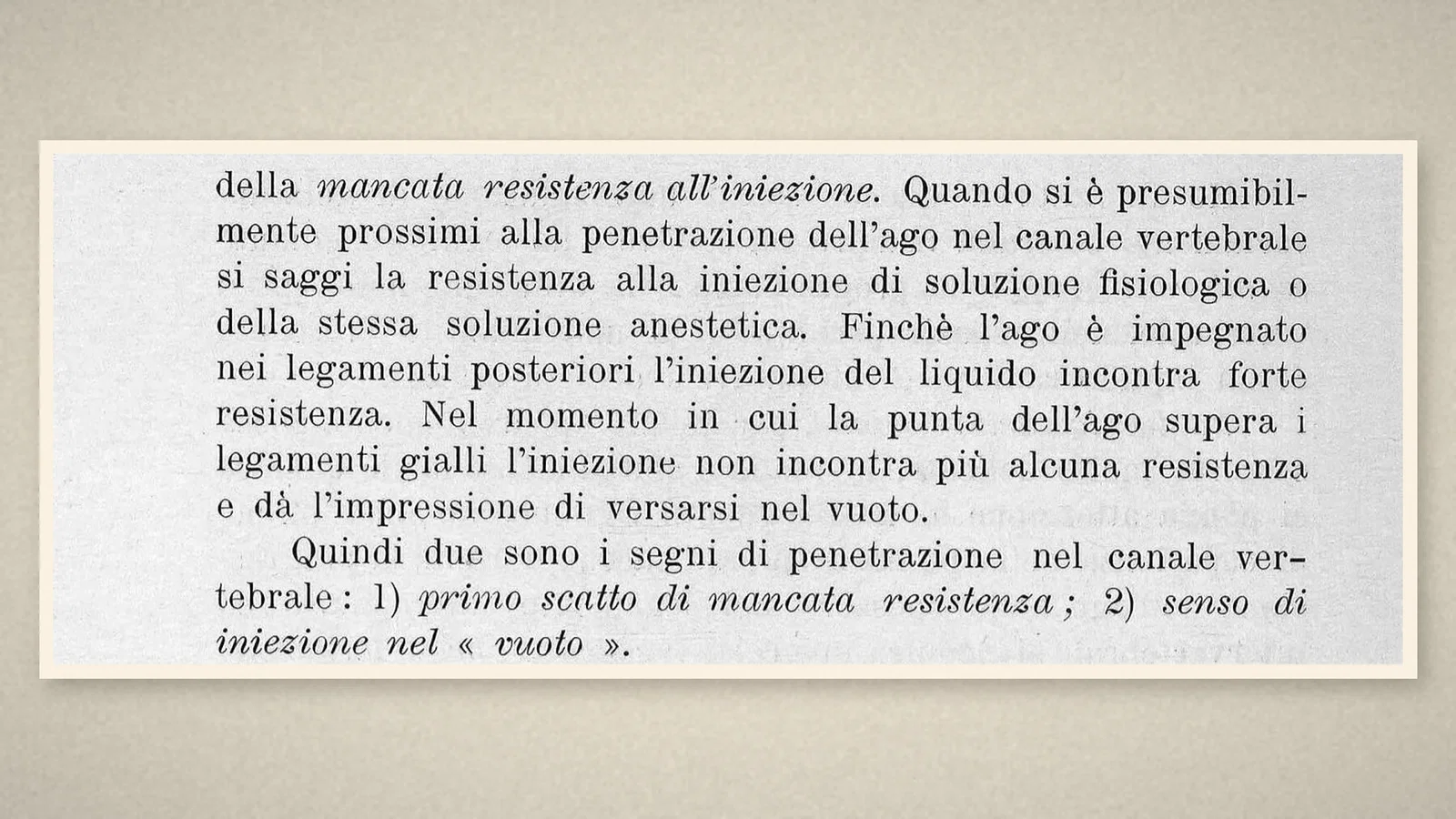
The 1931 Italian paper had put it in two signs: "1) primo scatto di mancata resistenza; 2) senso di iniezione nel « vuoto »", the first snap of lost resistance, and the sense of injecting into a void. [2]
What the method promised, and what it cost
The 1933 paper gives detailed rules: the patient on the side to be more deeply anaesthetized, because the solution later follows gravity; the interspace chosen by the level required; 15 to 20 cc injected, then a pause of three or four minutes while the patient was watched, then the rest. Dogliotti claimed less fall in blood pressure than spinal anaesthesia, little vomiting or headache, and one puncture instead of the many of paravertebral block. Toxic symptoms such as pallor and sweating occurred in "about 2 or 3 per cent", which Dogliotti put down to veins torn by too rapid injection. The neck and upper limbs were still untested. [1]
The 1931 paper is franker about how the method was developed. In the first cases Dogliotti had placed a second, control needle in the subarachnoid space to watch the spinal fluid drip; those patients had some backache and headache, which disappeared once the control needle was abandoned. The conclusion was cautious: a long work of clinical analysis was still needed before final judgement. [2]
Who came first
Neither paper cites a predecessor for lumbar epidural injection. A 2023 essay by Jordan Francke points out that Fidel Pagés had published a lumbar approach to the epidural space in 1921, and concludes that Dogliotti "was not actually the first to discover lumbar epidural anesthesia nor the loss-of-resistance technique", but popularized both. [3] This article makes no claim of priority.
What the record shows
Dogliotti turned the entry into the epidural space from a guess into a sign that could be taught: steady pressure, a slow advance, and a sudden loss of resistance felt in the hand. The papers also carry their own limits: no case totals, a toxic-reaction rate estimated by the author, and early cases done with a second needle in the spinal fluid.
Sources and reading limits
Read: Dogliotti's 1933 paper in the American Journal of Surgery in full; the 1931 Italian paper in full as an offprint; Francke's 2023 essay.
Not covered: Pagés's 1921 paper, covered by another article; Dogliotti's 1931 German paper and later work; Gutierrez's "hanging drop" sign, left to a separate article. Doses are as printed; Italian quotations are translated for this article.
Two illustrations are page crops from the 1933 and 1931 papers; two are drawn from them.
- Dogliotti AM. A new method of block anesthesia: segmental peridural spinal anesthesia. Am J Surg. 1933;20(1):107-18. Internet Archive
- Dogliotti AM. Un promettente metodo di anestesia tronculare in studio: la rachianestesia peridurale segmentaria. Boll Mem Soc Piemontese Chir. 1931;1(7) [offprint]. Internet Archive
- Francke J. The danger of using a medical eponym: missing the point of the Tuohy needle. CSA Bulletin. 2023 May 16. CSA
Continue exploring
Related reading connects shared questions and contexts; it does not by itself establish historical influence.
- 1931: Aburel Leaves a Fine Catheter in Place for Labour Analgesia
- 1907: Barker Makes the Spinal Solution Heavier Than Spinal Fluid
- 1921: Pagés Achieves Surgical Anesthesia Outside the Dura
Anesthesia Epochs · The Source Room · About & Editorial Method
Published November 2, 2026. Sources and reading limits are stated above. Illustrations are labelled as original source images or AI-made. Historical accounts are educational; they are not current treatment instructions.