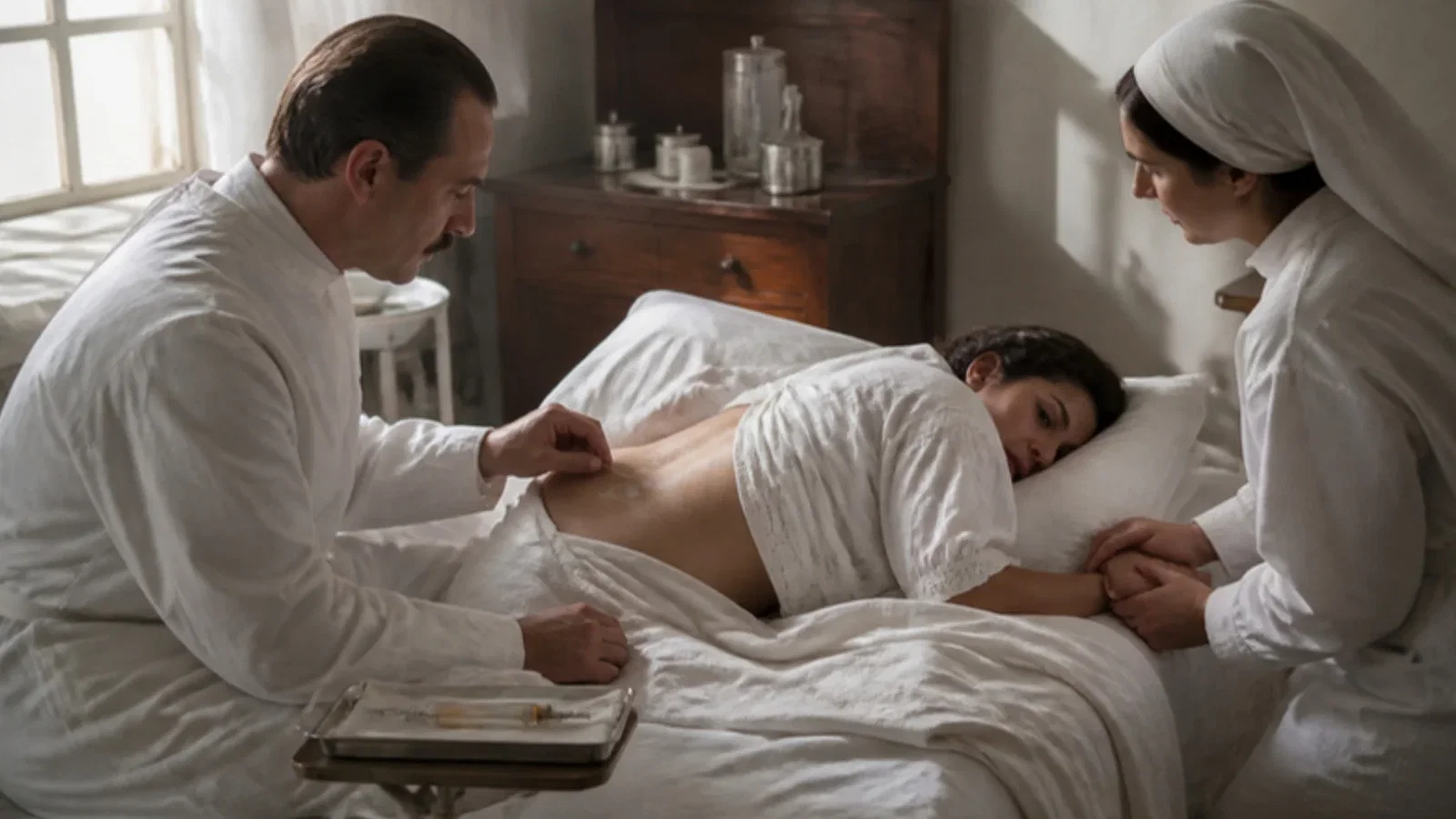
Reports of the Paris obstetrical society show a Romanian obstetrician moving from skin injections and a lumbo-aortic plexus block in 1930 to a thread-like catheter, passed through a trocar and left behind for repeated doses, in 1931.
Reading Library · Anesthesia Epochs · 中文版
Watch the education video (for clinicians)
1931: Aburel's Retained Catheter — Continuous Labour Analgesia · Anesthesia Epochs Education Series
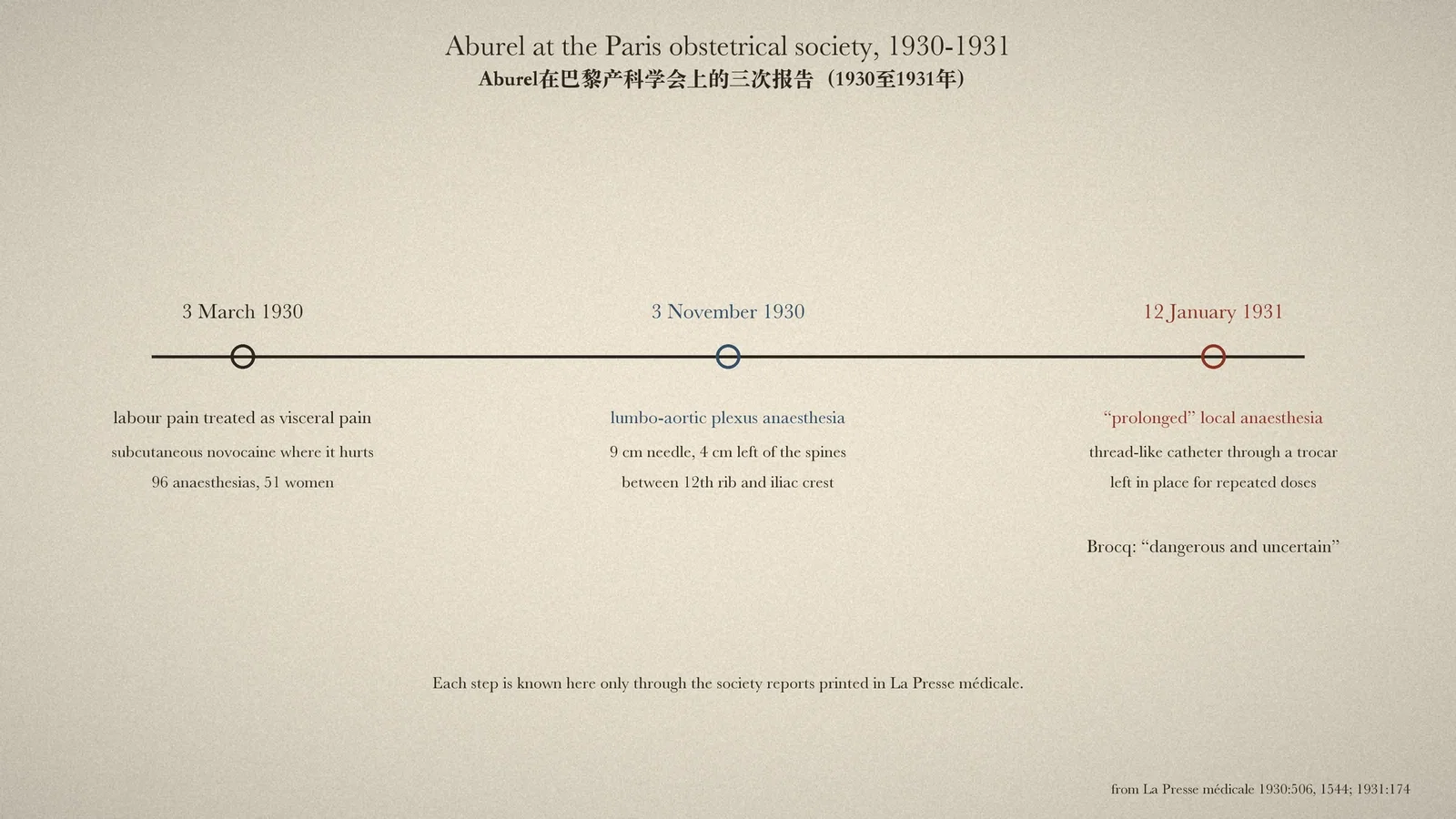
Labour lasts for hours; a single injection of local anaesthetic does not. One of the early attempts to bridge that gap was presented in Paris on 12 January 1931 by E. Aburel, a Romanian obstetrician listed elsewhere in the same journal as "Aburel (de Jassy, Roumanie)". Aburel's own papers in the bulletin of the Paris obstetrical society could not be obtained for this article. What can be read are the brief reports of the society's meetings printed in La Presse médicale, which follow Aburel through three steps in less than a year. This article is built on those reports, with a 1964 French thesis and a 2023 essay for how the story was told later. [1] [2] [3] [4]
Step one: labour pain as visceral pain
At the meeting of 3 March 1930, according to the report, Aburel argued against the usual view: labour pain was a visceral pain, felt in the skin, and could be treated by subcutaneous injections "loco dolenti", where it hurt, of 20 cc of 0.5 per cent novocaine. Aburel presented 96 such anaesthesias in 51 women, good in 62 per cent and mediocre in 16 per cent, with perineal infiltration added for the expulsive stage. The report calls it "easy, rapid and harmless". [2]
Later that year another report summarized Aburel's work on the sensory pathways of the uterus: a dull cerebrospinal supply and a more important sympathetic one, the sympathetic fibres running mostly by the utero-lumbar route. [2]
Step two: the lumbo-aortic plexus
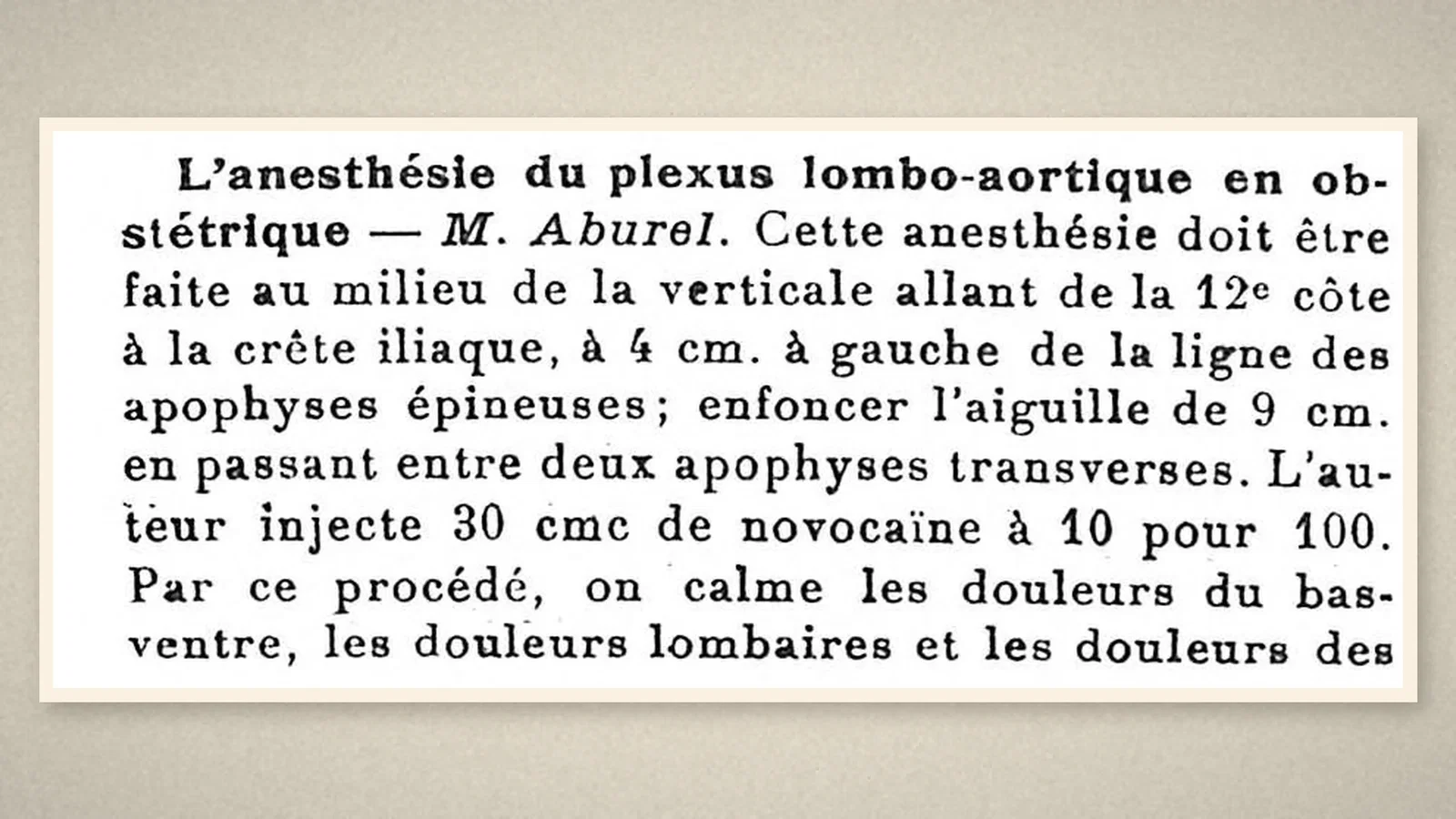
At the meeting of 3 November 1930 Aburel described anaesthesia of the lumbo-aortic plexus in obstetrics. The needle was to be inserted at the middle of the vertical line from the twelfth rib to the iliac crest, 4 cm to the left of the line of the spinous processes, and a 9 cm needle pushed in between two transverse processes. The report gives the injection as "30 cmc de novocaïne à 10 pour 100"; this article reproduces the figure as printed. The block relieved low abdominal, lumbar and hip pains, and a dilatation of the cervix followed by version and an embryotomy had been done without other anaesthesia. [2]
Step three: a catheter left behind
On 12 January 1931 came "Recherches sur l'anesthésie locale prolongée en obstétrique", research on prolonged local anaesthesia in obstetrics. The report is only a few sentences long. The anaesthesia was done with a trocar through which a thread-like catheter ("une sonde filiforme") was passed; the catheter was left in place after the trocar was withdrawn, and through it the anaesthetic solution could be injected repeatedly. Aburel had used novocaine, syncaine and percaine, and found the last gave a more intense and longer anaesthesia and was not toxic. The discussion is recorded in one line: Brocq found the procedure "dangerous and uncertain". [1]
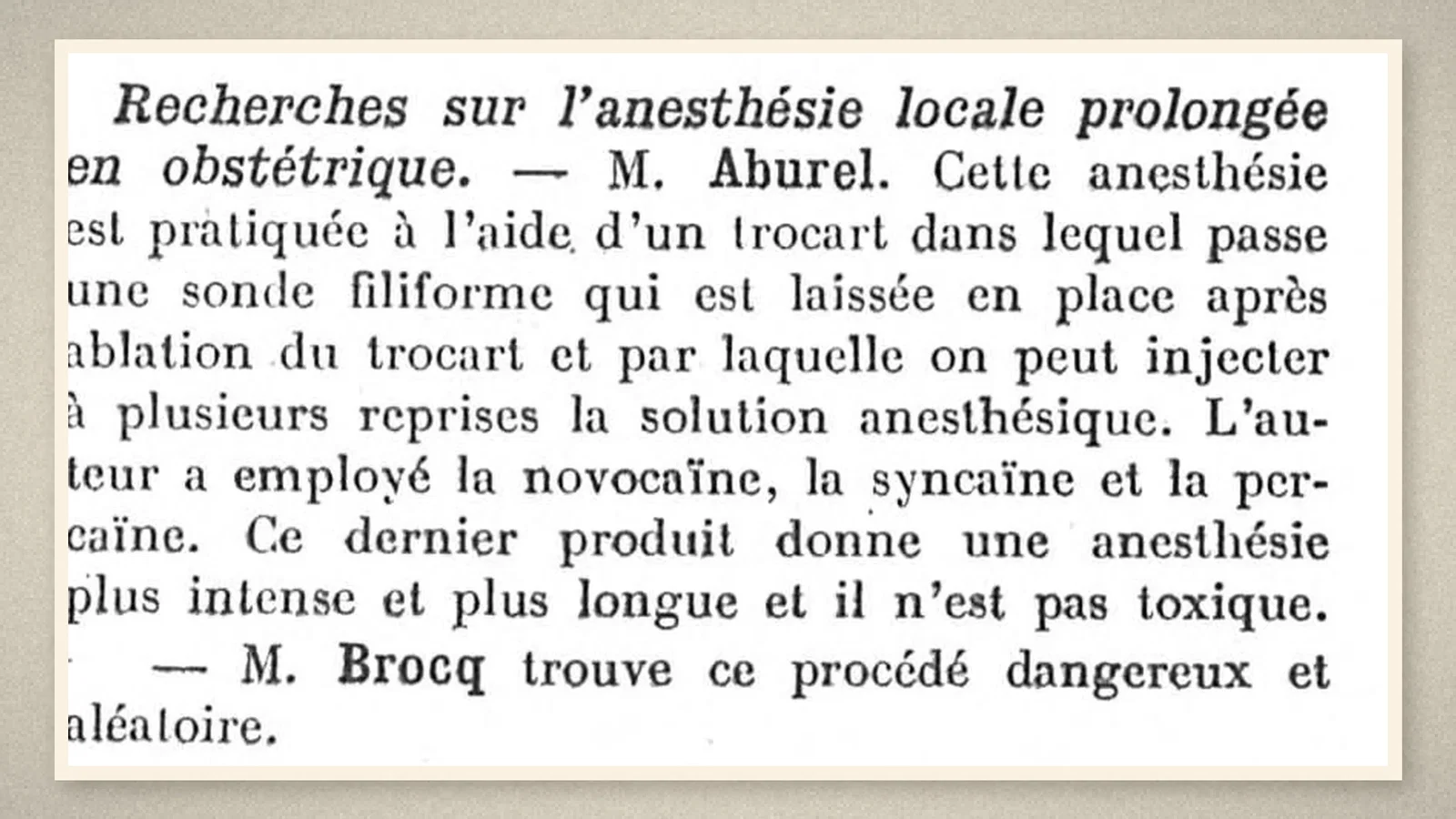
The report does not say where the catheter was placed, how many women received it, or how long it stayed in.
How the story was told later
A French thesis of 1964 on lumbar sympathetic infiltration in labour, by M. Giraud, gave Aburel "the merit of having carried out, in 1930, the first trial of anaesthetic infiltration of the lumbar sympathetic chain during labour", and traced the line through later French workers to continuous lumbar infiltrations. [3] A 2023 essay by Jordan Francke for the California Society of Anesthesiologists goes further: in 1931, it says, Eugen Aburel blocked the lumboaortic plexus in a labouring woman "with chinocaine through a silk ureteral catheter in the caudal epidural space", and is credited with the first use of an epidural catheter for continuous labour analgesia. [4] The silk, the ureteral catheter and the caudal site are not in the 1931 report read here; they may come from Aburel's full paper, which this article could not see.
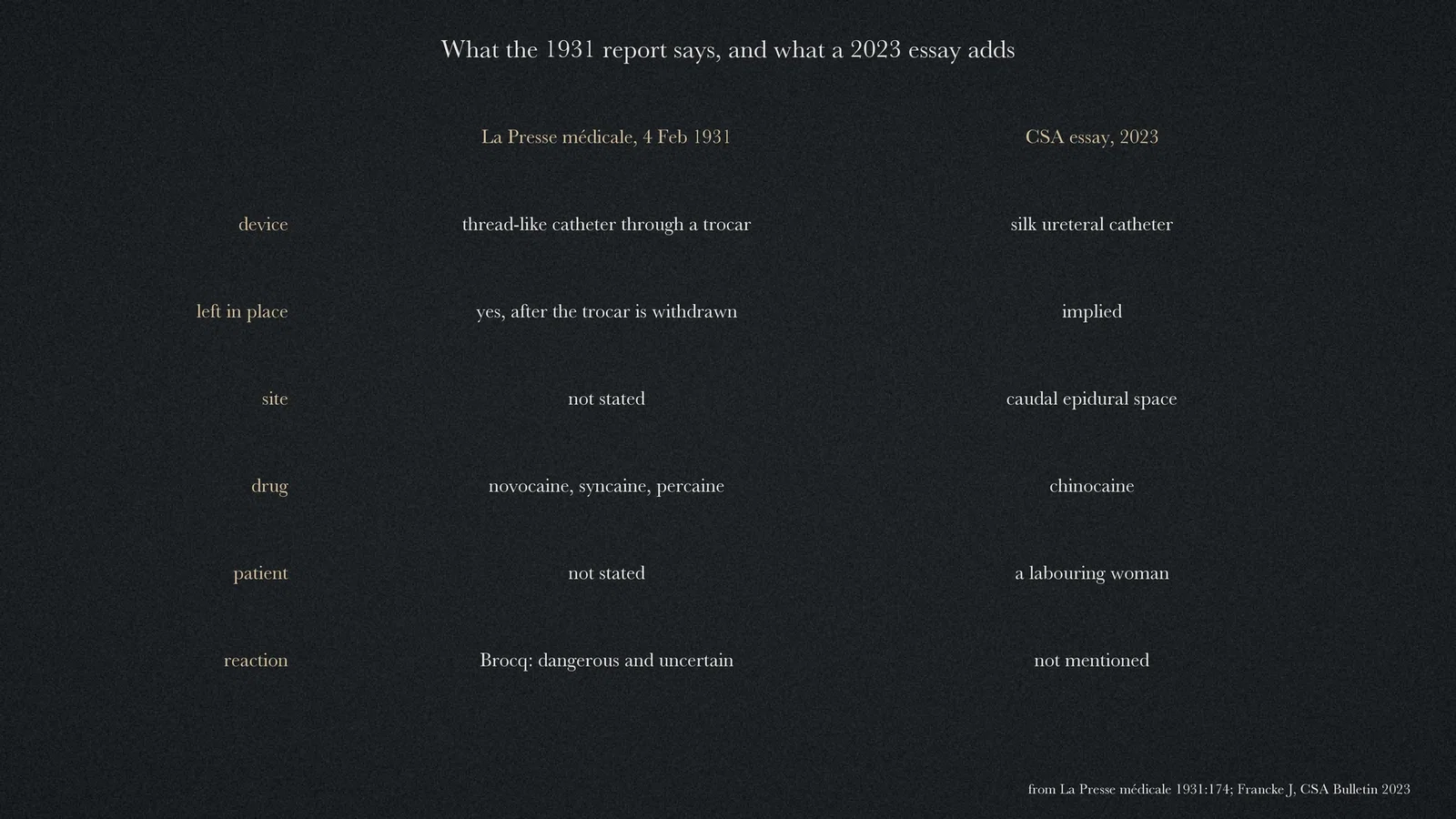
What the record shows
Within ten months Aburel moved from injections under the skin, to a deep block of the sympathetic supply of the uterus, to a fine catheter left in the body so that the block could be repeated. The idea of the indwelling catheter is clearly recorded in January 1931; its details, and its place among "firsts", rest on later accounts. The first recorded reaction was a colleague's doubt.
Sources and reading limits
Read: the reports of the Société d'obstétrique et de gynécologie de Paris in La Presse médicale for 3 March 1930 (p. 506), 3 November 1930 (p. 1544) and 12 January 1931 (p. 174); Giraud's 1964 thesis (history and bibliography); the bibliography of Delalande's 1938-1939 thesis; Francke's 2023 essay.
Not covered: Aburel's own papers in the society's bulletin, held on Gallica, which could not be accessed; biographical articles on Aburel. All statements about Aburel's methods are from reports written by others. Doses are as printed, including the November 1930 figure; French quotations are translated for this article.
Two illustrations are page crops from La Presse médicale; two are drawn from the sources.
- Société d'obstétrique et de gynécologie de Paris, séance du 12 janvier 1931 [Aburel E. Recherches sur l'anesthésie locale prolongée en obstétrique]. Presse Méd. 1931;(10):174. Internet Archive
- Société d'obstétrique et de gynécologie de Paris, séances du 3 mars et du 3 novembre 1930 [Aburel E.]. Presse Méd. 1930;(30):506; 1930;(91):1544. Internet Archive
- Giraud M. Etude statistique de 509 cas d'infiltrations du sympathique lombaire au cours du travail [thèse]. 1964. Internet Archive
- Francke J. The danger of using a medical eponym: missing the point of the Tuohy needle. CSA Bulletin. 2023 May 16. CSA
Continue exploring
Related reading connects shared questions and contexts; it does not by itself establish historical influence.
- 1909: Stoeckel Brings Sacral Anaesthesia into the Labour Room
- 1906: Dean Leaves the Spinal Cannula In
Anesthesia Epochs · The Source Room · About & Editorial Method
Published November 2, 2026. Sources and reading limits are stated above. Illustrations are labelled as original source images or AI-made. Historical accounts are educational; they are not current treatment instructions.