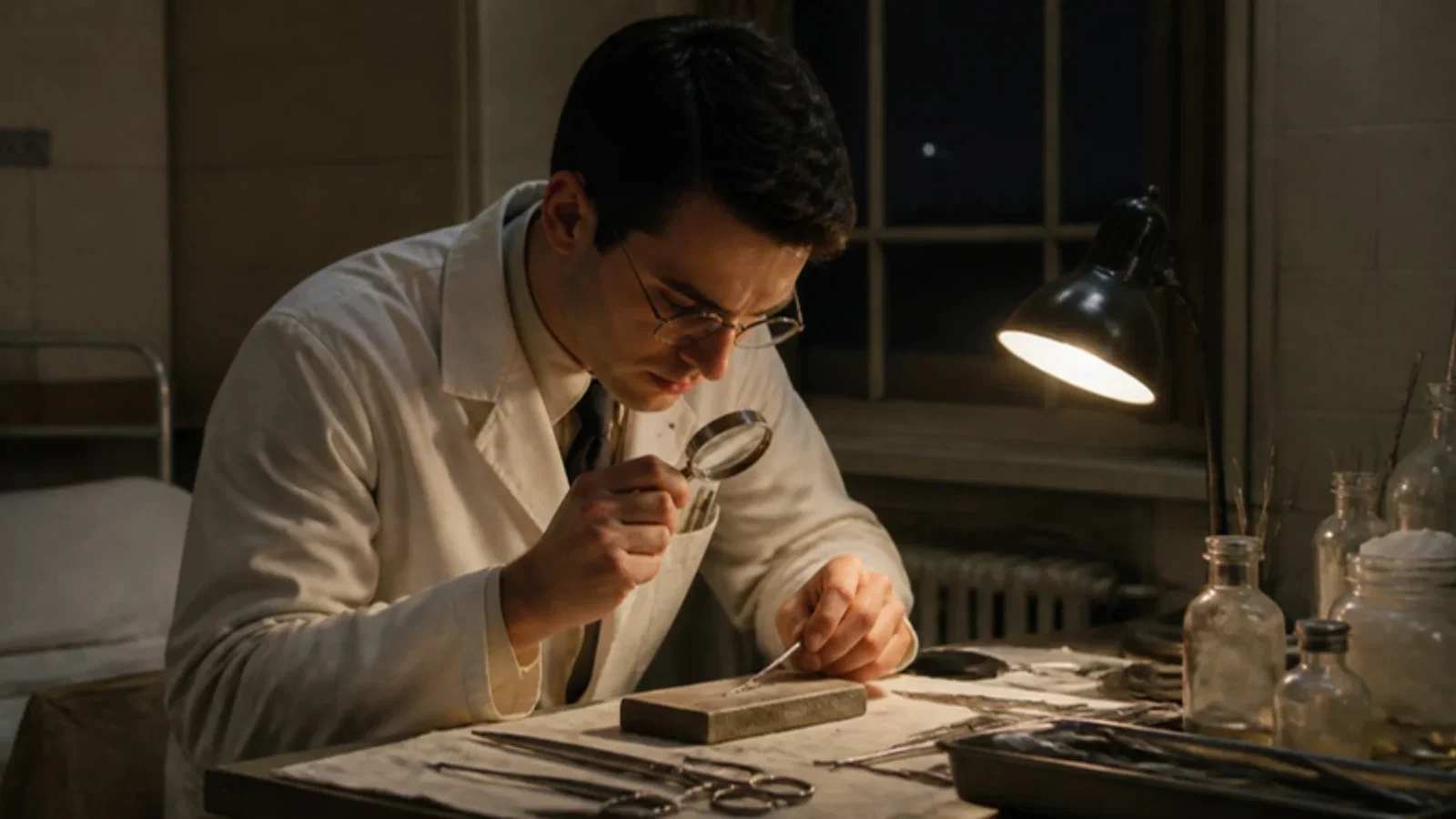
A first-year resident at Yale is said to have blunted the epidural needle's tip with a stone, shrunk its side opening and flattened its bevel; the story survives only at second hand, but by the 1980s 'Hustead needle' was a standard name.
Reading Library · Anesthesia Epochs · 中文版
Watch the education video (for clinicians)
1954: Hustead's Needle Tip — Reshaping the Tuohy-Flowers Needle · Anesthesia Epochs Education Series
Ask an anaesthetist for the needle used to place an epidural catheter and the answer is usually "a Tuohy". The needle in the hand, however, has been reshaped more than once since Edward Tuohy's day. One of those changes is credited to Robert Hustead, a first-year anaesthesia resident at Yale in 1954, and the name is still in use. This article set out to read Hustead's own account and could not find one. What it found is the 2001 history in which Hustead's recollections were written down, a later summary of it, the earlier needle Hustead changed, and evidence of the name in use thirty years later. The article says which is which. [4][1][2][3]
The needle before Hustead
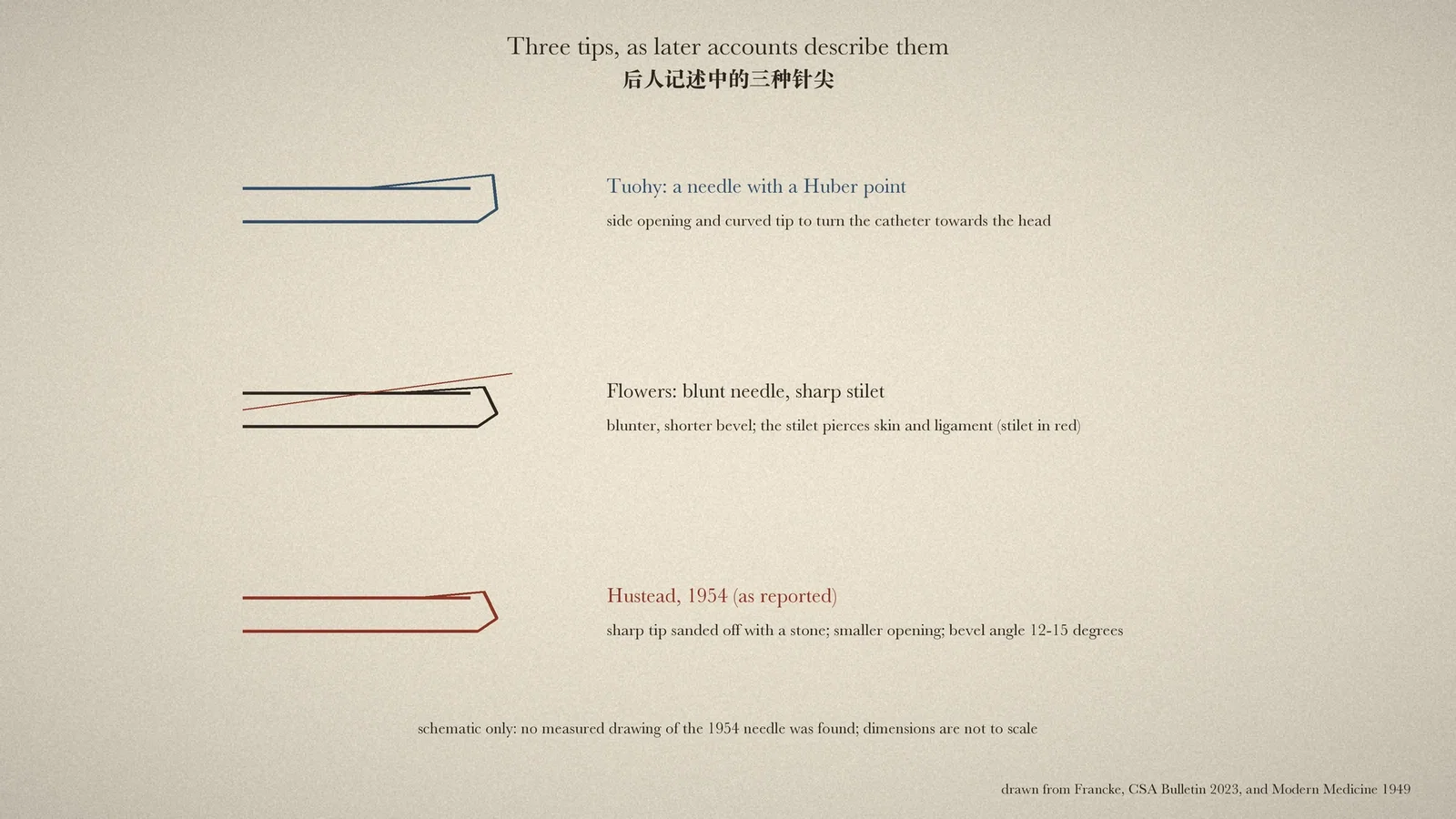
Tuohy, as Jordan Francke summarises the record in a 2023 essay for the California Society of Anesthesiologists, began with a spinal needle bent towards the head and then published results with "a needle with a Huber point". The Huber needle, "patented by Seattle-area dentist Ralph Huber in 1946", had a side opening and was designed to avoid coring tissue; Tuohy expected it to steer the catheter towards the head. [1]
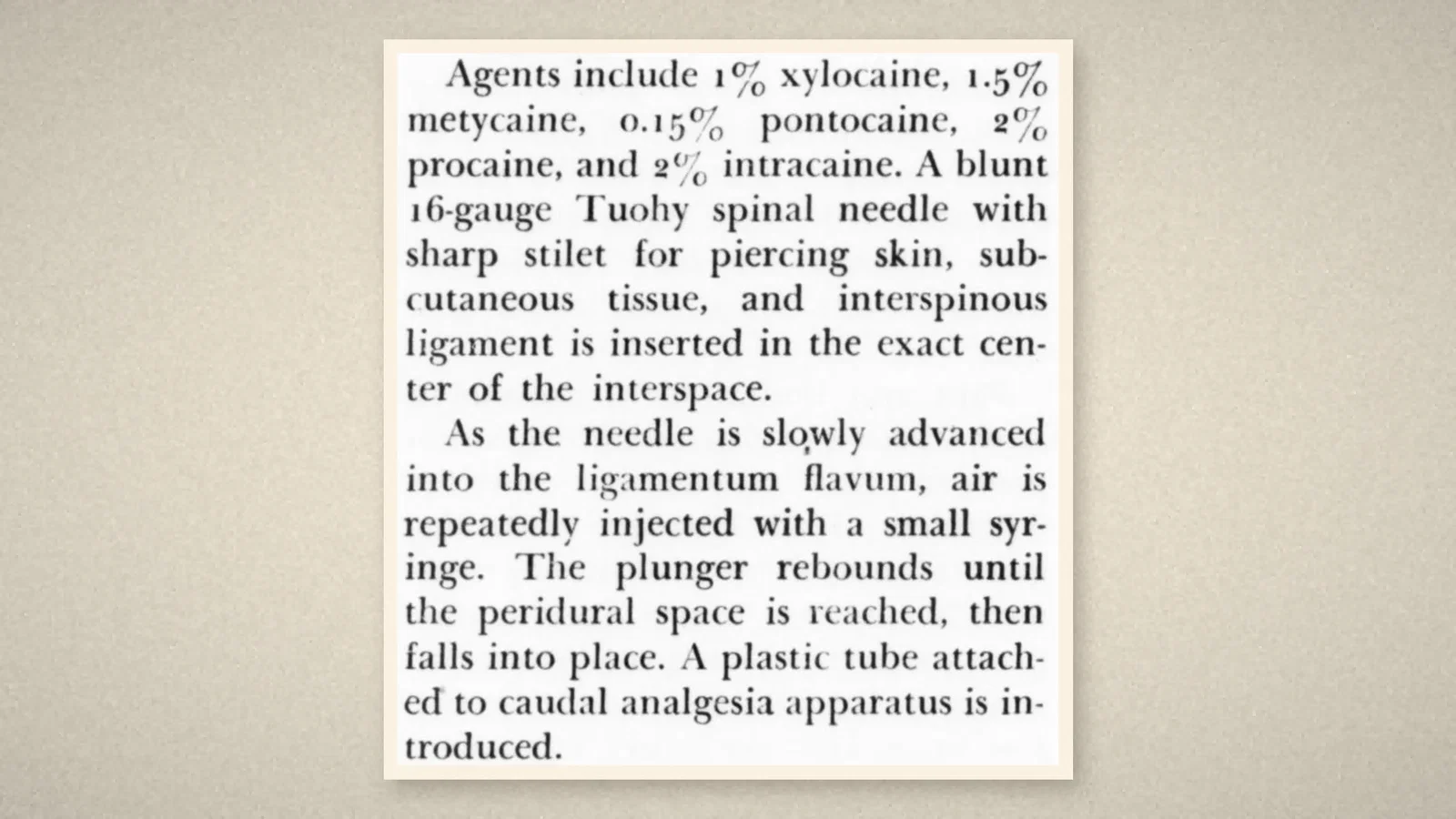
At Johns Hopkins, Charles Flowers changed the needle again. Francke describes "a 15-gauge needle with a blunter, shorter bevel and a sharp stylet" that protruded beyond the needle to get through tough ligament. The 1949 abstract of the Johns Hopkins method gives a slightly different size: "A blunt 16-gauge Tuohy spinal needle with sharp stilet for piercing skin, subcutaneous tissue, and interspinous ligament is inserted in the exact center of the interspace." Both are reported here as printed. [1][2]
What Hustead is said to have done
Francke's account of Hustead is one paragraph, citing a 2001 history by M. A. Frölich and D. Caton, "Pioneers in epidural needle design". In it, Hustead "modified the Tuohy-Flowers needle by using a stone to sand off the needle's sharp tip to reduce the likelihood of accidental dural puncture or trauma". Hustead "also reduced the size of the bevel opening to prevent dural straddling and minimized the bevel angle to 12-15º to prevent catheter kinking". [1]
Each change answers a problem in epidural practice. A sharp leading point can cut the dura when the needle overshoots the epidural space. A long side opening can lie partly in the epidural space and partly through the dura, so that a catheter or a dose can go either way. A steep bevel can bend the catheter as it leaves the needle. Francke presents these as Hustead's reasons; this article has no account in Hustead's own words to confirm them.
What Frölich and Caton recorded
The source behind Francke's paragraph is a 2001 article in Anesthesia and Analgesia, "Pioneers in epidural needle design", by Michael Frölich and Donald Caton of the University of Florida. Its account of Hustead rests on personal communications with Hustead in 1999 and 2000. [4, pp. 215, 218]
It begins with Flowers. The blunt Tuohy needle with a protruding sharp stylet "did not work. The needle tended to bend at the tip, making it difficult, if not impossible, to remove the stylet or to thread the catheter." Hustead, the authors write, called the Tuohy-Flowers modification a "technical nightmare". [4, p. 218]
Then Hustead. Hustead "first practiced anesthesiology as a student at Yale University (1952–1954)", giving anaesthesia on nights and weekends in the labour suite during the last two years of medical school and the internship. As a first-year anaesthesiology resident under Nicholas M. Greene, Hustead modified the Tuohy-Huber needle "by hand by using a stone and a needle sharpener". The sharp tip was sanded off, removing the secondary bevel, and the angle of the bevel changed: "The result was a needle opening that did not exceed 2.7 mm in length, with an angle of the needle bevel of 12°–15°." The heel of the bevel was also smoothed, so that a catheter would not be trapped and cut if it had to be withdrawn. [4, p. 218]
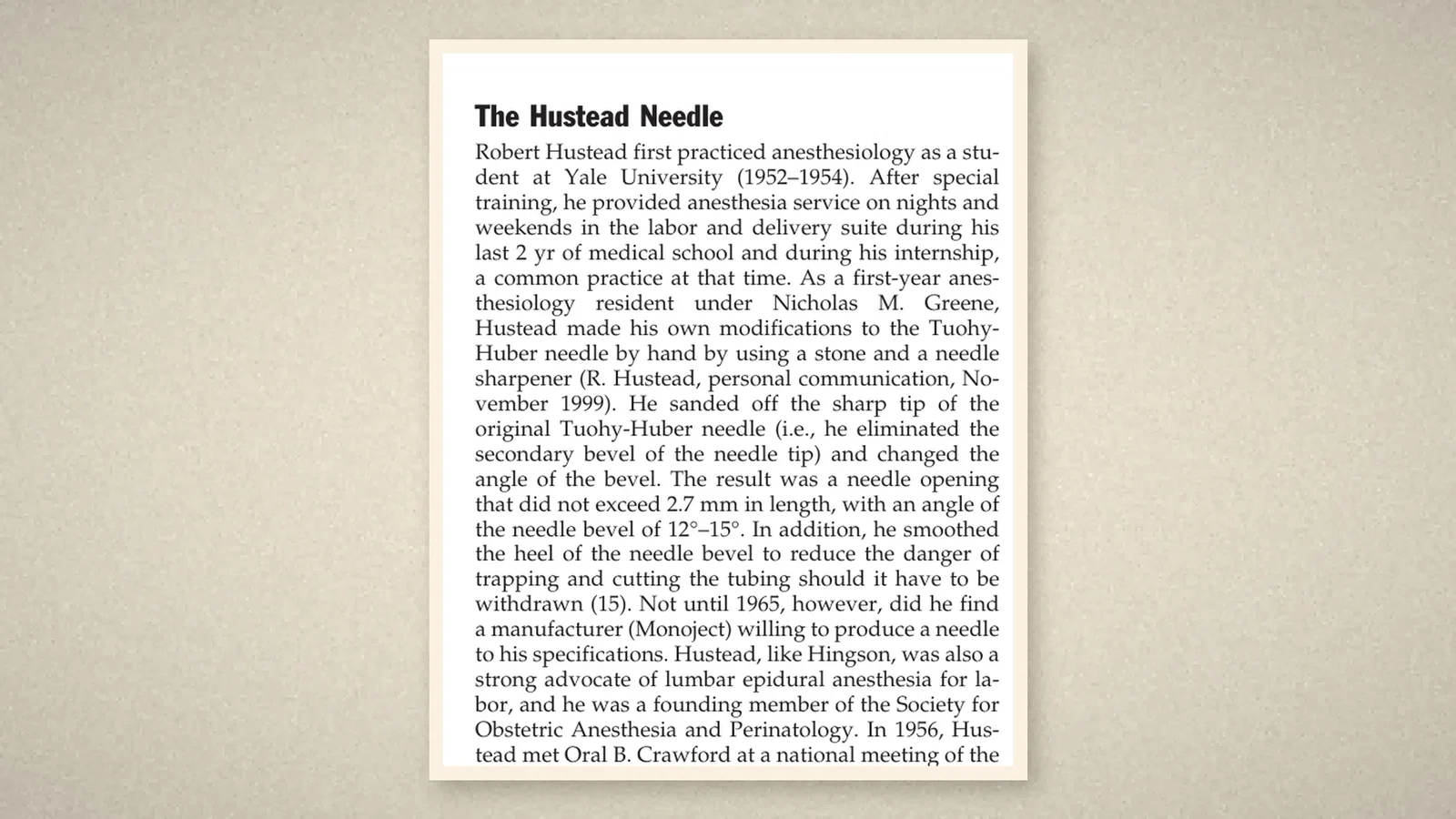
The needle stayed hand-made for some time: only in 1965, the article says, did Hustead find a manufacturer, Monoject, willing to produce it to Hustead's specifications. Hustead, like Hingson, advocated lumbar epidural analgesia for labour and was a founding member of the Society for Obstetric Anesthesia and Perinatology. The article adds two meetings: with Oral B. Crawford, whose own needle had a very short Quincke-type bevel, in 1956; and with Jess Weiss in 1960. The two became friends, "but neither admittedly became reconciled to the other's design", because they found the epidural space by different methods. [4, p. 218]
Frölich and Caton end on the point Francke later made: most of these changes were not patented, "thus, manufacturers apply names freely to their needles", and many needles sold as Tuohy needles have a tip "much closer to that of a Hustead needle design". [4, pp. 215, 219]
A name in use
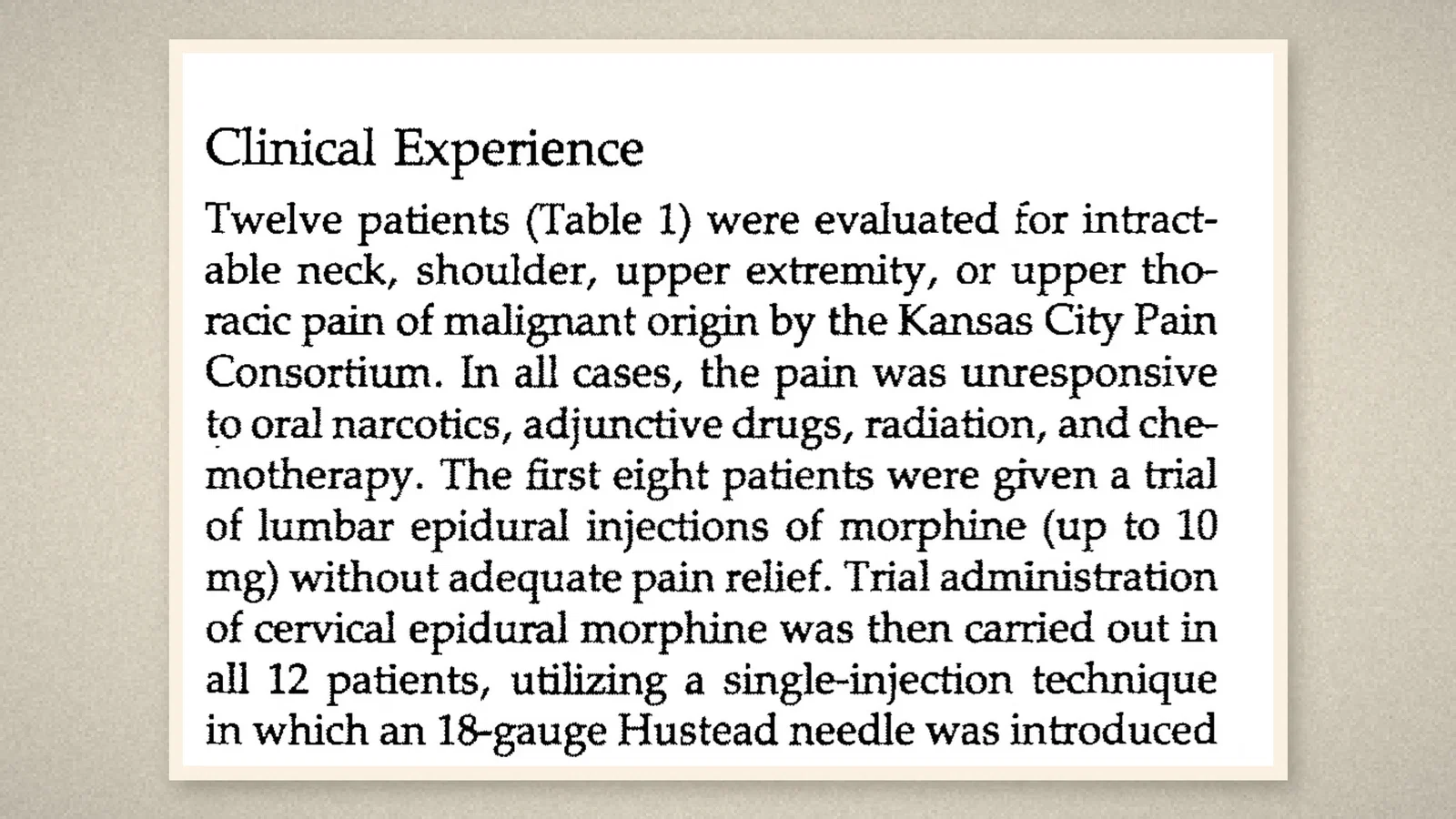
What the record does show clearly is that the name stuck. In 1987, Steven D. Waldman and colleagues of the Kansas City Pain Consortium, reporting cervical epidural drug delivery for cancer pain in Anesthesia and Analgesia, wrote simply that "an 18-gauge Hustead needle was introduced" at the C6-C7 interspace, and the same volume carries another paper using "a modified 18-gauge Hustead needle". By then the name needed no explanation. [3]
Francke lists the other refinements that followed: Peter Cheng's proposal of centimetre markers in 1958, and the wings Jess Weiss added in 1961 for slow advancement through the ligament. Francke's conclusion is that the eponym "Tuohy" hides the work of many people, and that "epidural needle" might be the fairer name. [1]
What the record shows
The tip of the epidural needle was shaped in stages, by people solving specific problems: steering the catheter, getting through ligament, sparing the dura, keeping the catheter from kinking. Hustead's part, as Hustead recalled it to historians nearly half a century later, was a small change made by hand with a stone and a needle sharpener, which took about a decade to reach a manufacturer. The article keeps that story with its single source attached, and keeps the 1987 papers as proof that the needle and the name were in everyday use.
Sources and reading limits
Read: Frölich and Caton 2001 in full; Francke's 2023 essay in full; the 1949 Modern Medicine abstract of Flowers, Hellman and Hingson; Anesthesia and Analgesia 1987 volume 66, including Waldman and colleagues.
Not covered: any account by Hustead in print (the 2001 article rests on personal communications and on a 1974 Monoject product data sheet, which is not covered); textbooks describing the Hustead needle (lending-only); Cheng's 1958 and Weiss's 1961 papers, which belong to later articles.
Limits: Frölich and Caton give no year for the modification; they place it in Hustead's first residency year under Greene, after the Yale student years 1952–1954, and the year 1954 is Francke's. The article calls Hustead "another Hopkins colleague" of Flowers while describing the training at Yale; both are reported as printed. The opening and bevel figures are Frölich and Caton's, citing the 1974 data sheet. The needle gauge for Flowers differs between Francke (15) and the 1949 abstract (16). The article's "probably the first" for Flowers is its own. The schematic is drawn from words, not from a measured drawing of the needle.
Three illustrations are page crops from the 1949, 1987 and 2001 journals; one is drawn from the sources.
- Francke J. The danger of using a medical eponym: missing the point of the Tuohy needle. CSA Bulletin. 2023 May 16. CSA
- Continuous peridural analgesia for obstetrics [abstract of Flowers CE Jr, Hellman LM, Hingson RA]. Mod Med. 1949 Oct 1;17(19):76-7. Internet Archive
- Waldman SD, Feldstein GS, Allen ML, Landers M, Turnage G. Cervical epidural implantable narcotic delivery systems in the management of upper body cancer pain. Anesth Analg. 1987;66:780-2. Internet Archive
- Frölich MA, Caton D. Pioneers in epidural needle design. Anesth Analg. 2001;93:215-20. DOI
Continue exploring
Related reading connects shared questions and contexts; it does not by itself establish historical influence.
- 1944: Tuohy Threads a Ureteral Catheter into the Spinal Space
- 1949: Flowers, Hellman and Hingson Run a Tube into the Epidural Space
- 1947: Curbelo Threads a Catheter into the Lumbar Epidural Space
Anesthesia Epochs · The Source Room · About & Editorial Method
Published November 2, 2026; updated November 3, 2026. Sources and reading limits are stated above. Illustrations are labelled as original source images or AI-made. Historical accounts are educational; they are not current treatment instructions.