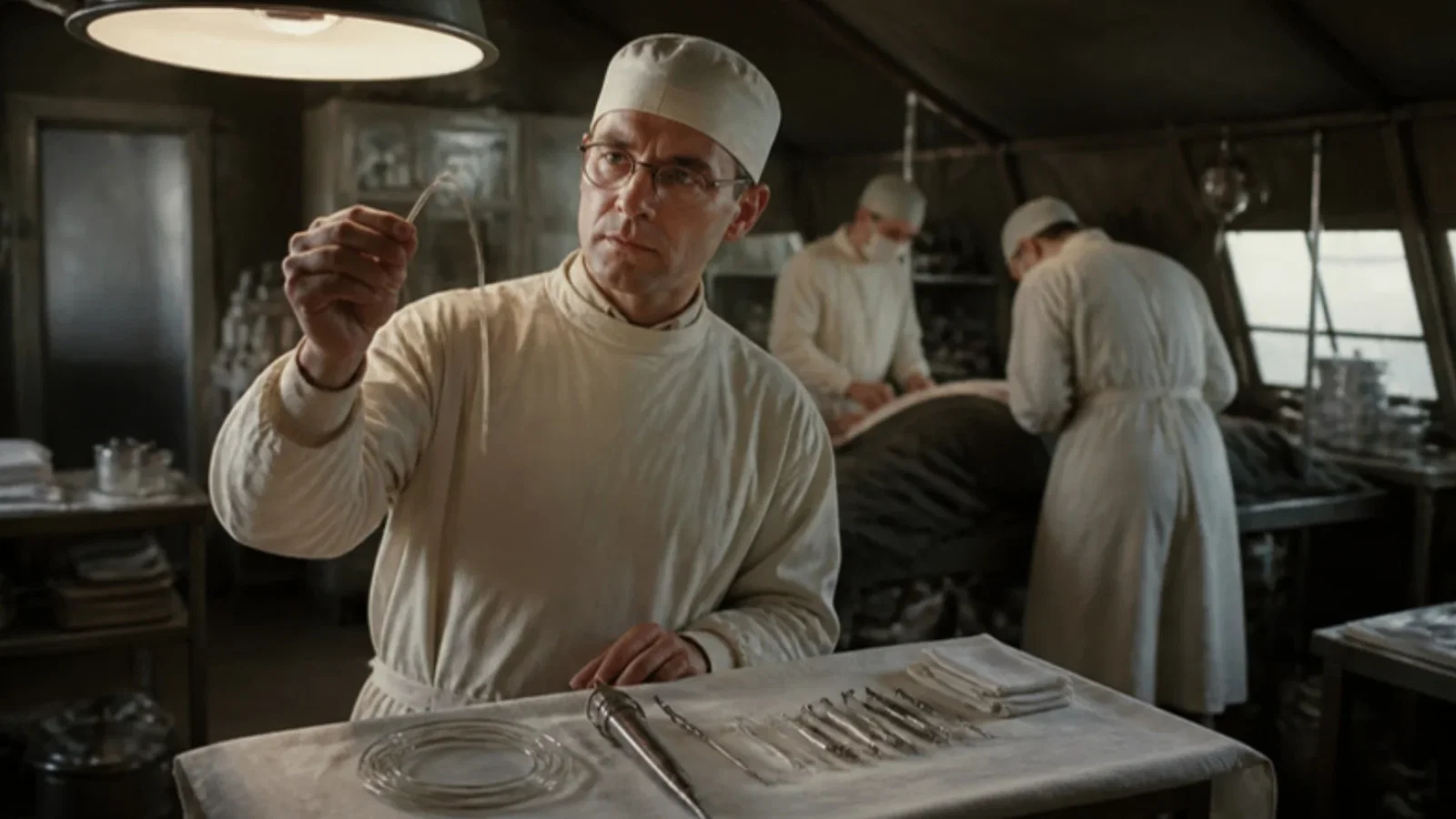
To stop Lemmon's malleable needle from slipping out during continuous spinal anaesthesia, an army anaesthetist passed a fine ureteral catheter through a 15 gage needle into the subarachnoid space, withdrew the needle and dosed through the catheter.
Reading Library · Anesthesia Epochs · 中文版
Watch the education video (for clinicians)
1944: Tuohy's Continuous Spinal — A Catheter in the Spinal Space · Anesthesia Epochs Education Series
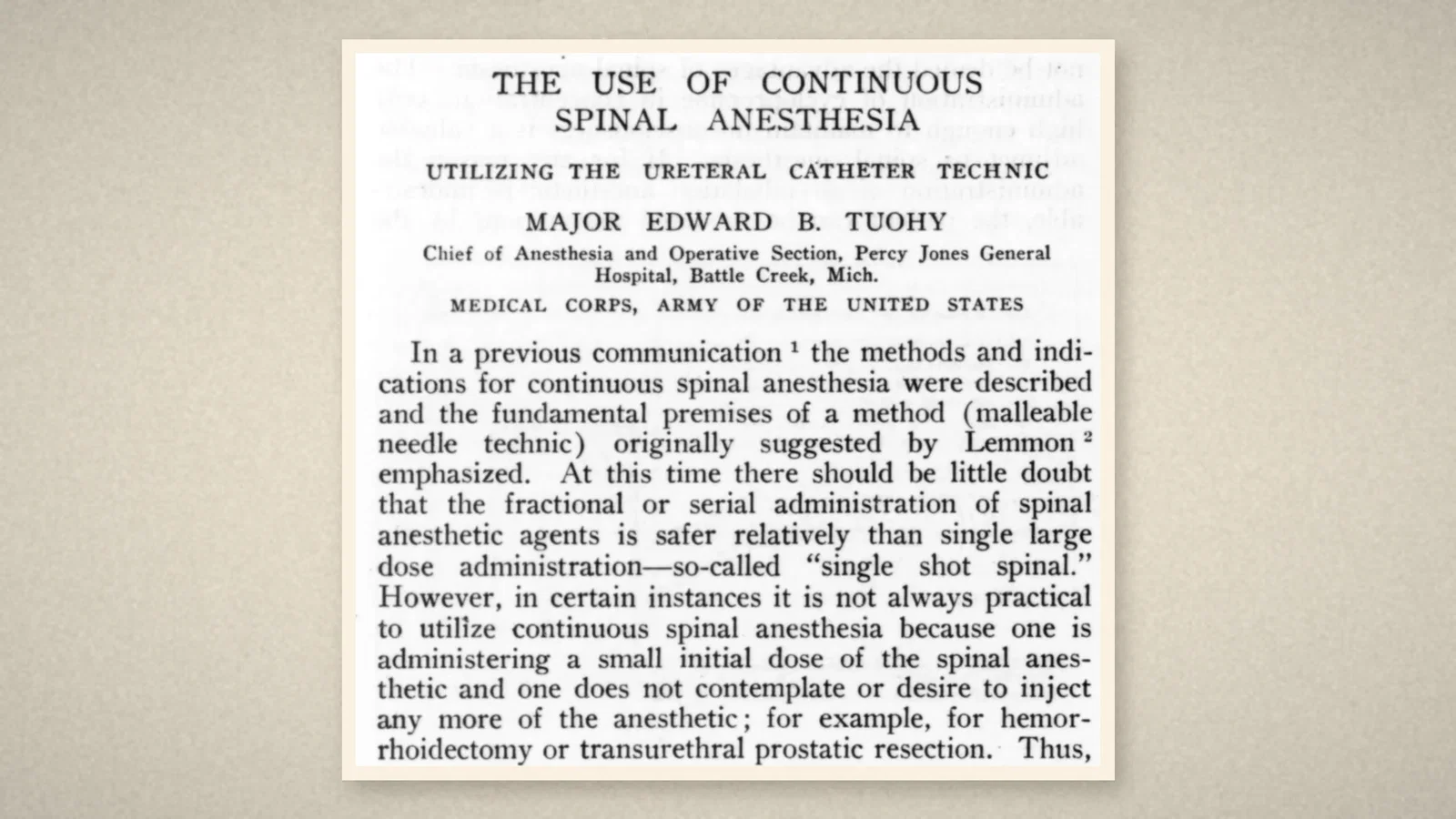
"Tuohy" is now the name of a needle: in the words of a 2023 essay, the needle with a lateral opening "used to place nearly every epidural catheter in the United States". The paper that put Edward B. Tuohy's name into the history of continuous neuraxial anaesthesia, however, is about a catheter, a spinal one, and about a problem with someone else's needle. Major Edward B. Tuohy, chief of the anaesthesia and operative section at Percy Jones General Hospital in Battle Creek, Michigan, read it before the American Medical Association's Section on Anesthesiology in Chicago on 14 June 1944; it appeared in JAMA on 26 May 1945. This article reads it in full, with the discussion that followed. [1]
The trouble with a needle left in the back
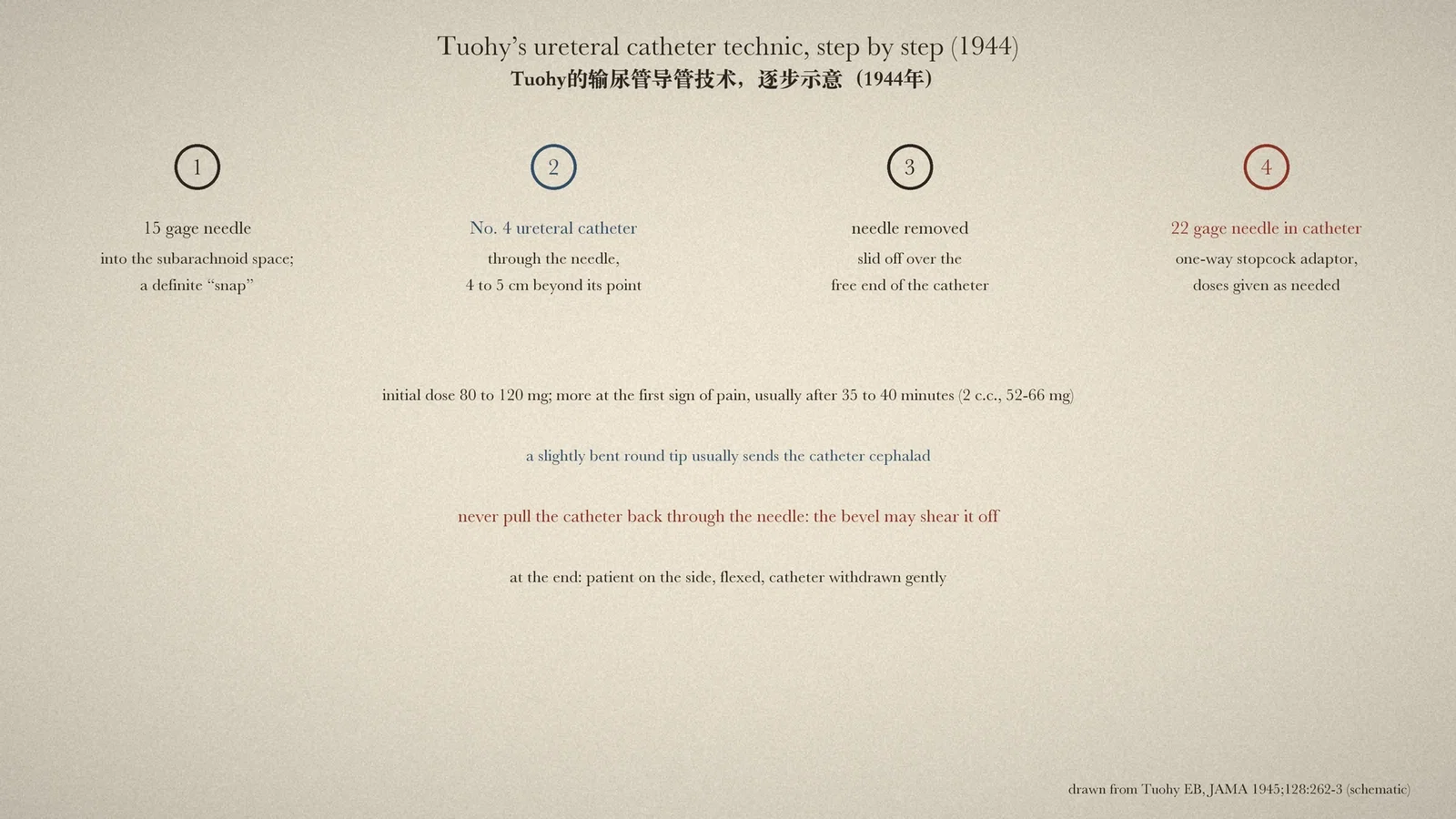
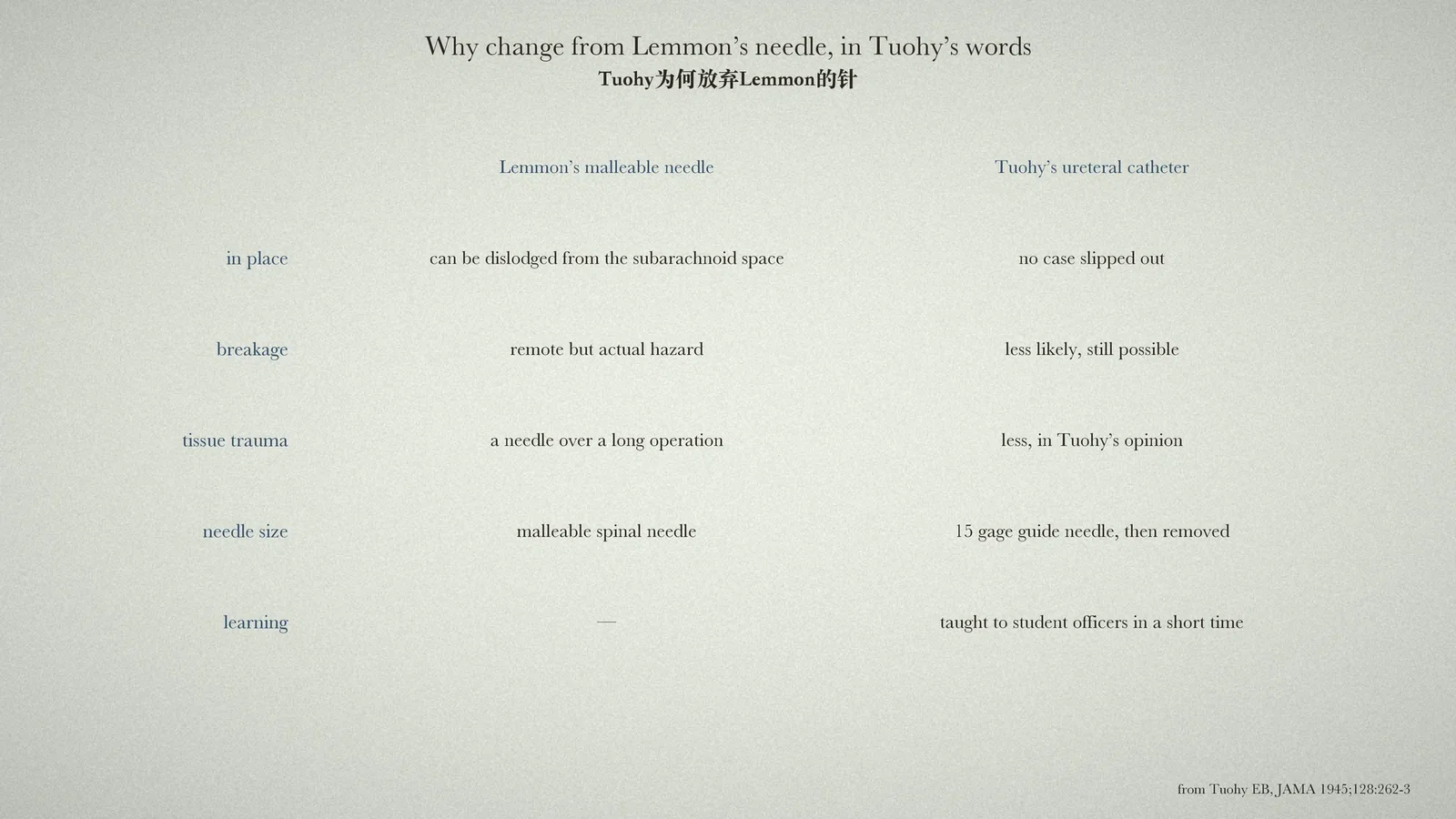
Tuohy began with Lemmon's method of continuous spinal anaesthesia, the malleable needle left in the spine and dosed through tubing, and declared that there should by now be "little doubt that the fractional or serial administration of spinal anesthetic agents is safer relatively than single large dose administration". The difficulty, in Tuohy's experience, was mechanical: "the dislodging of the malleable needle from the subarachnoid space", and breakage, "a remote but actual hazard to be conjured with continually". Prompted by earlier uses of a ureteral catheter for caudal anaesthesia and by Love's continuous subarachnoid drainage for meningitis, Tuohy tried a number 4 ureteral catheter instead, expecting it to be "less traumatic to tissues than a needle" and harder to dislodge. [1]
The technic
The catheter was the x-ray type, leaded, with a round tip. With the patient on one side, flexed, a 15 gage needle 7 to 9 cm long was passed into the subarachnoid space; "a definite 'snap'" marked the ligamentum flavum and dura. A first dose of procaine or metycaine was mixed with spinal fluid in the syringe, the syringe removed, and the catheter "inserted through the needle into the subarachnoid space", centimetre markings showing how far: about 4 to 5 cm beyond the needle point. The needle was then withdrawn and "slid off the free end of the catheter". A short 22 gage needle went into the catheter's end, with a one-way stopcock adaptor, added after spinal fluid pressure had pushed the syringe plunger back in some cases. Initial doses were 80 to 120 mg; more was given at the first sign of pain or poor relaxation, usually after thirty-five to forty minutes. [1]
Tuohy's warnings are the ones still taught. The catheter "should not be withdrawn through the needle once the catheter has entered the subarachnoid space, because the sharp point and bevel of the needle may shear off the catheter". A slight bend at the tip usually sent the catheter cephalad, checked on X-rays with the leaded catheters. [1]
250 cases
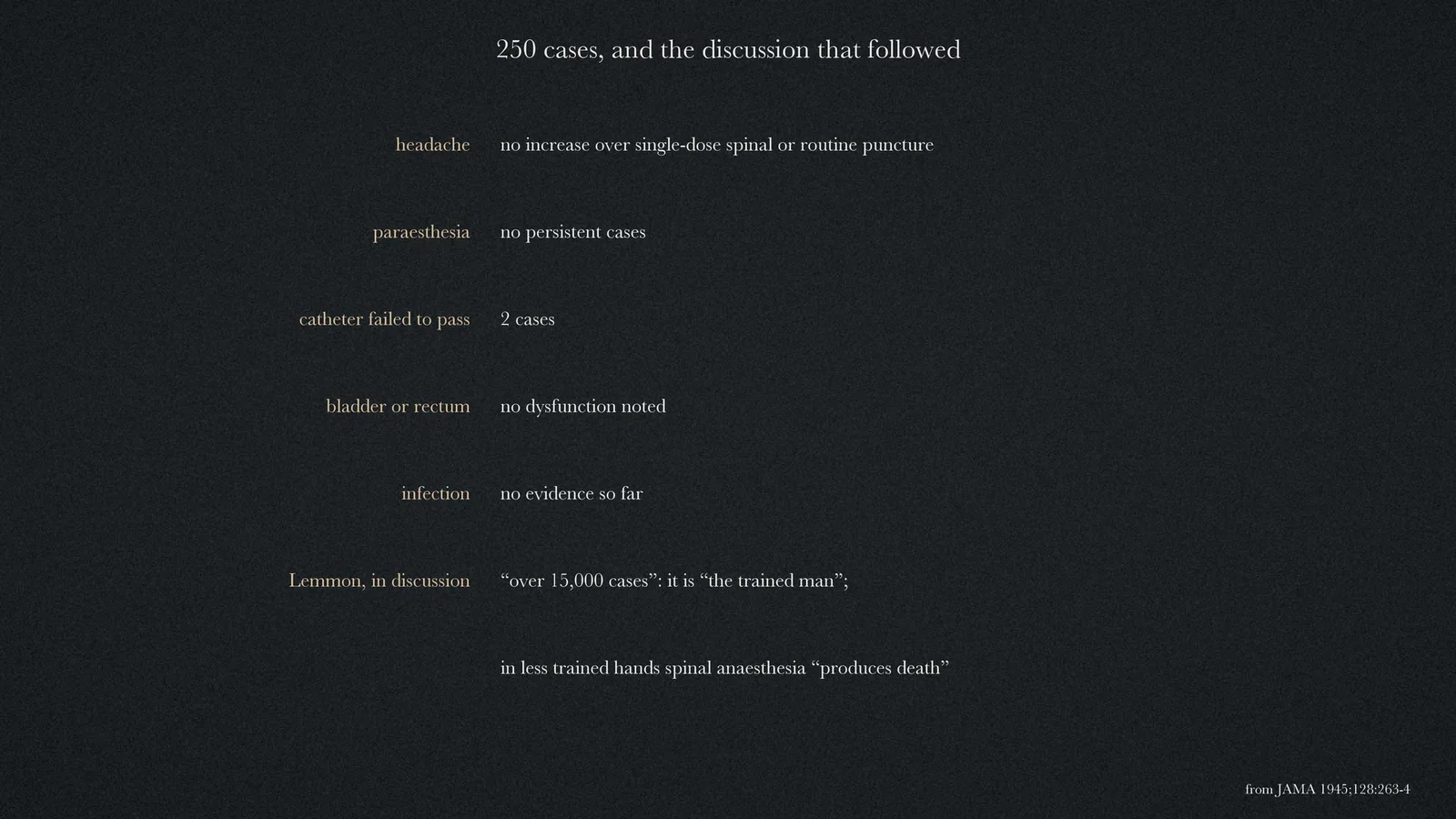
In 250 cases there had been no increase in spinal headache, no persistent paraesthesia, no bladder or rectal trouble and no infection; the catheter failed to pass twice, usually because the needle had gone in too far. No catheter had slipped out. The method had been taught to student officers, who learned it quickly. Tuohy accepted the charge that a 15 gage needle was unnecessarily traumatic, answering that no harm had yet been seen, and asked for "further experience with a larger series of cases". [1]
Lemmon answers
The first speaker in the discussion was William T. Lemmon himself, "with an experience of over 15,000 cases". Lemmon did not discuss the catheter. "It is not the drug, it is not the method, but the trained man who is giving the anesthesia," Lemmon said, and when the method was used "by others of lesser training and experience it produces death—rapid, sudden and dramatic death". [1]
Where the needle comes in
The paper read here uses an ordinary 15 gage needle. According to Jordan Francke's 2023 essay, Tuohy, inspired by the Mayo Clinic neurologist Grafton Love, initially used a 15-gauge Barker spinal needle with a cephalad bend, and a year later published results with "a needle with a Huber point", the design that now carries Tuohy's name. [2] That needle, and its later use for epidural catheters, are outside this article.
What the record shows
Tuohy's 1944 paper replaced a needle left in the spine with a fine catheter left in its place, and set down the rules for doing it safely. It came from a military hospital, was justified by 250 cases, and was met by Lemmon's reminder that skill mattered more than equipment.
Sources and reading limits
Read: Tuohy's 1945 JAMA paper in full, and the abstract of discussion; Francke's 2023 essay.
Not covered: Tuohy's 1944 Anesthesiology paper and the 1945 paper on the Huber-point needle; Huber's patent; Love's 1935 paper; Tuohy's epidural catheter work. Lemmon's 1940 method is covered in another article. Doses and case figures are as printed and are the author's own.
One illustration is a page crop from the 1945 paper; three are drawn from it.
- Tuohy EB. The use of continuous spinal anesthesia utilizing the ureteral catheter technic. JAMA. 1945;128(4):262-4. Internet Archive
- Francke J. The danger of using a medical eponym: missing the point of the Tuohy needle. CSA Bulletin. 2023 May 16. CSA
Continue exploring
Related reading connects shared questions and contexts; it does not by itself establish historical influence.
- 1906: Dean Leaves the Spinal Cannula In
- 1931: Aburel Leaves a Fine Catheter in Place for Labour Analgesia
- 1937: Soresi Takes One Needle Through Two Spaces
Anesthesia Epochs · The Source Room · About & Editorial Method
Published November 2, 2026. Sources and reading limits are stated above. Illustrations are labelled as original source images or AI-made. Historical accounts are educational; they are not current treatment instructions.