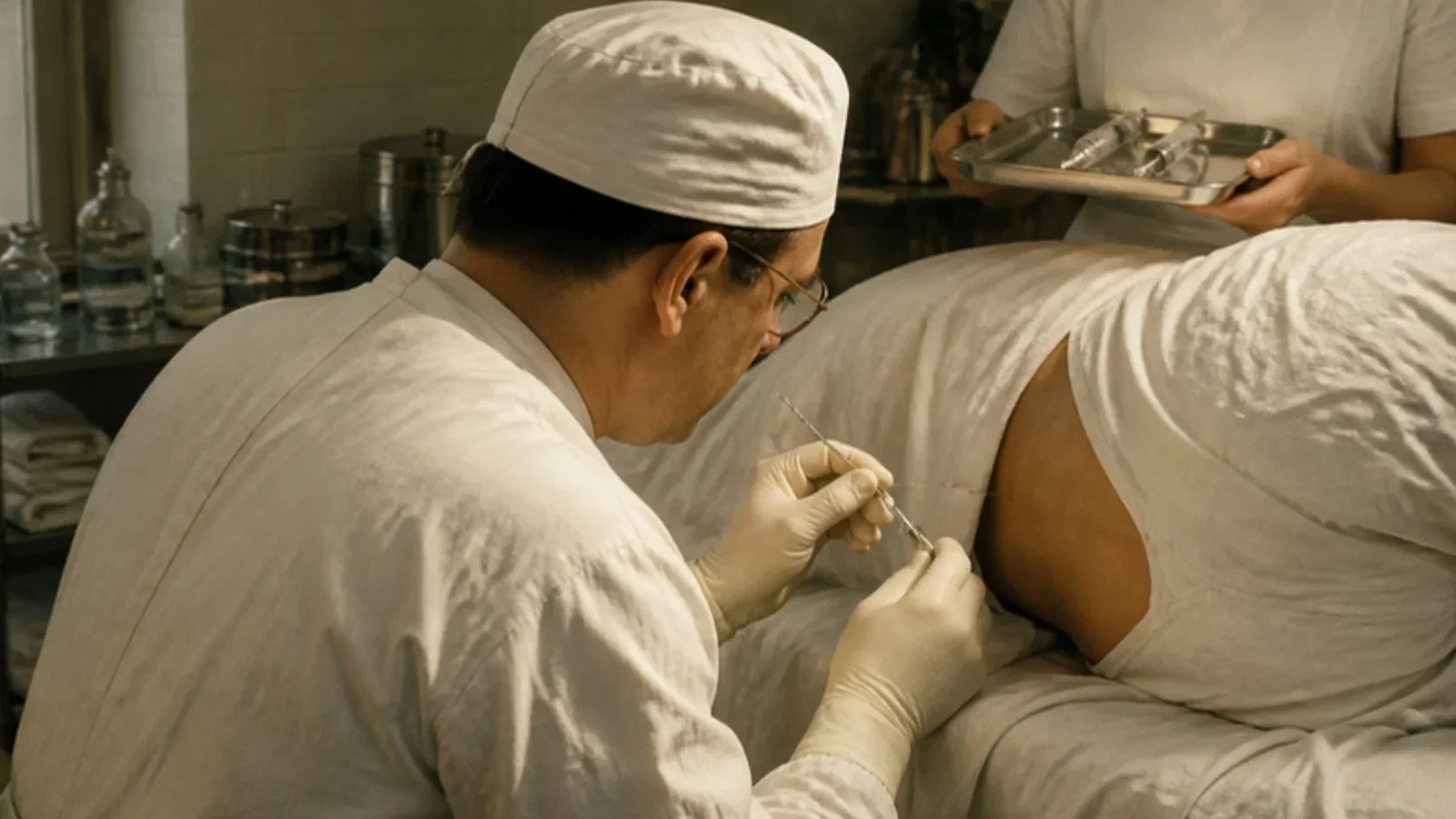
An 'episubdural' technique injected novocaine into the epidural space, found by a hanging drop, and then pushed the same needle on into the subarachnoid space for a spinal dose, so that one block would take over as the other faded.
Reading Library · Anesthesia Epochs · 中文版
Watch the education video (for clinicians)
1937: Soresi's Episubdural Anesthesia — One Needle, Two Spaces · Anesthesia Epochs Education Series
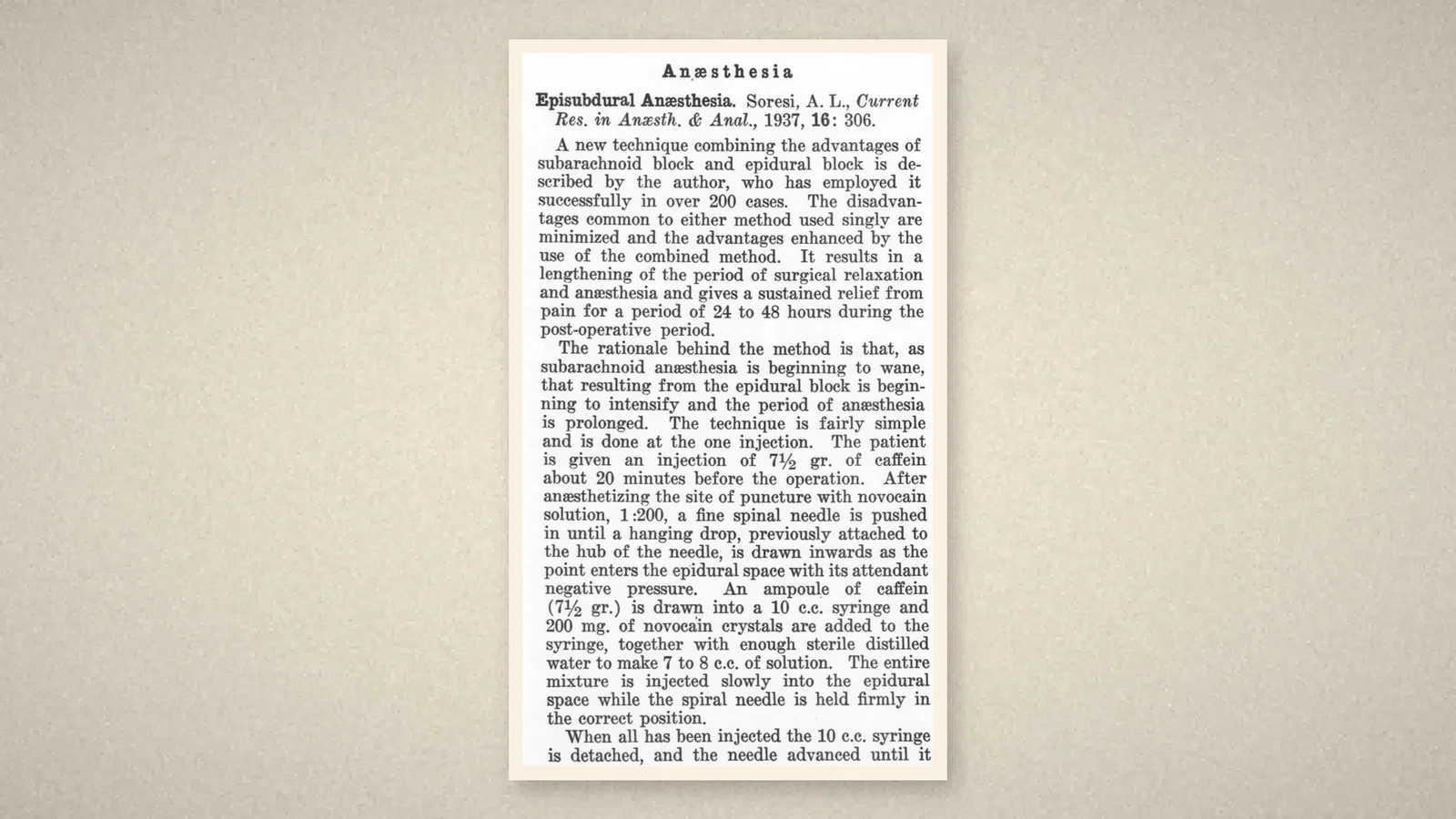
A spinal block works quickly and deeply but wears off; an epidural block comes on slowly but can be made to last. Combining the two, as a 2022 paper puts it, "has become increasingly popular in recent years". One of the earliest descriptions of doing so is A. L. Soresi's "Episubdural anesthesia", published in Current Researches in Anesthesia and Analgesia in 1937. Soresi's paper was not found in an open copy. What could be read is a careful abstract of it, signed F. Arthur H. Wilkinson, in the Canadian Medical Association Journal of February 1938; every figure below was checked against the printed page, because the machine-read text drops many numbers. [1]
The idea
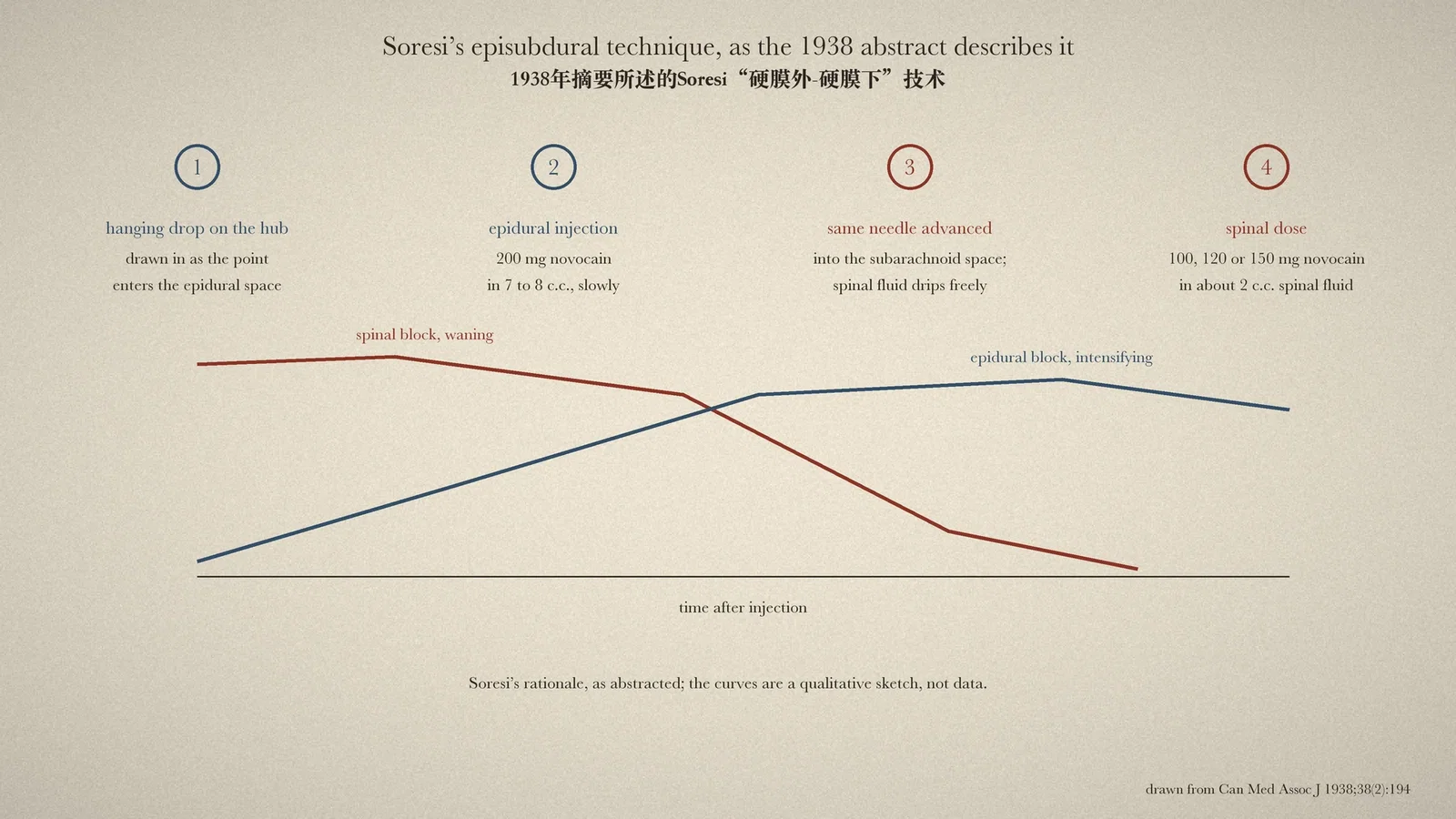
According to the abstract, Soresi described "a new technique combining the advantages of subarachnoid block and epidural block", which the author had "employed successfully in over 200 cases". The disadvantages of each method used alone were minimized and the advantages enhanced: the combination lengthened the period of surgical relaxation and anaesthesia and gave "a sustained relief from pain for a period of 24 to 48 hours" after operation. The reasoning was a hand-over: "as subarachnoid anaesthesia is beginning to wane, that resulting from the epidural block is beginning to intensify". [1]
One needle, two spaces
The technique was "done at the one injection". After the skin was anaesthetized with novocain 1:200, a fine spinal needle was pushed in "until a hanging drop, previously attached to the hub of the needle, is drawn inwards as the point enters the epidural space with its attendant negative pressure". A solution containing 200 mg of novocain crystals, made up to 7 to 8 c.c., was injected slowly into the epidural space while the needle was held firmly. Then the syringe was detached and "the needle advanced until it enters the subarachnoid space when spinal fluid will drip freely from the end". According to the size of the patient, 100, 120 or 150 mg of novocain crystals were dissolved in about 2 c.c. of spinal fluid and injected as an ordinary spinal block. [1]
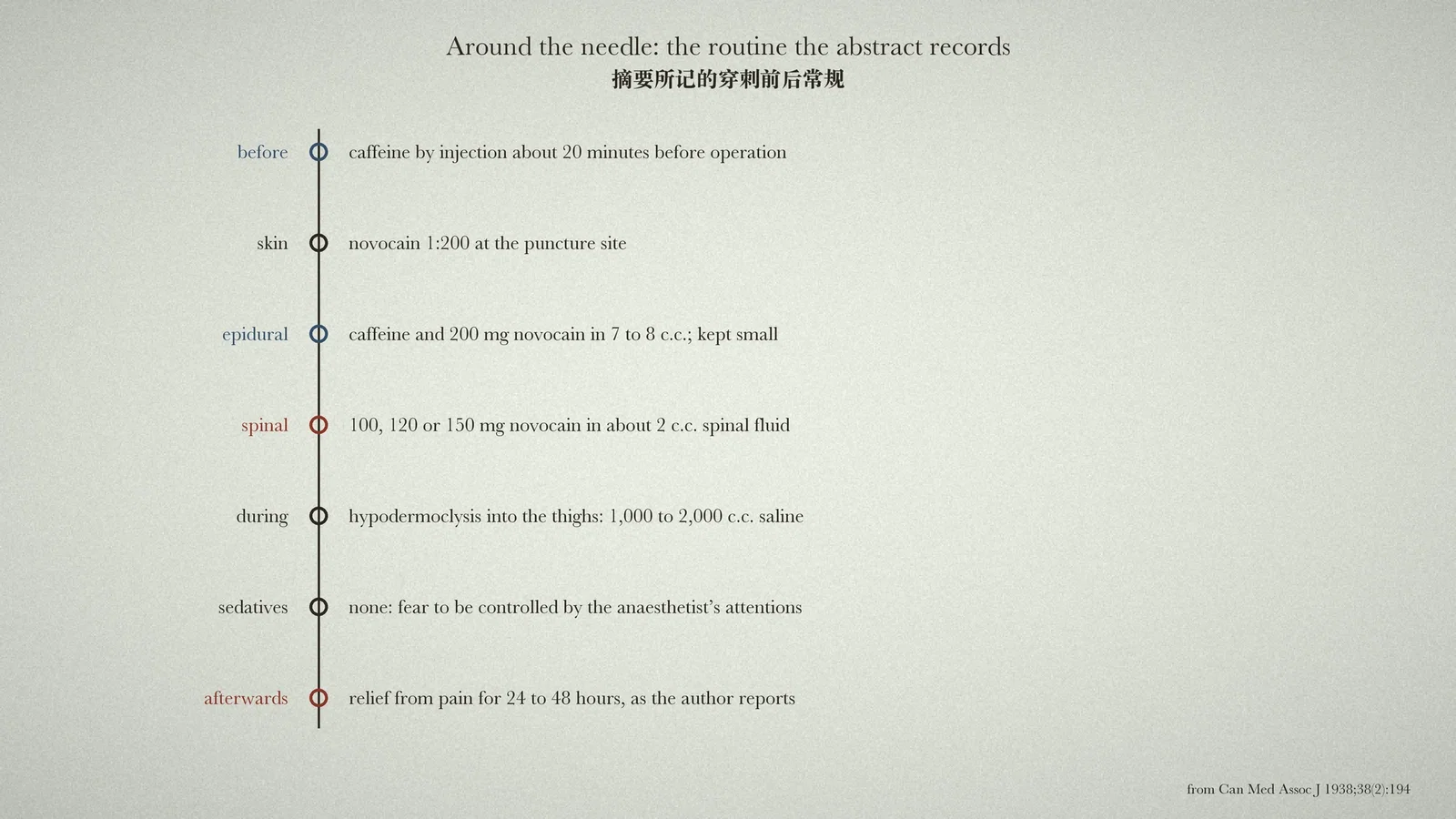
The abstract records the rest of Soresi's routine without comment: caffeine given before and during the anaesthesia, which Soresi believed counteracted the depressing effect of novocain; saline by hypodermoclysis into the thighs, 1,000 to 2,000 c.c. during and after operation; and no sedatives, since the patient's fear could be "controlled by the attentions of the anaesthetist". [1]
Why so little in the epidural space
Soresi deliberately kept the epidural volume small, about 8 c.c. The reason, as abstracted, was that "normally the pressure in this space is negative and large volumes will alter this, making it positive, and thus upset the normal physiological activity"; Soresi blamed the troubles of ordinary epidural anaesthesia on that rise in pressure. The abstract also makes clear what the 24 to 48 hours meant: not that surgical anaesthesia lasted that long, "but that sufficient anaesthesia remains to prevent the feeling of post-operative pain". [1]
How the story is told now
A 2022 trial of single- and double-space combined spinal-epidural techniques opens its introduction with a single sentence of history: the combined technique "was first described by Soresi in 1937 and was first performed by Curelaru in 1979". [2] The 1938 abstract, by contrast, describes Soresi as having used the method in more than 200 patients. The difference may lie in what is counted: Soresi's version used one needle and no catheter, epidural first and spinal second, while the modern technique leaves an epidural catheter in place. This article does not decide the question.
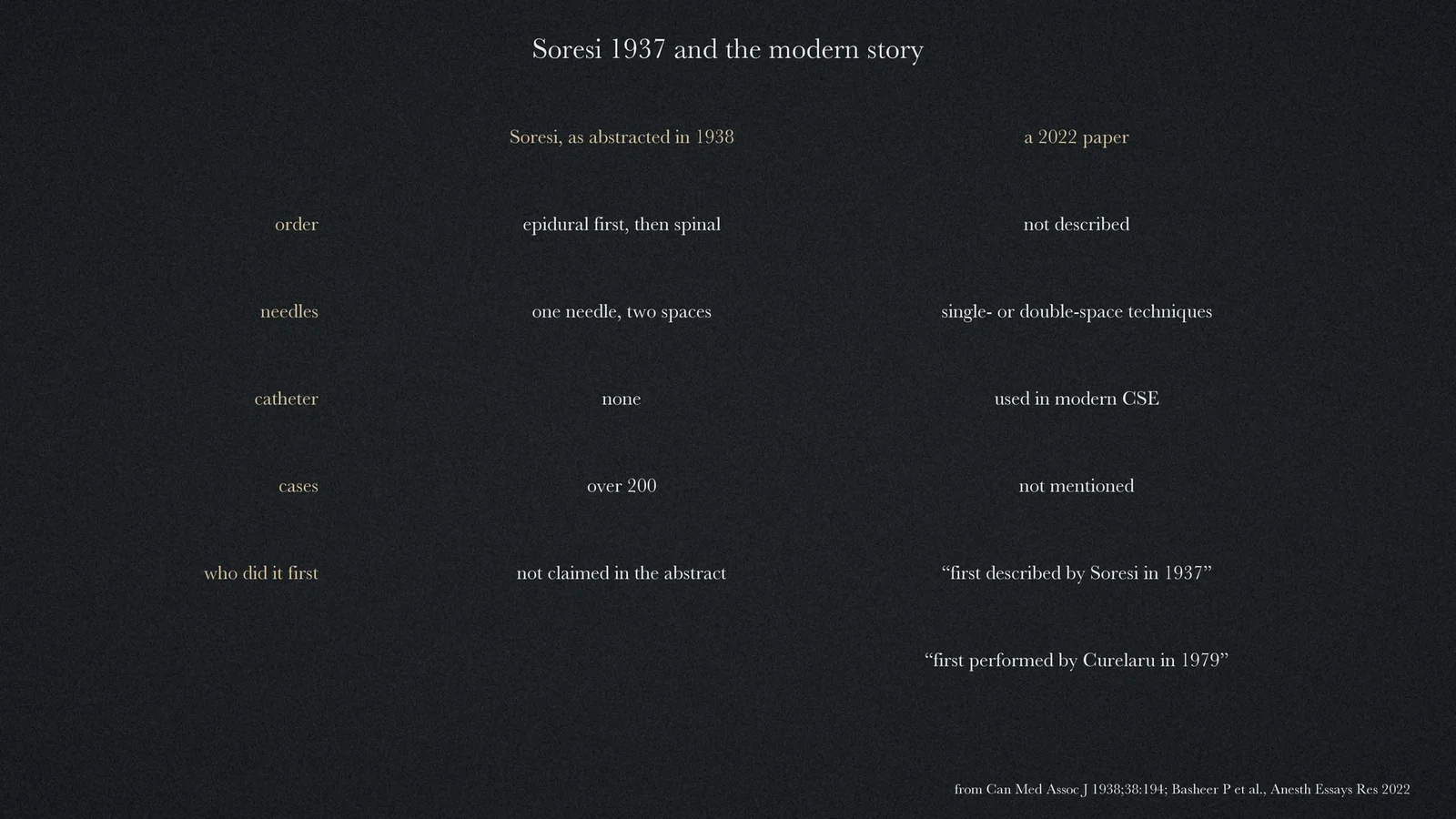
What the record shows
Soresi's 1937 method already contains the logic of the combined block: a fast spinal dose for the operation, an epidural dose timed to take over, and a single puncture. It also shows its period: the epidural space found by a hanging drop, volumes limited by a belief about negative pressure, caffeine and saline as supportive measures, and outcomes stated by the author.
Sources and reading limits
Read: the abstract of Soresi's paper in the Canadian Medical Association Journal, February 1938, p. 194; the introduction of a 2022 trial paper.
Not covered: Soresi's own 1937 paper; the later entries grouped in this topic (1979, 1982, 1984, 1986), which belong to the modern combined technique and other articles. All statements about Soresi's method and results come from the abstract, not from Soresi's own text. Doses are as printed.
One illustration is a page crop from the 1938 abstract; three are drawn from the sources.
- Soresi AL. Episubdural anaesthesia. Curr Res Anesth Analg. 1937;16:306. Abstract by F. A. H. Wilkinson in Can Med Assoc J. 1938;38(2):194. Internet Archive
- Basheer P, et al. A clinical comparison between single-space technique and double-space technique for combined spinal and epidural anesthesia. Anesth Essays Res. 2022. PMC
Continue exploring
Related reading connects shared questions and contexts; it does not by itself establish historical influence.
- 1933: Gutiérrez's Hanging Drop, a Sign Known Through Others
- 1933: Dogliotti Teaches the Hand to Feel the Epidural Space
Anesthesia Epochs · The Source Room · About & Editorial Method
Published November 2, 2026. Sources and reading limits are stated above. Illustrations are labelled as original source images or AI-made. Historical accounts are educational; they are not current treatment instructions.