
A Cuban anaesthetist passed a fine ureteral catheter through a Huber-pointed Tuohy needle into the lumbar peridural space and kept dosing it through long operations; others heard the 1947 talk and took the method into obstetrics before the paper appeared in print.
Reading Library · Anesthesia Epochs · 中文版
Watch the education video (for clinicians)
1947: Curbelo's Continuous Lumbar Epidural — Havana · Anesthesia Epochs Education Series
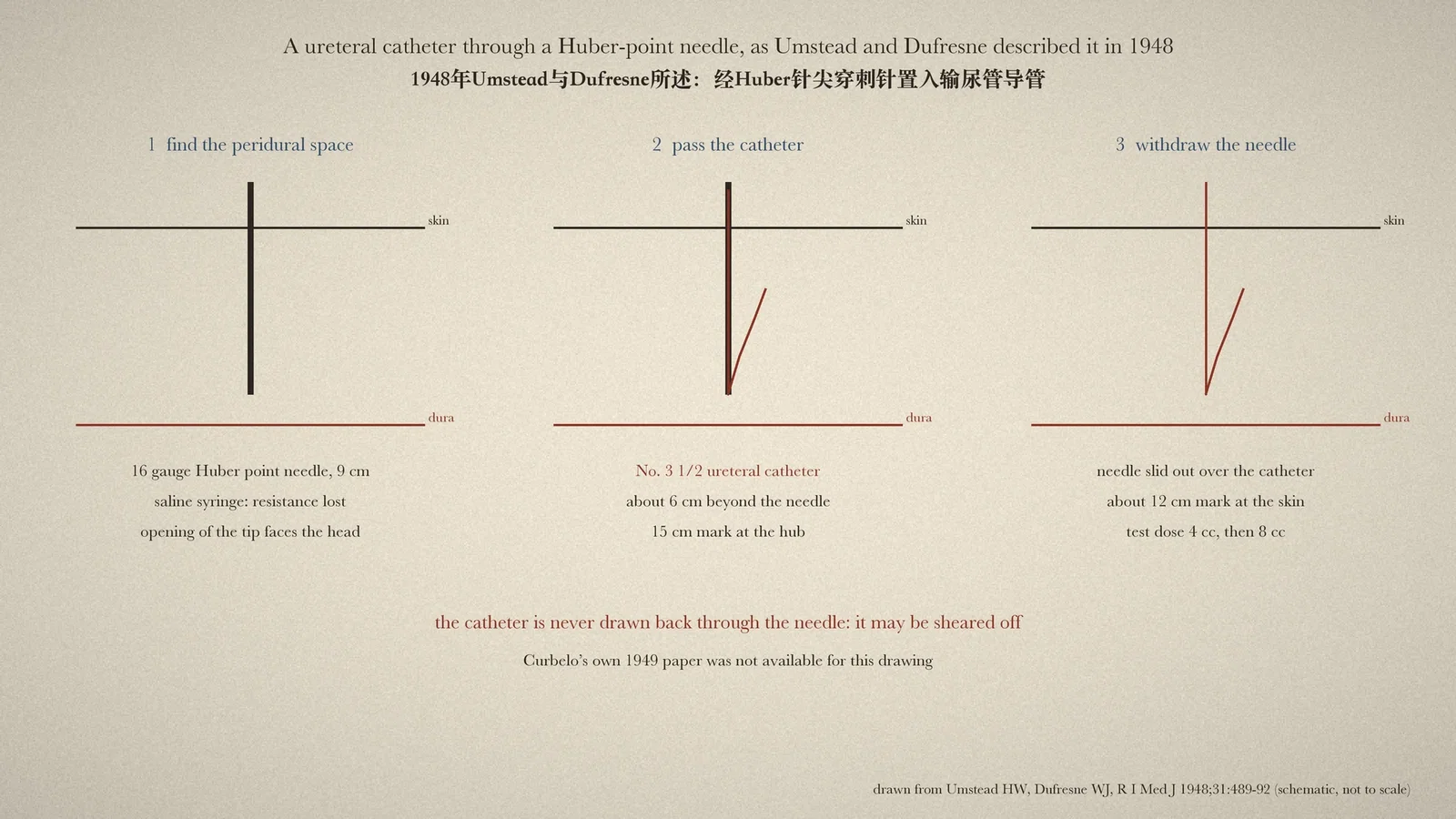
By 1947 a continuous spinal could be run through a malleable needle or a fine catheter, and continuous caudal analgesia, introduced in 1942 by Hingson, Edwards and Southworth, was spreading through American obstetrics. What was missing was a way to keep dosing the lumbar epidural space itself. In 1947 Manuel Martinez Curbelo of Havana described one: a ureteral catheter passed into the lumbar peridural space through a Huber-pointed Tuohy needle, the needle withdrawn and the catheter left in place. This article could not obtain Curbelo's own paper. It tells the story from the people who heard the talk, used the method and cited the paper, and says so throughout. [1][2][3][4]
What Bonica recorded
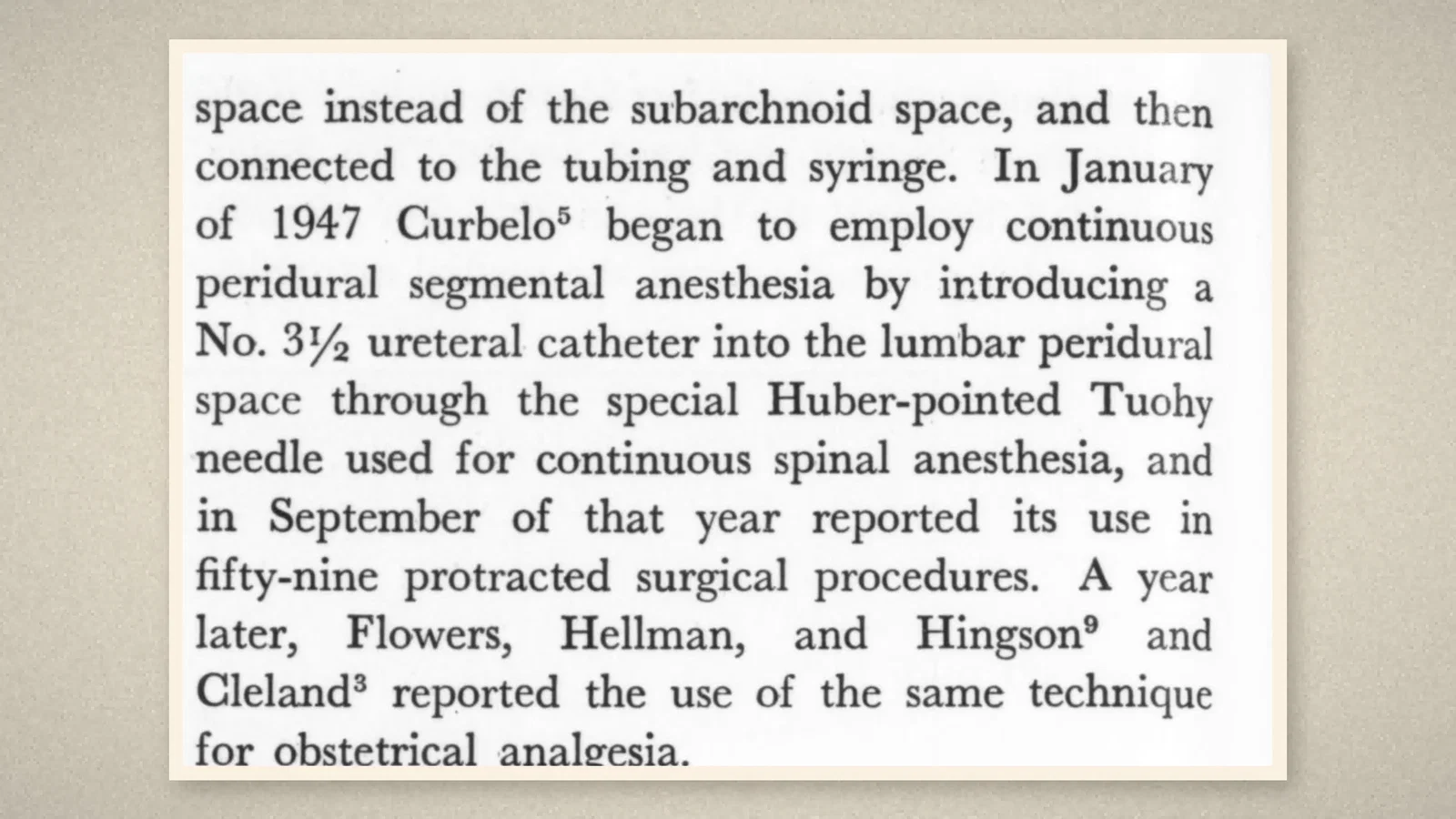
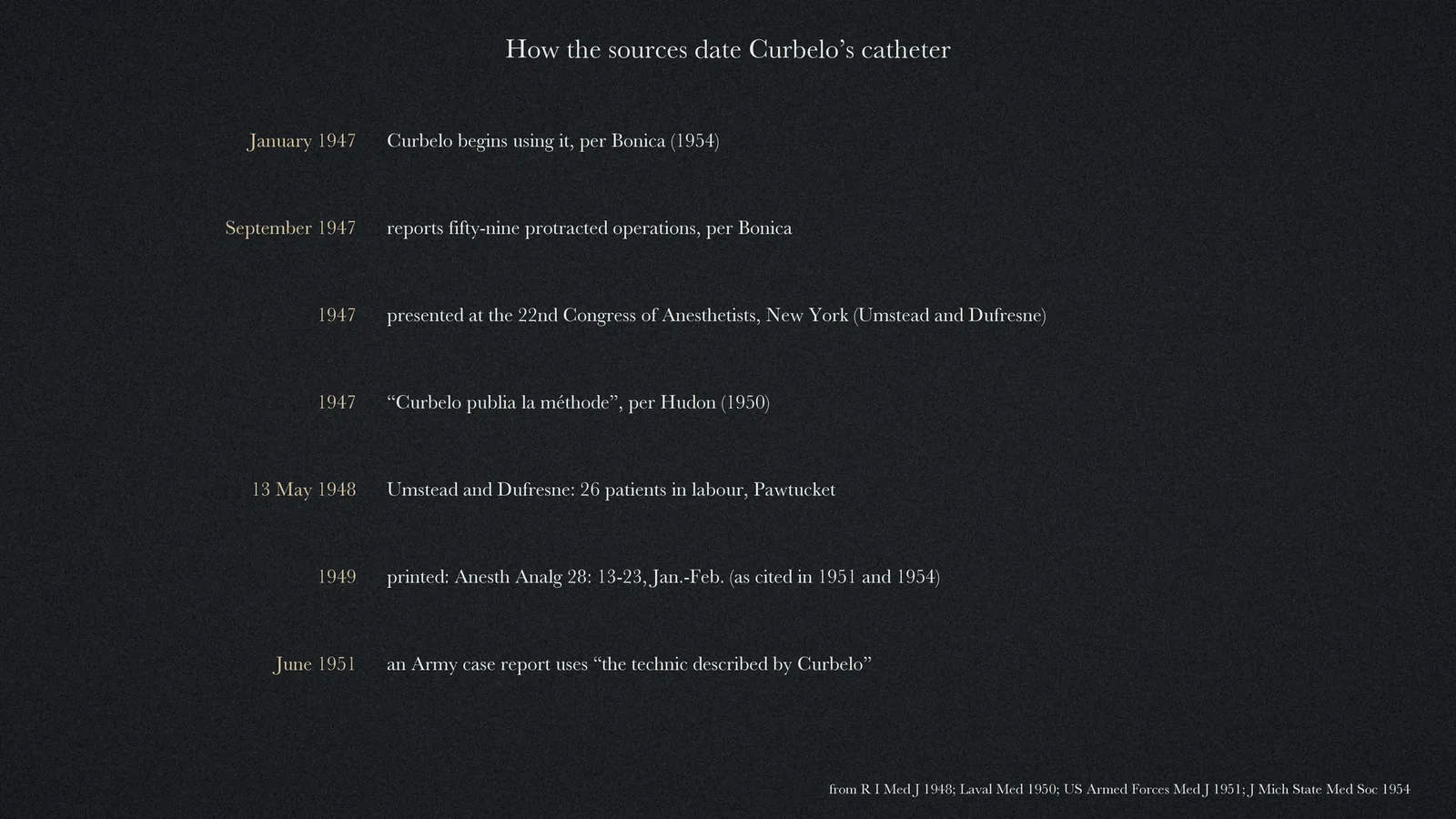
The clearest dating comes from John J. Bonica's 1954 review of segmental peridural block. "In January of 1947 Curbelo began to employ continuous peridural segmental anesthesia by introducing a No. 3½ ureteral catheter into the lumbar peridural space through the special Huber-pointed Tuohy needle used for continuous spinal anesthesia, and in September of that year reported its use in fifty-nine protracted surgical procedures." A year later, Bonica added, Flowers, Hellman and Hingson, and Cleland, reported the same technique for obstetric analgesia. [2]
The paper itself was printed in 1949. A 1951 Army case report and Bonica both cite it as "Continuous peridural segmental anesthesia by means of ureteral catheter", Anesthesia and Analgesia, volume 28, pages 13-23, January-February 1949. In Quebec, Fernando Hudon's 1950 history put it more briefly: in 1947 "Curbelo publia la méthode", using the Tuohy needle and the ureteral catheter. [2][3][4]
Heard in New York, tried in Rhode Island
Two clinicians from Pawtucket, Rhode Island, give the earliest account found for this article. Howard W. Umstead, chief of anaesthesia at Memorial Hospital, and the obstetrician Walter J. Dufresne read a paper on 13 May 1948. "Recently, one of us had the pleasure of hearing Dr. Manuel Curbelo of Havana, Cuba, describe a technique for the continuous administration of lumbar peridural anesthesia by means of a ureteral catheter." Their reference dates the talk to the 22nd Congress of Anesthetists in New York in 1947. Curbelo had presented it for abdominal surgery, and a report was "due to appear in one of the anesthesia journals this year". [1]
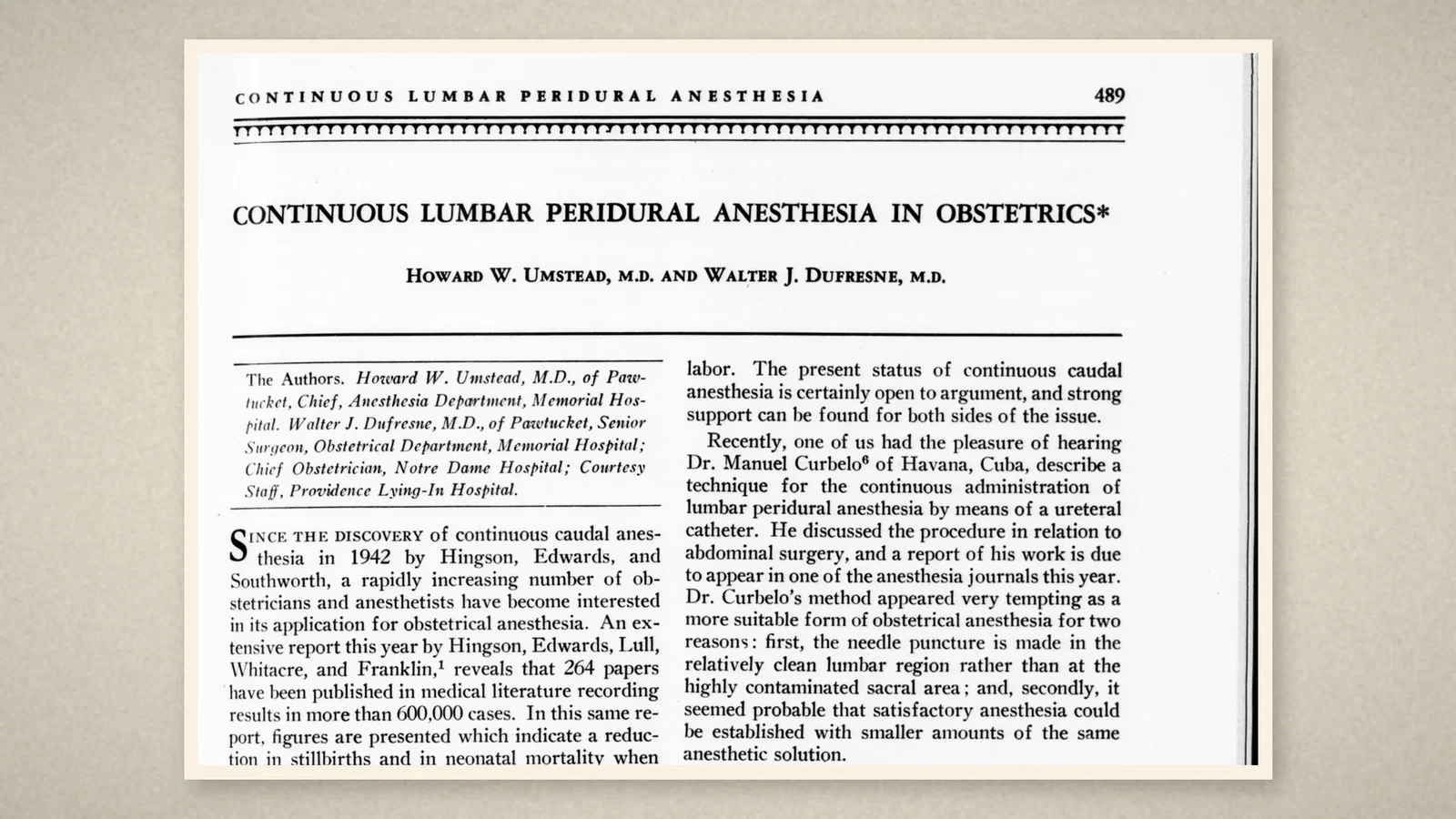
The Pawtucket pair saw two reasons to bring the method into labour: the puncture was made in "the relatively clean lumbar region rather than at the highly contaminated sacral area", and less drug might be needed. [1]
The technique as they printed it
Their technique, which they presented as Curbelo's method adapted for labour, ran as follows. A 16 gauge Huber point needle, 9 cm long, was advanced with a saline syringe until resistance vanished at the ligamentum flavum, with the lettering on the hub showing that the side opening faced the head. A No. 3½ ureteral catheter was passed until about 6 cm lay beyond the needle, so that the 15 cm mark sat at the hub; the needle was then slid out over the catheter, and a reading of about 12 cm at the skin showed proper placement. One rule was absolute: "The catheter is never drawn back through the needle for any reason", because the bevel might "shear off a portion of the catheter" in the patient. A 4 cc test dose guarded against a subarachnoid catheter, followed by 8 cc of 1½ per cent procaine or metycaine with adrenaline 1:200,000. [1]
The results were modest and stated as such. The method had been used "successfully on only 26 patients"; one of the authors, with wide experience of spinal puncture but none of peridural puncture, had placed the catheter in 26 of the first 29 attempts. The initial dose was about a third of the caudal dose, and the catheter was left no longer than six hours. [1]
Before and around Curbelo
Curbelo was already a regional anaesthetist of some standing. A French review of brachial plexus block by Louis Bazy and Blondin in 1935 cited a "new technique" Martinez Curbelo had published in 1933 and 104 personal cases. Nor was the ureteral catheter new in itself: Hudon credits Lundy's group with suggesting in 1943 a ureteral catheter in place of the needle, which passed easily into the spinal canal or sacral hiatus but only with great difficulty into the lumbar peridural space. The Huber-pointed Tuohy needle, which turned the catheter towards the head, is what made the lumbar route practical. [3][5]
What the record shows
Curbelo's contribution, as the surviving record shows it, was to combine the Tuohy needle with a ureteral catheter in the lumbar epidural space and to keep dosing it through long operations. Within a year, others who had heard the talk had moved it into the labour ward and written down rules, including never pulling a catheter back through its needle, that are still taught. The article does not claim that Curbelo was first, and it does not rely on details from Curbelo's paper that it could not read.
Sources and reading limits
Read: Umstead and Dufresne 1948 in full; the history section and references of Bonica 1954; the historical opening of Hudon 1950; the 1951 Army case report and its citation; the 1935 French brachial plexus review.
Not covered: Curbelo's 1949 paper in Anesthesia and Analgesia, which is not on the Internet Archive or in PubMed Central; the 1947 congress presentation; Aldrete, Cabrera and Wright's 2004 article on Curbelo in the Bulletin of Anesthesia History; Curbelo's 1933 paper. Everything said here about Curbelo comes from others' accounts. The sources date the work differently (January and September 1947, a 1947 congress, "published" in 1947, printed in 1949), and the article gives each as its source gives it. The technical details are Umstead and Dufresne's version for labour. Doses are as printed.
Two illustrations are page crops from the 1948 and 1954 papers; two are drawn from the sources.
- Umstead HW, Dufresne WJ. Continuous lumbar peridural anesthesia in obstetrics. R I Med J. 1948;31(8):489-92. Internet Archive
- Bonica JJ. Clinical evaluation of segmental peridural block. J Mich State Med Soc. 1954;53(2):167-78, 191. Internet Archive
- Hudon F. Infiltration continue du splanchnique par voie péridurale. Laval Méd. 1950;15(8):1059 ff. Internet Archive
- Ziperman HH, DeCiutiis V. Damage to the external iliac artery: report of a case. US Armed Forces Med J. 1951;2(6). Internet Archive
- Bazy L, Blondin. L'anesthésie du plexus brachial. Anesthésie et Analgésie. 1935;1(2). Internet Archive
Continue exploring
Related reading connects shared questions and contexts; it does not by itself establish historical influence.
- 1944: Tuohy Threads a Ureteral Catheter into the Spinal Space
- 1933: Dogliotti Teaches the Hand to Feel the Epidural Space
- 1931: Aburel Leaves a Fine Catheter in Place for Labour Analgesia
Anesthesia Epochs · The Source Room · About & Editorial Method
Published November 2, 2026. Sources and reading limits are stated above. Illustrations are labelled as original source images or AI-made. Historical accounts are educational; they are not current treatment instructions.