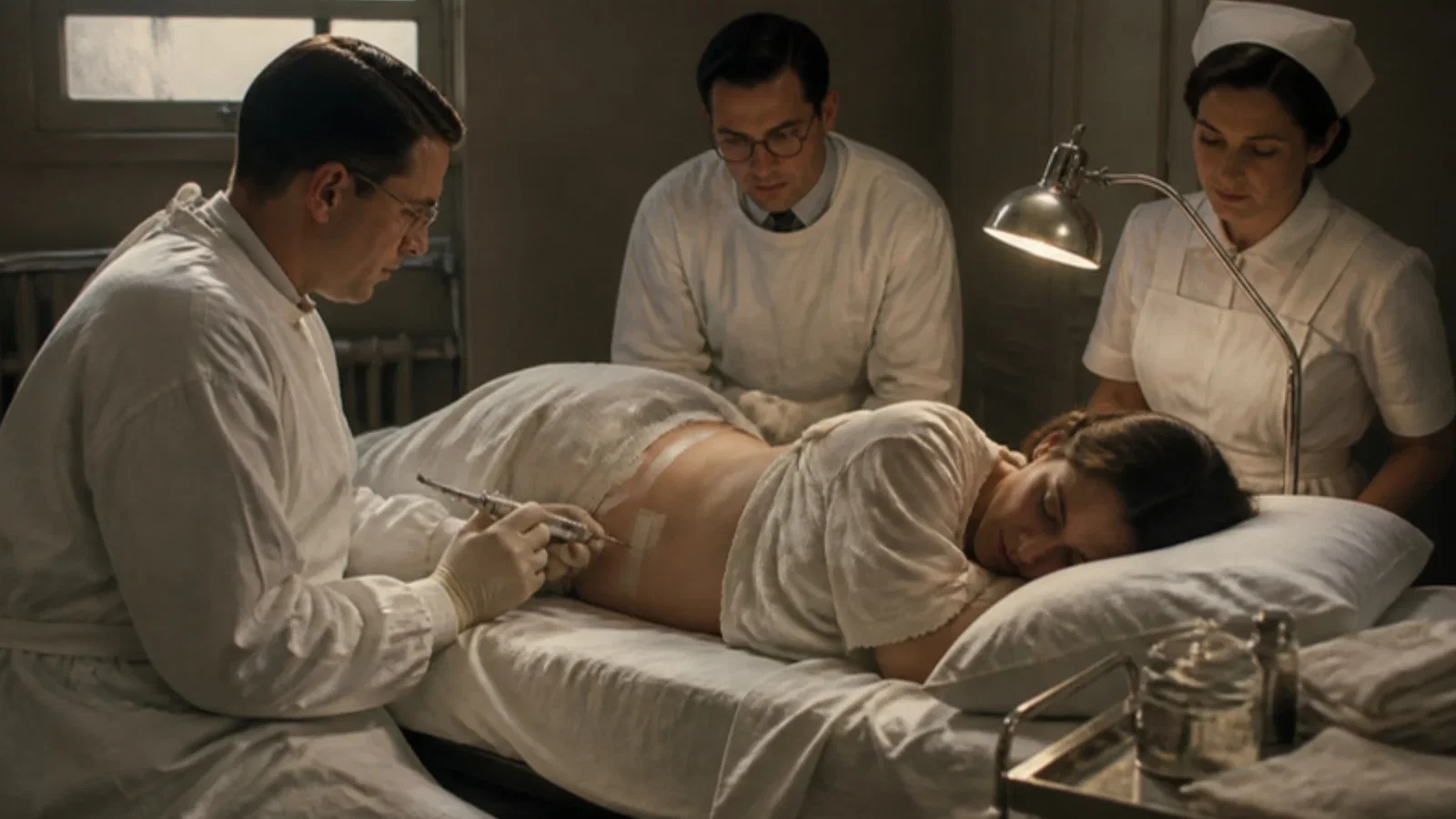
At Johns Hopkins, three clinicians set out continuous lumbar peridural analgesia for labour, delivery and caesarean section with a blunt Tuohy needle, an air syringe and a plastic tube on caudal apparatus; readers of a medical digest argued over who could safely use it.
Reading Library · Anesthesia Epochs · 中文版
Watch the education video (for clinicians)
1949: Flowers, Hellman and Hingson — A Plastic Epidural Catheter · Anesthesia Epochs Education Series
Continuous caudal analgesia had made pain relief in labour a matter of keeping a catheter dosed for hours. In 1949 three clinicians at Johns Hopkins University in Baltimore, Charles E. Flowers Jr, Louis M. Hellman and Robert A. Hingson, published a lumbar version: "Continuous peridural anesthesia and analgesia for labor, delivery and cesarean section", in Current Researches in Anesthesia and Analgesia. This article could not obtain that paper. What it could read is the abstract printed in the digest Modern Medicine on 1 October 1949, and the letters other anaesthetists sent in reply. Both are used here, and the limits are stated. [1][2]
The case for the lumbar route
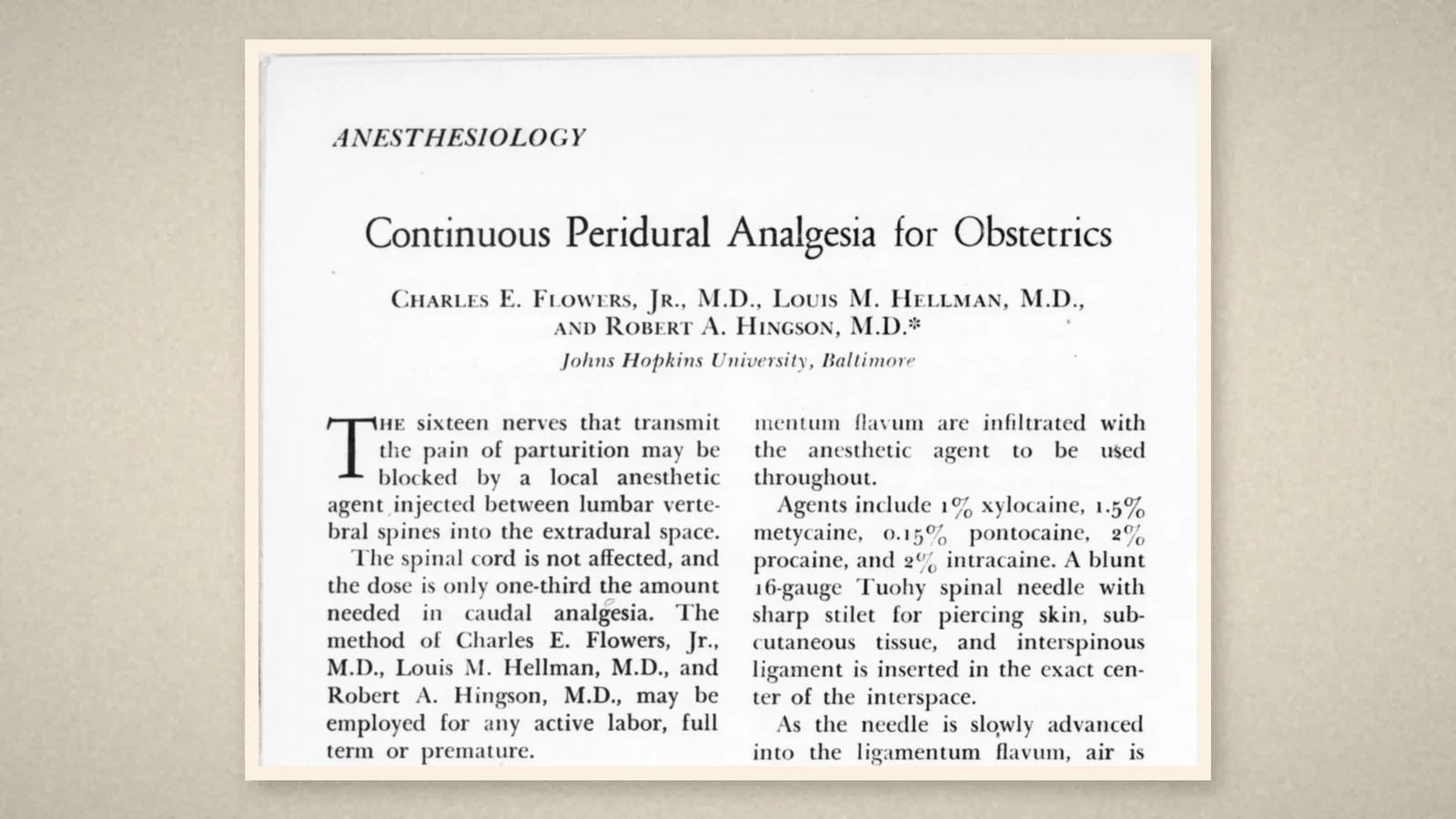
The abstract opens with anatomy: "The sixteen nerves that transmit the pain of parturition may be blocked by a local anesthetic agent injected between lumbar vertebral spines into the extradural space." The spinal cord was not affected, and "the dose is only one-third the amount needed in caudal analgesia". The method could be used in any active labour, at term or premature. The authors gave special indications: low physical reserve, conditions that ruled out caudal or spinal anaesthesia, and caesarean section. They called it safe and effective in grade 3 or 4 heart disease, severe tuberculosis, acute respiratory infection, metabolic disorders, caudal deformity, ruptured intervertebral disc, syphilis of the nervous system, and after recent poliomyelitis. [1]
The technique
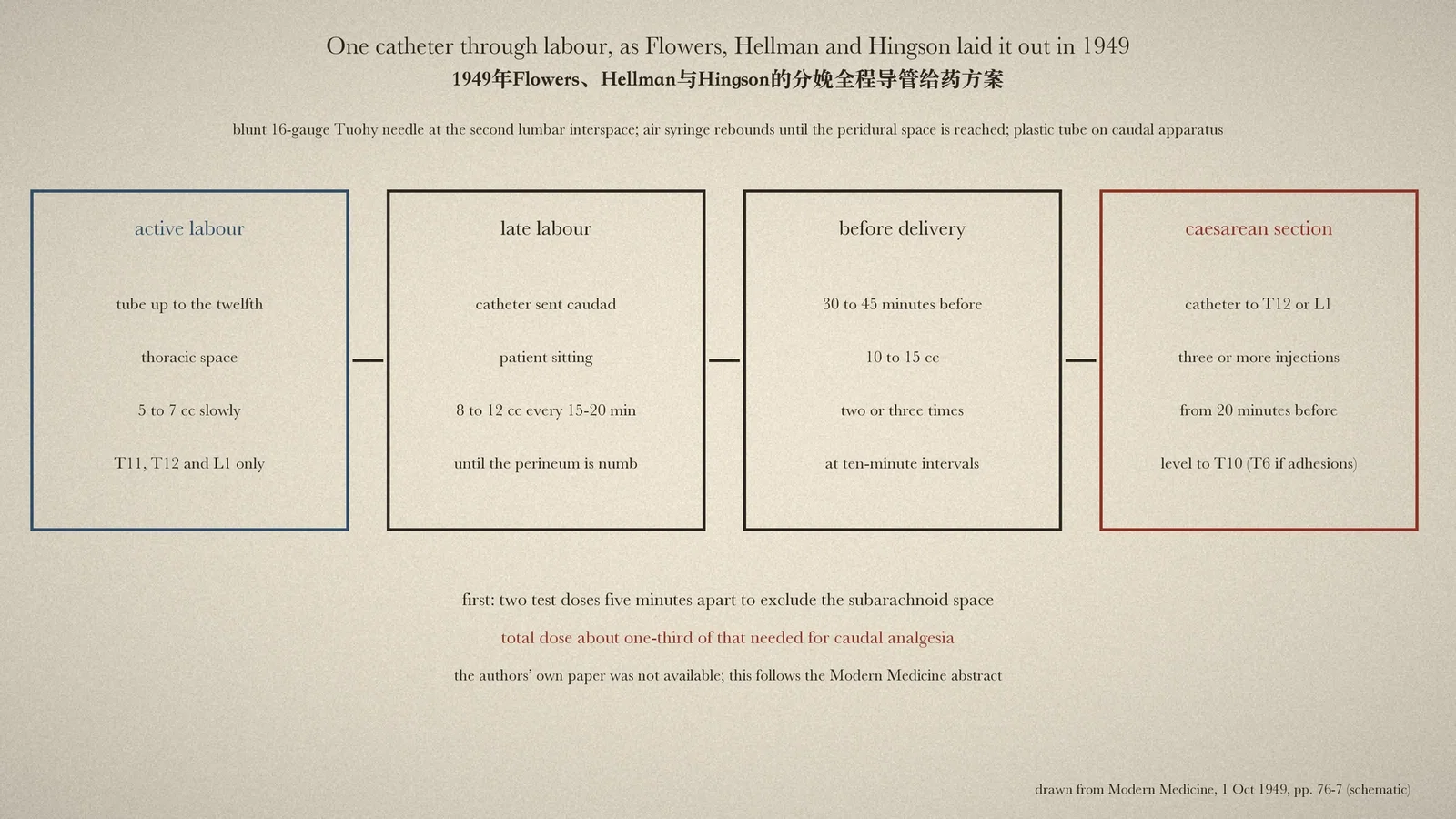
The block was started in the last five or six hours of labour, once contractions were strong and regular. At the second lumbar interspace the skin, interspinous ligament and ligamentum flavum were infiltrated with the agent to be used throughout; the abstract lists 1 per cent xylocaine, 1.5 per cent metycaine, 0.15 per cent pontocaine, 2 per cent procaine and 2 per cent intracaine. "A blunt 16-gauge Tuohy spinal needle with sharp stilet" went in at the exact centre of the interspace. To find the space, the authors used air: as the needle advanced into the ligamentum flavum, air was injected again and again from a small syringe, and "the plunger rebounds until the peridural space is reached, then falls into place". A plastic tube, attached to caudal analgesia apparatus, was then passed. [1]
Two doses given five minutes apart served as the test for a subarachnoid catheter. For the first half hour the patient was encouraged to sit in a chair or walk with support. [1]
One catheter, four stages
The dosing followed the labour. Early on, the tube was advanced to the twelfth thoracic space and 5 to 7 cc was injected slowly, "to affect only the eleventh and twelfth thoracic nerves and the first lumbar nerve"; often the test doses alone relieved the early contractions. Late in labour the catheter was sent caudad, and with the patient sitting, 8 to 12 cc was given every fifteen or twenty minutes until the perineum was numb; a second catheter in the caudal canal was an alternative. Before delivery, 10 to 15 cc was given two or three times at ten-minute intervals. For caesarean section the catheter went to the twelfth thoracic or first lumbar interspace, with at least three injections starting twenty minutes before operation and a level to the tenth thoracic dermatome, or the sixth when pelvic adhesions were present. [1]
What readers said
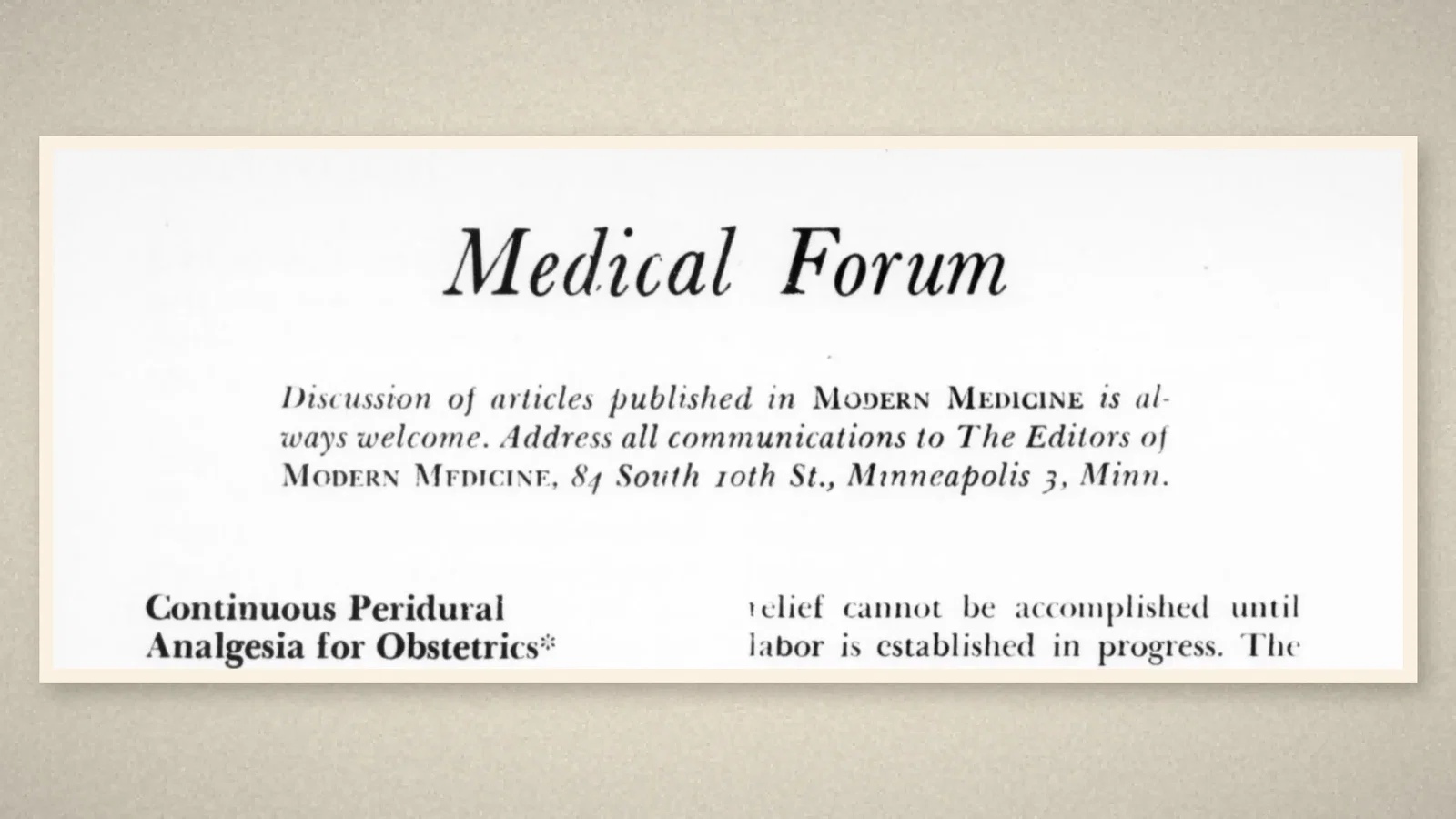
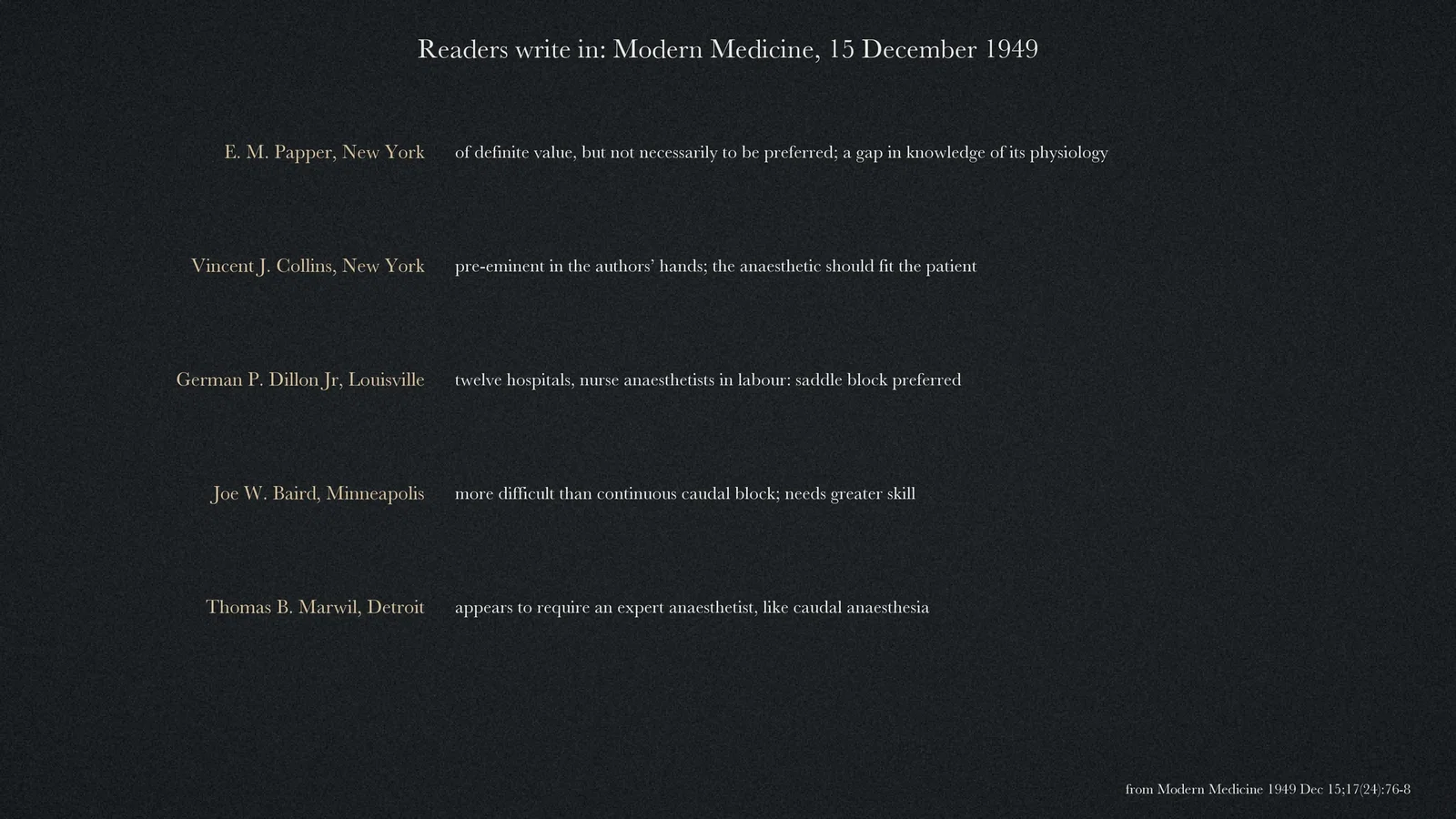
Modern Medicine printed five replies on 15 December 1949. E. M. Papper of New York thought it improper to call peridural analgesia "necessarily superior" to other methods, noted a small risk of infection, and pointed to "a considerable gap in our knowledge" of its physiology, while judging it "a method of definite value". Vincent J. Collins agreed that the method had reached a pre-eminent status in the authors' hands but argued that the anaesthetic should be fitted to the patient. German P. Dillon Jr described practice in Louisville, where the anaesthesiologist might be called to any of twelve hospitals and labour analgesia was mostly given by nurse anaesthetists, so the method could not be used there. Joe W. Baird of Minneapolis judged it "more difficult than continuous caudal block", and Thomas B. Marwil of Detroit wrote that it "appears to require an expert anesthetist". [2]
Where it sits
The Johns Hopkins method was not the first lumbar catheter in labour. Umstead and Dufresne in Rhode Island had already reported 26 patients in 1948 with a ureteral catheter after hearing Curbelo of Havana. Bonica's 1954 review recorded that Flowers, Hellman and Hingson, and Cleland, reported the same technique for obstetric analgesia "a year later" than Curbelo's 1947 report. What the 1949 abstract adds is a complete plan for one catheter through every stage of labour and caesarean section, a lower dose than caudal analgesia, and the air-filled syringe as a sign of the space. [3][4]
What the record shows
In 1949 the lumbar epidural catheter entered the labour ward as a full method, with the dose divided by stage of labour. The first replies did not dispute that it worked; they argued about who could do it safely, in which hospitals, and with how much knowledge of its effects.
Sources and reading limits
Read: the Modern Medicine abstract of 1 October 1949 in full; the Modern Medicine Medical Forum letters of 15 December 1949; Bonica's 1954 history paragraph; Umstead and Dufresne's 1948 paper.
Not covered: the original paper by Flowers, Hellman and Hingson (Curr Res Anesth Analg 1949;28:181-188), which is not on the Internet Archive or in PubMed Central; their later papers; Cleland's 1949 paper. Everything said about the method comes from the digest's abstract, which is an editor's condensation, and the abstract gives no number of patients, so none is given here. Doses are as printed.
Two illustrations are page crops from Modern Medicine; two are drawn from it.
- Continuous peridural analgesia for obstetrics [abstract of Flowers CE Jr, Hellman LM, Hingson RA. Curr Res Anesth Analg. 1949;28:181-188]. Mod Med. 1949 Oct 1;17(19):76-7. Internet Archive
- Medical forum: continuous peridural analgesia for obstetrics [letters from Papper EM, Collins VJ, Dillon GP Jr, Baird JW, Marwil TB]. Mod Med. 1949 Dec 15;17(24):76-8. Internet Archive
- Bonica JJ. Clinical evaluation of segmental peridural block. J Mich State Med Soc. 1954;53(2):167-78, 191. Internet Archive
- Umstead HW, Dufresne WJ. Continuous lumbar peridural anesthesia in obstetrics. R I Med J. 1948;31(8):489-92. Internet Archive
Continue exploring
Related reading connects shared questions and contexts; it does not by itself establish historical influence.
- 1947: Curbelo Threads a Catheter into the Lumbar Epidural Space
- 1931: Aburel Leaves a Fine Catheter in Place for Labour Analgesia
- 1942: Hingson and Edwards Sustain Caudal Analgesia Through Labor
Anesthesia Epochs · The Source Room · About & Editorial Method
Published November 2, 2026. Sources and reading limits are stated above. Illustrations are labelled as original source images or AI-made. Historical accounts are educational; they are not current treatment instructions.