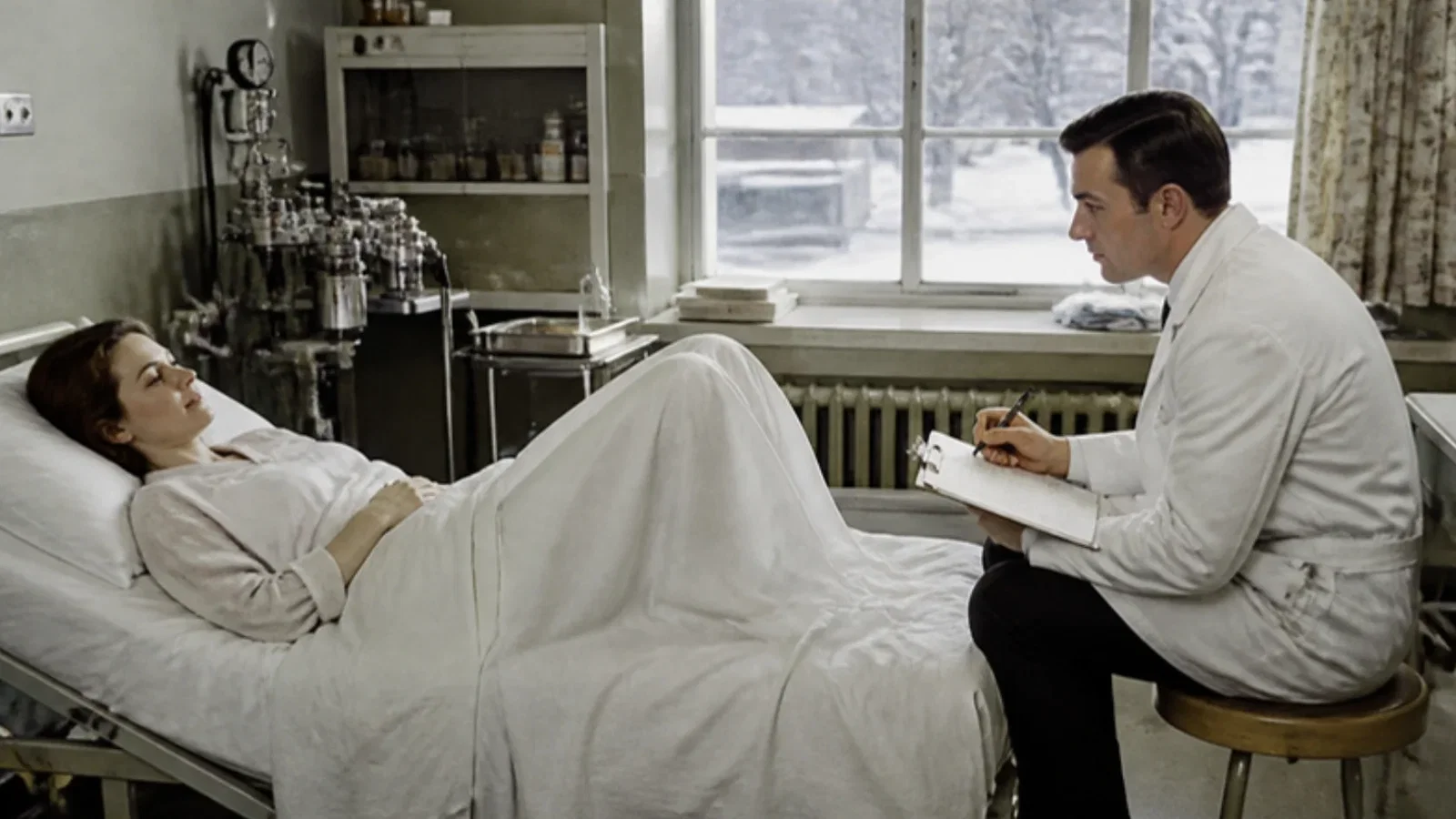
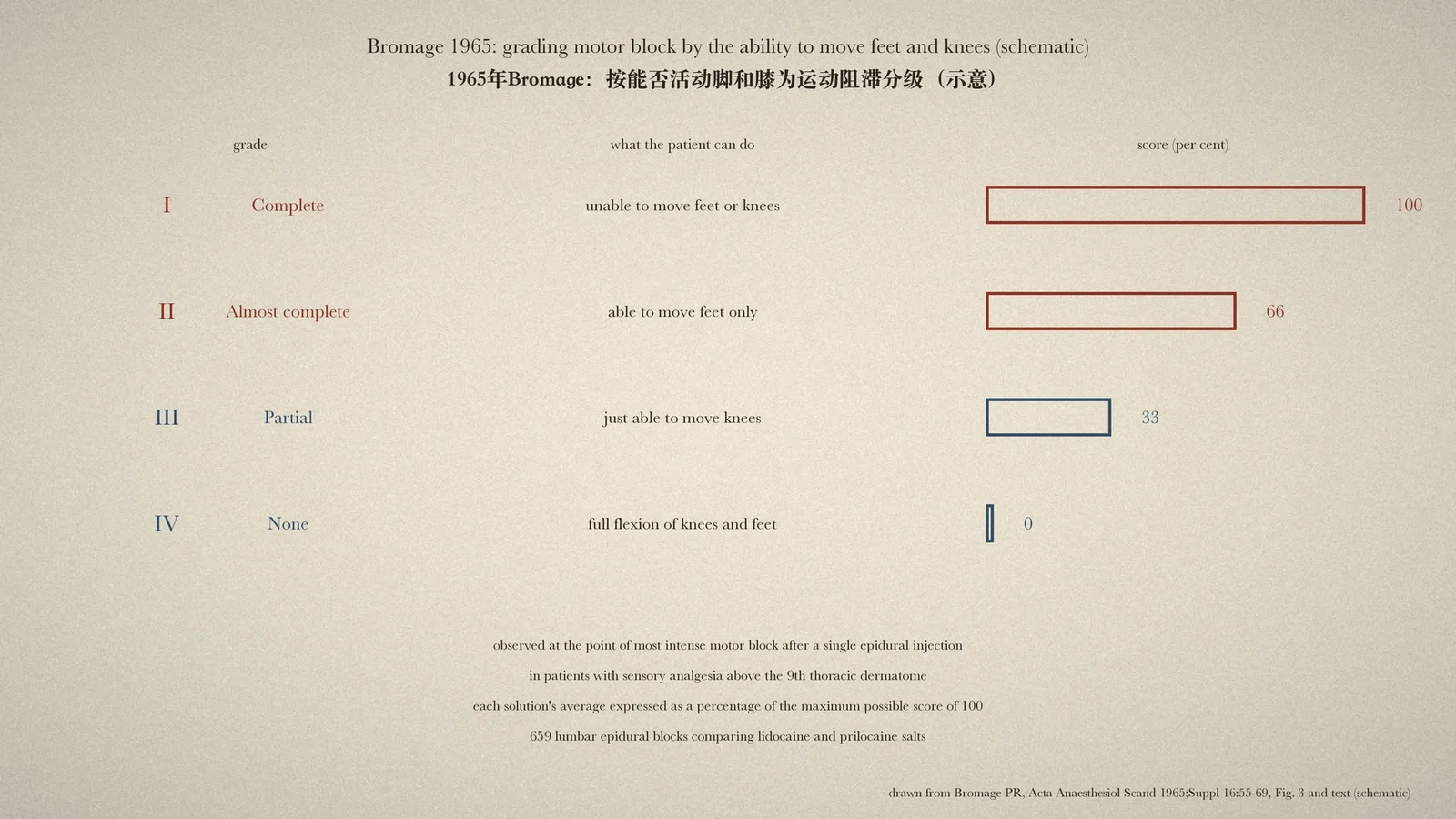
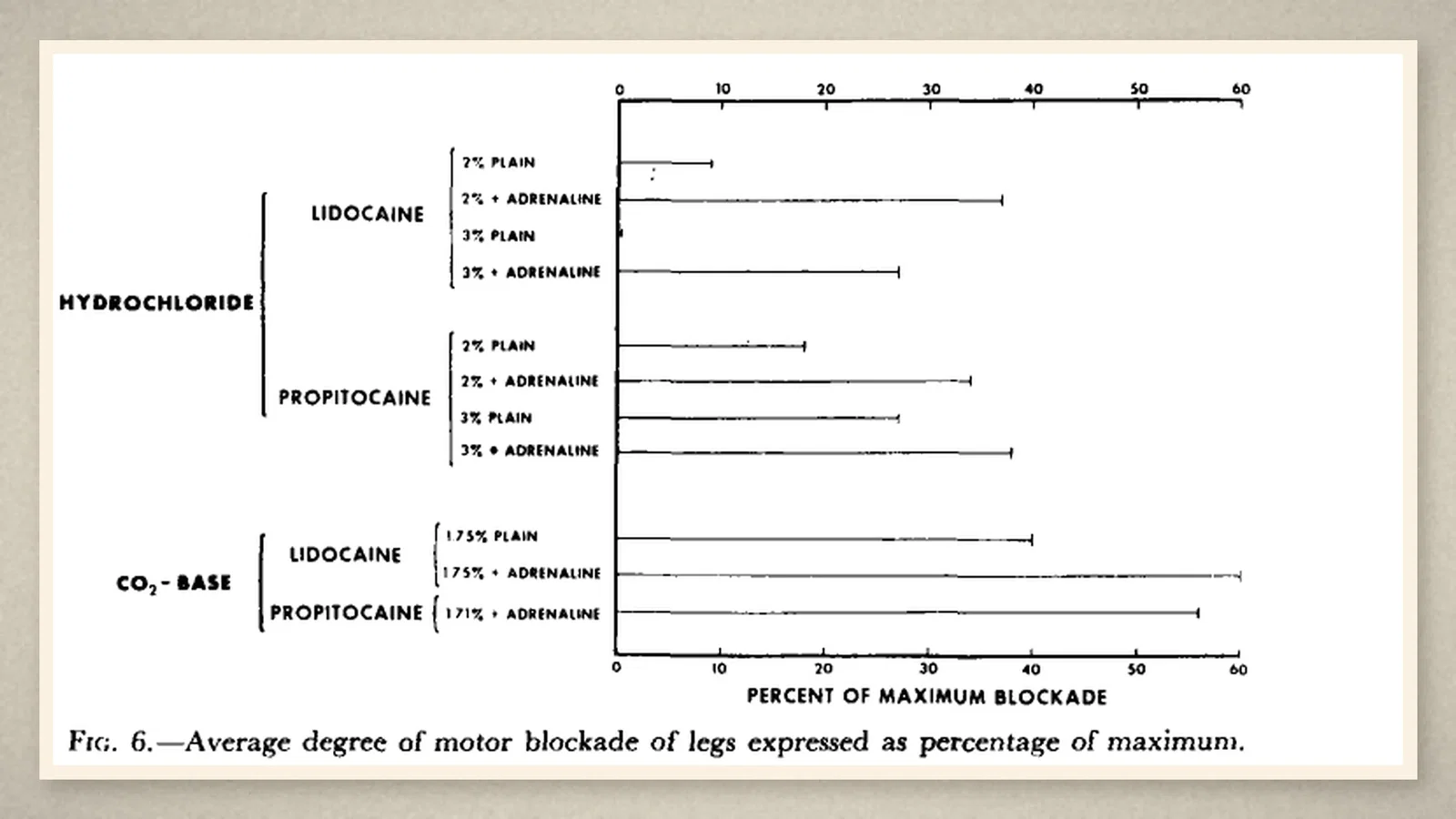
Philip R. Bromage of McGill University and the Royal Victoria Hospital, Montreal, compared hydrochloride and carbonated solutions of lidocaine and prilocaine in 659 lumbar epidural blocks; to compare motor block, Bromage graded it at its most intense point as complete, almost complete, partial or none by the patient's ability to move feet and knees, scoring 100, 66, 33 and 0 per cent, so that each solution's average could be expressed as a percentage of the maximum.
Reading Library · Anesthesia Epochs · 中文版
Watch the education video (for clinicians)
1965: The Bromage Scale — Four Grades of Motor Block · Anesthesia Epochs Education Series
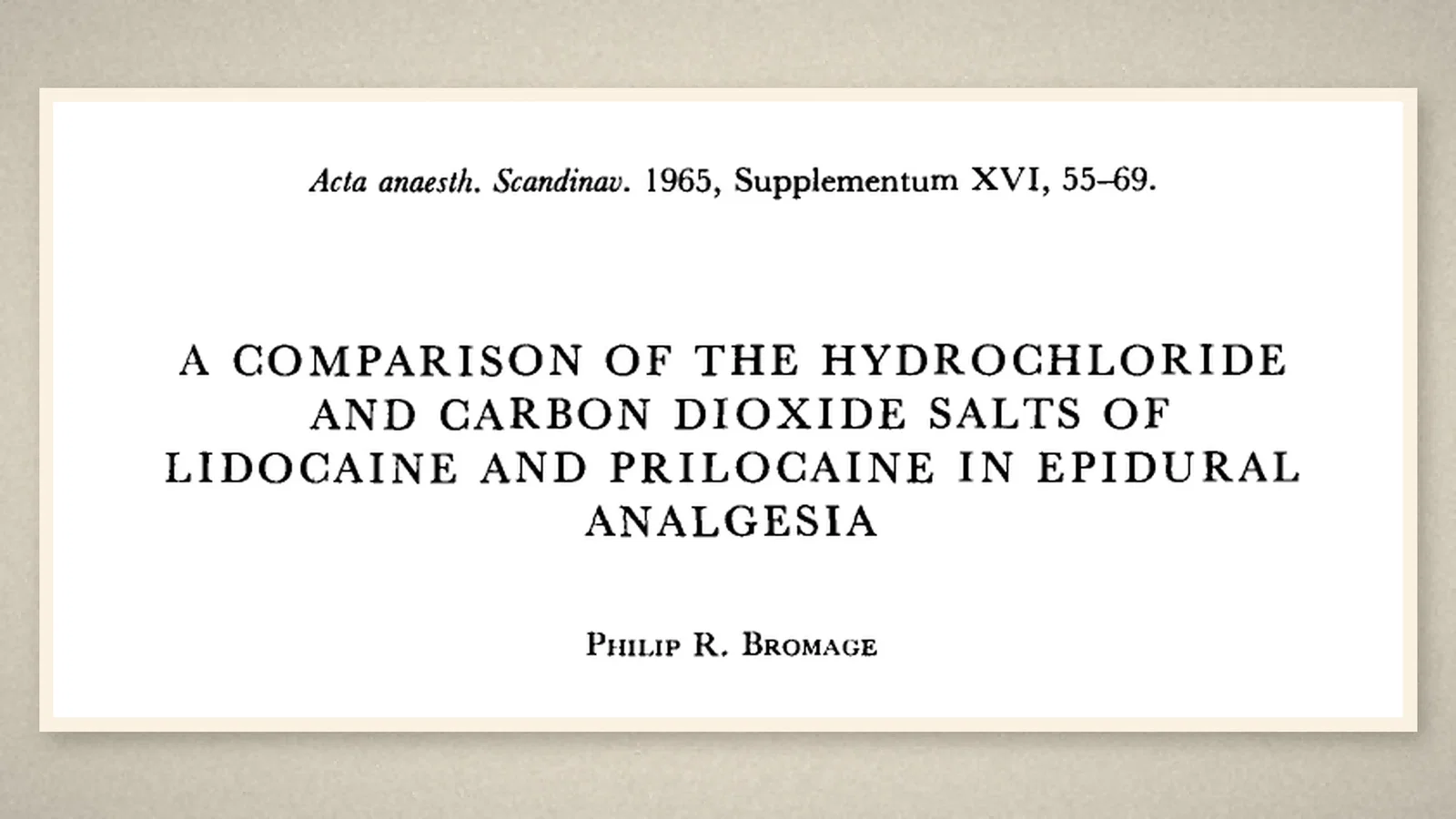
A score is only useful if different observers apply it the same way. In epidural analgesia, how much the legs are weakened matters to the patient, the obstetrician and the surgeon. This article reads the paper in which Philip R. Bromage, of McGill University and the Royal Victoria Hospital in Montreal, set out a simple four-step grading of motor block: "A comparison of the hydrochloride and carbon dioxide salts of lidocaine and prilocaine in epidural analgesia", in a 1965 supplement of Acta Anaesthesiologica Scandinavica. [1]
A method for comparing drugs
The grading was a tool, not the paper's subject. Bromage was comparing local anaesthetics, and argued that epidural analgesia was well suited to it, because "the onset and spread of analgesia is slow, allowing plenty of time for observation and comparative measurements". The question was whether local anaesthetics dissolved with carbon dioxide (carbonated salts) blocked better than the usual hydrochloride salts; Truant and Bromage had found, in unpublished work, that the carbonic salts had "a more powerful blocking action". Latency, spread, intensity of motor block and duration were measured in 659 patients receiving lumbar epidural blocks. [1]
How motor block was graded
Motor block posed a practical difficulty. It is "slower to develop and of shorter duration than sensory analgesia", so observations had to be made late enough for it to have developed, but before it began to recede. Bromage therefore recorded it at the point at which motor block "is most intense after a single epidural injection". [1]
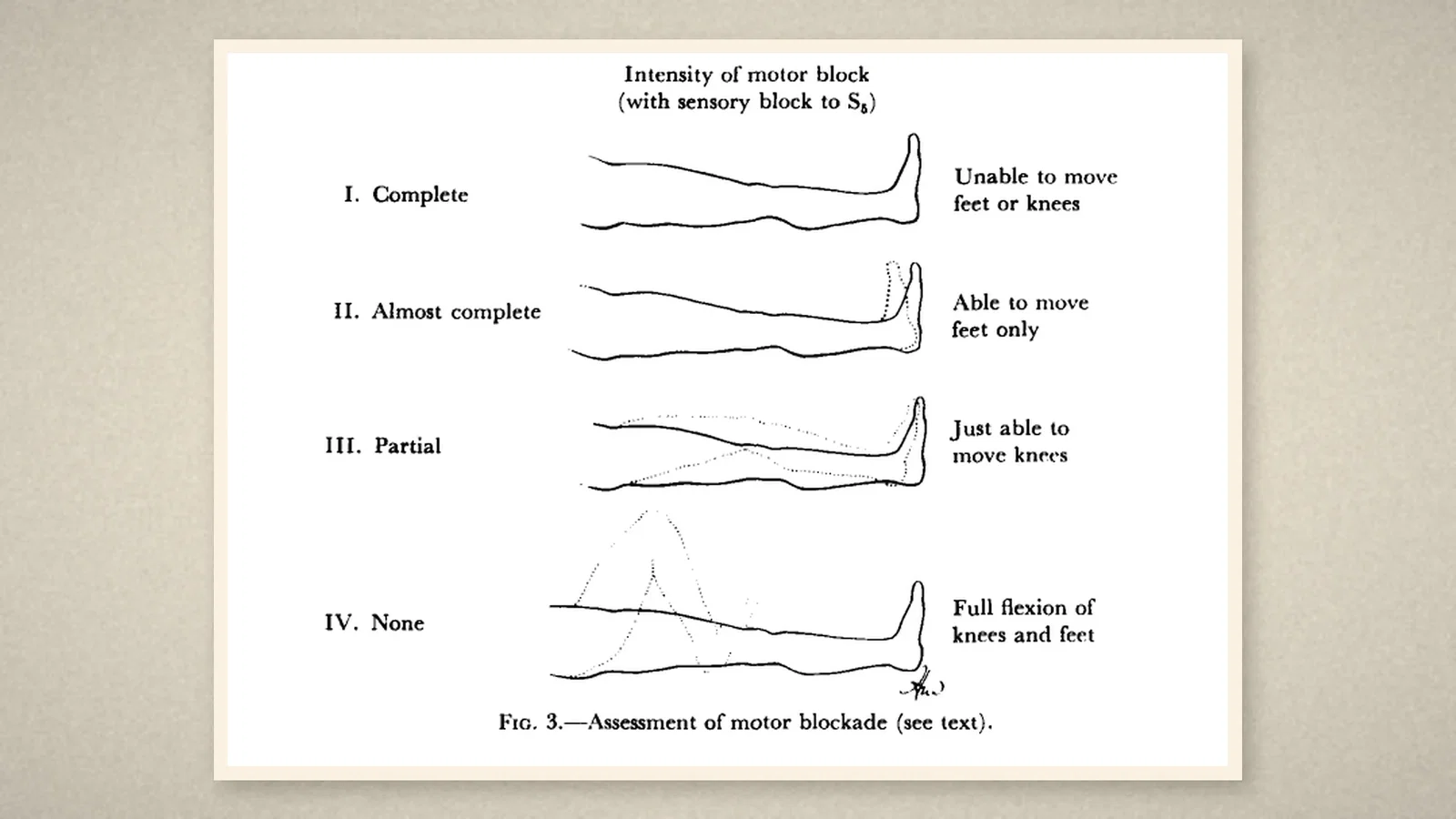
Tests were made in patients whose analgesia reached above the 9th thoracic dermatome, and degrees of motor blockade "were classified simply in terms of ability to move the feet and legs". Figure 3 shows four grades: I, complete, "unable to move feet or knees"; II, almost complete, "able to move feet only"; III, partial, "just able to move knees"; and IV, none, "full flexion of knees and feet". "The categories of blockade, Complete, Almost Complete, Partial and Nil were given arbitrary scores of 100, 66, 33 and 0 per cent respectively, so that the average results from each test solution could be expressed as a percentage of the maximum possible score of 100." [1]
What the scores showed
Expressed this way, the solutions produced "widely differing degrees of motor block" (Fig. 6). Adrenaline "consistently improved the quality of motor blockade of all the plain solutions", and the most intense motor paralysis came from the carbonated solutions with adrenaline. Bromage concluded that the carbonated solutions were "superior in every way" to their hydrochloride counterparts and "worthy of wider clinical trial"; more than 400 patients had received them "and no untoward effects have been encountered". [1]
What the record shows
The grades turned a bedside observation into a number without any equipment. The examiner asks the patient to move the feet and knees, and the answer places the block in one of four classes. Bromage called the scores "arbitrary"; their value lay in letting different solutions be compared on one scale, at a fixed moment, in patients with a defined level of sensory block. The scale is now often called the Bromage motor block score, a name that does not appear in the 1965 paper.
Sources and reading limits
Read: Bromage PR, Acta Anaesthesiol Scand 1965;9(Suppl 16):55-69, in full.
Not covered: Bromage's textbook Epidural Analgesia (1978); later modified versions of the scale; Truant and Bromage's unpublished data. The name "Bromage score" is later usage and is not attributed to the paper; no source on the scale's later use was read. Bromage's conclusions on the carbonated salts are Bromage's. Drug concentrations, adrenaline strengths and timings of observation are not repeated. Quotations are from the English original.
Three illustrations are crops of pp. 55, 60 and 64, including Figs. 3 and 6; one is drawn from Fig. 3 and the text.
- Bromage PR. A comparison of the hydrochloride and carbon dioxide salts of lidocaine and prilocaine in epidural analgesia. Acta Anaesthesiol Scand. 1965;9(Suppl 16):55-69. Wiley
Continue exploring
Related reading connects shared questions and contexts; it does not by itself establish historical influence.
- 1947: Curbelo Threads a Catheter into the Lumbar Epidural Space
- 1949: Flowers, Hellman and Hingson Run a Tube into the Epidural Space
Anesthesia Epochs · The Source Room · About & Editorial Method
Published November 2, 2026. Sources and reading limits are stated above. Illustrations are labelled as original source images or AI-made. Historical accounts are educational; they are not current treatment instructions.