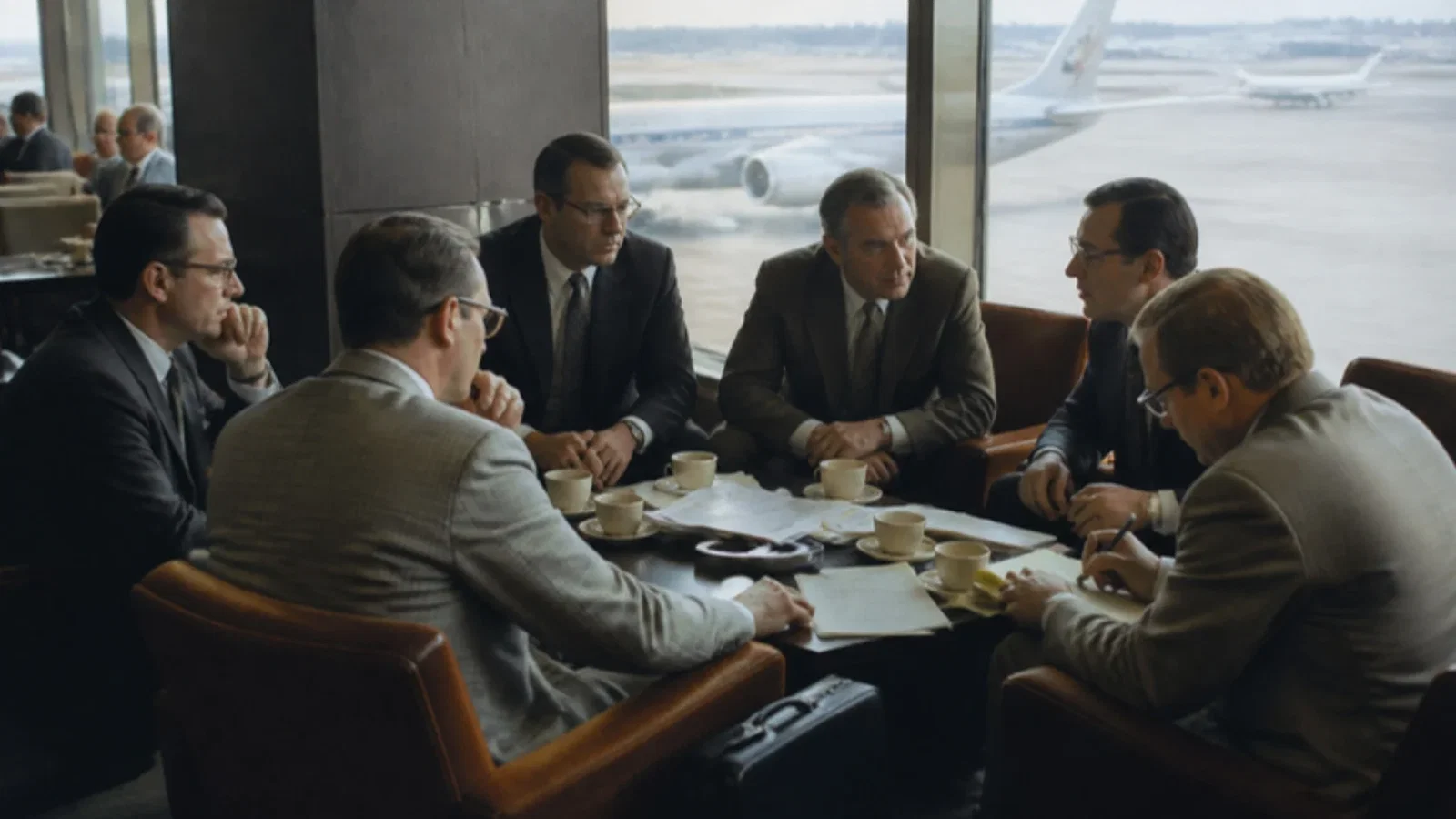
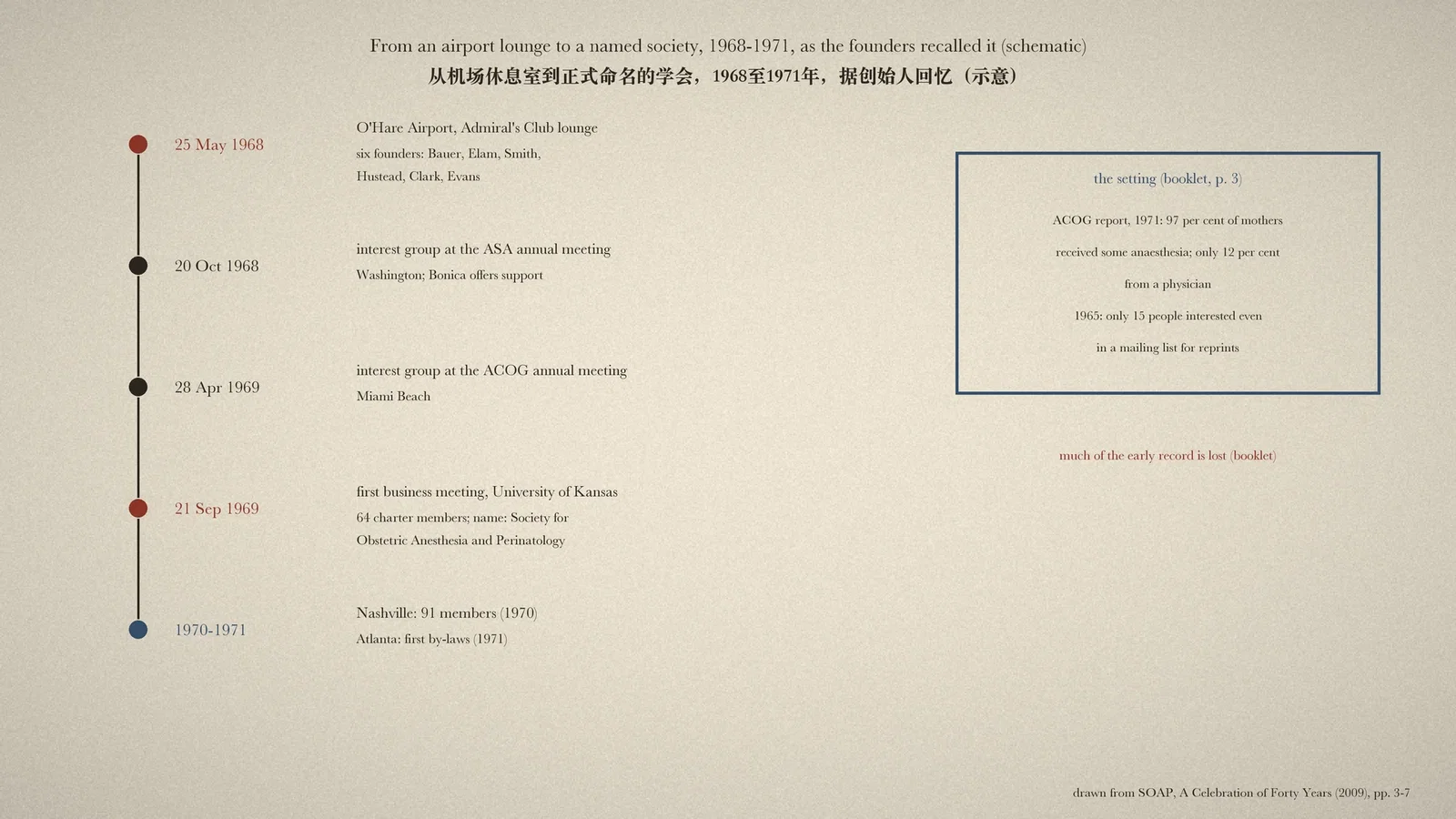
In SOAP's fortieth-anniversary booklet of 2009, Robert Hustead, Richard Clark and Bradley Smith set down how the society began: on Saturday 25 May 1968 Bauer, Elam, Smith, Hustead, Clark and Evans met in the Admiral's Club lounge at O'Hare Airport to organise a group for obstetric anesthesia; after interest-group meetings at the ASA and ACOG annual meetings, those at a meeting at the University of Kansas decided on 21 September 1969 that a new organization had been born and named it the Society for Obstetric Anesthesia and Perinatology.
Reading Library · Anesthesia Epochs · 中文版
Watch the education video (for clinicians)
1968: SOAP Is Founded — Six Anaesthesiologists at O'Hare · Anesthesia Epochs Education Series
Societies of specialists usually begin in a lecture hall or a hotel ballroom. The Society for Obstetric Anesthesia and Perinatology (SOAP) began, by its founders' account, in an airline lounge at Chicago's O'Hare Airport, between flights, on a Saturday in May 1968. The account comes from the booklet SOAP published for its fortieth anniversary, in which three of the six founders, Robert Hustead, Richard Clark and Bradley Smith, wrote down what they remembered, and admitted that much of the record had already been lost. [1, pp. 3-5]
The setting
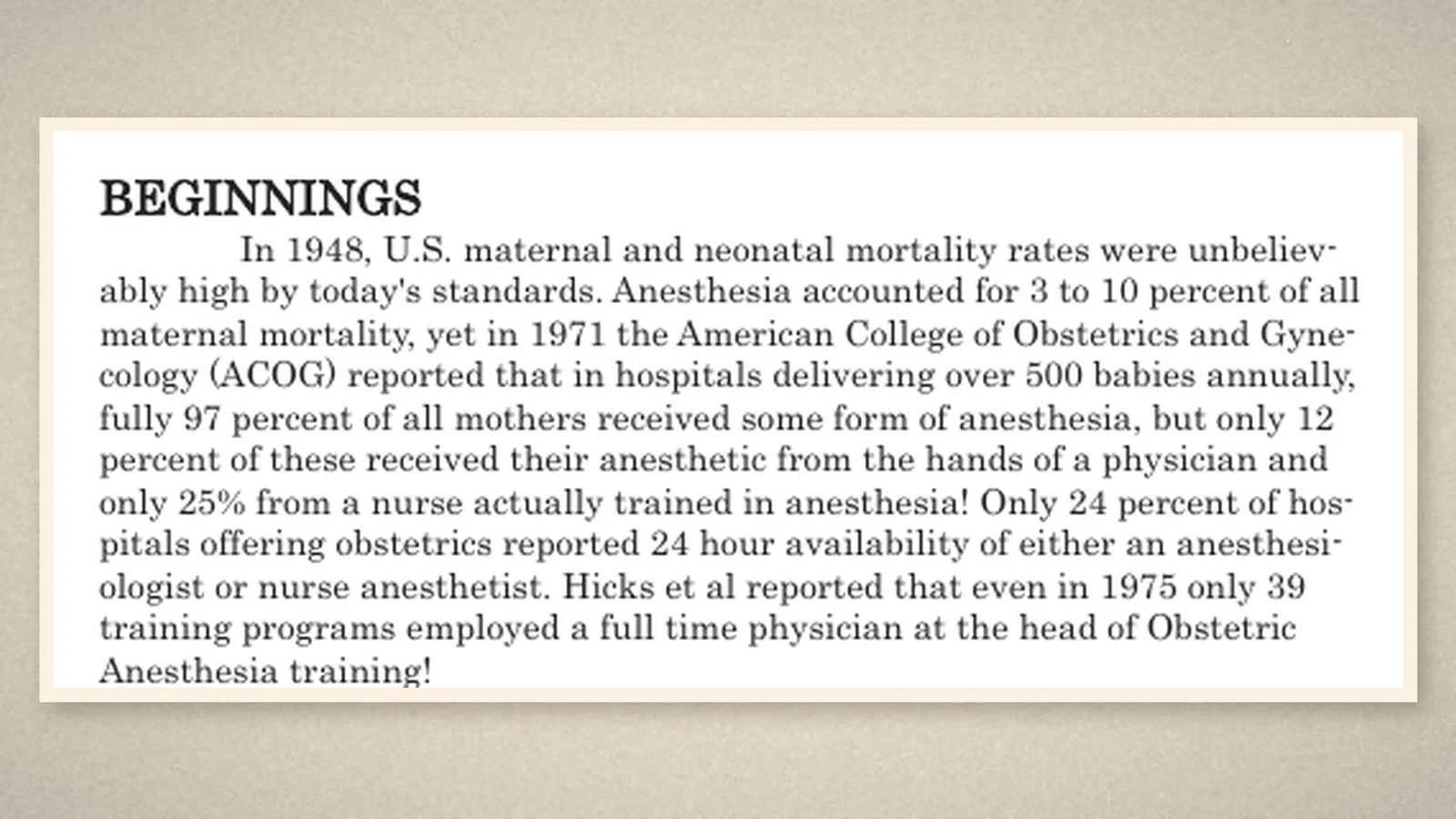
The booklet begins with the state of obstetric anaesthesia in the United States. In 1948, it says, anaesthesia accounted for 3 to 10 per cent of maternal deaths, and as late as 1971 the American College of Obstetricians and Gynecologists (ACOG) reported that in hospitals delivering more than 500 babies a year, "fully 97 percent of all mothers received some form of anesthesia, but only 12 percent of these received their anesthetic from the hands of a physician". A few people had made obstetric anaesthesia their work, at Boston Lying-In, Columbia, Johns Hopkins, Yale and Seattle, but they were scattered. [1, p. 3]
In 1964 and 1965 Bradley Smith wrote to colleagues to raise interest in a study group. In 1965 Sol Shnider (spelled "Schnider" in the booklet) surveyed the teaching programmes and "found only 15 people around the country interested in even forming a mailing list to circulate pertinent Obstetric Anesthesia reprints". Otto Phillips, chairman of the American Society of Anesthesiologists (ASA) Committee on Maternal Welfare, began to speak of an "Association of Obstetrical Anesthesiologists". [1, p. 3]
The meeting at O'Hare
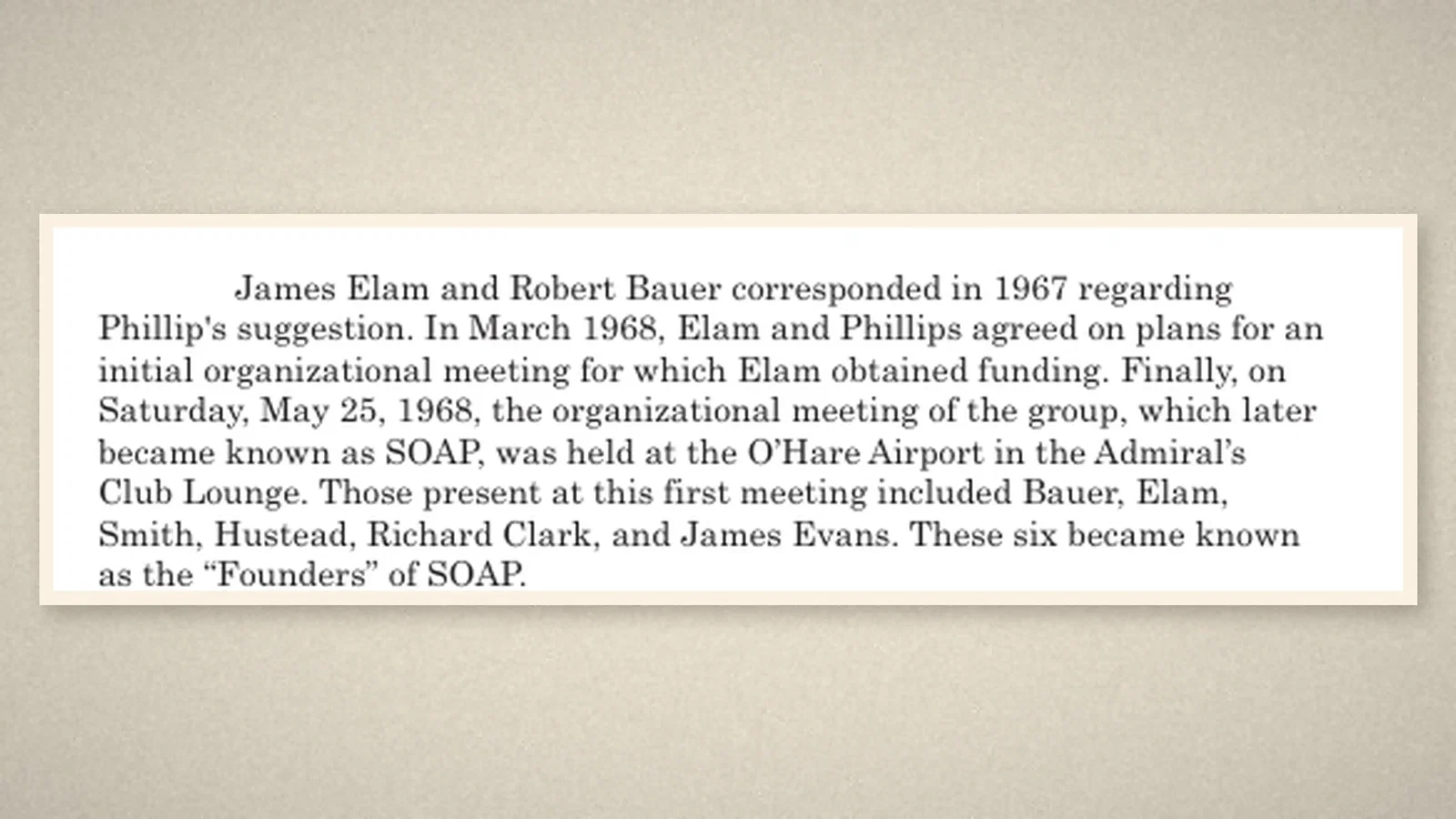
"James Elam and Robert Bauer corresponded in 1967 regarding Phillip's suggestion. In March 1968, Elam and Phillips agreed on plans for an initial organizational meeting for which Elam obtained funding. Finally, on Saturday, May 25, 1968, the organizational meeting of the group, which later became known as SOAP, was held at the O'Hare Airport in the Admiral's Club Lounge." Present were Bauer, Elam, Smith, Hustead, Richard Clark and James Evans: "These six became known as the 'Founders' of SOAP." [1, p. 4]
The six did not agree on where the group belonged. Clark, Evans and Smith were asked to draft a constitution; Smith hoped to merge the group into the ASA, while Clark thought resistance there would make that impractical and looked instead to a section within the obstetricians' organisation. Smith, by then chairing the ASA Obstetric Anesthesia Committee, convened an "interest group" at the ASA annual meeting in Washington on 20 October 1968, where the incoming ASA president, John Bonica, came from a dinner to offer "firm support"; and another at the ACOG annual meeting in Miami Beach on 28 April 1969, attended by anaesthesiologists including Fred Hehre, Gertie Marx and Hustead, and by obstetricians. [1, p. 4]
Going ahead alone
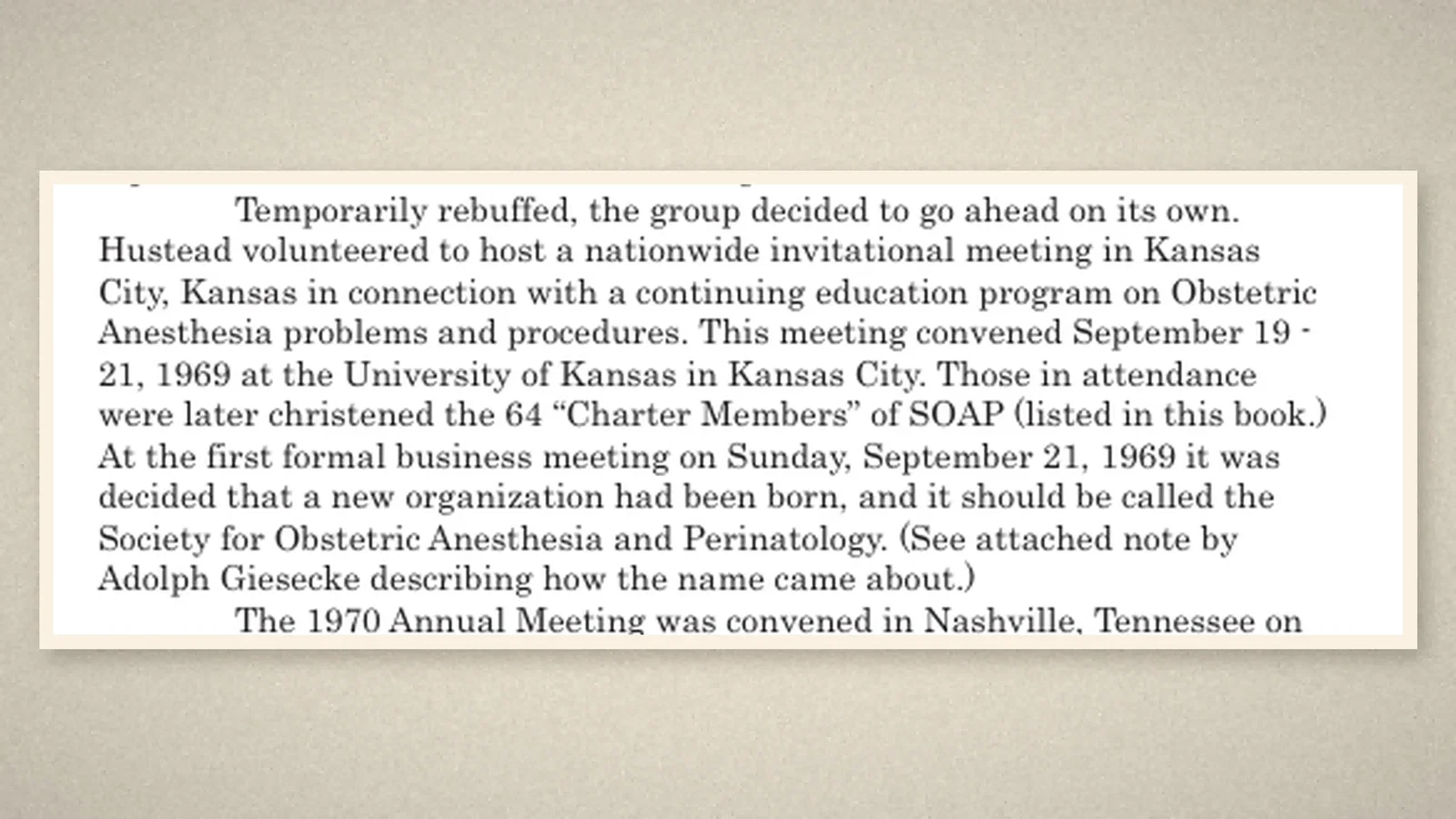
Neither parent organisation took the group in. ACOG's interest "was not sustained", and the ASA "decided against encouraging anesthesia specialty groups". So, "temporarily rebuffed, the group decided to go ahead on its own". Hustead hosted a nationwide invitational meeting with a continuing education programme on obstetric anaesthesia at the University of Kansas in Kansas City in September 1969; those attending "were later christened the 64 'Charter Members' of SOAP". "At the first formal business meeting on Sunday, September 21, 1969 it was decided that a new organization had been born, and it should be called the Society for Obstetric Anesthesia and Perinatology." [1, p. 4]
Adolph Giesecke, who was in the room, added a note on the name. A motion to call the group the Virginia Apgar Society was debated for an hour. Giesecke, doodling the words obstetricians, anesthesiologists and pediatricians on a pad, saw the acronym and proposed it, "saying that this would be the cleanest society in the world"; the group adjusted the words, and the name "passed without dissent". [1, p. 6]
The society then took shape slowly. At Nashville in September 1970 there was still no charter, and membership stood at 91; at Atlanta in April 1971 the first by-laws were adopted, with 185 names on the rolls; in 1972 a new attendance requirement cut them to 78. [1, pp. 4-5] Hustead, whose epidural needle appears in another article of this series, is also recorded by Frölich and Caton as "a founding member of the Society for Obstetric Anesthesia and Perinatology". [2, p. 218]
What the record shows
A specialty society that started as six people in an airport lounge, tried twice to find a home inside larger organisations, and then founded itself, with a name chosen to cover obstetricians, anaesthesiologists and paediatricians alike. The founders wrote this down forty years later because they feared it would otherwise be forgotten.
Sources and reading limits
Read: SOAP's fortieth-anniversary booklet, the history pages (pp. 3-5), Giesecke's vignette (p. 6) and the table of meetings (p. 7), with page images; Frölich and Caton's 2001 paragraph on Hustead; SOAP's history web page.
Not covered: the Wood Library-Museum video on the SOAP archives (a video, not watched); minutes, letters or the charter-member list from 1968 to 1972 beyond what the booklet summarises; contemporary journal notices of the early meetings, which were searched for in open Internet Archive items and not found.
Limits: the booklet is the society's own history, written by three founders about forty years after the events, and it states that much of the record is lost. It dates the Kansas City meeting 19-21 September 1969 in the text and 20-21 September in its table. Giesecke recalls a group of "twelve to fifteen" at the naming and does not trust the list of names. The booklet's claim that SOAP was "clearly the first" of the specialty societies is its own and is not repeated here as the article's. The 1971 ACOG figures are as the booklet quotes them. Quotations are from the English originals.
Three illustrations are crops of the booklet (pp. 3-4); one is drawn from it.
- Society for Obstetric Anesthesia and Perinatology. A celebration of forty years [pioneers booklet]. 2009. History by Hustead RF, Clark RB, Smith BE; vignette by Giesecke AH. SOAP
- Frölich MA, Caton D. Pioneers in epidural needle design. Anesth Analg. 2001;93:215-20. DOI
- Society for Obstetric Anesthesia and Perinatology. History and VIPs. SOAP
Continue exploring
Related reading connects shared questions and contexts; it does not by itself establish historical influence.
- 1975: Five Anaesthesiologists Refound the American Society of Regional Anesthesia
- 1954: Hustead Sands Down the Point of the Tuohy-Flowers Needle
Anesthesia Epochs · The Source Room · About & Editorial Method
Published November 3, 2026. Sources and reading limits are stated above. Illustrations are labelled as original source images or AI-made. Historical accounts are educational; they are not current treatment instructions.