
The American Society of Regional Anesthesia and Pain Medicine (ASRA) dates itself to 1975 and calls that year a refounding: late in 1973, at an examination in a New York hotel, Alon Winnie told Harold Carron, Jordan Katz and Donald Bridenbaugh of a society devoted to teaching regional anesthesia, and in 1975 the four, with P. Prithvi Raj, refounded the American Society of Regional Anesthesia; by its first annual meeting on 18 March 1976 it had more than 300 members, and its journal Regional Anesthesia appeared that October. The first society of the name was founded in 1923 by anaesthetists and neurosurgeons to honour Gaston Labat, was still meeting at the New York Academy of Medicine in 1931, was almost extinct for lack of paying members by the late 1930s, allied itself with the American Society of Anesthetists, and dissolved in 1940.
Reading Library · Anesthesia Epochs · 中文版
Watch the education video (for clinicians)
1975: ASRA Refounded — From Labat's 1923 Society to 1975 · Anesthesia Epochs Education Series
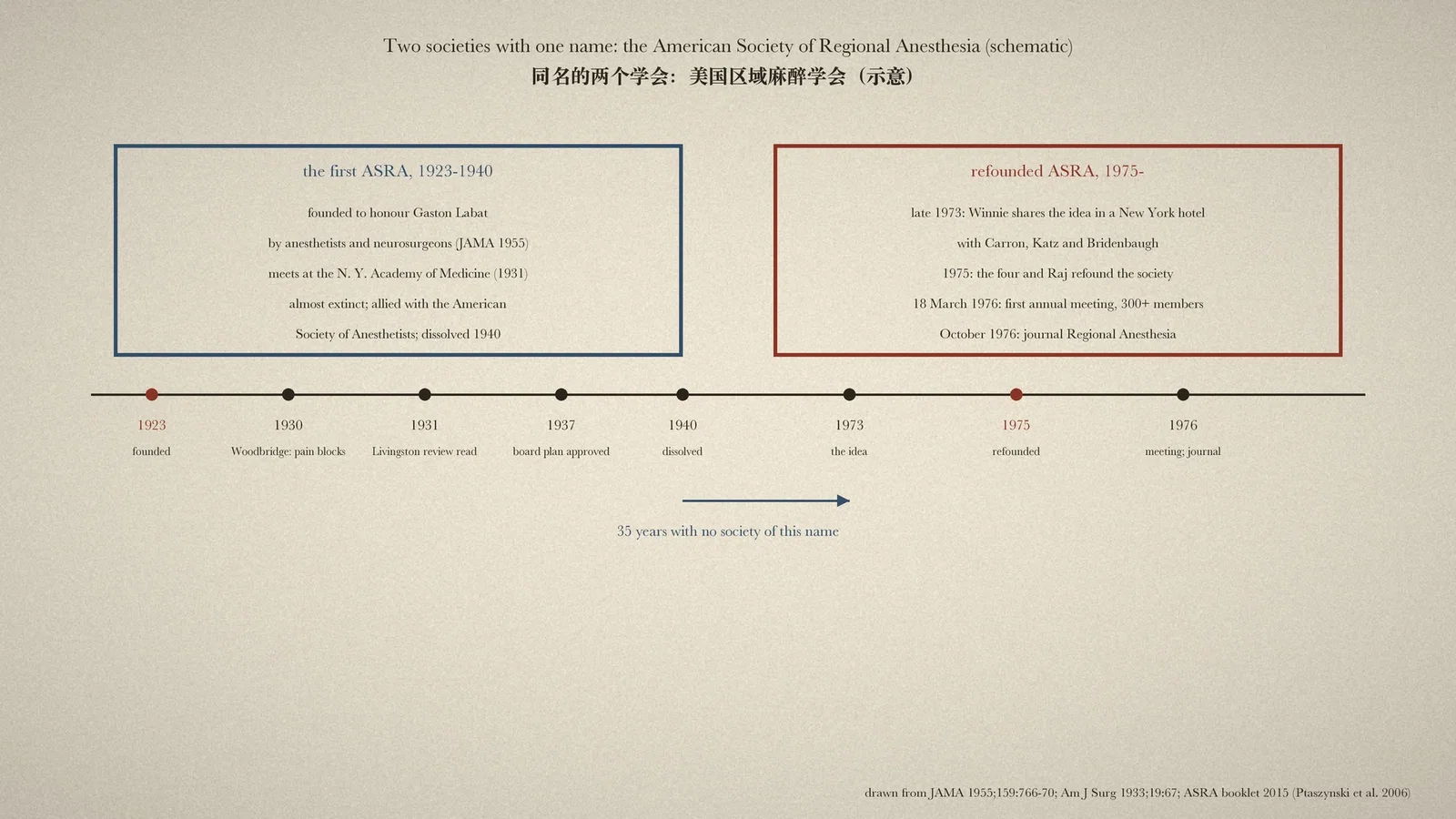
The American Society of Regional Anesthesia and Pain Medicine (ASRA) counts its anniversaries from 1975, but it does not call 1975 a founding. Its own history says the society was "re-founded" that year. There had been an American Society of Regional Anesthesia before, and it had disappeared. This article reads both societies through what can be found in print: a 1955 history of organised anaesthesiology in the Journal of the American Medical Association, a paper read before the first society in 1931, and the anniversary booklet the refounded society published in 2015. [4][2][3][1]
The first society
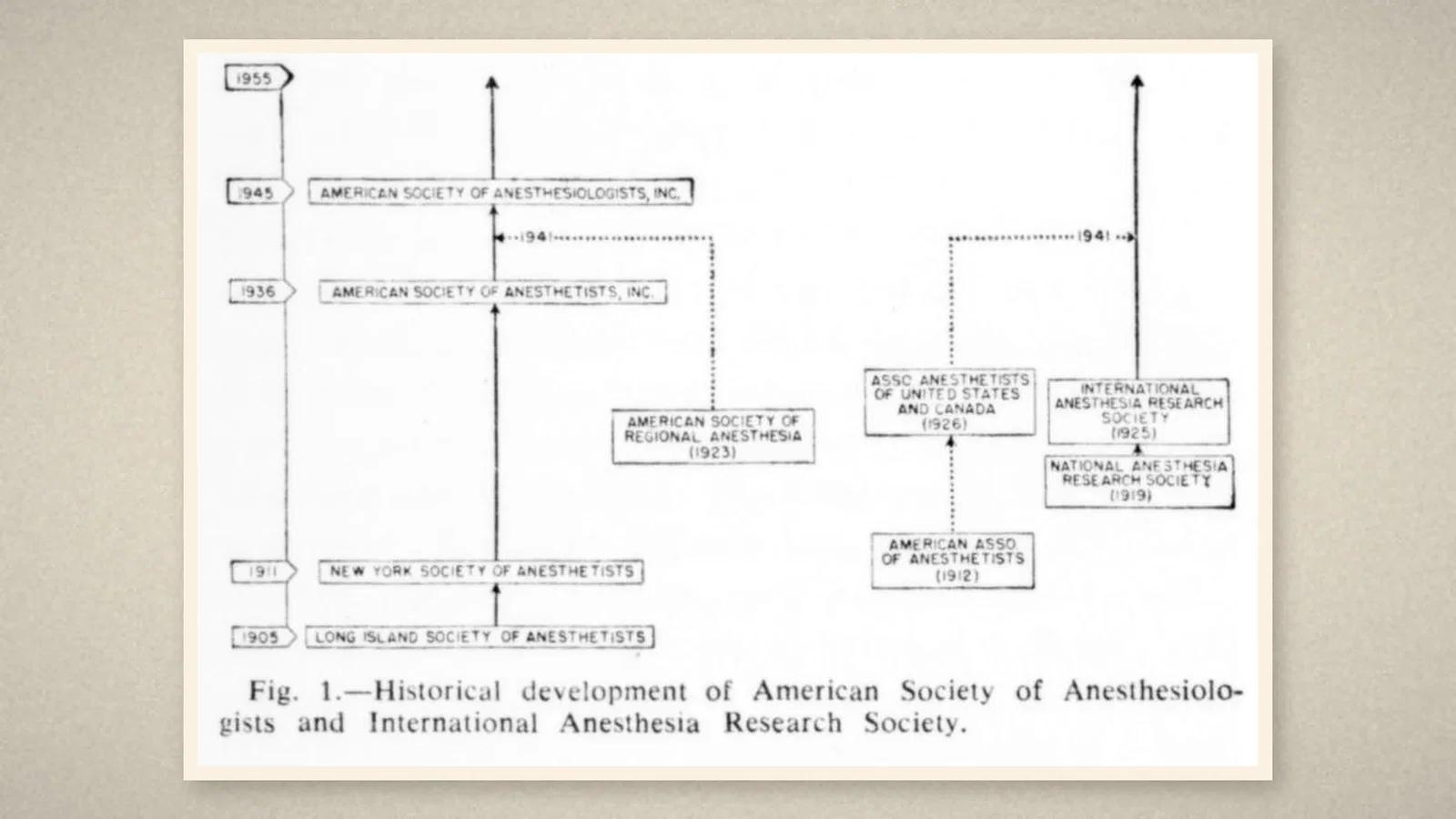
In 1955 four New York anaesthesiologists, Albert Betcher, Benjamin Ciliberti, Paul Wood and Lewis Wright, traced fifty years of organised anaesthesiology in the United States. Their chart of the societies that led to the American Society of Anesthesiologists includes a box labelled "American Society of Regional Anesthesia (1923)". The text explains: the society "was started by a group of anesthetists and neurosurgeons in 1923. Its original intent was to honor Gaston Labat, who had developed the art of local infiltration and nerve block techniques. Although it was a small organization, its existence later proved of inestimable value." [2, pp. 766-7]
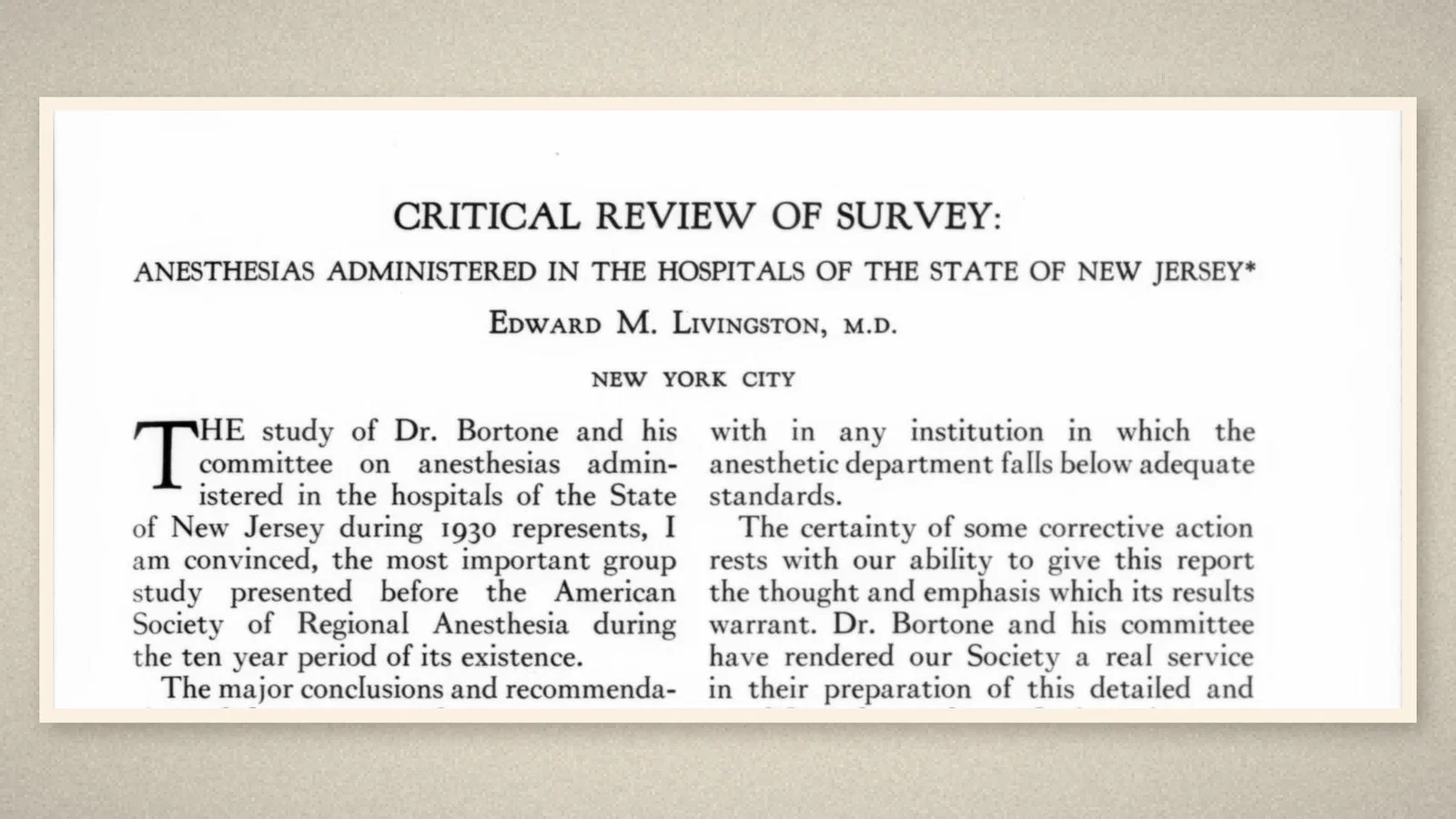
The society's meetings left traces in the journals. In January 1933 the American Journal of Surgery printed a review by Edward M. Livingston of New York, "prepared for the Executive Committee of the American Society of Regional Anesthesia" and read before it at the New York Academy of Medicine on 8 December 1931. Livingston called a survey of anaesthesia in New Jersey hospitals the most important group study presented before the society "during the ten year period of its existence". The survey's recommendations, as Livingston summarised them, were that hospital anaesthesia departments be headed by trained physician anaesthetists and that the untrained intern anaesthetist be recognised as a danger. [3, p. 67]
The 2015 booklet adds that the first ASRA honoured Labat, "a French surgeon" who "came to America with Mayo Clinic founder Charles Mayo" and created a course in regional anaesthesia through New York University at Bellevue Hospital, and that in 1930 Philip Woodbridge presented the use of therapeutic blocks for chronic pain at one of its meetings. By the end of that decade, it says, meetings were held less often and fewer members paid dues; "In 1940, the group was dissolved" and its members were invited to join the American Society of Anesthesiologists. [1, p. 2]
The 1955 authors explain why the small society still mattered. When anaesthetists sought recognition as a specialty in the years before 1937, the American Society of Regional Anesthesia, "almost extinct because of its lack of dues-paying membership, allied itself with" the American Society of Anesthetists, and the plan to affiliate an anaesthesiology board with the American Board of Surgery, approved by both societies, was completed on 2 June 1937. [2, p. 768]
The second society
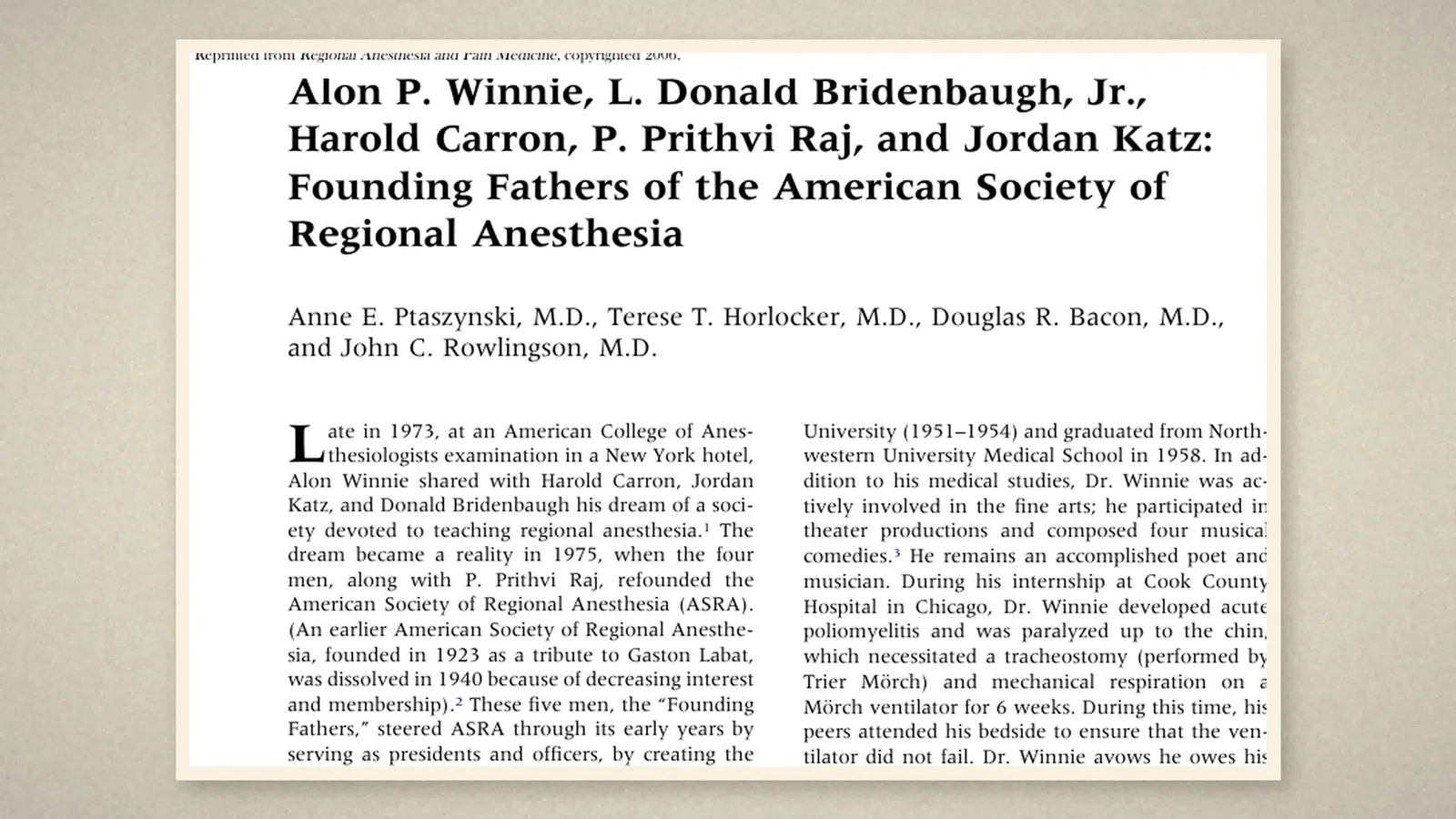
The refounding is told in an article by Anne Ptaszynski, Terese Horlocker, Douglas Bacon and John Rowlingson, published in 2006 and reprinted in the booklet. Late in 1973, at an American College of Anesthesiologists examination in a New York hotel, Alon Winnie told Harold Carron, Jordan Katz and Donald Bridenbaugh of a dream: "a society devoted to teaching regional anesthesia". In 1975 the four, "along with P. Prithvi Raj, refounded the American Society of Regional Anesthesia". [1, p. 4]
The five took the offices and built the institutions. Winnie was the first president, from 1975 to 1980; Carron was the first secretary-treasurer and established the society's journal, Regional Anesthesia, in 1976, editing it until 1982. At the first annual meeting, on 18 March 1976, "only 6 months after the birth of the organization", the society already had more than 300 members, and the first issue of the quarterly journal was distributed in October 1976. [1, pp. 4, 9] The refounded society concentrated at first on regional anaesthesia and later added pain medicine, as its present name records. [1, p. 3]
In a lecture named after Labat in 1982, the article recalls, Winnie warned against repeating the first society's fate: there was "a need for the present society to finish the work started by the old society, and then some". [1, p. 9]
What the record shows
Two societies with one name, separated by thirty-five years. The first was small, met in New York, honoured a teacher of nerve blocks and helped the specialty win its board before fading away. The second was started by five anaesthesiologists who knew that history, took the old name, and gave the society a journal and a regular meeting from the start.
Sources and reading limits
Read: ASRA's 2015 anniversary booklet in full, including the reprinted 2006 article by Ptaszynski and colleagues, with page images; Betcher and colleagues, JAMA 1955, on the society and on certification; the first page of Livingston's 1933 review (page image); the ASRA web page's history paragraph.
Not covered: the Wood Library-Museum video on the ASRA archives (a video, not watched); Bacon, Reddy and Murphy's 1995 paper on regional anaesthesia between the wars; minutes or membership lists of either society; the first issue of Regional Anesthesia.
Limits: the founding year 1923 is given by the 1955 article and the 2015 booklet; Livingston's "ten year period" in 1931 is consistent with it but not exact. The dissolution in 1940 is the booklet's statement. The accounts of 1973 and 1975 come from the society's own anniversary publications, written about the founders by later colleagues. Phrases such as Labat as the "father" of regional anaesthesia are the booklet's. Quotations are from the English originals.
Three illustrations are crops of JAMA 1955, the American Journal of Surgery 1933 and the 2015 booklet; one is drawn from the sources.
- American Society of Regional Anesthesia and Pain Medicine. 1975-2015: a rich tradition, an exciting future. 2015. Includes Ptaszynski AE, Horlocker TT, Bacon DR, Rowlingson JC. Founding fathers of the American Society of Regional Anesthesia. Reg Anesth Pain Med. 2006;31:71-8. ASRA
- Betcher AM, Ciliberti BJ, Wood PM, Wright LH. Fifty years of organized anesthesiology. JAMA. 1955;159(8):766-70. Internet Archive
- Livingston EM. Critical review of survey: anesthesias administered in the hospitals of the State of New Jersey. Am J Surg. 1933;19(1):67. Internet Archive
- ASRA Pain Medicine. About ASRA Pain Medicine. ASRA
Continue exploring
Related reading connects shared questions and contexts; it does not by itself establish historical influence.
Anesthesia Epochs · The Source Room · About & Editorial Method
Published November 3, 2026. Sources and reading limits are stated above. Illustrations are labelled as original source images or AI-made. Historical accounts are educational; they are not current treatment instructions.