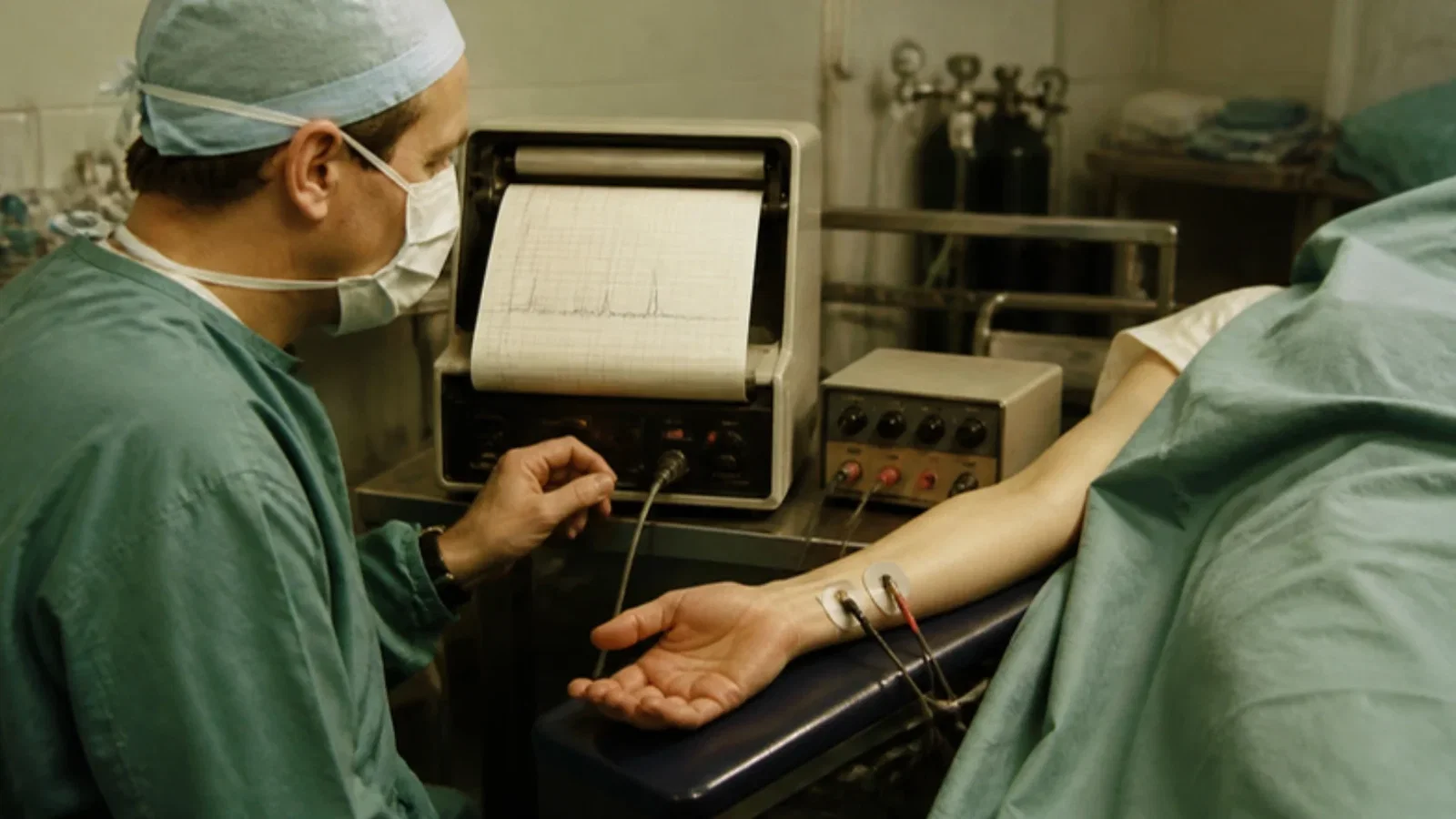
In 1970 the British Journal of Anaesthesia (vol. 42, pp. 967-78) printed 'Stimulus frequency in the detection of neuromuscular block in humans' by Hassan H. Ali, J. E. Utting and Cecil Gray of the Department of Anaesthesia, University of Liverpool. From the physiology of neuromuscular transmission they proposed two new ways to assess block: comparing twitch heights at different stimulus frequencies, and examining the fade of twitches in response to a short train of four stimuli. After tubocurarine the four twitches faded progressively, apparently in proportion to the degree of curarization, and the authors suggested expressing the last response of the train as a percentage of the first. They noted earlier work: Grob and colleagues' trains of four on the electromyogram in 1956, and Roberts and Wilson's train of four in myasthenia gravis in 1968. In 1971 Part I showed that the fourth-to-first ratio needed no control observation and correlated closely with a ratio that did; Part II compared it with patients' ability to lift the head after anaesthesia, obvious weakness going with a ratio below 0.6.
Reading Library · Anesthesia Epochs · 中文版
Watch the education video (for clinicians)
1970: The Train of Four — Ali, Utting and Gray · Anesthesia Epochs Education Series
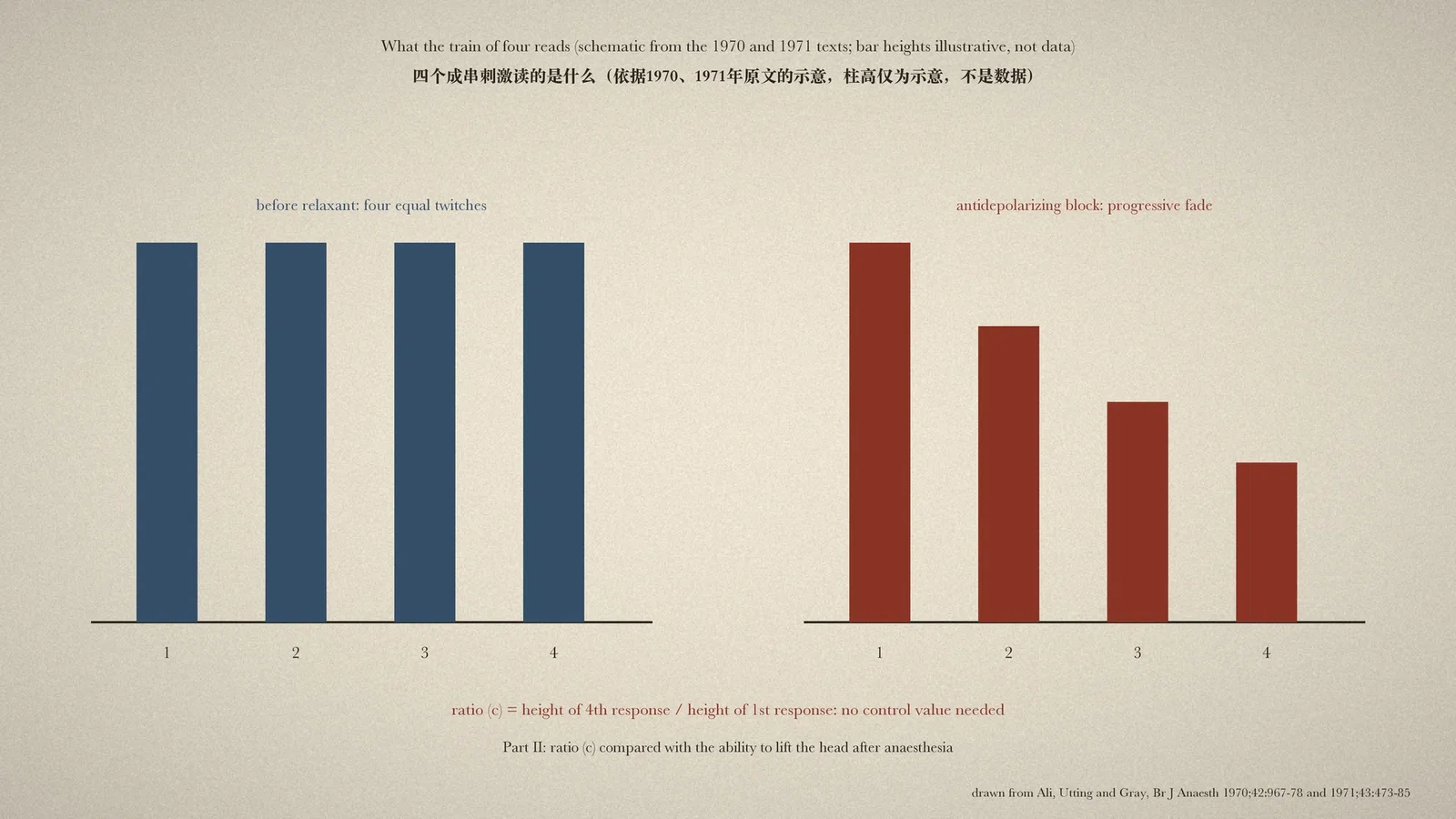
How much of a relaxant's effect is left at the end of an operation? Give four stimuli in quick succession and see how much each twitch falls below the one before, and the answer can be read off. In 1970 and 1971 three papers from Liverpool proposed this method, tested it, and matched it against whether a patient could lift the head. [1, p. 967][3, p. 478]
Two new methods
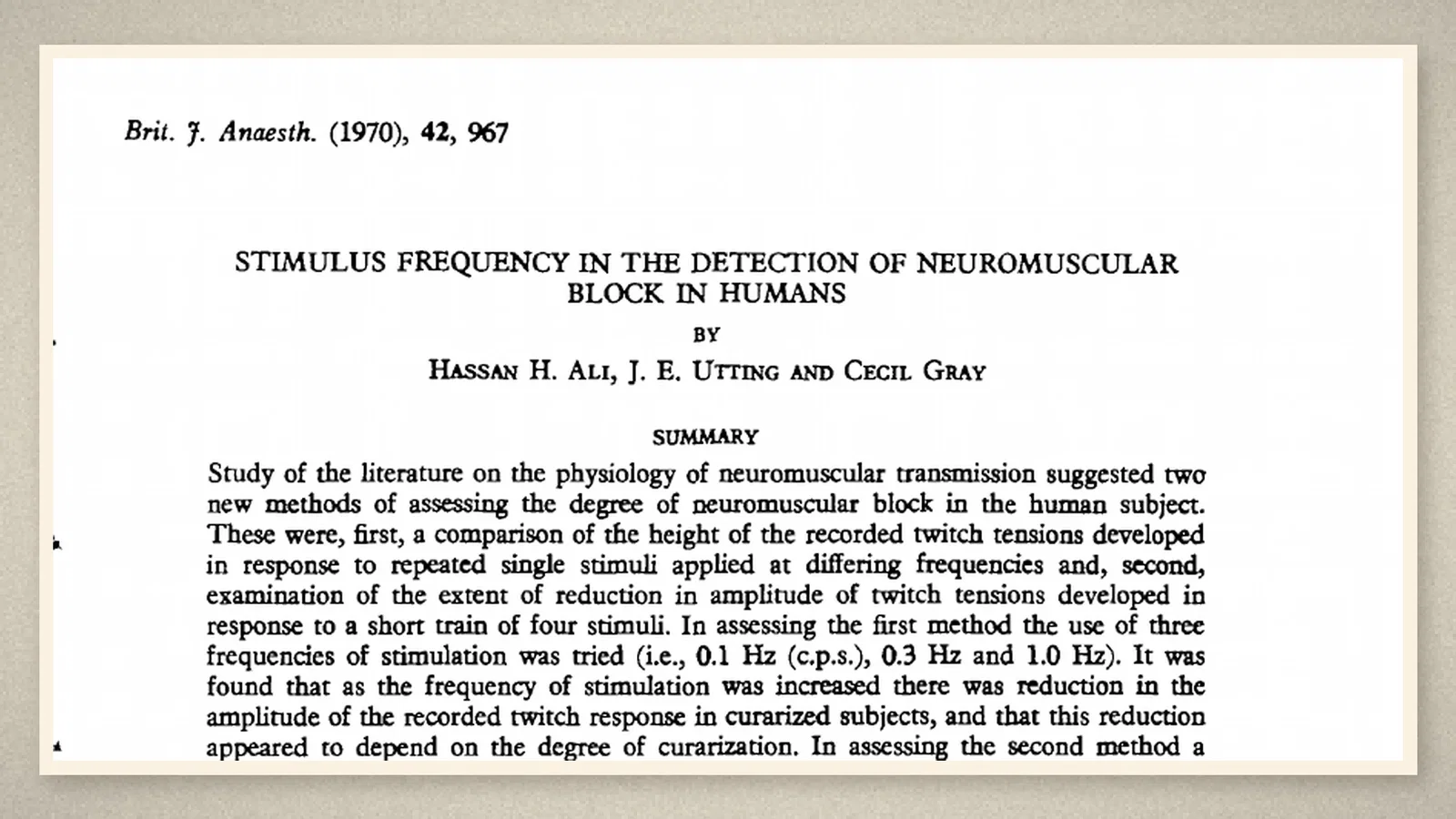
In November 1970 the British Journal of Anaesthesia printed "Stimulus frequency in the detection of neuromuscular block in humans" by Hassan H. Ali, J. E. Utting and Cecil Gray of the Department of Anaesthesia, University of Liverpool. Their summary says that a study of the literature on neuromuscular transmission had suggested two new methods of assessing the degree of block in human subjects. One compared the heights of twitches evoked by single stimuli at different frequencies. The other examined how far the twitches fell in response to "a short train of four stimuli". [1, p. 967]
For the second method the authors found "a progressive fade of successive recorded mechanical twitch responses in curarized subjects", which appeared to depend on the degree of curarization. They suggested that the last response of the train, expressed as a percentage of the first, might be useful in measuring the degree of block in man. [1, p. 967]
Earlier work
The paper is open about its predecessors. Its introduction notes that Grob, Johns and Harvey in 1956 had already used trains of four stimuli to record evoked electromyograms in man, with a steplike depression of the second to fourth potentials after tubocurarine, the fourth falling most. Roberts and Wilson in 1968 had used a train of four to assess myasthenia gravis. [1, p. 967][1, p. 968] The Liverpool group's contribution was to use the fade to measure block during anaesthesia and to offer a ratio that could be read directly.
Volunteers and patients
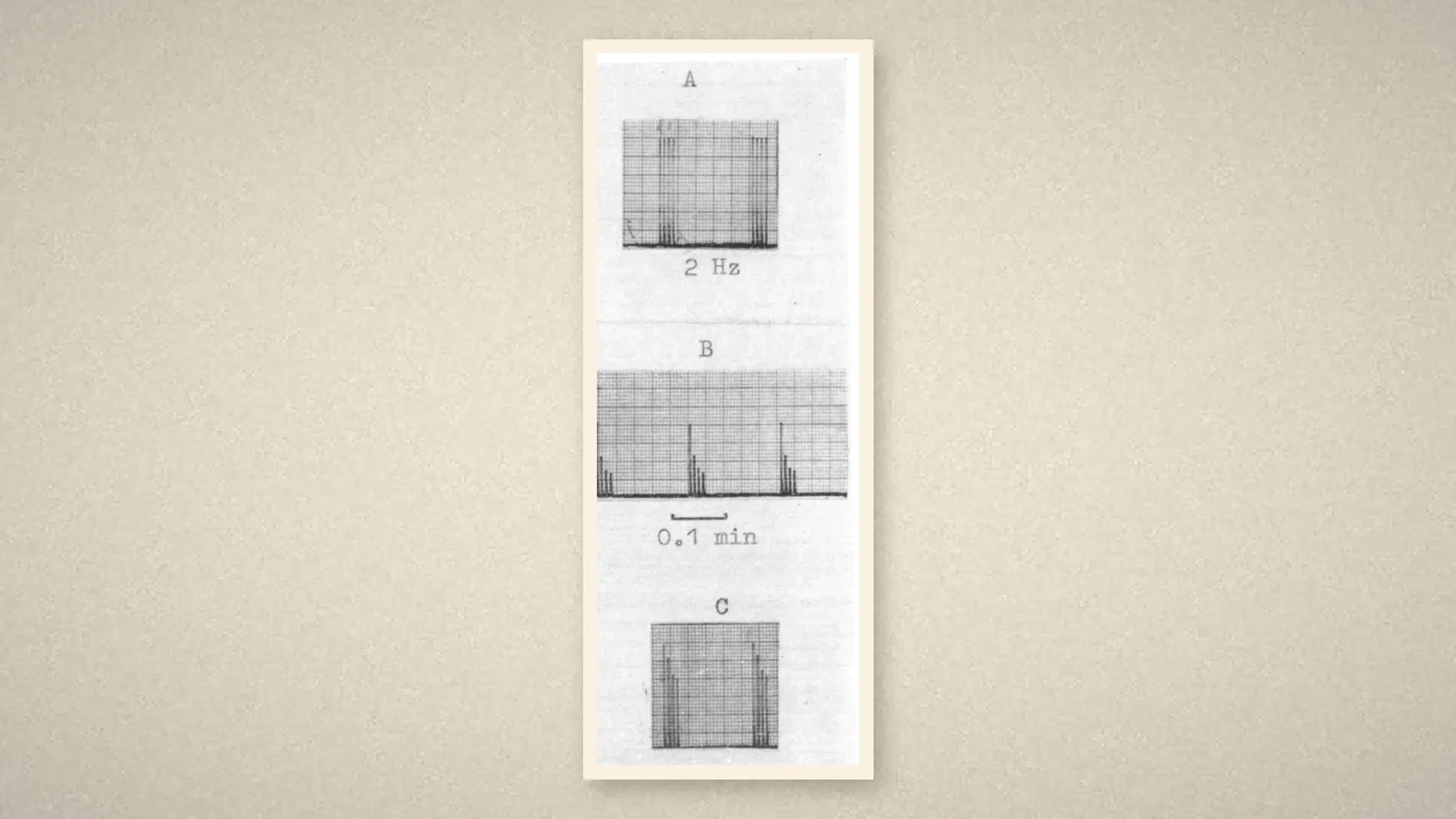
The study included conscious volunteers as well as anaesthetized patients. In most volunteers the second to fourth twitches of the train fell after tubocurarine. During recovery the four twitches returned gradually to control, the first most rapidly and the fourth most slowly. Anaesthetized patients showed the same pattern, and neostigmine hastened recovery. The three tracings of Fig. 9, before, during and after block, show the fade plainly. [1, p. 972]
No control value needed
In 1971 the group published two sequels in the same journal. Part I presented a way of assessing residual block after antidepolarizing relaxants "which does not involve the necessity for establishing control observations". The ulnar nerve at the elbow was stimulated with intermittent trains of four, and three ratios were analysed: ratio (a), the first response against the control before relaxant; ratio (b), the second against the first; and ratio (c), the fourth against the first. There was a highly significant positive linear association between ratio (a), which needs a control, and ratios (b) and (c), which do not. [2, p. 473]
Matching it to head lift
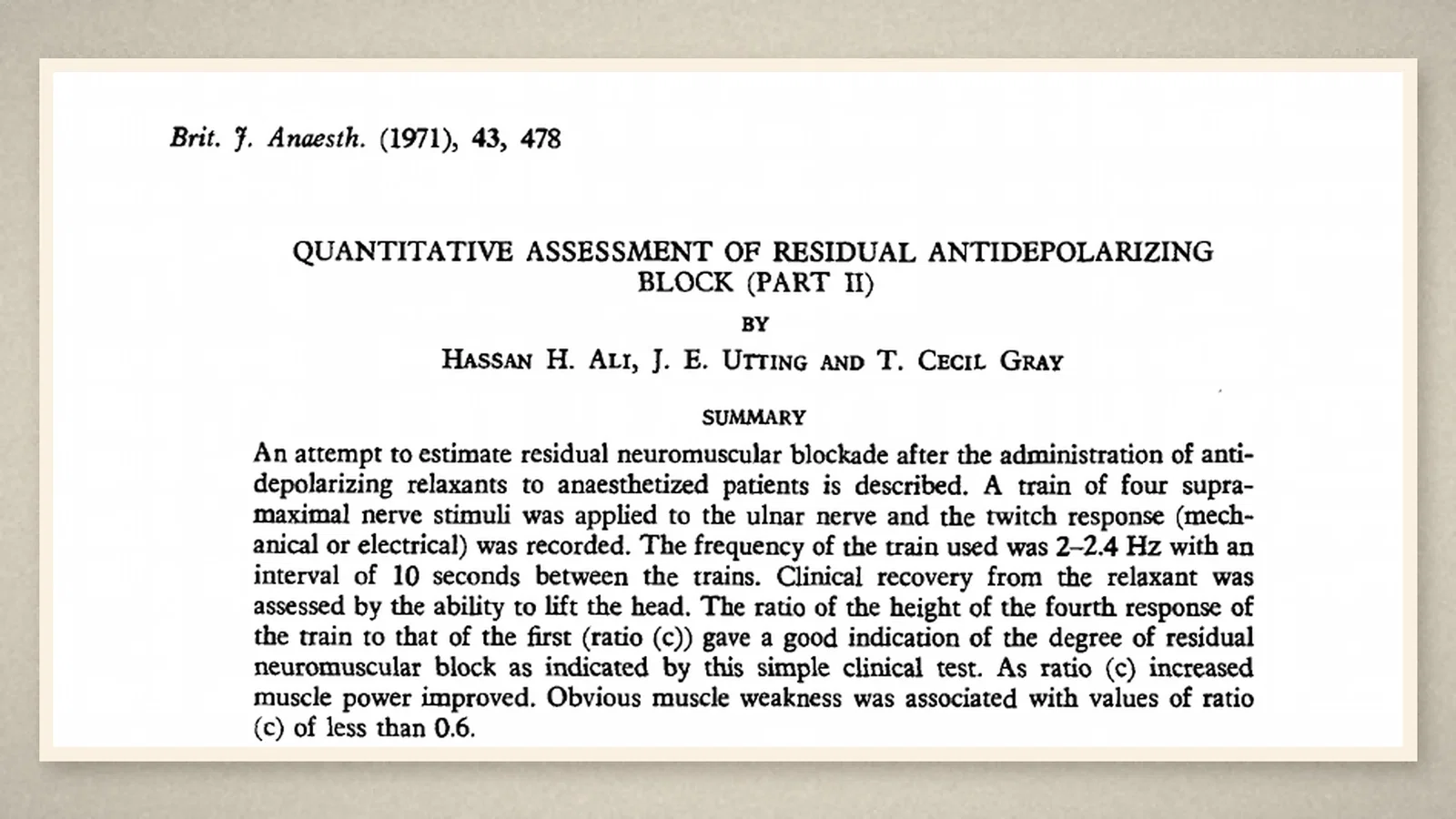
Part II compared the train of four in patients after anaesthesia with a simple clinical test: could they lift the head? The authors chose head-lifting because it is easy to test straight after anaesthesia and is a more sensitive index of weakness than maximal inspiratory and expiratory flows. Ratio (c) "gave a good indication of the degree of residual neuromuscular block": as it rose, muscle power improved, and "obvious muscle weakness was associated with values of ratio (c) of less than 0.6". [3, p. 478]
What the record shows
The beauty of the train of four is that it carries its own reference. The earliest twitch is the yardstick for the other three, so no one needs to know what the patient looked like before the relaxant. The value 0.6 was a line the authors saw in their own patients, not a recommendation made here; how later standards revised it was not checked.
Sources and reading limits
Read: Ali, Utting and Gray, Br J Anaesth 1970;42:967-78 (summary, introduction, methods headings, results on the train of four and discussion, with figures and page images of pp. 967 and 972 checked); Part I, Br J Anaesth 1971;43:473-7 (summary, introduction and method); Part II, Br J Anaesth 1971;43:478-85 (summary, introduction and methods, results skimmed, page image of p. 478 checked). All three are publisher PDFs of the published articles; the British Journal of Anaesthesia's 1998 reprint of the 1970 paper was also obtained but not used.
Not covered: Grob, Johns and Harvey (1956) and Roberts and Wilson (1968), which the authors cite; later work on acceleromyography and recovery thresholds. The ASA timeline entry was not used as evidence.
Limits: the authors themselves cite earlier trains of four (Grob and colleagues on the electromyogram, Roberts and Wilson in myasthenia), so this article describes Ali, Utting and Gray's contribution as using the fade of a train of four, and the fourth-to-first ratio, to measure block in anaesthesia, not as the origin of trains of stimuli. The value 0.6 is the authors' observation in their patients, not a recommendation of this article. Drug doses are not repeated, and page crops stop before them. Volunteers and patients are not identified.
Three illustrations are crops of Br J Anaesth 1970 pp. 967 and 972 and 1971 p. 478 (p. 972 shows the tracings of Fig. 9 without the caption that gives doses). One is a schematic drawn from the texts, with illustrative bar heights, not data.
- Ali HH, Utting JE, Gray C. Stimulus frequency in the detection of neuromuscular block in humans. Br J Anaesth. 1970;42:967-78. DOI
- Ali HH, Utting JE, Gray TC. Quantitative assessment of residual antidepolarizing block (Part I). Br J Anaesth. 1971;43:473-7. DOI
- Ali HH, Utting JE, Gray TC. Quantitative assessment of residual antidepolarizing block (Part II). Br J Anaesth. 1971;43:478-85. DOI
Continue exploring
Related reading connects shared questions and contexts; it does not by itself establish historical influence.
- 1958: Christie and Churchill-Davidson's Operating-Theatre Nerve Stimulator
- 1977: Crul and Booij Begin Trials of Org NC 45, Later Vecuronium
Anesthesia Epochs · The Source Room · About & Editorial Method
Published November 3, 2026. Sources and reading limits are stated above. Illustrations are labelled as original source images or AI-made. Historical accounts are educational; they are not current treatment instructions.