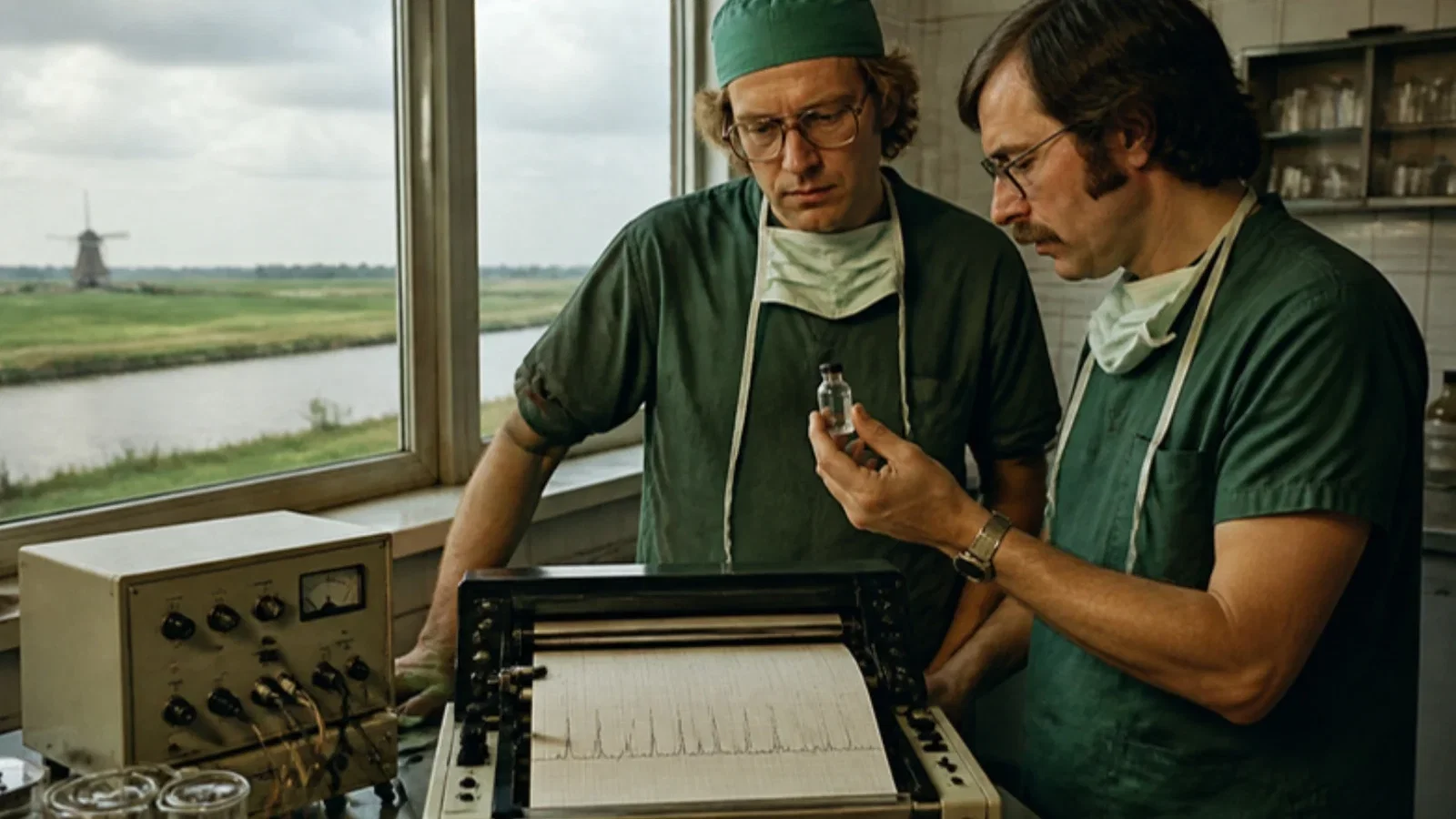
Supplement 1 to volume 52 of the British Journal of Anaesthesia (1980) gathered work on Org NC 45 presented at a meeting organised by Organon-Teknica in Lucerne in November 1979. The editors, Norman and Bowman, called it a steroidal agent similar to pancuronium but with only one quaternary group. Savage, Sleigh and Carlyle of Organon described how, since a shorter-acting agent was still needed, they arrived at Org NC 45 from the pancuronium series. Crul and Booij of the University Hospital, Nijmegen, reported that after animal work they had begun their first clinical trials in 1977: 18 patients received Org NC 45 and 22 pancuronium; Org NC 45 was slightly more potent, with significantly shorter onset, duration and recovery, no cumulation over repeated doses, and no tachycardia or change in arterial pressure even at three times the 95% blocking dose, whereas pancuronium almost always caused tachycardia. In 1982 Gencarelli and Miller in the same journal gave Org NC 45 its new generic name, vecuronium.
Reading Library · Anesthesia Epochs · 中文版
Watch the education video (for clinicians)
1977: Vecuronium (Org NC 45) — Reading the Early Trials · Anesthesia Epochs Education Series
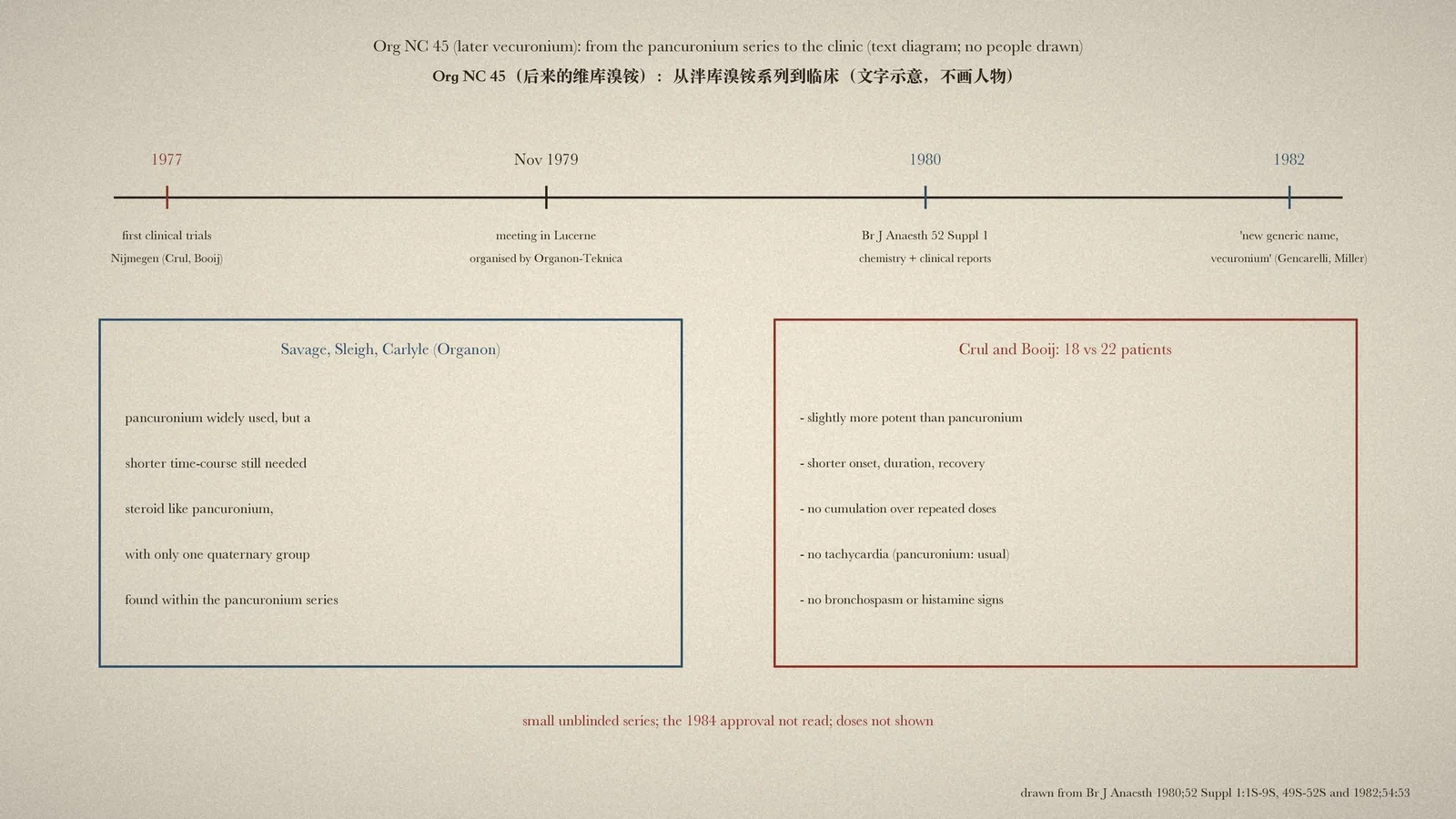
Pancuronium was widely used, but it lasted a long time and usually quickened the heart. The drug later named vecuronium began as a close relative of pancuronium, with the code Org NC 45. In 1977 two anaesthetists in the Netherlands began giving it to patients. Their report, along with the chemists' account of how the compound was found, filled a supplement of the British Journal of Anaesthesia in 1980. [1, p. 3S][1, p. 49S]
A supplement for one drug
The supplement's introduction, by John Norman and W. C. Bowman, called Org NC 45 "a steroidal agent similar to pancuronium but with only one quaternary" nitrogen group. The papers had been presented "at a meeting in Lucerne in November 1979 organized by Organon-Teknica". [1, p. 2S] The editors listed what anaesthetists need to know about any new relaxant: the type of block, its potency, its effects on the autonomic system, histamine release, pharmacokinetics, and the roles of the kidney and liver in elimination. They left readers to judge how well the supplement answered those questions. [1, p. 2S]
From the pancuronium series
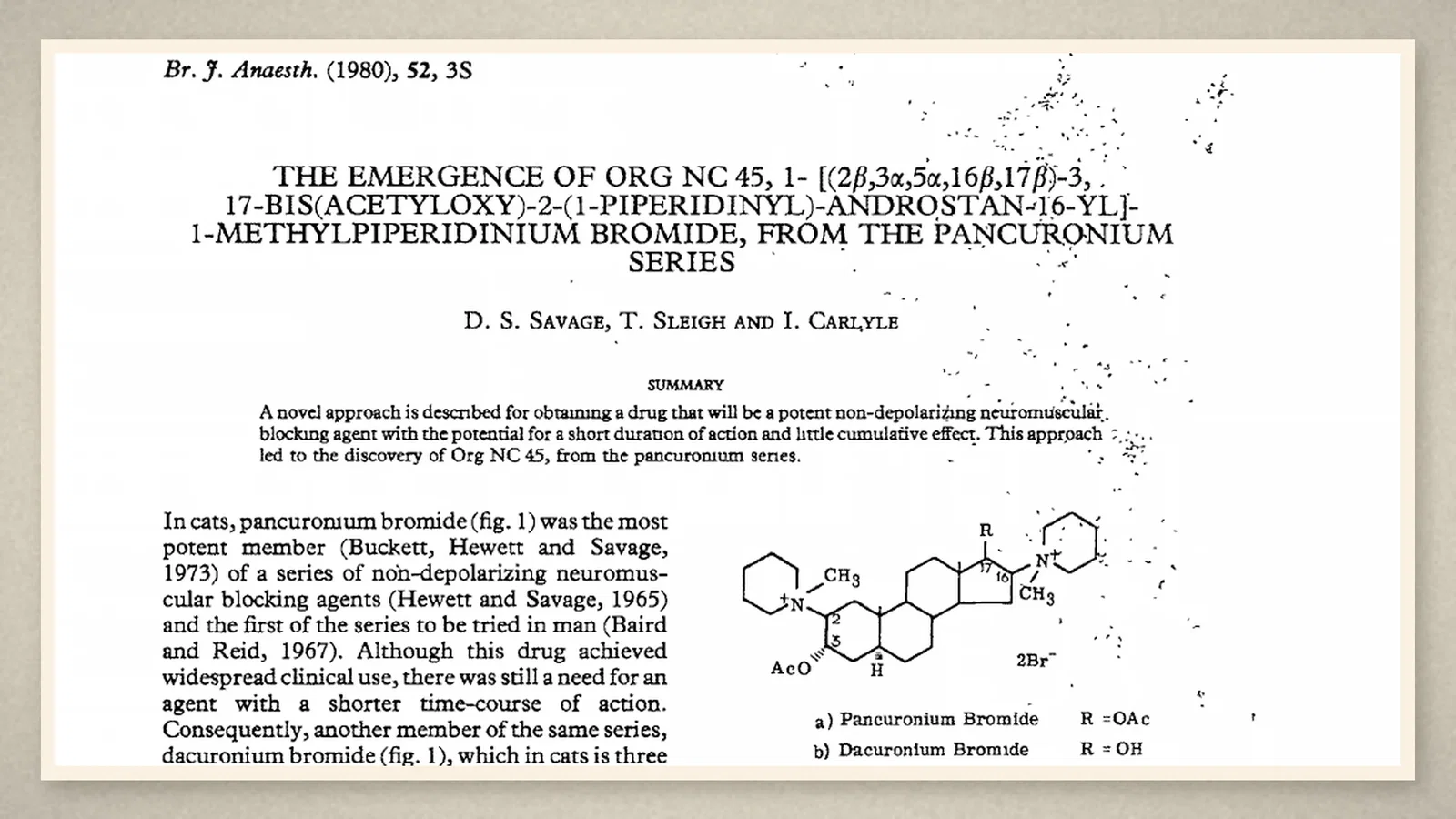
The chemists were D. S. Savage, T. Sleigh and I. Carlyle of the Scientific Development Group, Organon Laboratories. Their paper's title describes "the emergence of Org NC 45 ... from the pancuronium series". In cats, pancuronium had been the most potent member of the series and the first tried in man. Although it achieved widespread clinical use, "there was still a need for an agent with a shorter time-course of action". [1, p. 3S]
Earlier attempts in the same series had been faster or weaker, but not usefully shorter in man. The new approach was to build features into the molecule that would make it more selective for the neuromuscular junction than for the vagus, and more open to metabolic inactivation. The summary says this approach "led to the discovery of Org NC 45, from the pancuronium series". [1, p. 3S]
First clinical experiences
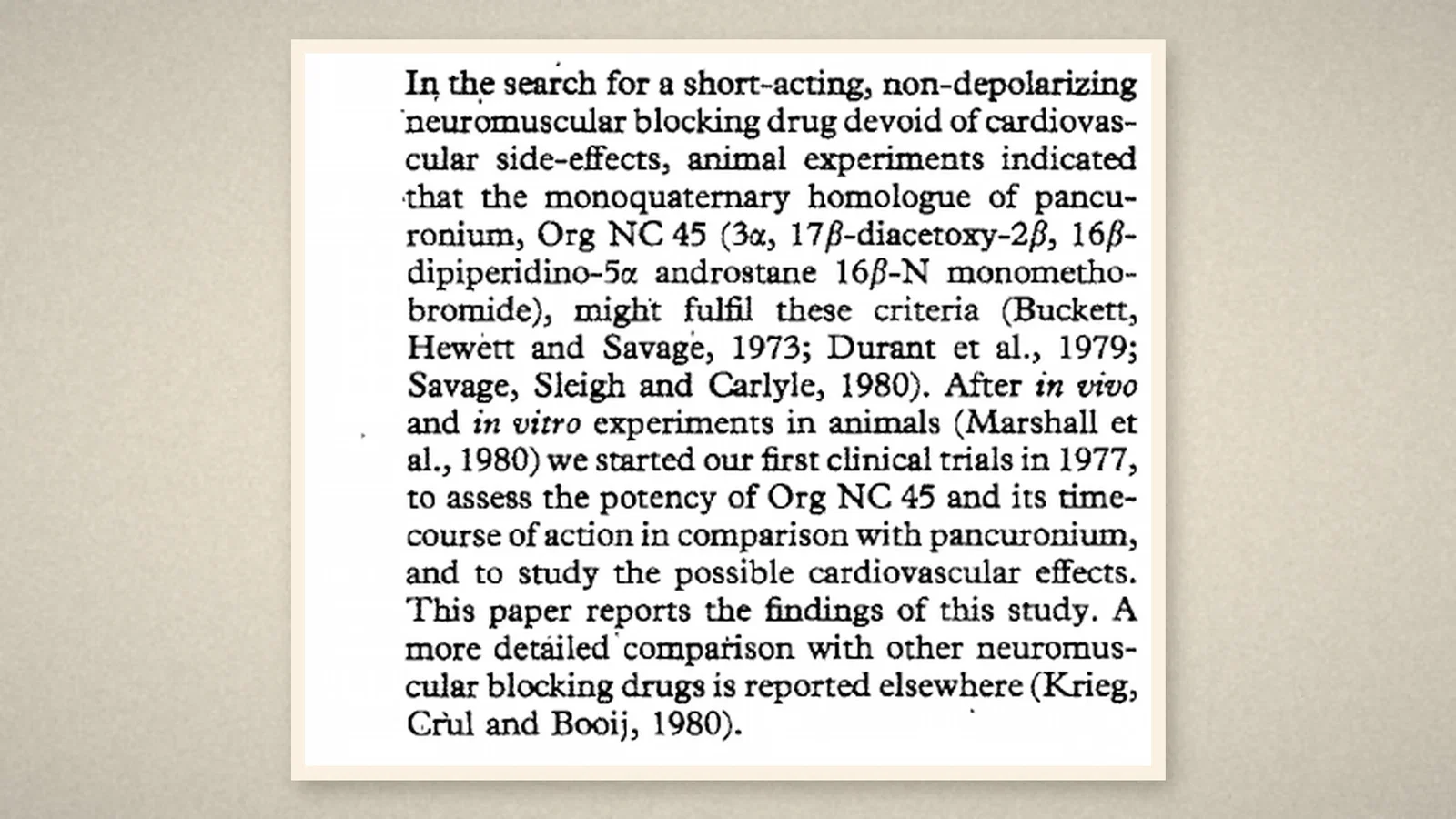
J. F. Crul and L. H. D. J. Booij of the Department of Anesthesiology, University Hospital, Nijmegen, wrote "First clinical experiences with Org NC 45". After animal experiments, "we started our first clinical trials in 1977". Their aim was to assess its potency and time-course against pancuronium and to look for cardiovascular effects. [1, p. 49S]
Forty adult patients having abdominal or limb surgery took part: 18 received Org NC 45 and 22 received pancuronium. The authors recorded the twitch of the thumb, the electromyogram, the ECG and arterial pressure, and they watched for signs of histamine release or bronchospasm. [1, p. 49S] Onset, duration and slope of recovery "were significantly shorter for Org NC 45", and "no cumulative effects were noticed over several consecutive doses". Even at three times the dose that blocked 95% of the twitch, there was "no tachycardia or arterial pressure changes". [1, p. 49S]
What the authors made of it
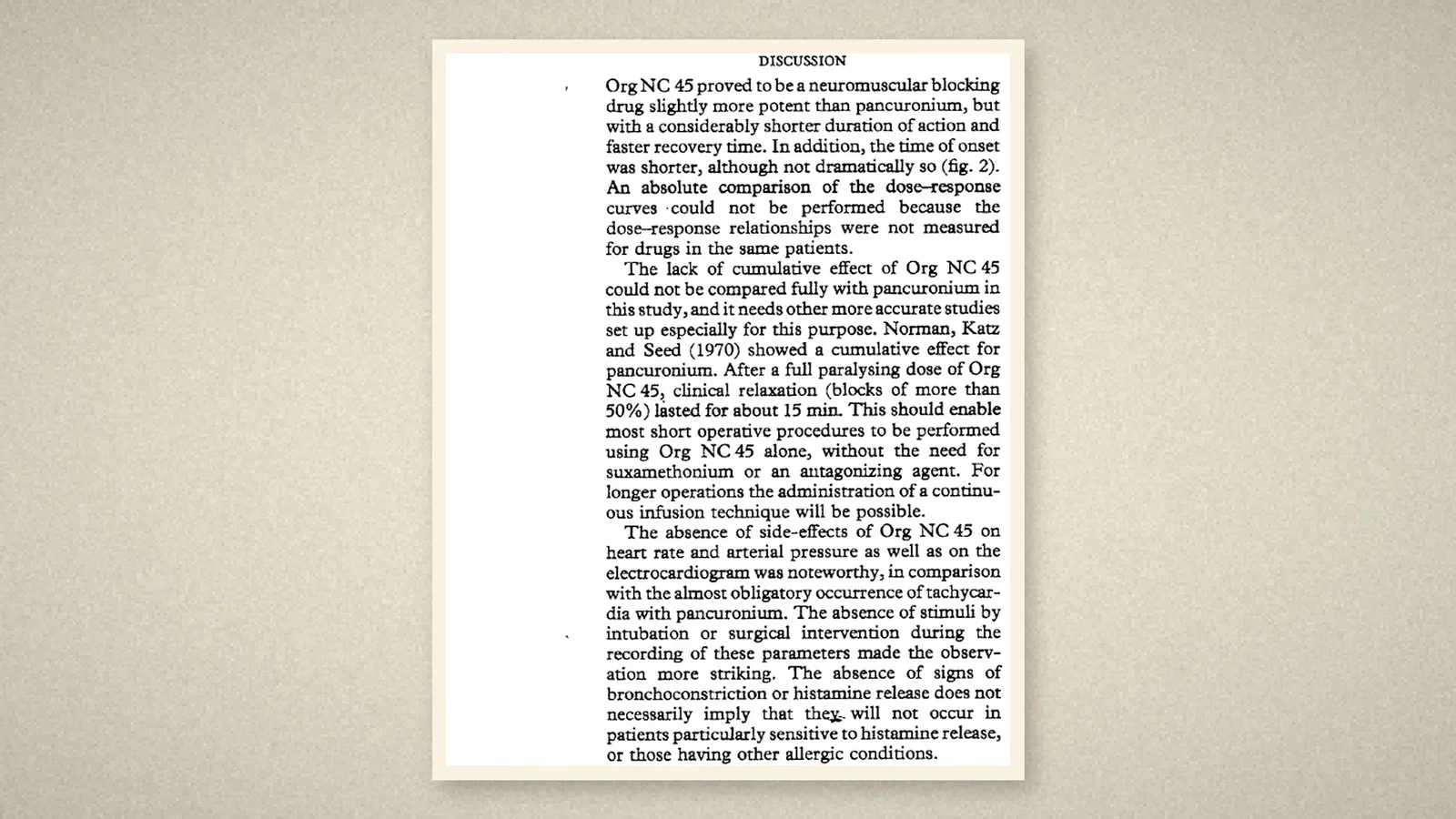
In the discussion, Org NC 45 proved a "drug slightly more potent than pancuronium, but with a considerably shorter duration of action". After a full paralysing dose, clinical relaxation lasted "for about 15 min", enough for most short operations without suxamethonium or an antagonist. Longer operations could use a continuous infusion. [1, p. 51S]
The absence of effects on heart rate and pressure was "noteworthy" in comparison "with the almost obligatory occurrence of tachycardia with pancuronium". The authors also added a caution. The lack of histamine release in their patients "does not necessarily imply that they will not occur" in patients who are sensitive to histamine or allergic. [1, p. 51S]
A name
Two years later the code gave way to a name. A 1982 paper by Gencarelli and Miller in the same journal is titled "Antagonism of Org NC45 (vecuronium) and pancuronium neuromuscular blockade by neostigmine". Its text begins with "Org NC 45 (new generic name, vecuronium)". [2, p. 53]
What the record shows
The drug that became vecuronium was designed as a shorter pancuronium that would leave the heart alone. The first patients in Nijmegen bore out both aims, in a small series that the authors themselves treated as preliminary.
Sources and reading limits
Read: British Journal of Anaesthesia 1980;52 Supplement 1. This covered Norman and Bowman's introduction (1S-2S) and Savage, Sleigh and Carlyle (3S-9S), with the chemistry skimmed, and Crul and Booij (49S-52S) in full. Also read: Gencarelli and Miller, 1982, the title and opening. All of these come from Internet Archive (Digital Library of India) scans, with page images checked.
Not covered: the other papers in the supplement; Organon's patent; Krieg, Crul and Booij's potency study; and the approval record, dated by some timelines to 1984.
Limits: some timelines list this topic as the approval of vecuronium in 1984, which was not read; this article covers its origin and first clinical use instead. "1977" is the authors' own statement, and "first" is their word. The series is small and unblinded. The potency comparison was not made in the same patients, as the authors note. Doses are not repeated, and page crops stop before them. Patients are not identified.
Three illustrations are crops of the 1980 supplement (pp. 3S, 49S and 51S). One is a text diagram drawn from the sources, with no people drawn and no doses shown.
- Norman J, Bowman WC. Introduction; Savage DS, Sleigh T, Carlyle I. The emergence of Org NC 45 from the pancuronium series; Crul JF, Booij LHDJ. First clinical experiences with Org NC 45. Br J Anaesth. 1980;52 Suppl 1:1S-9S, 49S-52S. Internet Archive
- Gencarelli PJ, Miller RD. Antagonism of Org NC45 (vecuronium) and pancuronium neuromuscular blockade by neostigmine. Br J Anaesth. 1982;54:53-6. Internet Archive
Continue exploring
Related reading connects shared questions and contexts; it does not by itself establish historical influence.
- 1975: Stenlake Patents the Relaxants That Became Atracurium
- 1951: Thesleff Brings Succinylcholine into the Operating Room
- 1974: Roche Patents the Compounds That Include Midazolam
Anesthesia Epochs · The Source Room · About & Editorial Method
Published November 3, 2026. Sources and reading limits are stated above. Illustrations are labelled as original source images or AI-made. Historical accounts are educational; they are not current treatment instructions.