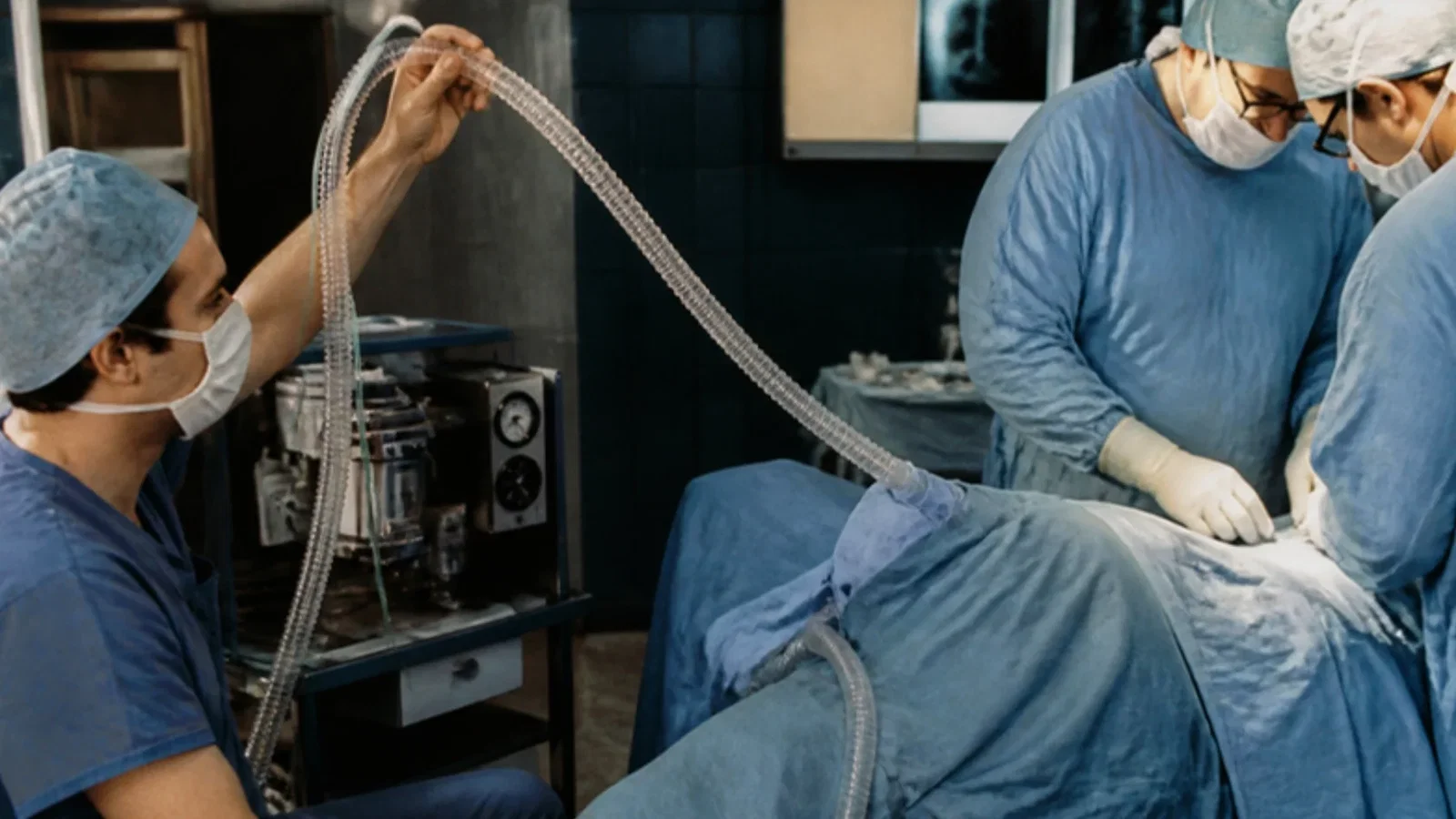
In July 1972 the Canadian Anaesthetists' Society Journal (vol. 19, pp. 426-35) printed 'A streamlined anaesthetic system' by J. A. Bain and W. E. Spoerel of the University of Western Ontario and Victoria Hospital, London. Head and neck surgery needed a light system that did not distort the face or drag on the tracheal tube; the Magill (Mapleson A) attachment had a heavy valve close to the patient's face, usually buried under the drapes, and the Rees modification of system D suited only children. Wanting a single-limb system that could include pollution control, the authors combined the Mapleson D and E systems: the fresh gas tube ran inside the exhalation limb, cutting bulk and drag; the light plastic attachment connected to a mask or tube, and ventilation could be controlled by bag or a Bird Mark VII respirator, for patients of all ages; the bag and valve could sit on a special mount or far from the machine, and exhaled gas could be led to hospital suction. They measured arterial carbon dioxide in unselected adults breathing spontaneously or ventilated, listed the circuit's advantages over the circle system, and made it their preferred system for cerebral angiography.
Reading Library · Anesthesia Epochs · 中文版
Watch the education video (for clinicians)
1972: The Bain Coaxial Circuit — A Tube Inside a Tube · Anesthesia Epochs Education Series
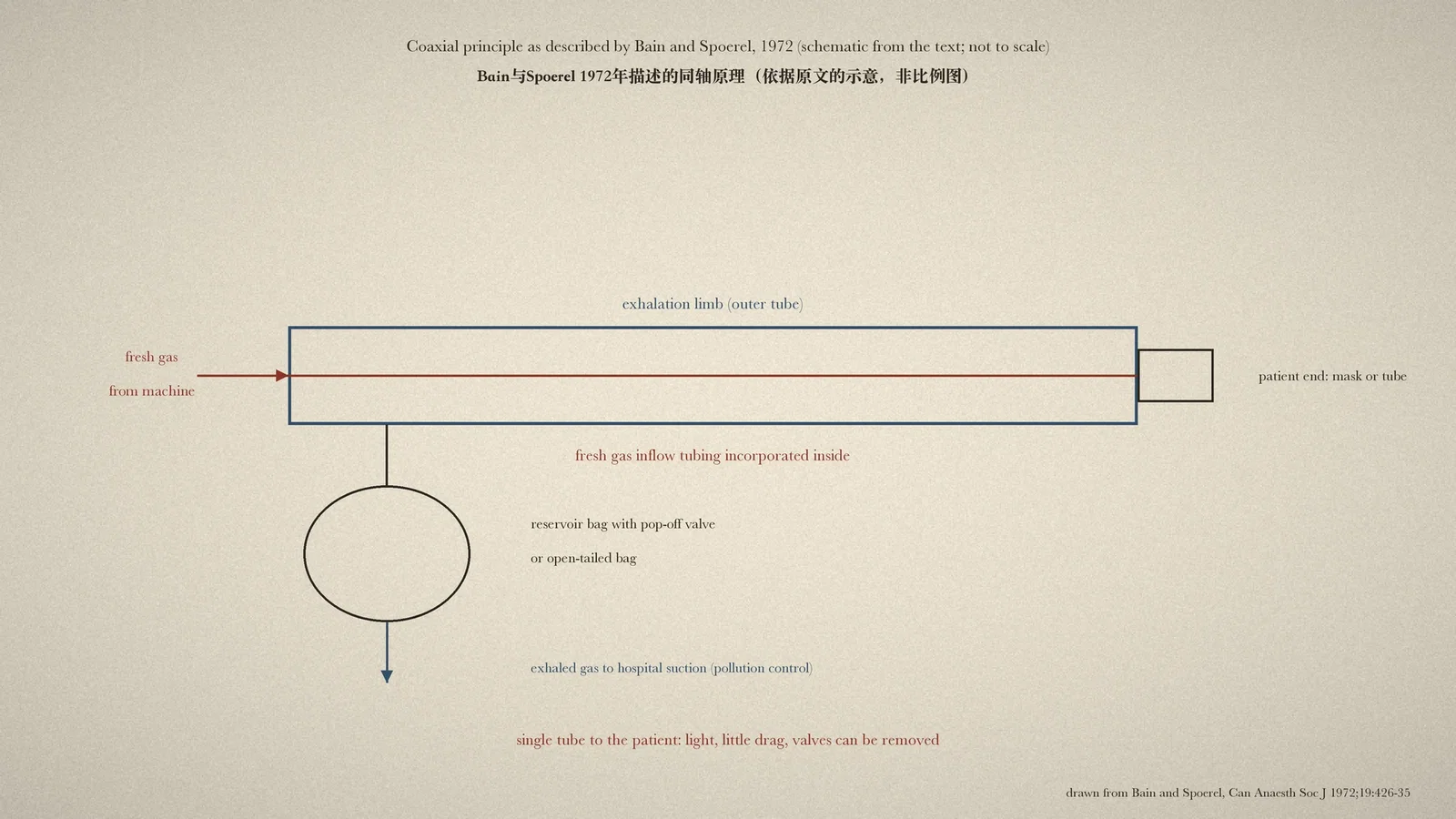
In operations on the cleft palate, the tonsils or the face, anaesthetist and surgeon crowd round the same head. The breathing system then needs to be as light and slim as possible, ideally a single tube to the patient's face. In July 1972 two anaesthetists in London, Ontario, described how to manage it: thread the narrow tube that carries fresh gas right through the wide tube that carries the breath out. [1, p. 426][1, p. 428]
What was wrong
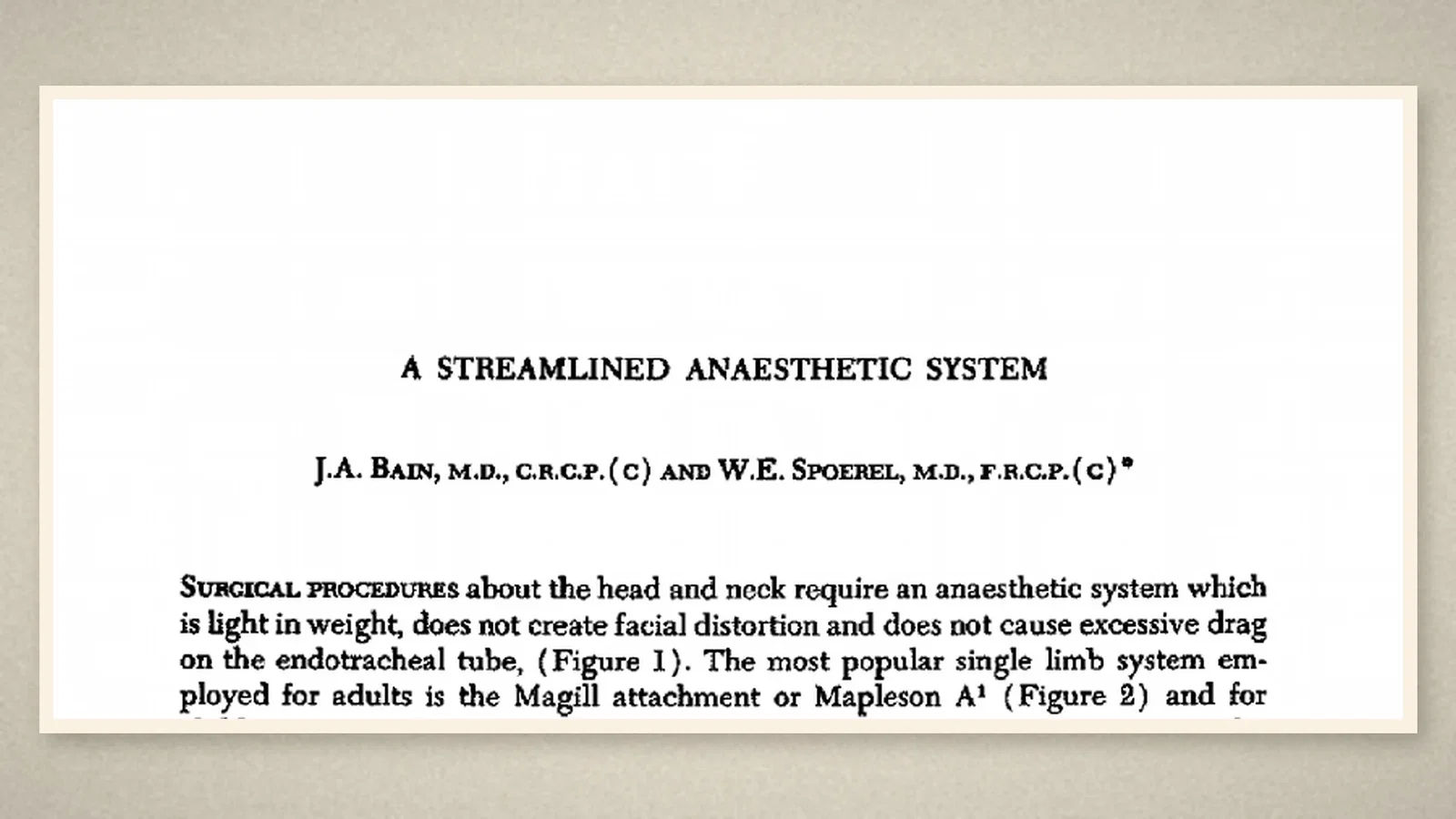
The authors were J. A. Bain and W. E. Spoerel of the Department of Anaesthesia, University of Western Ontario, and Victoria Hospital, and their paper was called "A streamlined anaesthetic system". Head and neck surgery, they began, requires an anaesthetic system that "is light in weight, does not create facial distortion and does not cause excessive drag" on the tracheal tube. [1, p. 426]
The most popular single-limb system for adults was then the Magill attachment, or Mapleson A, and for children a variant of the Mapleson D system, especially Rees's. The Mapleson A system had a relatively heavy pop-off valve close to the patient's face, usually buried under the sterile drapes, leaving the anaesthetist awkwardly placed to adjust it, while the Rees version of system D was useful only for children. The authors also wanted a single-limb system that could include pollution control. So they built a streamlined modification combining the Mapleson D and E systems. [1, p. 426]
A tube within a tube
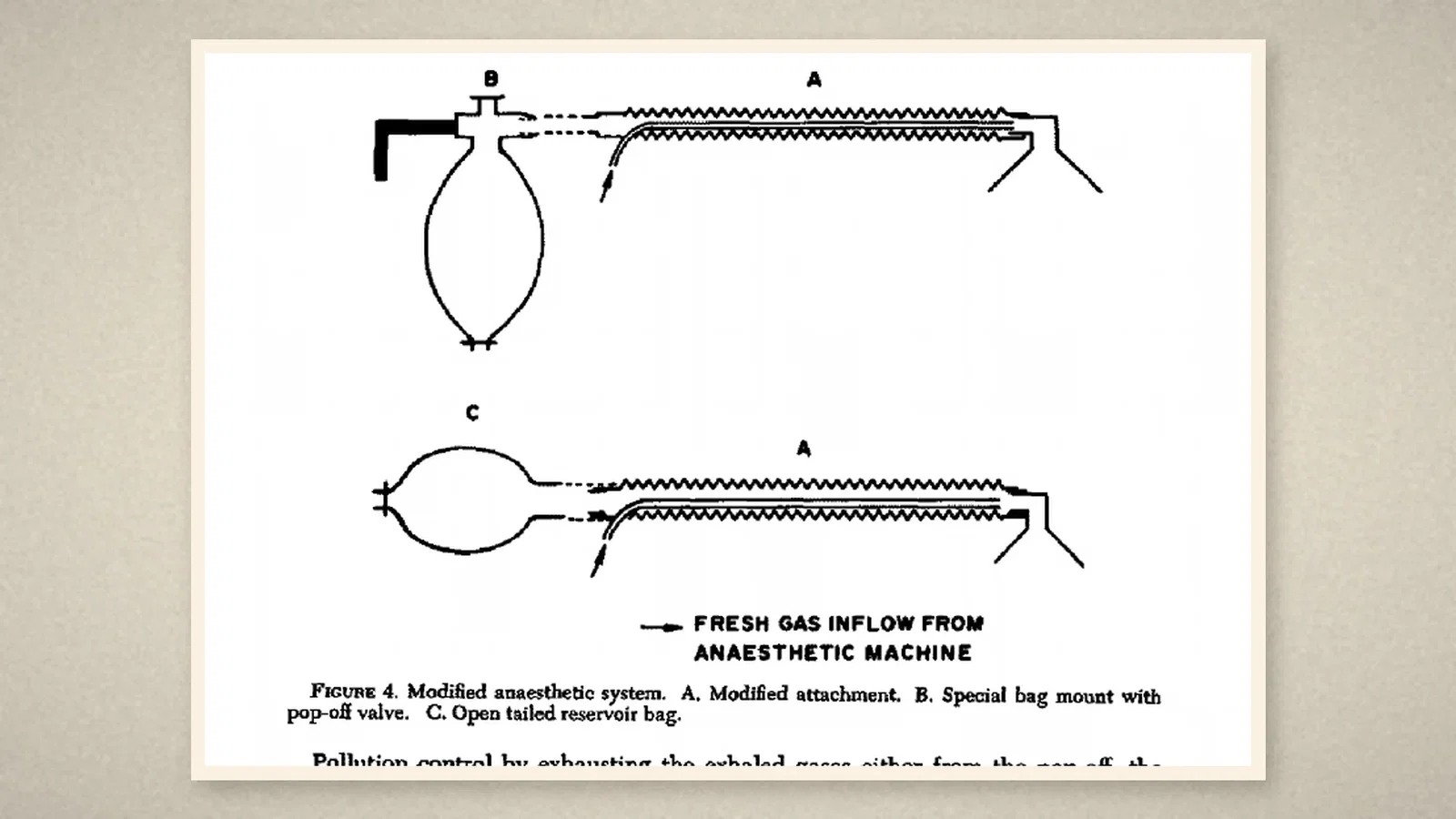
The key step was that "the fresh gas inflow tubing is incorporated inside the exhalation limb". This reduced the bulk of the system and spared the drag of a second tube running to the patient's face. The system was made of lightweight plastic, and its patient end fitted a mask or the tracheal tube directly. Controlled ventilation could be started by squeezing the reservoir bag or by attaching a Bird Mark VII respirator to the end of the attachment. The authors found it suitable for all patients, including children. [1, p. 426]
Figure 4 of the paper shows two arrangements. In one, a special bag mount with a pop-off valve sits on the anaesthetic machine, giving the bag a fixed, reachable position. In the other, an open-tailed bag replaces the valve, with less resistance to breathing out for children. Sometimes the authors simply attached the open-tailed bag to the end of the attachment, so that the whole system lay far from the machine, joined to it only by the fresh gas line. [1, p. 426][1, p. 428]
Exhaled gases could be drawn off to the hospital suction line from the pop-off valve, the open-tailed bag or the respirator's exhalation valve with a simple suction arrangement. With the Magill attachment, the authors pointed out, breath leaves at the patient's face, where it is hard to exhaust, so anaesthetist and surgeon alike were exposed to anaesthetic pollution. [1, p. 428]
Clinical evaluation
The authors ran a clinical study with "no patient selection", measuring arterial carbon dioxide tension at arbitrarily chosen fresh gas flows in 26 adults breathing spontaneously and 28 on controlled ventilation. [1, p. 430] In the discussion they noted, citing earlier work, that the Magill system is unsatisfactory during artificial ventilation and so is confined to operations in which adequate spontaneous breathing can be kept up throughout. [1, p. 432]
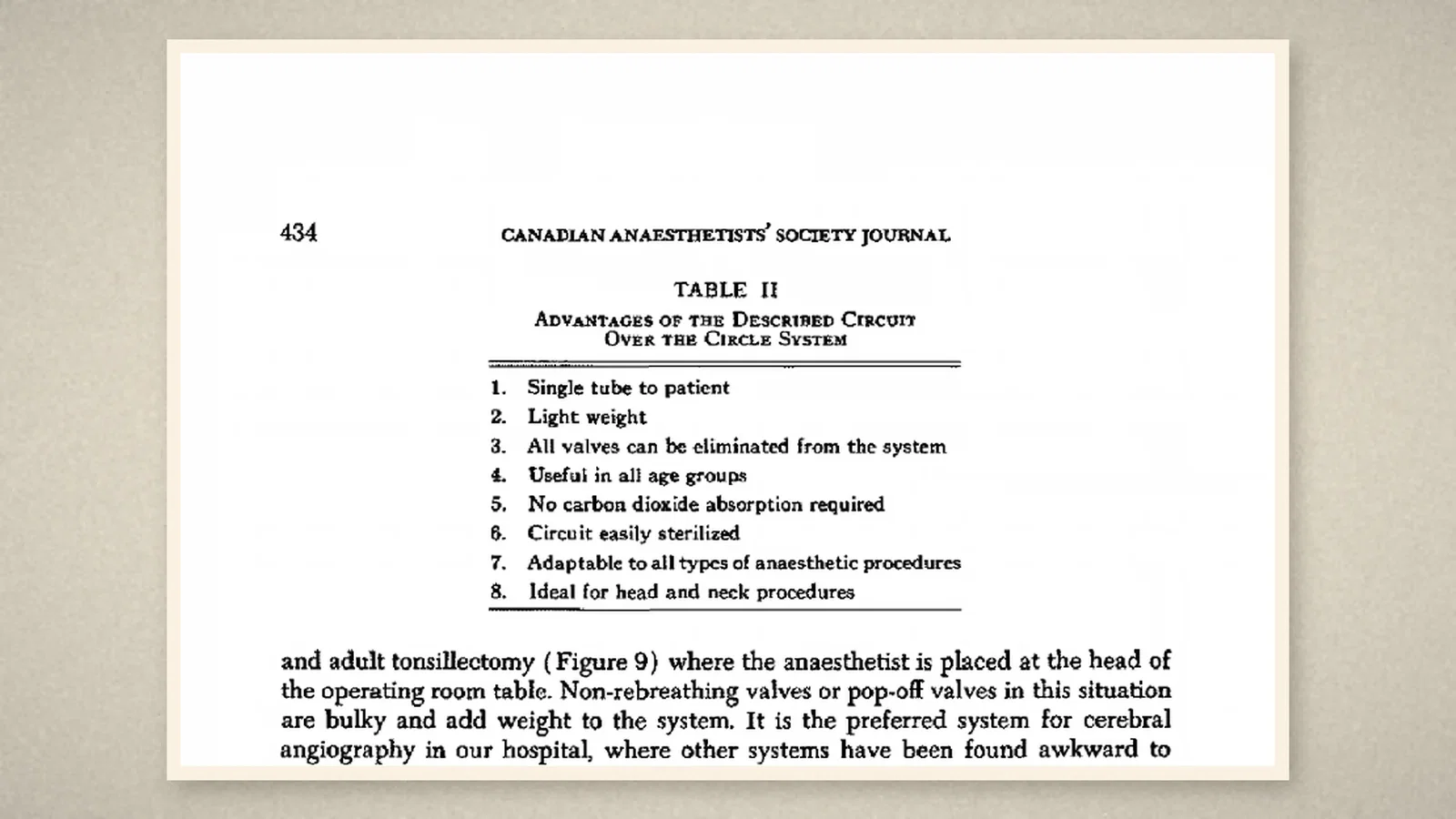
Table II lists eight advantages over the circle system: a single tube to the patient, light weight, all valves removable, use in all age groups, no carbon dioxide absorption required, easy sterilization, adaptability to every type of procedure, and suitability for head and neck surgery. It was "the preferred system for cerebral angiography" in the authors' hospital, and compared with conventional circuits it gave the surgeon better conditions, particularly in operations on the head, face and neck. [1, p. 434]
What the record shows
Bain and Spoerel's change looks small, one tube inside another, yet it answered three problems at once: weight on the face, drag on the tube, and waste gas in the theatre. The paper does not discuss the danger of the inner tube coming apart or kinking; that was left to letters in the following years.
Sources and reading limits
Read: Bain and Spoerel, "A streamlined anaesthetic system", Can Anaesth Soc J 1972;19:426-35 (the whole paper: introduction, description with Figures 1-6, evaluation, results, discussion and Table II; page images of pp. 426, 428 and 434 checked). Obtained through institutional access.
Not covered: Mapleson's classification paper and Rees's paediatric system, which the authors cite; Smith's description of the Bird respirator connection; later laboratory studies of the Bain system's fresh gas requirements. The History of Anaesthesia Society and ASA timeline entries were not used as evidence.
Limits: the paper is its designers' own description with one clinical study, and it does not discuss the hazard of a disconnected or kinked inner tube; later letters addressed that, in separate articles. The authors' fresh gas recommendations, flow rates and blood-gas values are not repeated, and page crops stop before them. Patients are not identified, and the paper's clinical photographs are not used.
Three illustrations are crops of Can Anaesth Soc J 1972 pp. 426, 428 (the paper's Figure 4) and 434 (Table II). One is a schematic of the coaxial principle drawn from the text, not to scale.
- Bain JA, Spoerel WE. A streamlined anaesthetic system. Can Anaesth Soc J. 1972;19:426-35. DOI
Continue exploring
Related reading connects shared questions and contexts; it does not by itself establish historical influence.
- 1969: Vale Blocks a Child's Lobar Bronchus with a Fogarty Catheter
- 1962: Epstein, Lee and Colleagues Report a Fail-Safe Against Anoxic Gas Mixtures
Anesthesia Epochs · The Source Room · About & Editorial Method
Published November 3, 2026. Sources and reading limits are stated above. Illustrations are labelled as original source images or AI-made. Historical accounts are educational; they are not current treatment instructions.