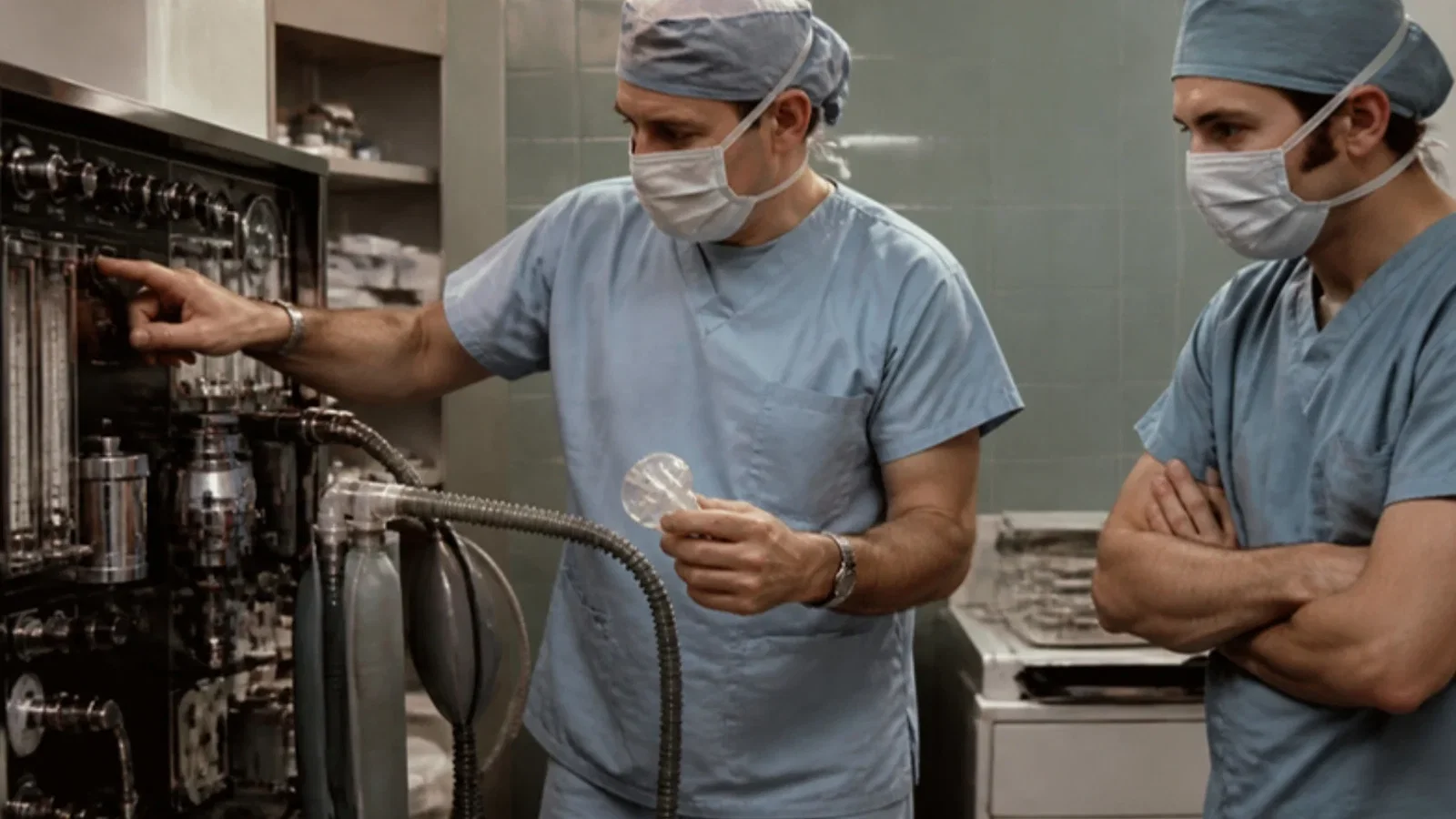
In a Bain circuit the fresh gas tube runs hidden inside the expiratory tube; if it comes apart at the machine end or breaks, fresh gas no longer reaches the patient. In January 1975 the Canadian Anaesthetists' Society Journal printed a short letter from S. L. Pethick: in response to the hazard of re-using Bain circuits reported by Hannallah and Rosales in September 1974, Pethick suggested testing the inner tube with the oxygen by-pass. When the inner tube is intact, the flush creates a high-velocity flow in it that, by Venturi effect, lowers the pressure in the outer tube, and the reservoir bag collapses; when the inner tube is disconnected, the bag instead inflates slightly; the method may be especially valuable with black tubing, where the inner tube cannot be seen. In March 1977 Anaesthesia printed 'A test for co-axial circuits' from Pierre Foex and A. Crampton Smith of the Nuffield Department of Anaesthetics, Oxford, written in a mock-solemn style: occluding the inner tube at the patient end, with a finger or more hygienically a syringe plunger, makes the rotameter bobbins dip, and they recover when it is released. On the same page Sugg of Penlon warned against using co-axial circuits with demand-flow dental machines.
Reading Library · Anesthesia Epochs · 中文版
Watch the education video (for clinicians)
1975: Testing the Bain Circuit — A Tube You Cannot See · Anesthesia Epochs Education Series
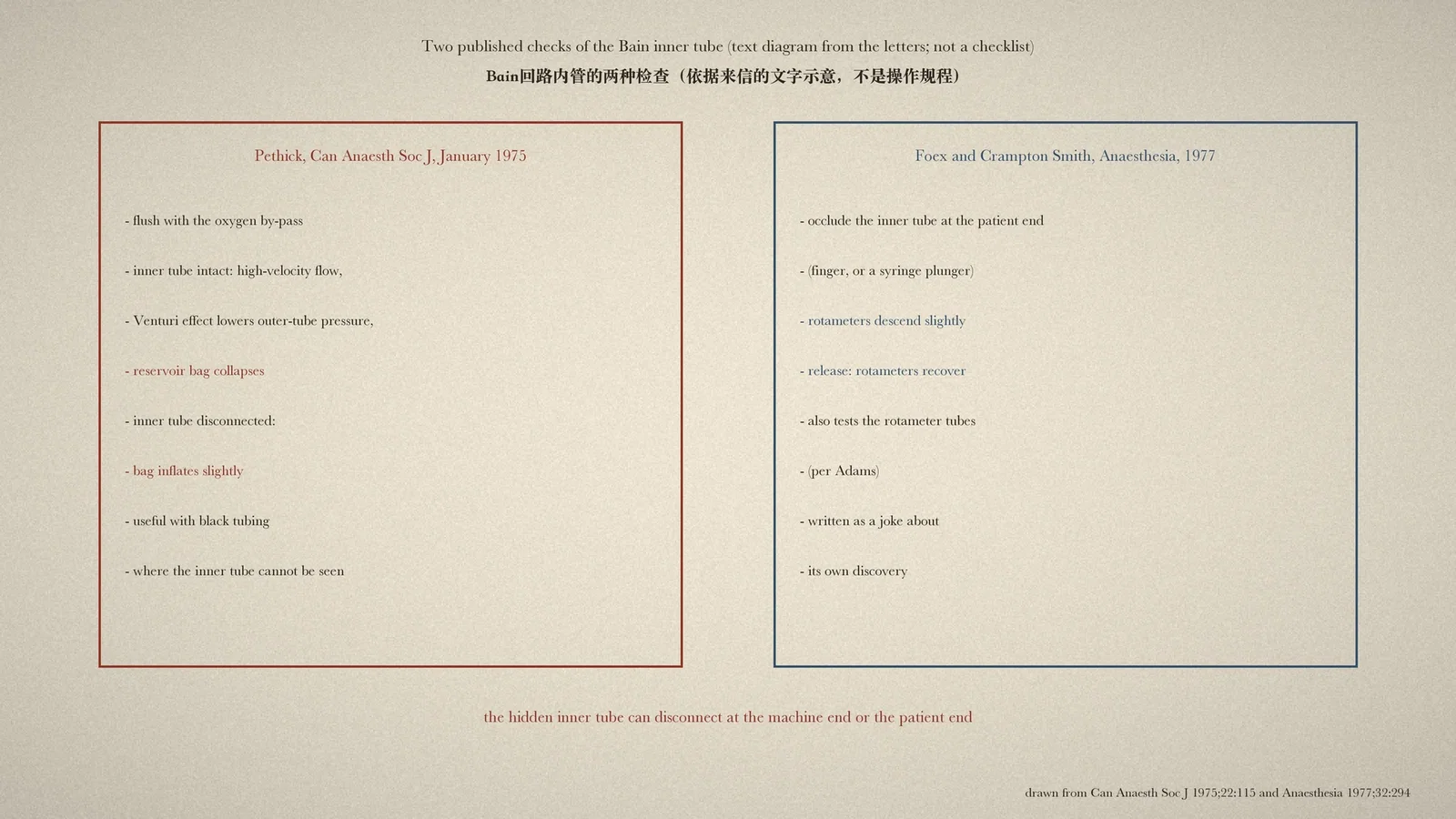
The cleverness of the Bain circuit was to hide the fresh gas tube inside the expiratory tube, and that was also its weak point. The inner tube cannot be seen. If it comes apart at the machine end or breaks, fresh gas no longer reaches the patient, while everything looks normal from outside. In 1975 and 1977 two letters each proposed a simple check: one watches the reservoir bag, the other the rotameters. [1, p. 115][2, p. 294]
Watching the bag
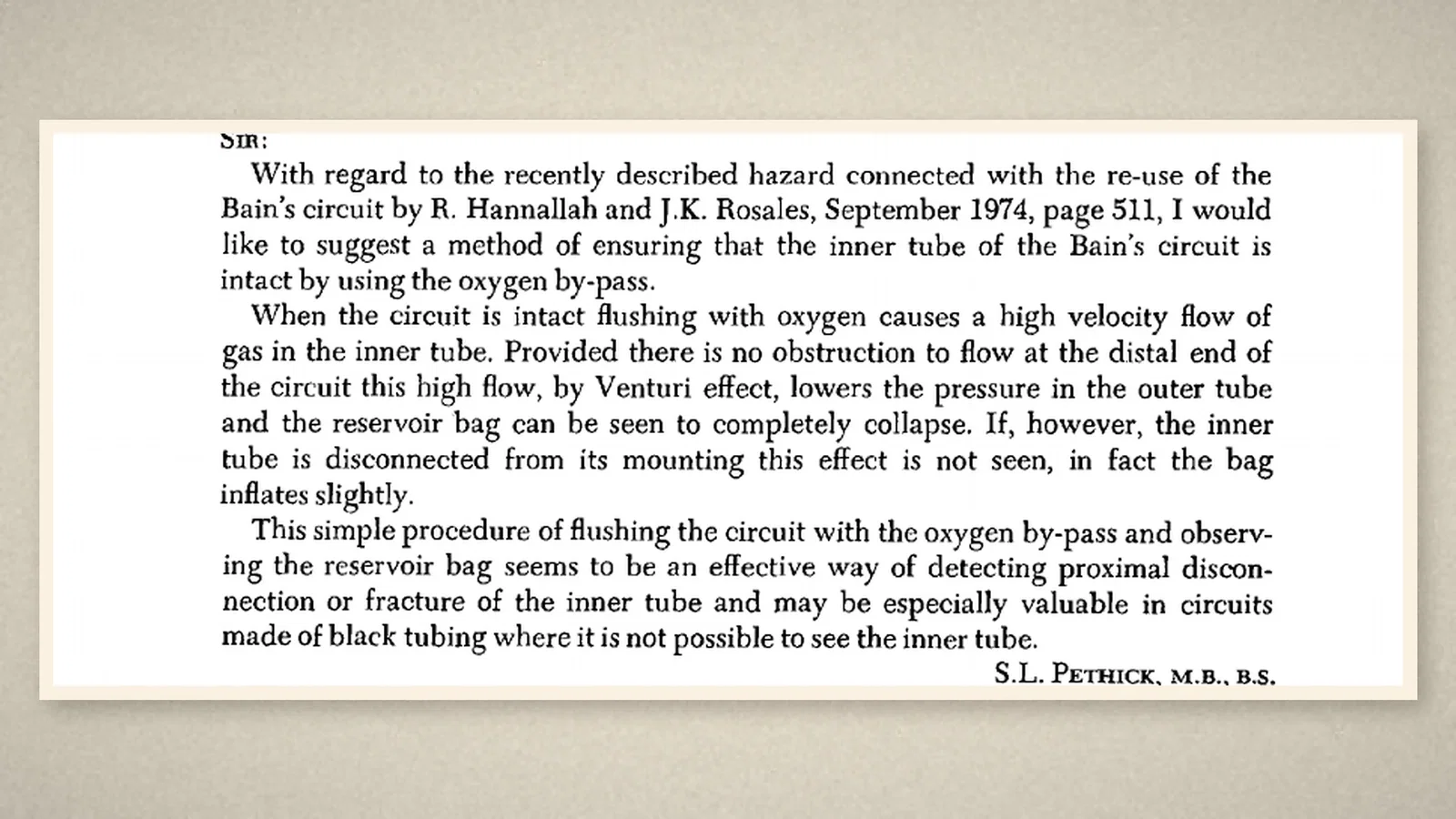
In January 1975 the letters section of the Canadian Anaesthetists' Society Journal printed a short letter from S. L. Pethick. It responded to "the recently described hazard connected with the re-use of the Bain's circuit" reported by Hannallah and Rosales in September 1974. Pethick suggested using the machine's oxygen by-pass to make sure that the inner tube was intact. [1, p. 115]
The principle was this. When the circuit is intact, flushing with oxygen creates a high-velocity flow in the inner tube. Provided there is no obstruction at the distal end, "this high flow, by Venturi effect, lowers the pressure in the outer tube and the reservoir bag can be seen to completely collapse". If the inner tube has come off its mounting, the effect is not seen; in fact the bag inflates slightly. [1, p. 115]
Flushing with the by-pass and watching the bag, Pethick wrote, seemed an effective way to detect proximal disconnection or fracture of the inner tube. It might be especially valuable in circuits "made of black tubing where it is not possible to see the inner tube". [1, p. 115]
Watching the rotameters
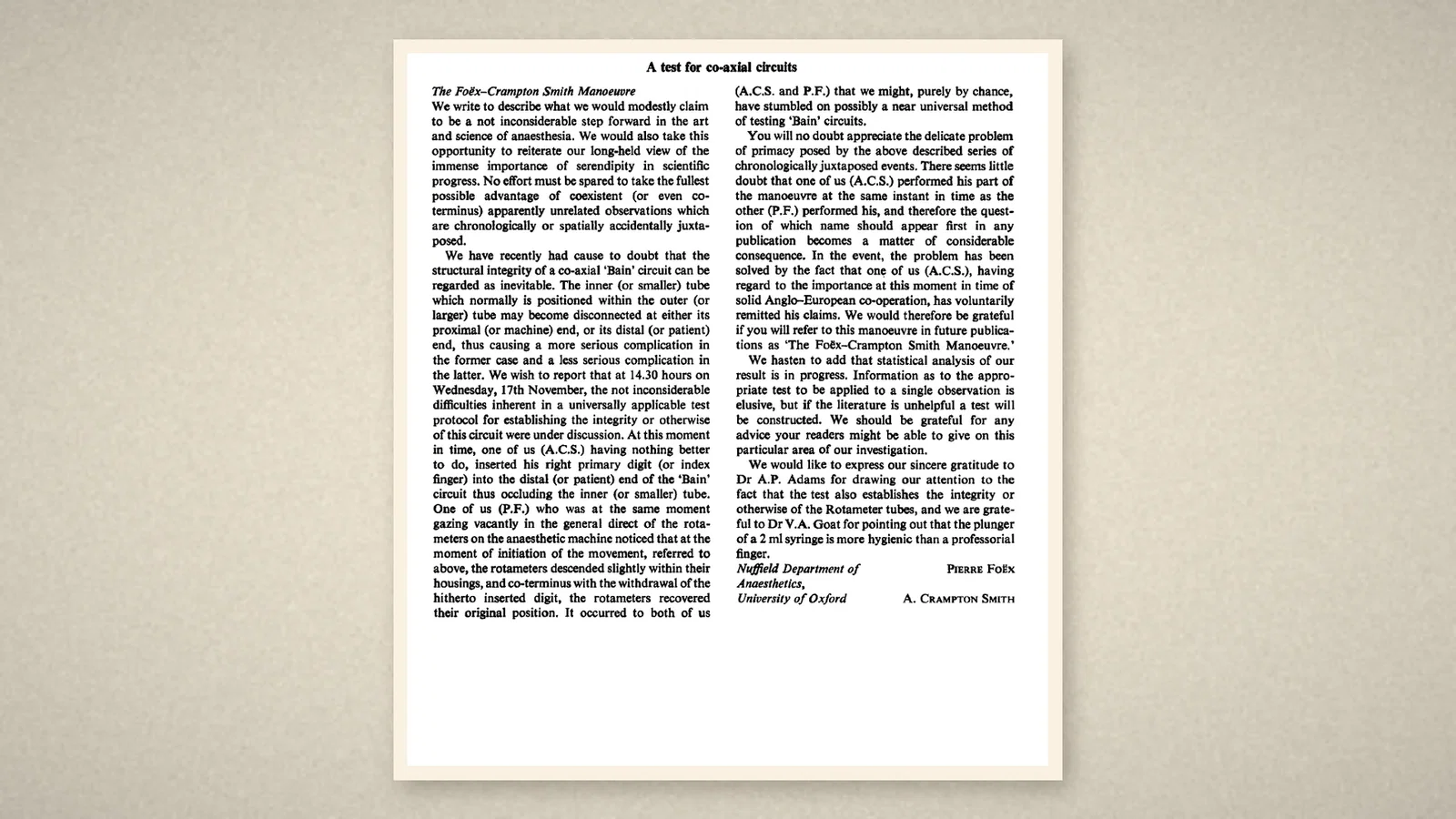
Two years later, in March 1977, the correspondence section of Anaesthesia printed a letter from Pierre Foex and A. Crampton Smith of the Nuffield Department of Anaesthetics, University of Oxford. Its title was "A test for co-axial circuits" and its subtitle "The Foex-Crampton Smith Manoeuvre". The whole letter is a joke told with a straight face. [2, p. 294]
The two wrote that they had recently had cause to doubt that the structural integrity of a co-axial "Bain" circuit could be taken for granted. The inner tube might come apart at its proximal (machine) end or its distal (patient) end, the former being more serious. At half past two on Wednesday 17th November, while the two were discussing how to find a universally applicable test, Crampton Smith put a finger into the patient end of the circuit and so blocked the inner tube. Foex happened to be looking at the rotameters and saw that, at that moment, they "descended slightly", and that they recovered when the finger was withdrawn. The two concluded that they might have stumbled on "a near universal method of testing 'Bain' circuits", and made a solemn show of debating whose name should come first. [2, p. 294]
The letter ends with thanks: to A. P. Adams for pointing out that the test also shows whether the rotameter tubes themselves are intact, and to V. A. Goat for noting that the plunger of a 2 ml syringe "is more hygienic than a professorial finger". [2, p. 294]
Another warning on the same page
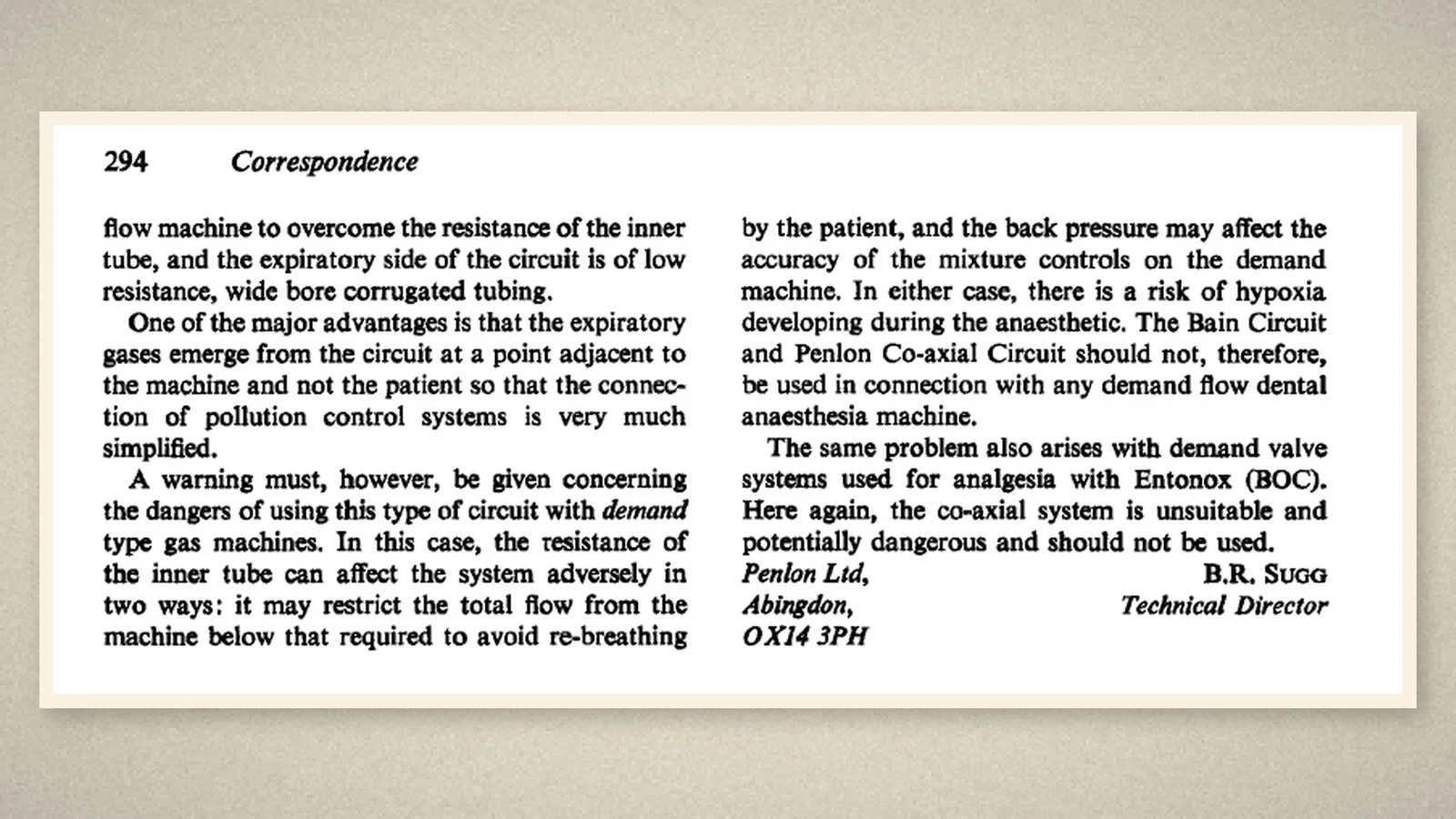
Above it on the same page is the end of a letter from B. R. Sugg, technical director of Penlon. A major advantage of co-axial circuits, it says, is that the expiratory gases emerge near the machine rather than the patient, which simplifies pollution control. But it warns that the resistance of the inner tube can upset demand-type gas machines and risk hypoxia, so the Bain and Penlon co-axial circuits "should not, therefore, be used in connection with any demand flow dental anaesthesia machine", nor with Entonox demand valves. [2, p. 294]
What the record shows
The two letters could not differ more in tone, one plain and one playful, but they make the same point: a hidden inner tube must be checked on purpose. Watching whether the bag collapses or whether the bobbins dip turns an invisible fault into a visible sign.
Sources and reading limits
Read: Can Anaesth Soc J 1975;22:114-5, "Letters to the editor" (Pethick's letter in full; the preceding letter by Nash and Mailhot on methoxyflurane skimmed only to confirm it is unrelated); Anaesthesia 1977;32:294, correspondence page (Foex and Crampton Smith's letter in full and the end of Sugg's letter above it). Page images were checked. Both were obtained through institutional access.
Not covered: Hannallah and Rosales's report of the hazard of re-used Bain circuits (September 1974, p. 511), which prompted Pethick; the beginning of Sugg's letter on the previous page; later machine-check recommendations. The ASA timeline entries on this subject were not used as evidence.
Limits: this article covers two short letters on the same problem, Pethick's and Foex and Crampton Smith's, together. Foex and Crampton Smith's letter jokes about its own discovery; the test is reported as they describe it, not recommended. The letter's 17th November is given without a year. Neither letter reports a series of patients.
Three illustrations are crops of Can Anaesth Soc J 1975 p. 115 and Anaesthesia 1977 p. 294. One is a text diagram drawn from the two letters, not a checklist, with no people drawn.
- Nash PH, Mailhot R, Pethick SL. Letters to the editor. Can Anaesth Soc J. 1975;22:114-5 (Pethick's letter on p. 115). DOI
- Foex P, Crampton Smith A. A test for co-axial circuits. Anaesthesia. 1977;32:294. DOI
Continue exploring
Related reading connects shared questions and contexts; it does not by itself establish historical influence.
- 1972: Bain and Spoerel Introduce a Single-Tube Coaxial Breathing System
- 1962: Epstein, Lee and Colleagues Report a Fail-Safe Against Anoxic Gas Mixtures
Anesthesia Epochs · The Source Room · About & Editorial Method
Published November 3, 2026. Sources and reading limits are stated above. Illustrations are labelled as original source images or AI-made. Historical accounts are educational; they are not current treatment instructions.