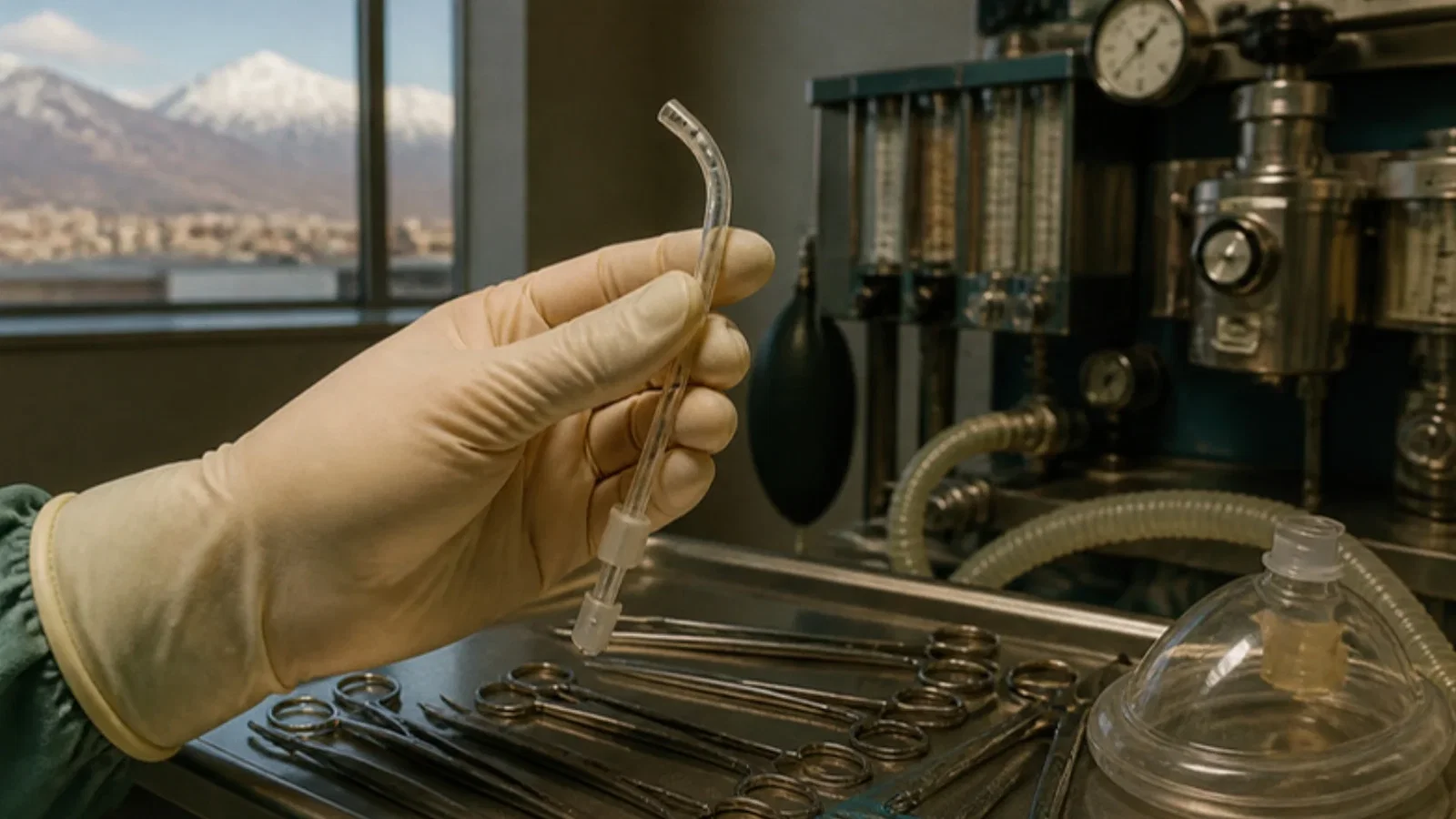
In March-April 1975 the Brief Reports section of Anesthesia and Analgesia (vol. 54, no. 2) printed 'A new pediatric endotracheal tube' by Wallace H. Ring, John C. Adair and Richard A. Elwyn of the Primary Children's Medical Center and the University of Utah, Salt Lake City, received on 25 October and accepted on 15 November 1974. Other preformed tubes had been proposed, the authors wrote, but in theirs the acute-angle bend lay in the part that stays outside the patient; near the bevel were two elliptical side ports, so that a tube pushed into the right main bronchus could still ventilate the right upper lobe and the left lung, which Cole's slotted tube could not. Lengths were set by deliberately intubating the right main bronchus, confirmed on chest films in 16 patients, and marking the maximum safe depth. The bend prevented kinking when connectors were removed from around the face, gave the surgeon access in head and neck surgery, avoided pressure from metal connectors, and by its springiness held the tube in place. After three years and more than 10,000 cases, the 'RAE' tubes, named for the authors' initials, had become an essential part of their paediatric practice.
Reading Library · Anesthesia Epochs · 中文版
Watch the education video (for clinicians)
1975: The RAE Tube — The Bend Outside the Mouth · Anesthesia Epochs Education Series
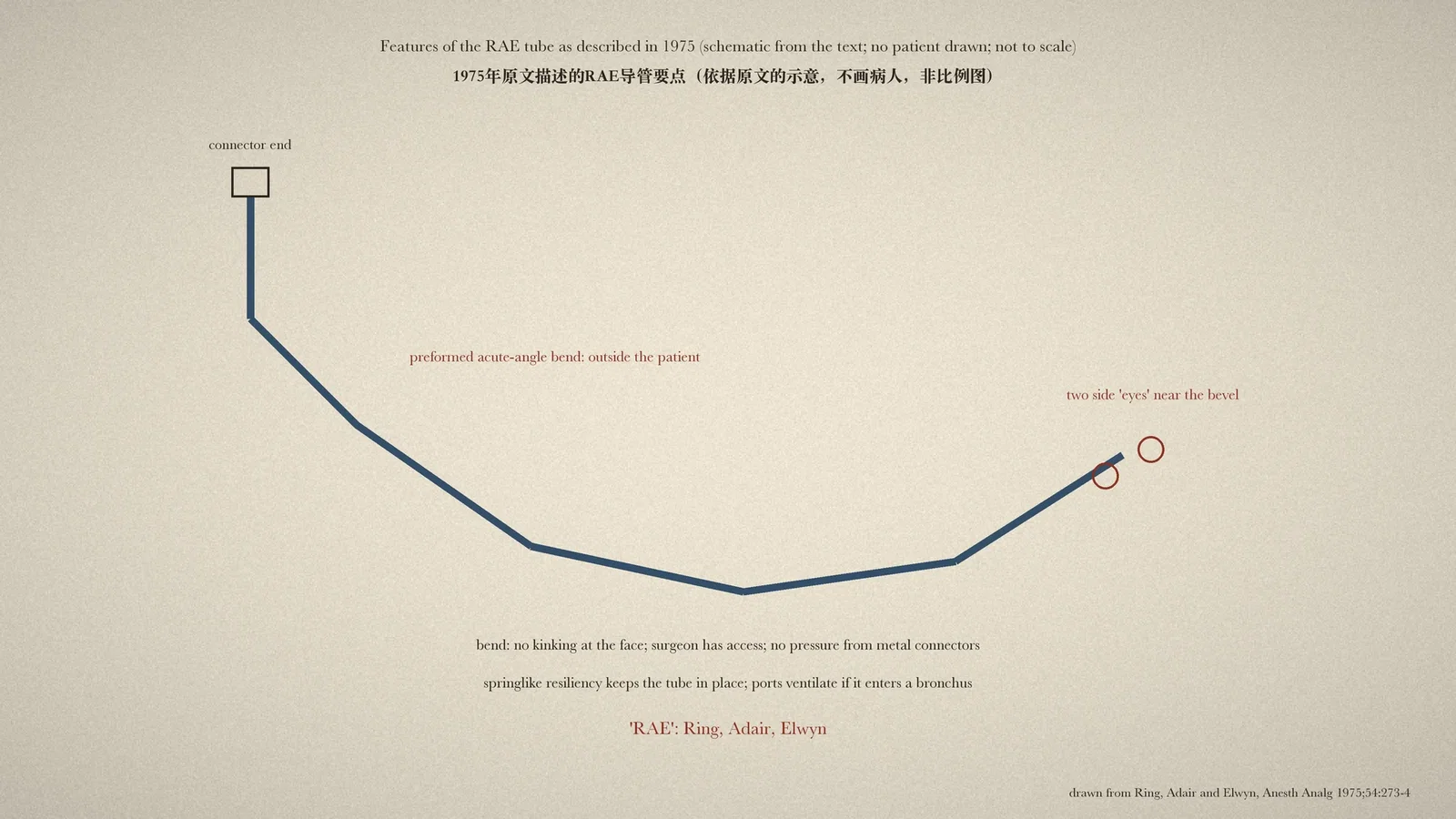
In a child's lip repair or other head and neck surgery, the tracheal tube and its connectors crowd the very place where the surgeon has to work. A two-page brief report in Anesthesia and Analgesia in 1975 offered a simple answer: let the tube bend at an acute angle as soon as it leaves the mouth or nose, and lead it away from the face. Its three authors named it after their own initials. [1, p. 273][1, p. 274]
The bend outside the patient
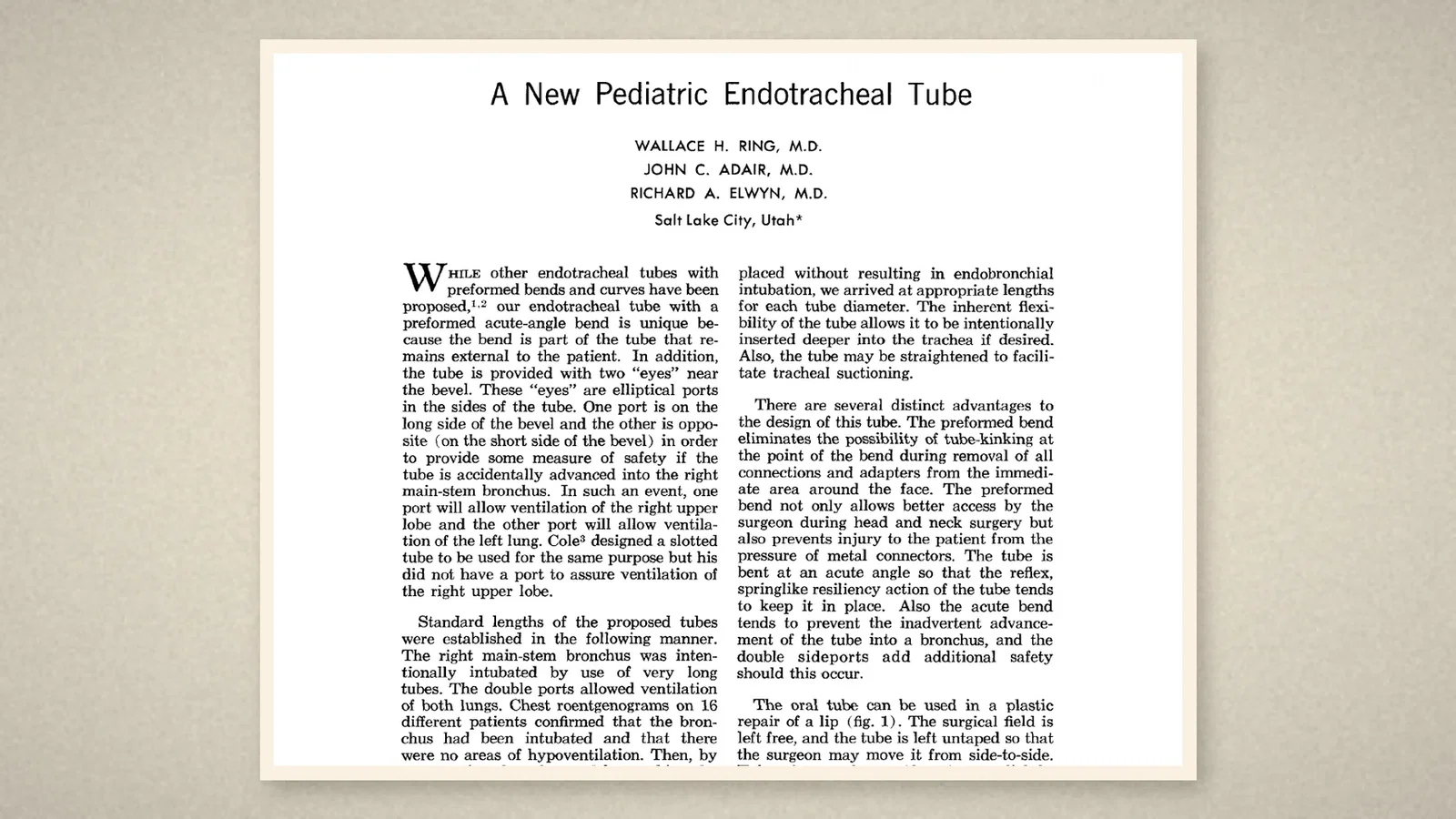
The authors were Wallace H. Ring, John C. Adair and Richard A. Elwyn of the Primary Children's Medical Center and the University of Utah College of Medicine, Salt Lake City. The report was received on 25 October 1974 and accepted on 15 November 1974. Other tubes with preformed bends and curves had been proposed, they wrote, but theirs was "unique because the bend is part of the tube that remains external to the patient". [1, p. 273]
Near the bevel the tube also had two "eyes", elliptical ports in its sides, one on the long side of the bevel and one opposite. If the tube were accidentally pushed into the right main bronchus, one port would ventilate the right upper lobe and the other the left lung. Cole had designed a slotted tube for the same purpose, the authors noted, but it had no port to ensure ventilation of the right upper lobe. [1, p. 273]
Setting the lengths
Standard lengths were set like this. The right main bronchus was deliberately intubated with very long tubes, the two ports allowing both lungs to be ventilated, and chest radiographs in 16 patients confirmed that the bronchus had been entered without areas of hypoventilation. The tubes were then withdrawn and the greatest depth that avoided the bronchus was marked, giving a suitable length for each diameter. Because the tube is flexible, it could still be passed deeper on purpose or straightened for suction. [1, p. 273]
The advantages
The authors listed several advantages. The preformed bend removed the chance of the tube kinking at the bend when connectors were taken away from around the face. It gave the surgeon better access in head and neck surgery and prevented injury from the pressure of metal connectors. Bent at an acute angle, the tube's "springlike resiliency" tended to hold it in place and to stop it slipping into a bronchus, with the two ports as a further safeguard if that happened. [1, p. 273]
The oral tube could be used in plastic repair of a lip: the field was left free, and the tube was left untaped so that the surgeon could move it from side to side. Nasal tubes were slightly longer, bent the other way so that the tube ran over the patient's forehead, and avoided pressure on the nostrils. [1, p. 273][1, p. 274]
Three years, more than 10,000 cases
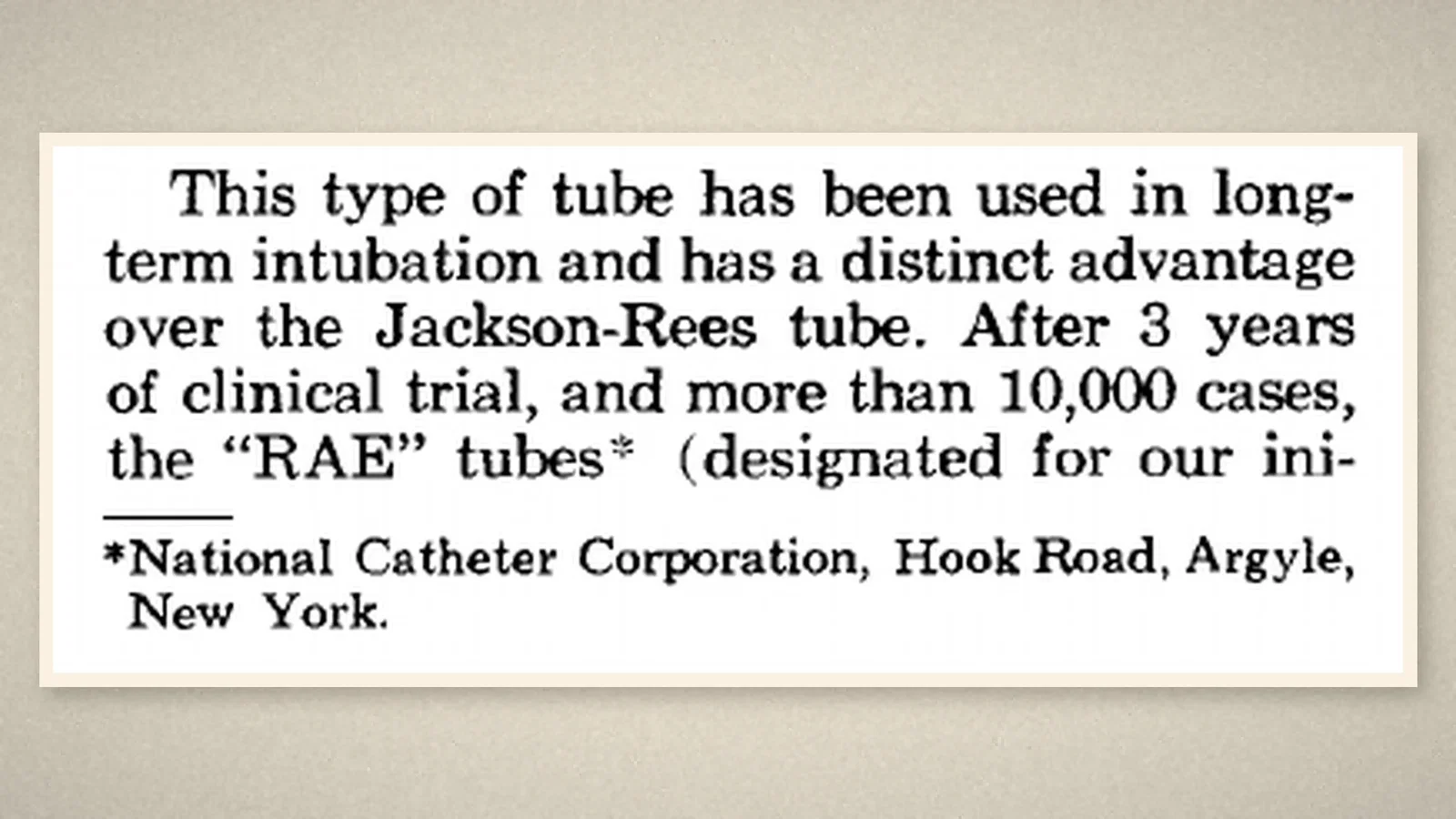
The tube had been used for long-term intubation and had a distinct advantage over the Jackson-Rees tube, the authors wrote. "After 3 years of clinical trial, and more than 10,000 cases", the "RAE" tubes, "designated for our initials", had become an essential part of their paediatric anaesthesia practice. The tubes were made by the National Catheter Corporation of New York. [1, p. 274]
What the record shows
The RAE tube's change lay only in its shape: the bend moved from inside the mouth to outside it, and an extra port was opened at the tip. It addressed an old problem of head and neck surgery, anaesthetist and surgeon competing for the same space. The 10,000 cases are the authors' own figure, without controls or a breakdown.
Sources and reading limits
Read: Ring, Adair and Elwyn, "A new pediatric endotracheal tube", Anesth Analg 1975;54:273-4 (the whole brief report with both figures; page images checked). Obtained through institutional access.
Not covered: the earlier preformed and non-kinking tubes the authors cite (Alsop 1955; Duckworth 1962) and Cole's slotted tube (1945); the maker's records; adult RAE tubes and later studies of tube position. The History of Anaesthesia Society timeline entry was not used as evidence.
Limits: this is a two-page brief report by the designers, without a comparison series; "three years" and "more than 10,000 cases" are the authors' own figures and are not broken down. Tube diameters, lengths and the depths in the 16 radiographs are not repeated, and page crops stop before them. Fig. 1, a photograph of a child with the oral tube, is not shown. Patients are not identified.
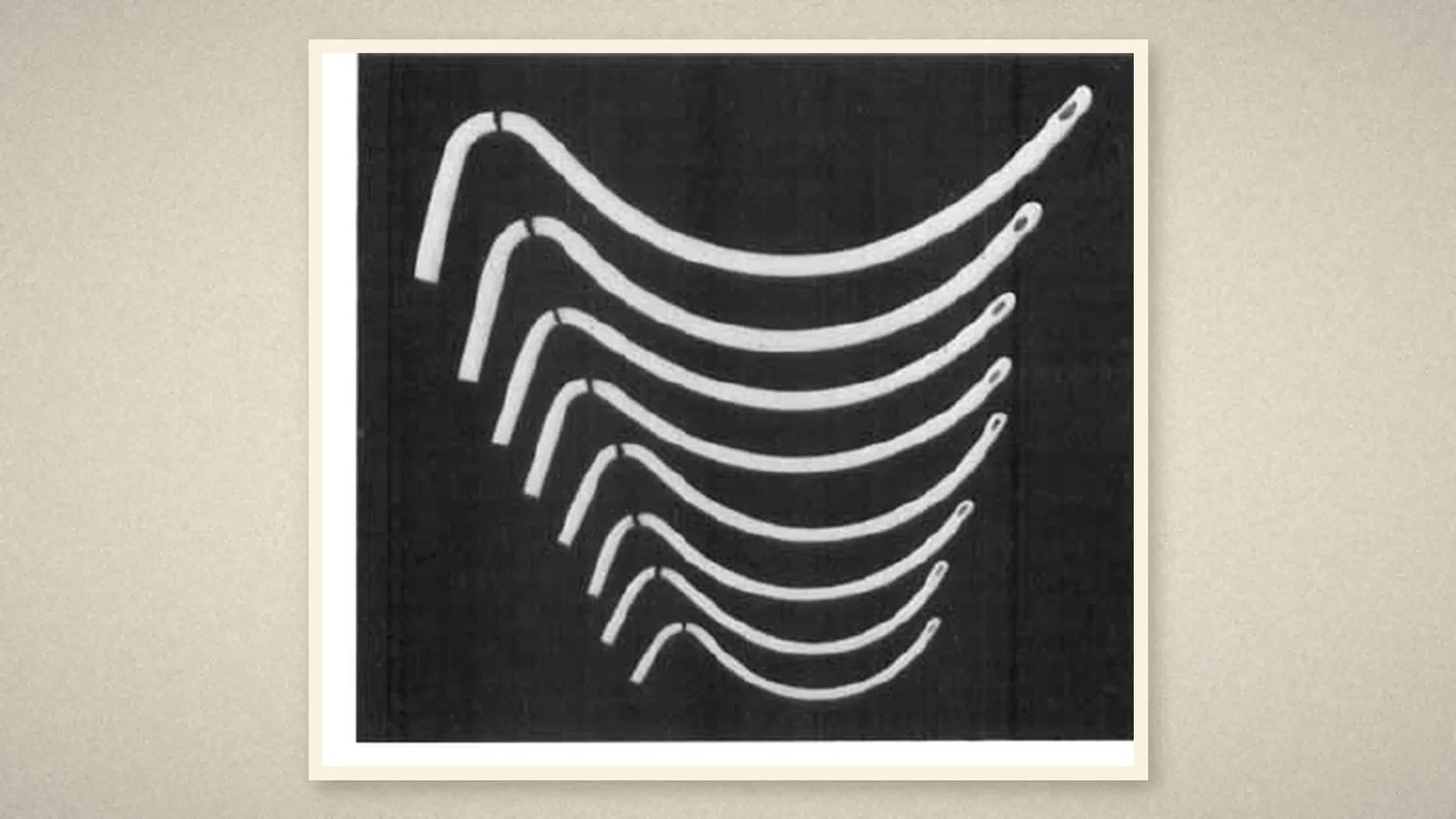
Three illustrations are crops of Anesth Analg 1975 pp. 273 and 274 (p. 274 shows the photograph of Fig. 2 without the caption giving sizes). One is a schematic of the tube's features drawn from the text, not to scale, with no patient drawn.
- Ring WH, Adair JC, Elwyn RA. A new pediatric endotracheal tube. Anesth Analg. 1975;54:273-4. DOI
Continue exploring
Related reading connects shared questions and contexts; it does not by itself establish historical influence.
- 1972: Bain and Spoerel Introduce a Single-Tube Coaxial Breathing System
- 1969: Vale Blocks a Child's Lobar Bronchus with a Fogarty Catheter
Anesthesia Epochs · The Source Room · About & Editorial Method
Published November 3, 2026. Sources and reading limits are stated above. Illustrations are labelled as original source images or AI-made. Historical accounts are educational; they are not current treatment instructions.