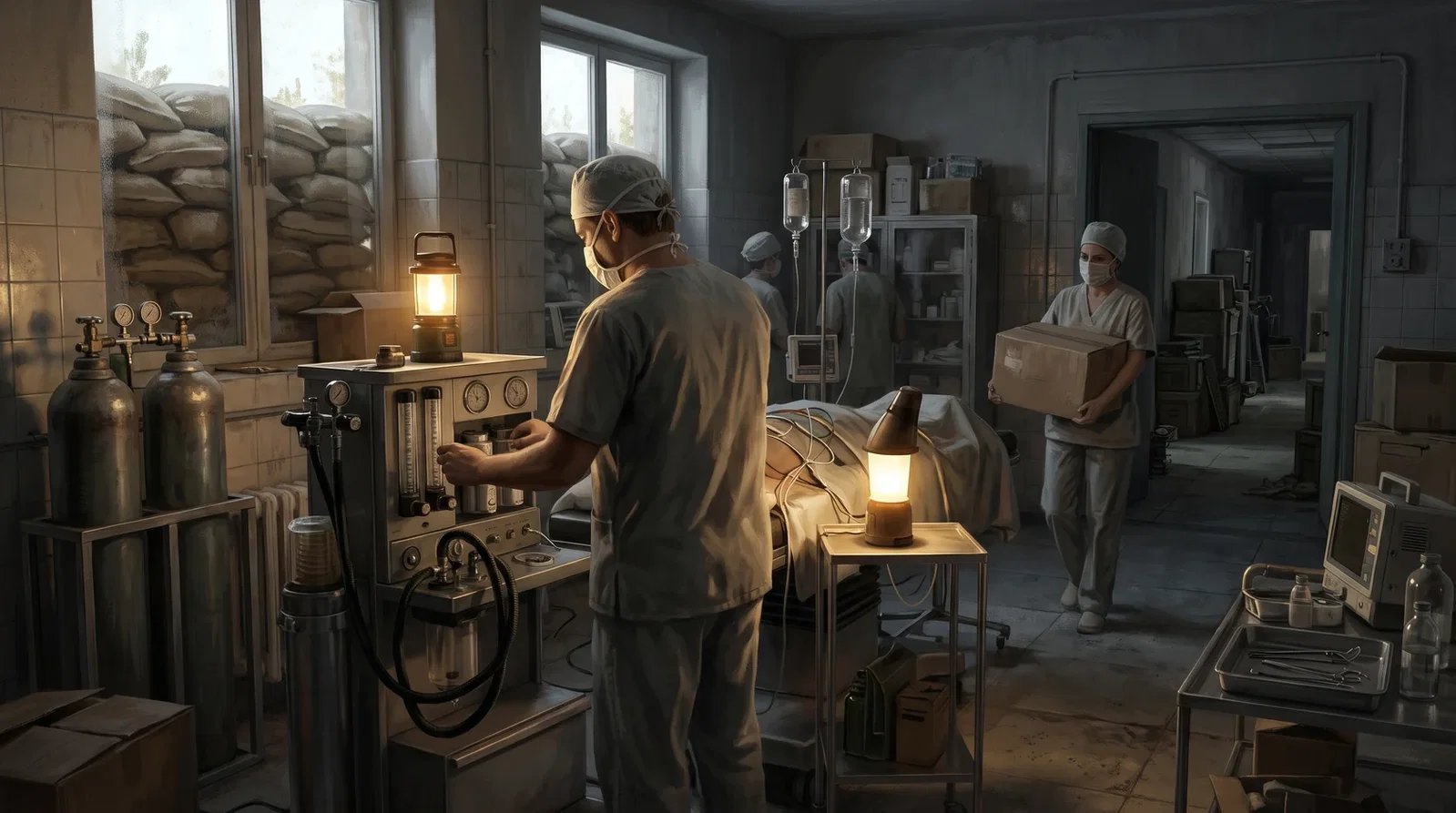
In the WFSA's Update in Anaesthesia vol. 40 (October 2025), Shreim, Aouad and Yazbeck's short report 'While some must sleep: the story of anaesthesia in Lebanon' records that during the Lebanese civil war (1975-1990) all hospitals faced staff safety risks, shortages of personnel and of supplies, especially oxygen and nitrous oxide, and that patients received general anaesthesia 95% of the time, often with crash induction and Sellick manoeuvres using succinylcholine and pancuronium; Anis Baraka chaired the American University of Beirut's anaesthesia department from 1971 to 2007, his resilience and devotion during the war credited with putting it on the 'Anaesthesia Map of the World'; the Lebanese Society of Anesthesiologists was mostly inactive during the war; the number of anaesthesiologists in Lebanon rose from five in 1952 to 105 in 1988.
Reading Library · Anesthesia Epochs · 中文版
Watch the education video (for clinicians)
1975–1990: The Lebanese Civil War — The Theatre Without Oxygen · Anesthesia Epochs Education Series
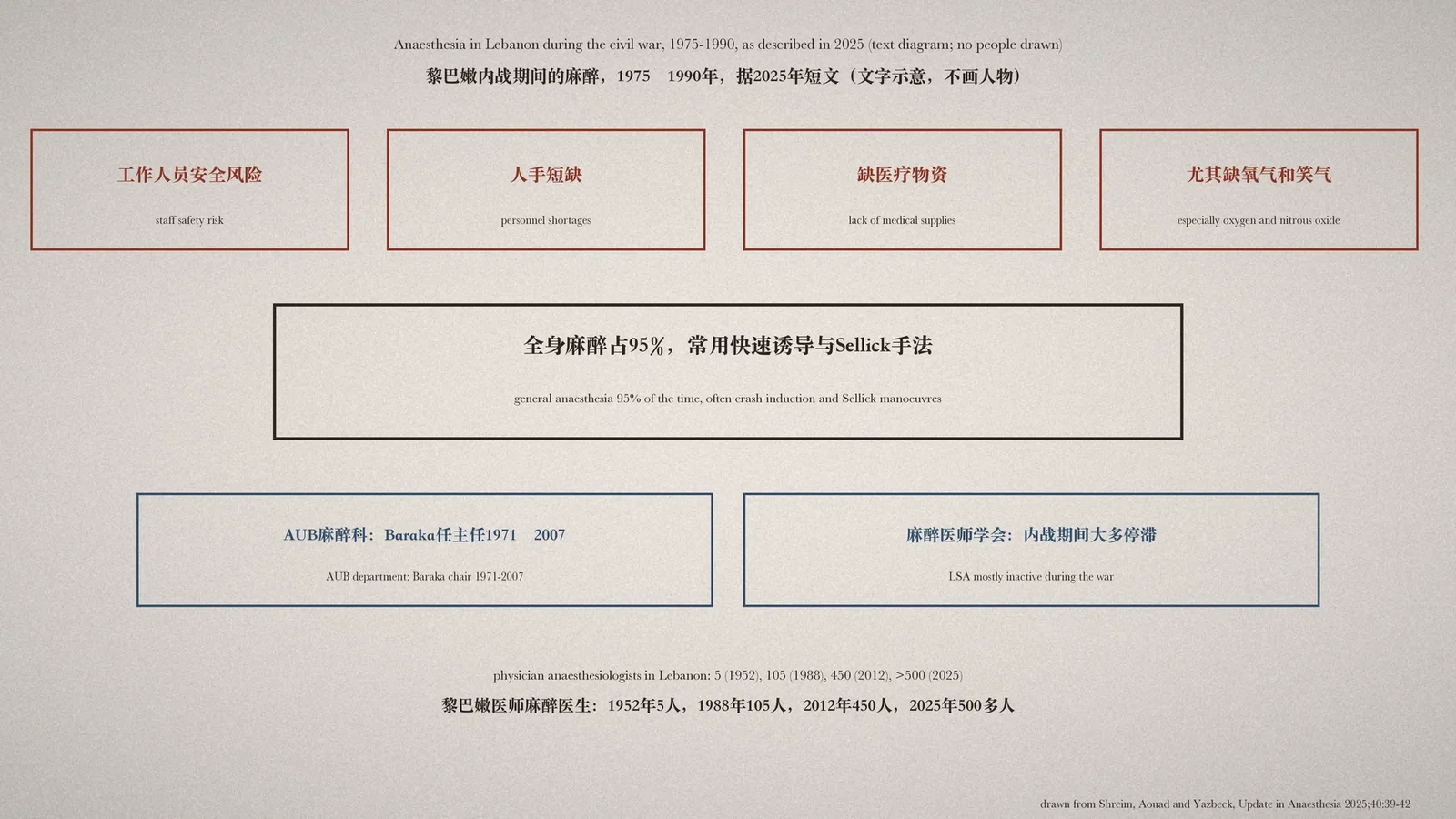
From 1975 to 1990 Lebanon lived through fifteen years of civil war. Operating theatres kept working, while anaesthetists faced personal danger, too few colleagues and shortages of supplies. The 2025 history issue of Update in Anaesthesia, published by the World Federation of Societies of Anaesthesiologists (WFSA), includes a short report by Lebanese anaesthesiologists that records this period in a few lines. This article reads that report. [1, p. 39][1, p. 40]
A short report
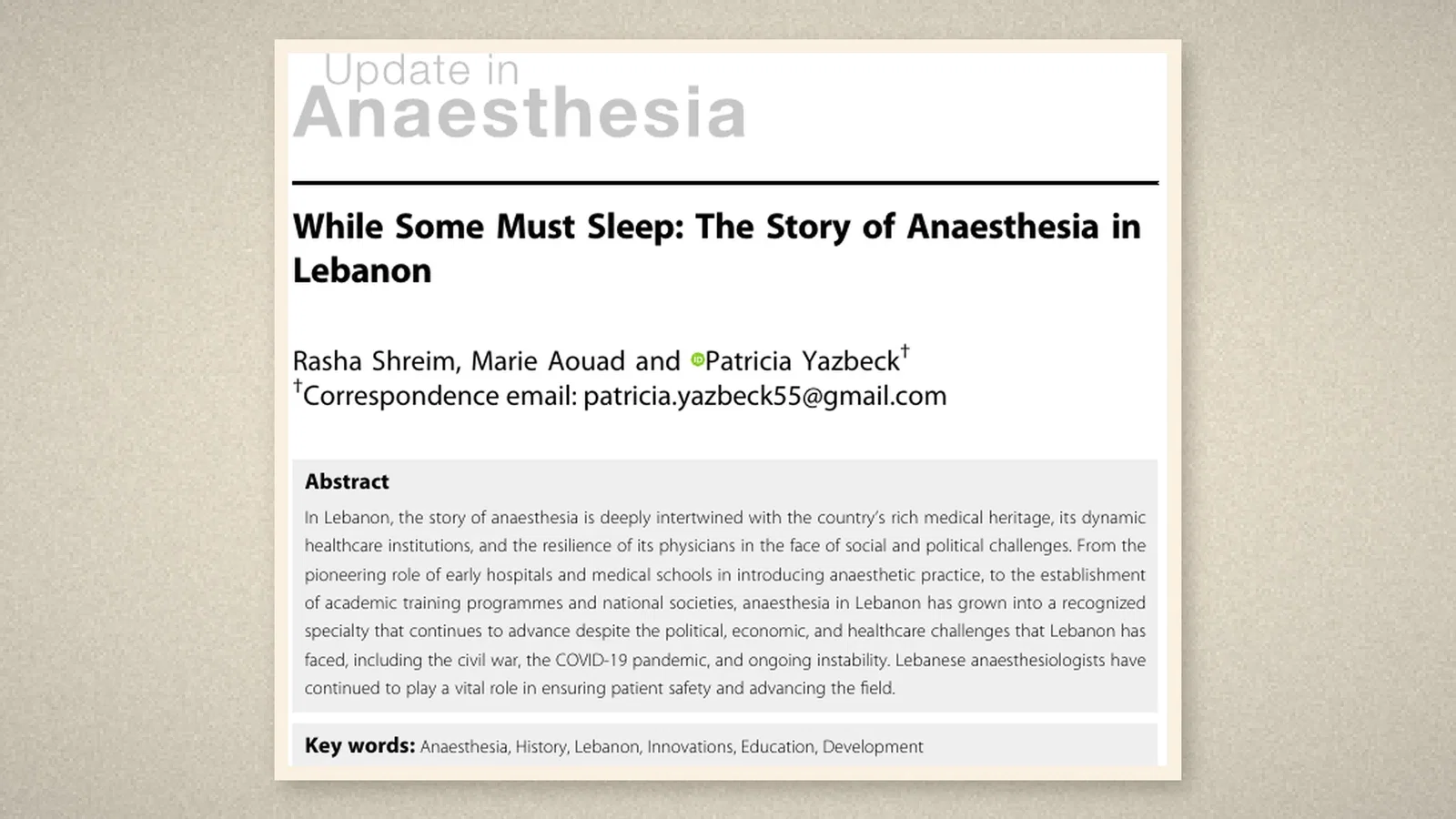
The report, "While Some Must Sleep: The Story of Anaesthesia in Lebanon", is by Rasha Shreim, Marie Aouad and Patricia Yazbeck of the American University of Beirut Medical Center and the Hotel-Dieu de France, Saint Joseph University. Its title echoes the motto of the Middle East Journal of Anesthesiology, "For some must watch, while some must sleep". Its abstract describes a specialty that kept advancing through the civil war, the COVID-19 pandemic and continuing instability, and its acknowledgement says it rests mainly on documents of Fuad Haddad, Musa Muallem, Wagih Sabbagh and Nadim Raphael. [1, p. 39][1, pp. 41-42]
What came before
The report traces the specialty from George Post, an American missionary surgeon who used chloroform on a dog in a village of Mount Lebanon in 1865, to five physician anaesthesiologists in the country in 1952; the American University of Beirut (AUB) started a two-year anaesthesia residency in 1954, made anaesthesiology an independent department in 1958 and extended training to three years. The new AUB Medical Center, with ten new operating rooms, opened in 1970. [1, pp. 39-40]
Operating theatres at war
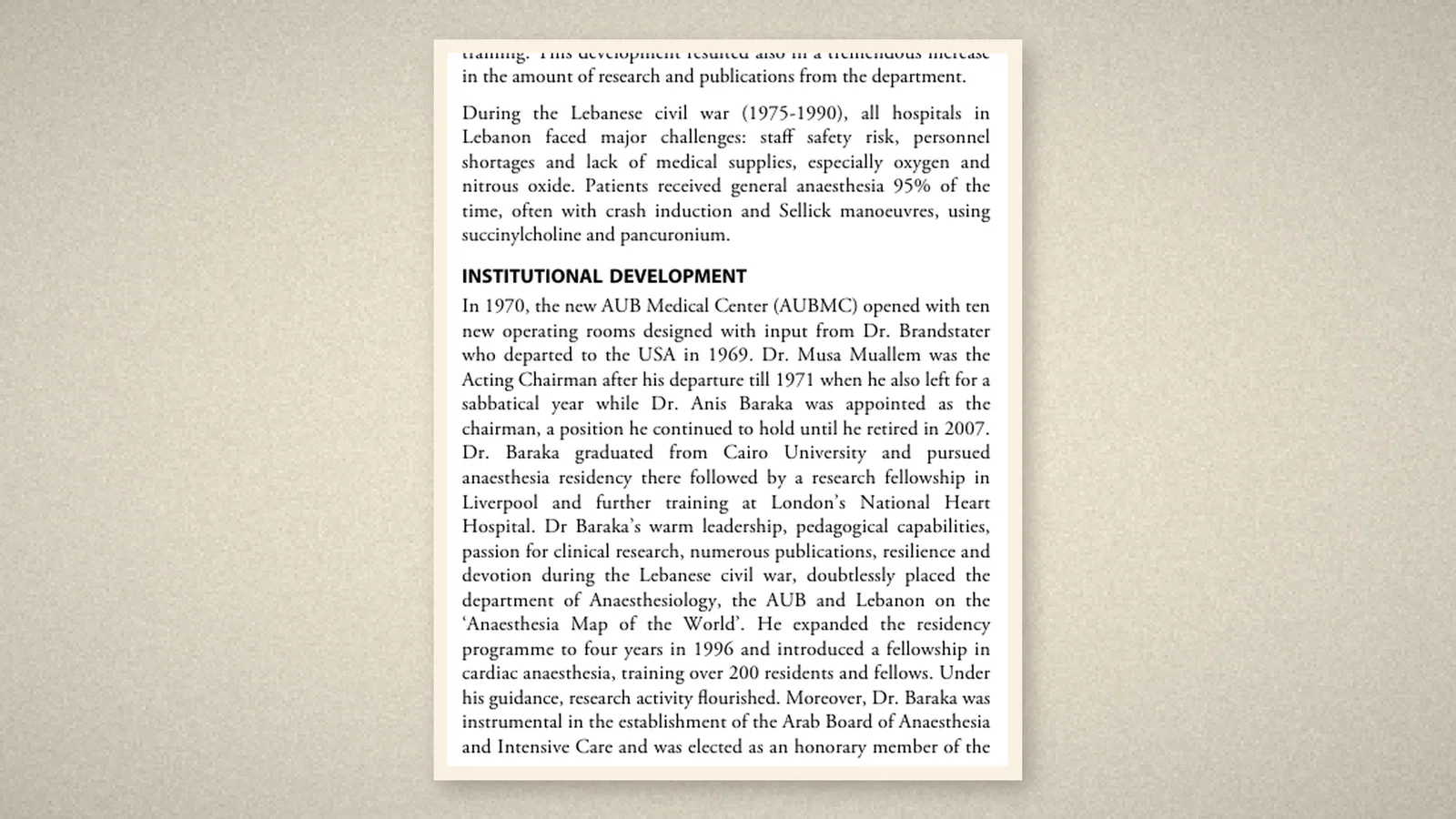
Of the civil war the report says that during the Lebanese civil war (1975-1990) all hospitals in Lebanon faced major challenges: staff safety risk, personnel shortages and lack of medical supplies, especially oxygen and nitrous oxide. Patients received general anaesthesia 95% of the time, often with crash induction and Sellick manoeuvres, using succinylcholine and pancuronium. [1, p. 40]
Anis Baraka
From 1971 Anis Baraka chaired AUB's anaesthesia department, a post held until retirement in 2007. A graduate of Cairo University, where the residency in anaesthesia was also completed, Baraka had a research fellowship in Liverpool and further training at London's National Heart Hospital. The authors credit Baraka's leadership, teaching, passion for clinical research, numerous publications, and resilience and devotion during the civil war with placing the department, AUB and Lebanon on the "Anaesthesia Map of the World". The residency was extended to four years in 1996 with a cardiac anaesthesia fellowship, over 200 residents and fellows were trained, and Baraka helped establish the Arab Board of Anaesthesia and Intensive Care. [1, pp. 40-41]
Meanwhile, at Saint Joseph University's Hotel-Dieu de France, Marie-Claire Antakly started a local three-year residency in anaesthesiology and reanimation in 1981, extended to four years in 1988. [1, p. 40]
A society on hold
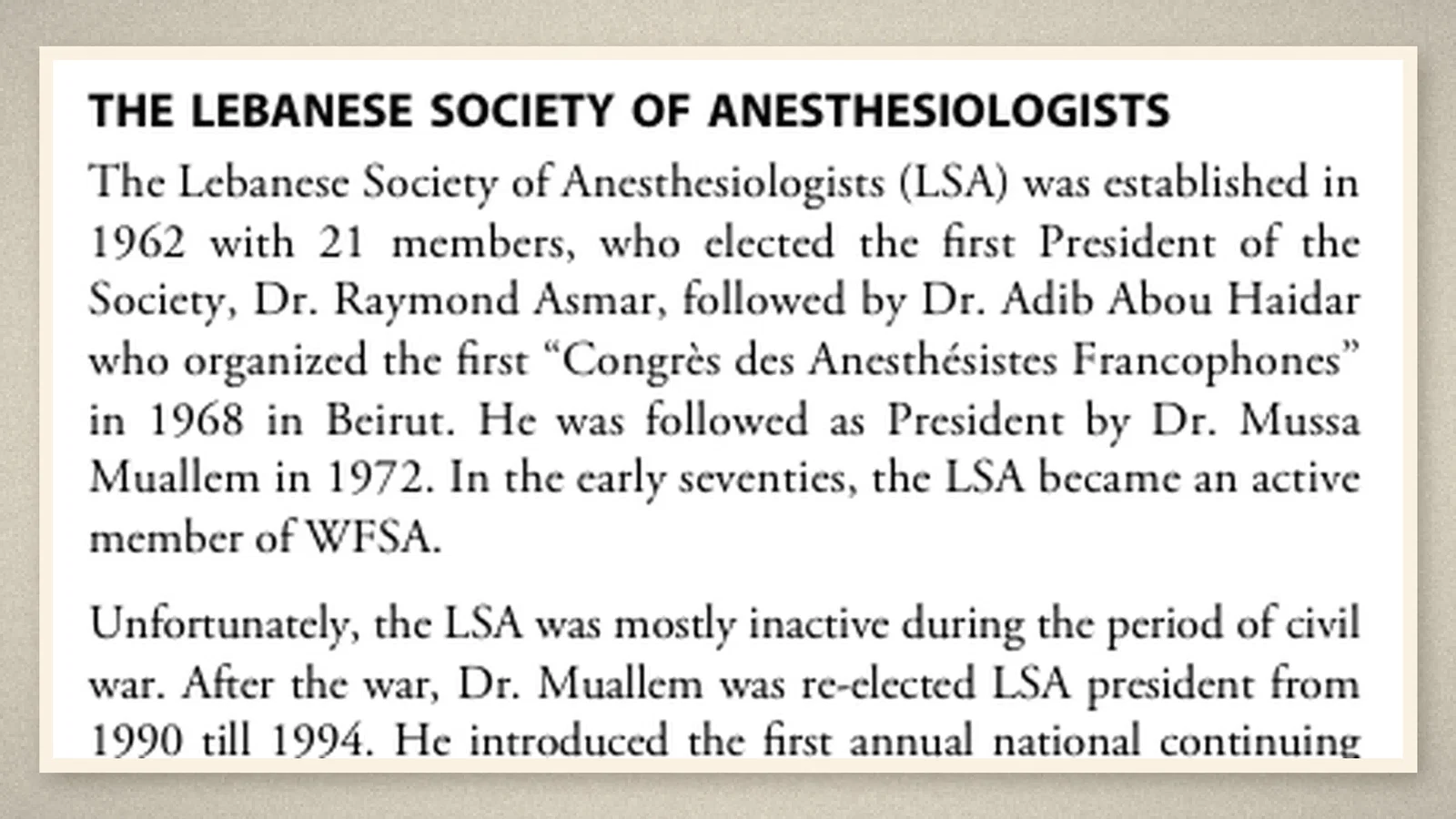
The Lebanese Society of Anesthesiologists was founded in 1962 with 21 members. It was, the report says, mostly inactive during the civil war; afterwards Musa Muallem was re-elected president from 1990 to 1994 and introduced an annual national continuing medical education meeting. [1, p. 41]
The war did not stop the specialty's growth: physician anaesthesiologists in Lebanon numbered five in 1952, 105 in 1988, 450 in 2012 and more than 500 in 2025. [1, p. 42]
What the record shows
The report gives the war years only a few sentences, yet they name the essentials of wartime anaesthesia: no oxygen, too few people, mostly general anaesthesia, mostly crash inductions. And in those years a department went on teaching and trained the next generation.
Sources and reading limits
Read: Rasha Shreim, Marie Aouad and Patricia Yazbeck, "While some must sleep: the story of anaesthesia in Lebanon", Update in Anaesthesia vol. 40 (October 2025), pp. 39-42, in full, with the issue's front matter. Page images of pp. 39, 40 and 41 checked.
Not covered: Baraka's publications from the war years and any first-hand account of wartime anaesthesia; the documents of Haddad, Muallem and others on which the report rests; the Middle East Journal of Anesthesiology.
Limits: this is a secondary account by members of the Lebanese anaesthesia community, and its description of the war years is brief; this article does not go beyond it. Drugs are named as in the source, without doses.
Three illustrations are taken from the issue of Update in Anaesthesia (pp. 39, 40 and 41). One is a text diagram drawn from the report, with no people drawn.
- Shreim R, Aouad M, Yazbeck P. While some must sleep: the story of anaesthesia in Lebanon. Update in Anaesthesia. 2025;40:39-42. PDF
Continue exploring
Related reading connects shared questions and contexts; it does not by itself establish historical influence.
Anesthesia Epochs · The Source Room · About & Editorial Method
Published November 4, 2026. Sources and reading limits are stated above. Illustrations are labelled as original source images or AI-made. Historical accounts are educational; they are not current treatment instructions.