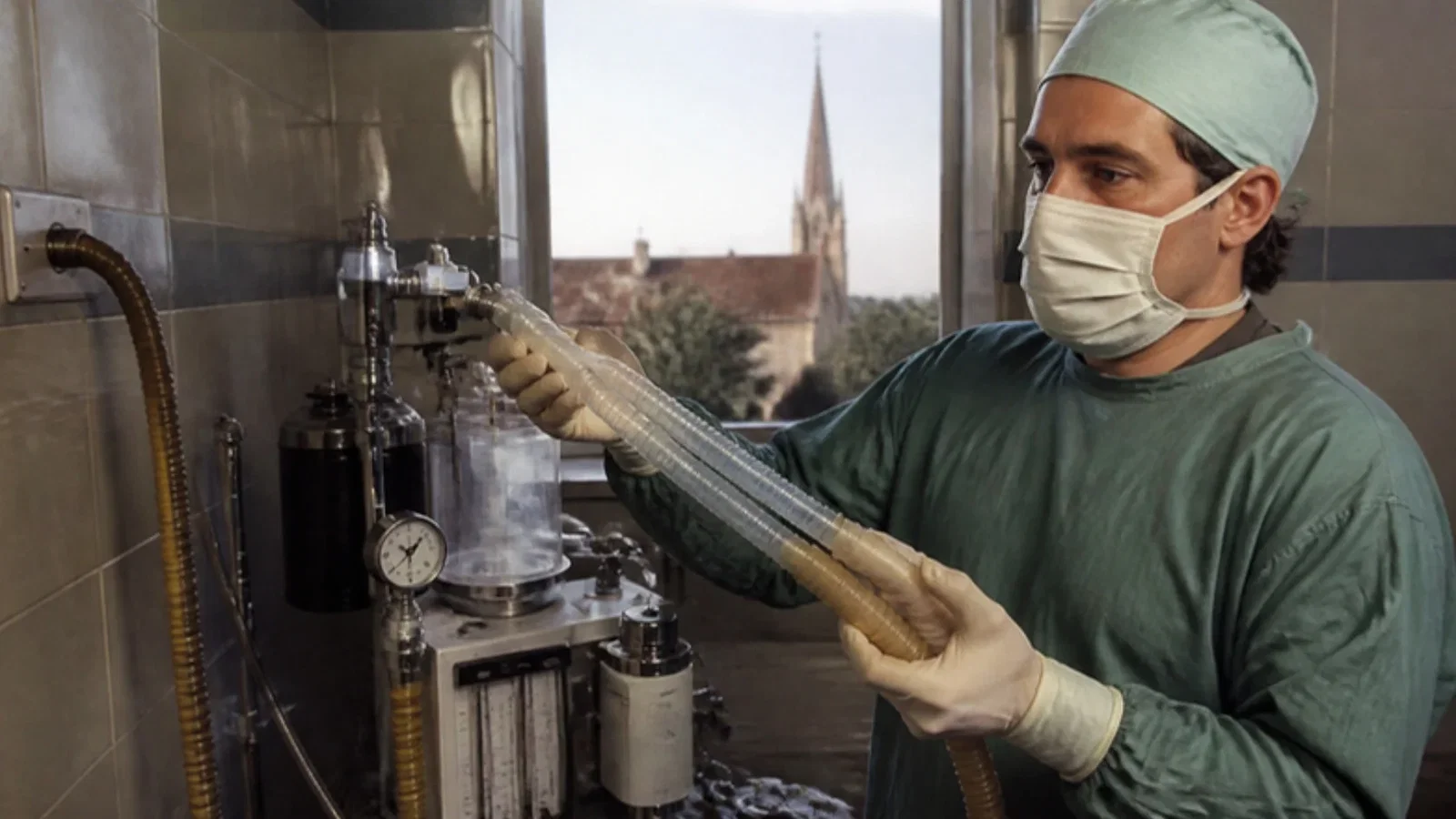
In March 1976 the Apparatus section of Anaesthesia (vol. 31) printed 'Theatre pollution control' by J. A. Lack, consultant anaesthetist at Salisbury General Hospital. Theatre pollution by waste anaesthetic gases clearly existed and should be controlled, and equipment should be safe, efficient, simple and cheap. Between patient and machine Lack designed a new circuit that kept the efficiency of the Magill circuit but removed the expiratory valve from its inaccessible place near the patient: two concentric tubes, fresh gas to the patient through the outer and expired gas back through the inner, the bag in the fresh gas line (Mapleson A), the reverse of the Bain circuit (Mapleson D), so that waste gas could be collected at the machine. Beyond the machine Lack chose a passive exhaust in copper pipe to the roof or outside wall, with an active system where needed. In April 1983, after a preliminary report in Hamburg in 1980, D. Humphrey of the University of Natal, Durban, described in the same journal a system combining Mapleson A, D and E principles, coaxial or non-coaxial and switched by two levers, for low-flow use in adults, children and neonates; the ideal universal system, Humphrey wrote, would use the principles of the Lack system for spontaneous breathing in adults and of the Bain for controlled ventilation.
Reading Library · Anesthesia Epochs · 中文版
Watch the education video (for clinicians)
1976: The Lack Circuit — The Coaxial Circuit Turned Inside Out · Anesthesia Epochs Education Series
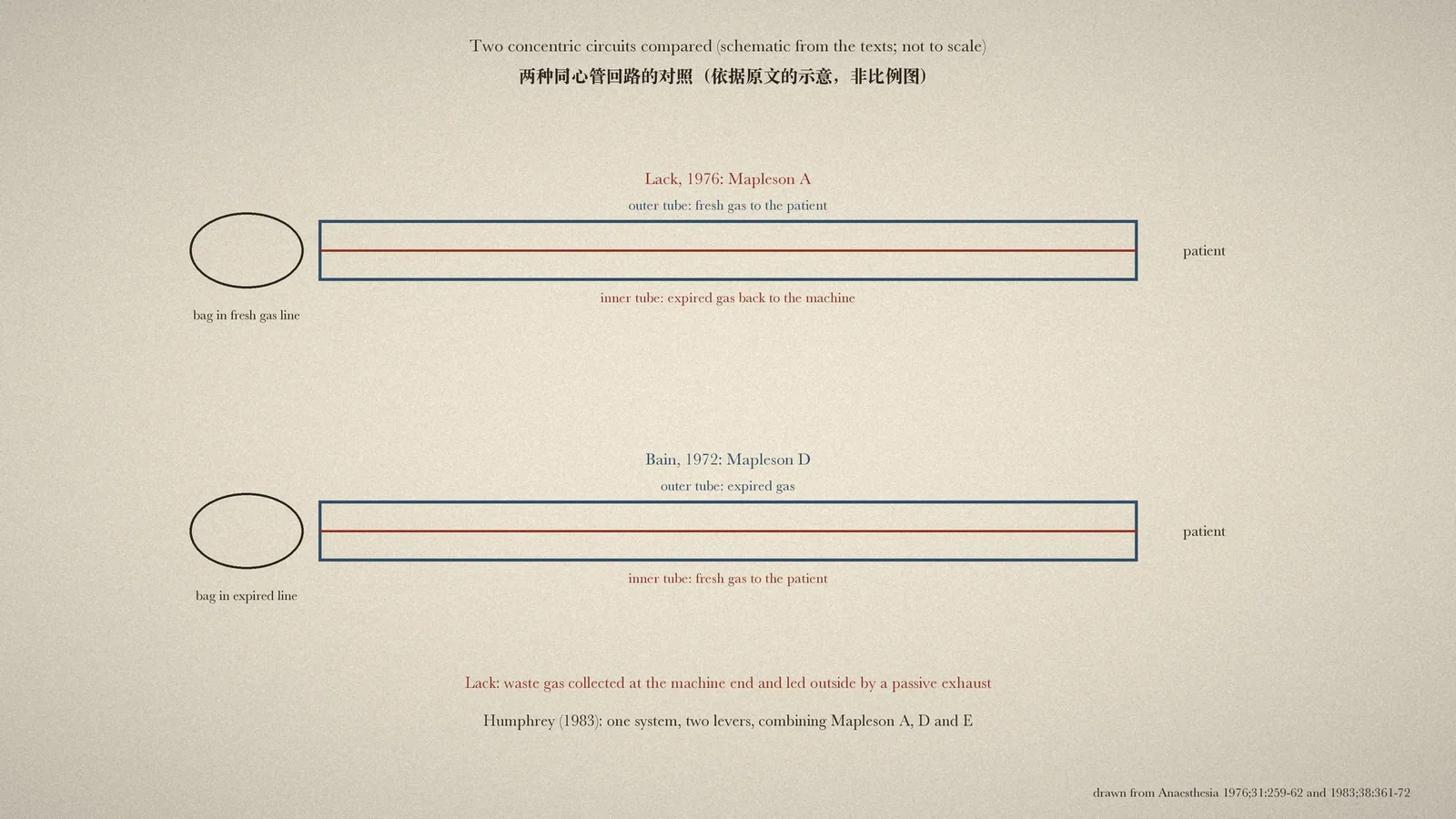
A few years after the Bain circuit appeared, an anaesthetist in Salisbury, England, also made a "tube within a tube" circuit, but with the flow running the other way. Yet the paper's title was not about a circuit at all: it was "Theatre pollution control". For its author, the circuit was the first link in a chain for getting rid of waste anaesthetic gas. [1, p. 259]
The pollution problem first
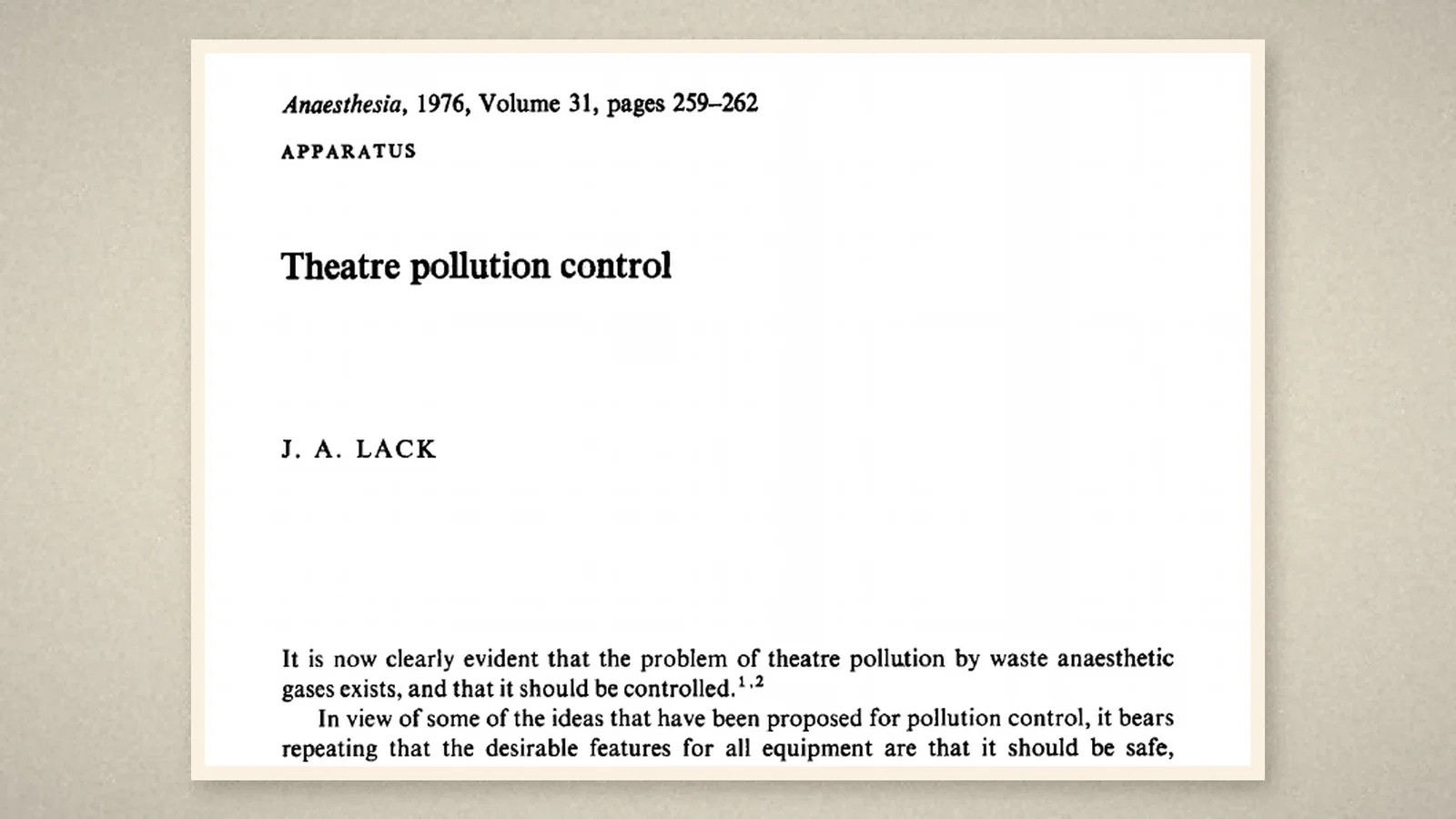
In March 1976 the Apparatus section of Anaesthesia printed an article by J. A. Lack, consultant anaesthetist at Salisbury General Hospital. It was now clearly evident, Lack began, that theatre pollution by waste anaesthetic gases existed and should be controlled. Given some of the ideas that had been proposed, it bore repeating that all equipment "should be safe, efficient, simple and cheap", and the article described a system in use at Salisbury that met these criteria. [1, p. 259]
The system had three parts: from the patient to the anaesthetic machine, from the machine to the wall, and from the wall to the outside. [1, p. 259]
Concentric tubes, reversed
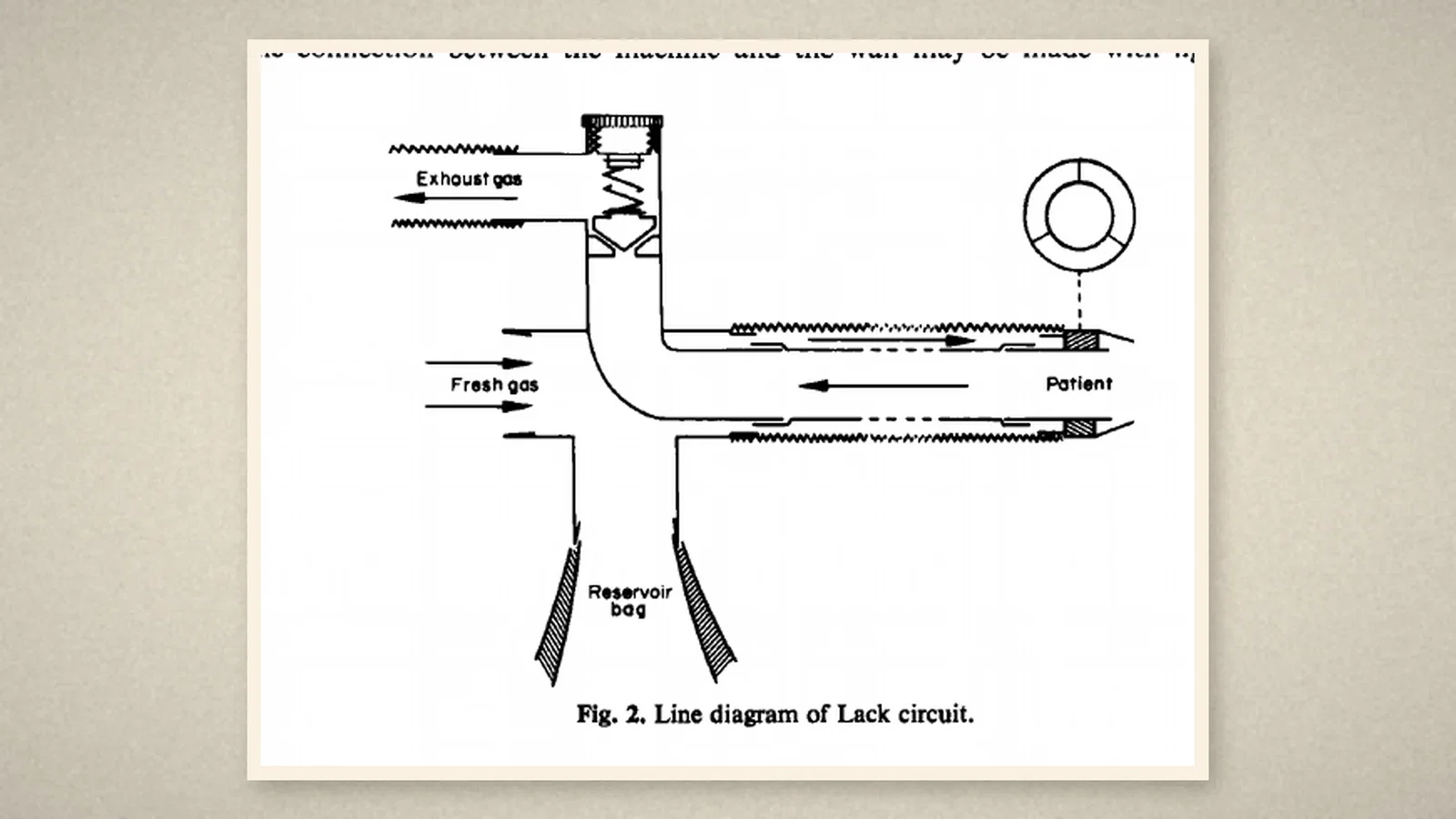
For the first part Lack designed a new circuit. It "retains the efficiency of the Magill circuit but overcomes the disadvantages" of its expiratory valve being placed inaccessibly close to the patient. The circuit came as a machine end and a patient end joined by two tubes, an inner one of ordinary vinyl and an outer one of standard black corrugated hose. Fresh gas went to the patient through the outer of the two concentric tubes, and expired gas came back along the inner one. The reservoir bag lay in the fresh gas line, making it a Mapleson A system, "in contrast to the Bain circuit", whose bag sits in the expired line as a Mapleson D. [1, p. 259]
So expired gas was gathered at the machine end. Lack also designed a new spill valve with less pressure drop at high flows and a shroud whose outlet could swivel in any direction. The same collecting valve could replace the spill valve of the BOC circle absorber, and ventilators in theatre should have a specific exhaust port. [1, p. 260]
From the wall to the outside
Lightweight corrugated plastic tubing linked the machine to the wall, kept off the floor so that it could not be squashed or trip the staff. For the last part Lack chose a passive exhaust system for its simplicity and freedom from outside influences. It suited most theatres and could be put in by hospital engineers from stock materials: copper pipe from the wall socket, rising slightly all the way so that condensation drained, run by the simplest route outside, turned over in an inverted U at the roof or an outside wall, and finished with a T-piece covered by fine wire netting. [1, p. 261] Where a theatre was far from an outside wall, or wind conditions were unusual, an active system with a reservoir and pump could be used instead, at the cost of complexity and regular maintenance. [1, p. 262]
The conclusion reads: pollution control should be simple, cheap and effective; it should not bring new hazards to the patient or noticeably complicate anaesthesia; a simple passive system could achieve this; and the concentric tubing let waste gas be collected at the machine and sent outside with minimal added resistance to breathing out. [1, p. 262]
Three systems in one
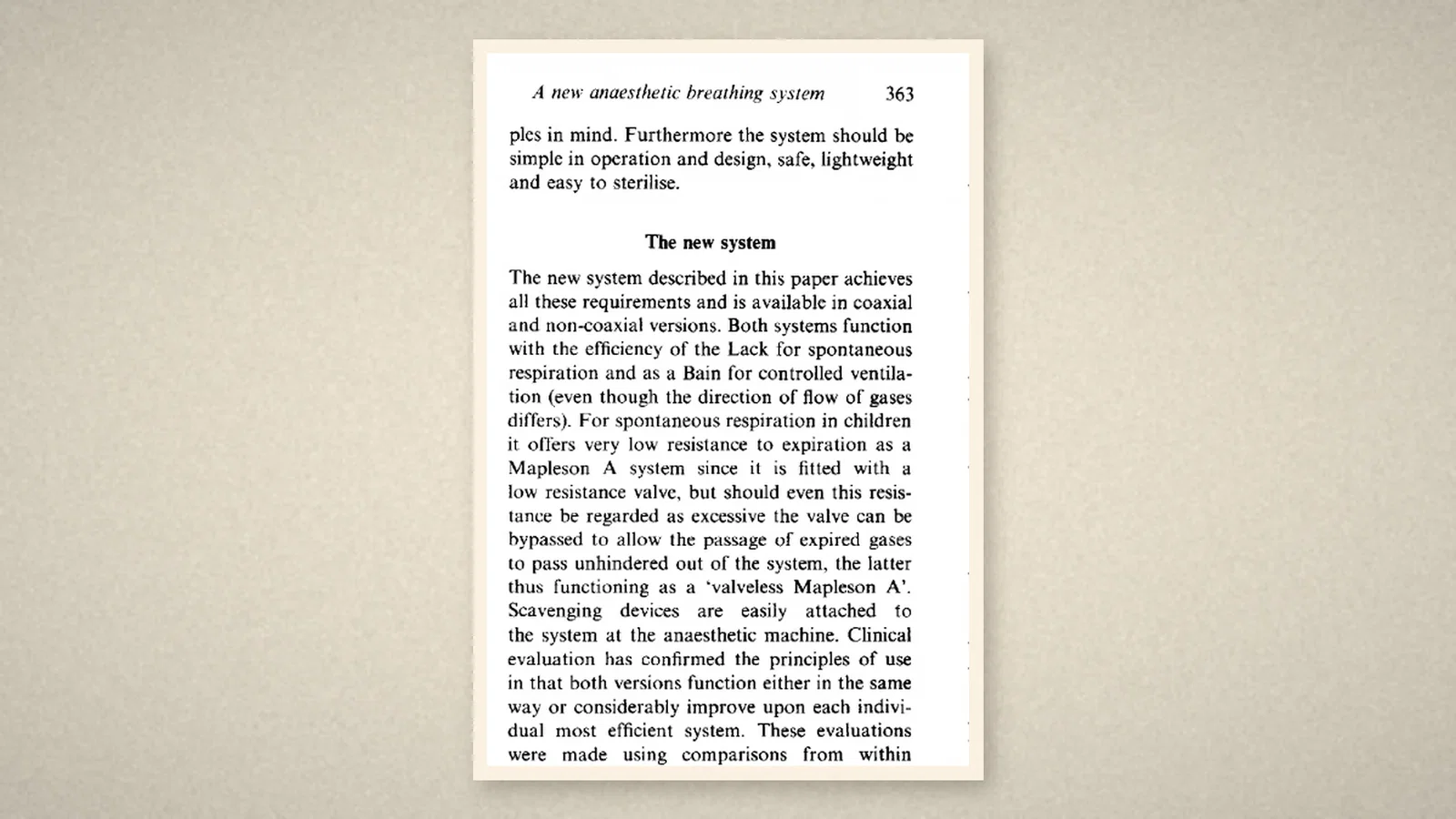
Seven years later, in April 1983, Anaesthesia printed a paper by D. Humphrey of the Faculty of Medicine, University of Natal, Durban, South Africa: "A new anaesthetic breathing system combining Mapleson A, D and E principles", subtitled "A simple apparatus for low flow universal use without carbon dioxide absorption". A preliminary report had been given at the 7th World Congress of Anaesthesiologists in Hamburg in 1980. The system came in coaxial and non-coaxial versions and could be used for adults, children or neonates, breathing spontaneously or ventilated, with low fresh gas flows throughout. [2, p. 361]
Humphrey recalled that the Lack system, introduced in 1976, and the Bain both made scavenging easy, and that the Bain had "gained worldwide acceptance" as a light modified Mapleson D/E system. [2, p. 362] An ideal universal system, Humphrey wrote, would use the principles of a Lack system for spontaneous breathing in adults, a Bain system for controlled ventilation in adults and children, and a low-resistance or valveless Mapleson A system for spontaneous breathing in children. Both versions of the new system worked on exactly the same principles and depended simply on the position of two levers, "nothing else being altered". [2, p. 363]
What the record shows
Lack turned Bain's concentric tubes round so that one circuit kept the efficiency of the Magill and also carried waste gas back to the machine. Seven years later Humphrey put both ideas into a single device and switched between them with levers. Both started from the same practical question: how one circuit could serve different patients and ways of breathing while saving gas and keeping the theatre air clean.
Sources and reading limits
Read: Lack, "Theatre pollution control", Anaesthesia 1976;31:259-62 (the whole paper with Figs 2-5; page images of pp. 259 and 260 checked); Humphrey, "A new anaesthetic breathing system combining Mapleson A, D and E principles", Anaesthesia 1983;38:361-72 (summary, rationale, the ideal universal system, the new system and the description of apparatus; the clinical evaluation and tables skimmed; page image of p. 363 checked). Both were obtained through institutional access.
Not covered: the efficiency studies of the Lack circuit that Humphrey cites; Humphrey's 1980 Hamburg presentation itself; Vickers's notice on theatre pollution and the editorial that Lack cites; later multimode systems. The ASA timeline entries were not used as evidence.
Limits: some timelines date this topic to 1976 and 1980. Humphrey's full paper read here appeared in 1983 and says a preliminary report was given in Hamburg in 1980. Lack's article is chiefly about scavenging, with the coaxial circuit as its first element. Humphrey's efficiency comparisons and recommended flows are not repeated, nor are pipe sizes, flows or resistances, and page crops stop before them. The paper's Fig. 1, a clinical photograph with a patient, is not shown.
Three illustrations are crops of Anaesthesia 1976 pp. 259 and 260 (the paper's Fig. 2 line diagram) and 1983 p. 363. One is a schematic comparison of the concentric circuits drawn from the texts, not to scale.
- Lack JA. Theatre pollution control. Anaesthesia. 1976;31:259-62. DOI
- Humphrey D. A new anaesthetic breathing system combining Mapleson A, D and E principles: a simple apparatus for low flow universal use without carbon dioxide absorption. Anaesthesia. 1983;38:361-72. DOI
Continue exploring
Related reading connects shared questions and contexts; it does not by itself establish historical influence.
- 1972: Bain and Spoerel Introduce a Single-Tube Coaxial Breathing System
- 1975: Pethick Proposes an Oxygen-Flush Test for the Bain Circuit
Anesthesia Epochs · The Source Room · About & Editorial Method
Published November 3, 2026. Sources and reading limits are stated above. Illustrations are labelled as original source images or AI-made. Historical accounts are educational; they are not current treatment instructions.