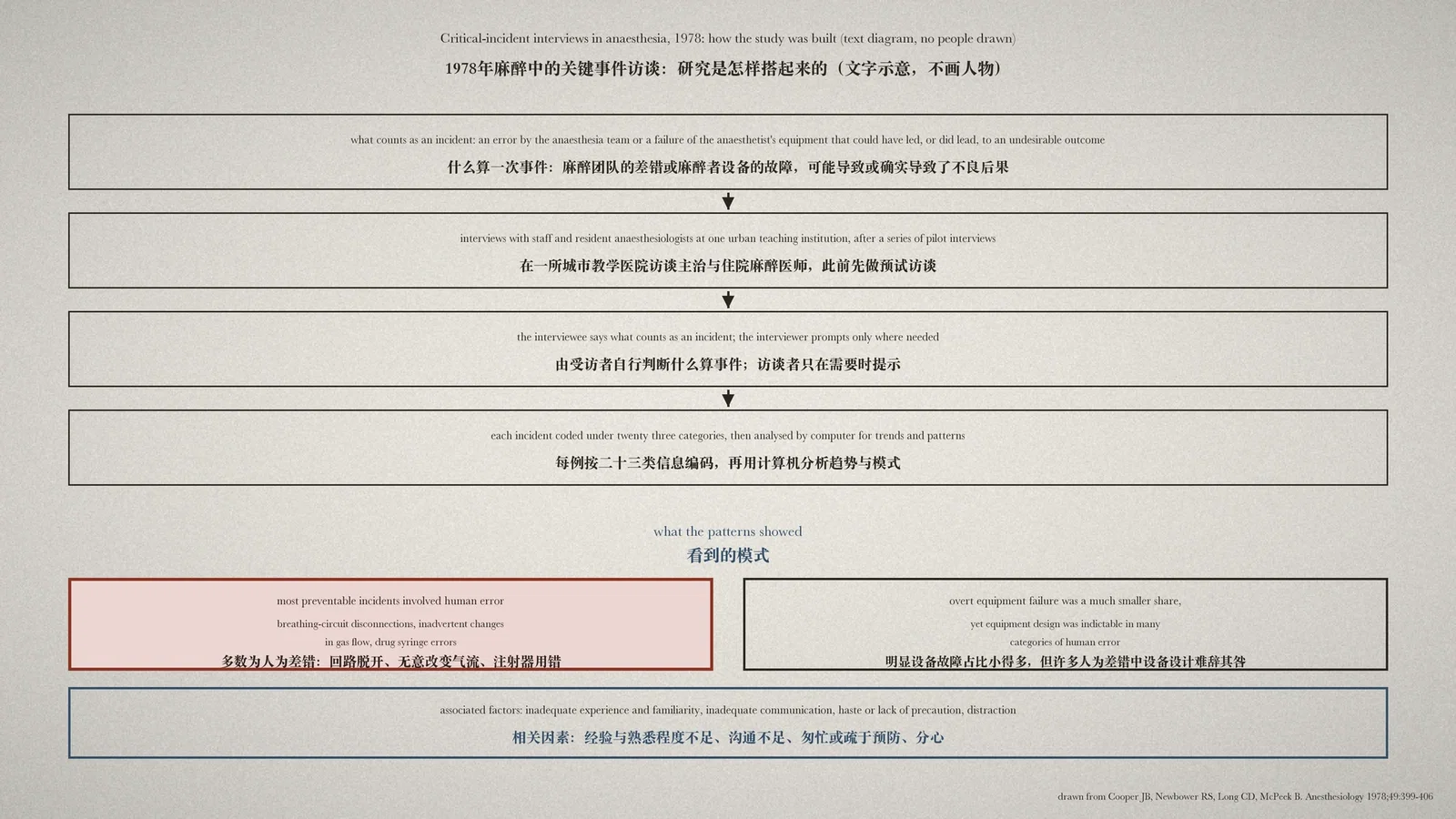
Anesthesiology for December 1978 (vol. 49, no. 6) carried 'Preventable anesthesia mishaps: a study of human factors' by Jeffrey B. Cooper, Ronald S. Newbower, Charlene D. Long and Bucknam McPeek. A modified critical-incident analysis technique was used in a retrospective examination of human error and equipment failure in anaesthetic practice, the objective being to uncover patterns of frequently occurring incidents needing prospective study. Forty seven interviews with staff and resident anaesthesiologists at one urban teaching institution yielded descriptions of 359 preventable incidents, each coded under twenty three categories of detail and analysed by computer for trends. Most of the incidents involved human error, 82 per cent, with breathing-circuit disconnections, inadvertent changes in gas flow and drug syringe errors among the frequent problems. Overt equipment failures made up only 14 per cent, yet equipment design was indictable in many categories of human error, as were inadequate experience and insufficient familiarity with the equipment or the particular operation; inadequate communication, haste or lack of precaution and distraction were among the associated factors. The technique, the authors wrote, lets human-factors principles be applied to anaesthesia as they had been in fields such as aviation, and they set out frankly the known problems of retrospective interview methods.
Reading Library · Anesthesia Epochs · 中文版
Watch the education video (for clinicians)
1978: Critical Incidents — Ask What Happened · Anesthesia Epochs Education Series
Counting anaesthetic deaths shows the outcome. To learn how things go wrong step by step, someone has to ask the people who were there. In December 1978 Anesthesiology, vol. 49, no. 6, published "Preventable anesthesia mishaps: a study of human factors" by Jeffrey B. Cooper, Ronald S. Newbower, Charlene D. Long and Bucknam McPeek. This article reads that paper. [1, p. 399][2, p. 277]
A borrowed method
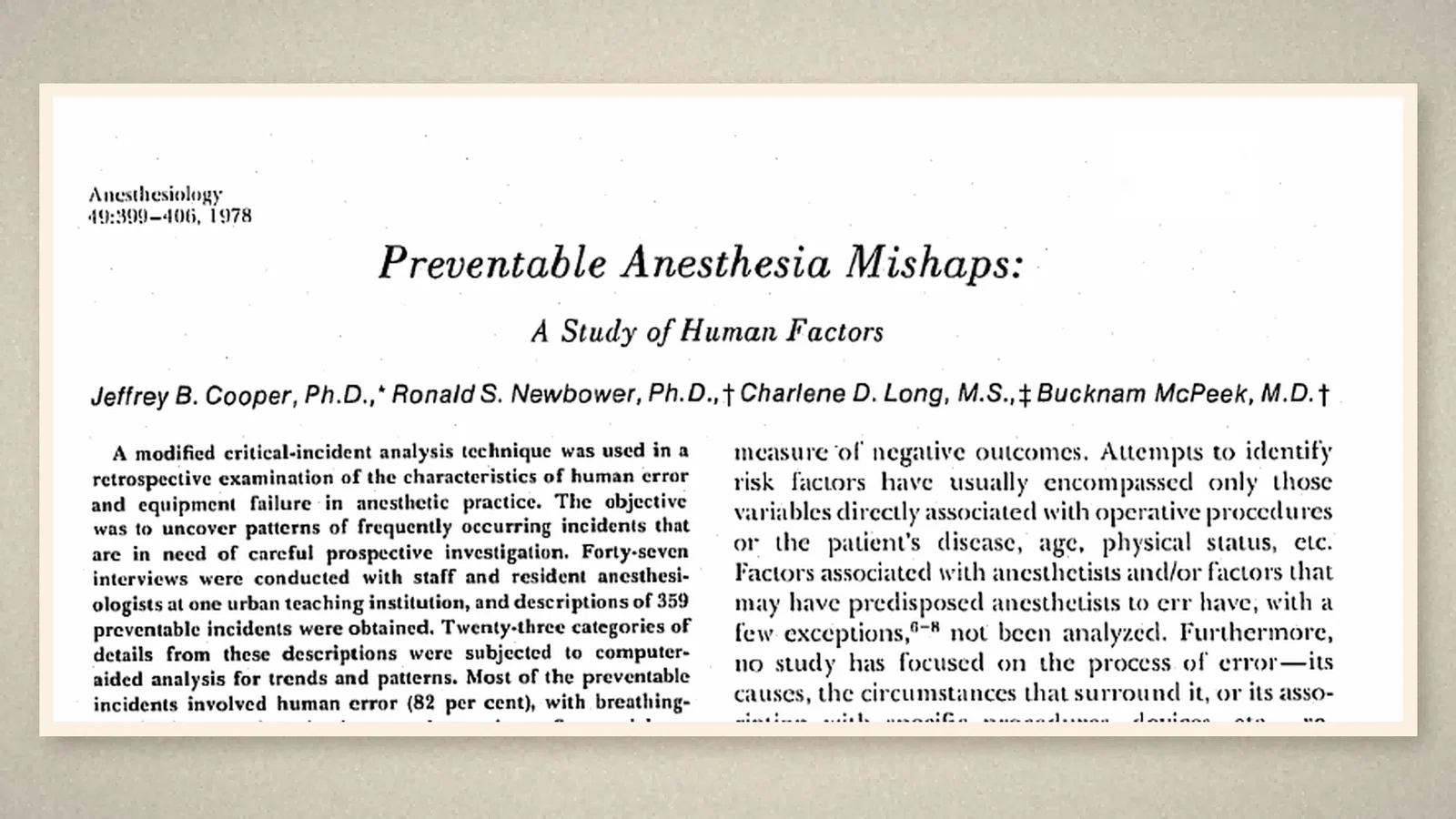
The technique was a modified critical-incident analysis. A footnote explains the term: as intended by Flanagan, the originator of the technique, a "critical incident" is an occurrence that is significant or pivotal, in either a desirable or an undesirable way; for this study the authors chose to examine only incidents with potentially undesirable consequences. [1, p. 399]
The objective is stated plainly: a retrospective examination of the characteristics of human error and equipment failure in anaesthetic practice, to uncover patterns of frequently occurring incidents that are in need of careful prospective investigation. [1, p. 399][2, p. 277]
What counted as an incident? A mishap was labelled a critical incident when it was clearly an occurrence that could have led, if not discovered or corrected in time, or did lead to an undesirable outcome, ranging from increased length of hospital stay to death or permanent disability. It also had to involve an error by a member of the anaesthesia team or a failure of the anaesthetist's equipment. [1, p. 399]
How they were gathered
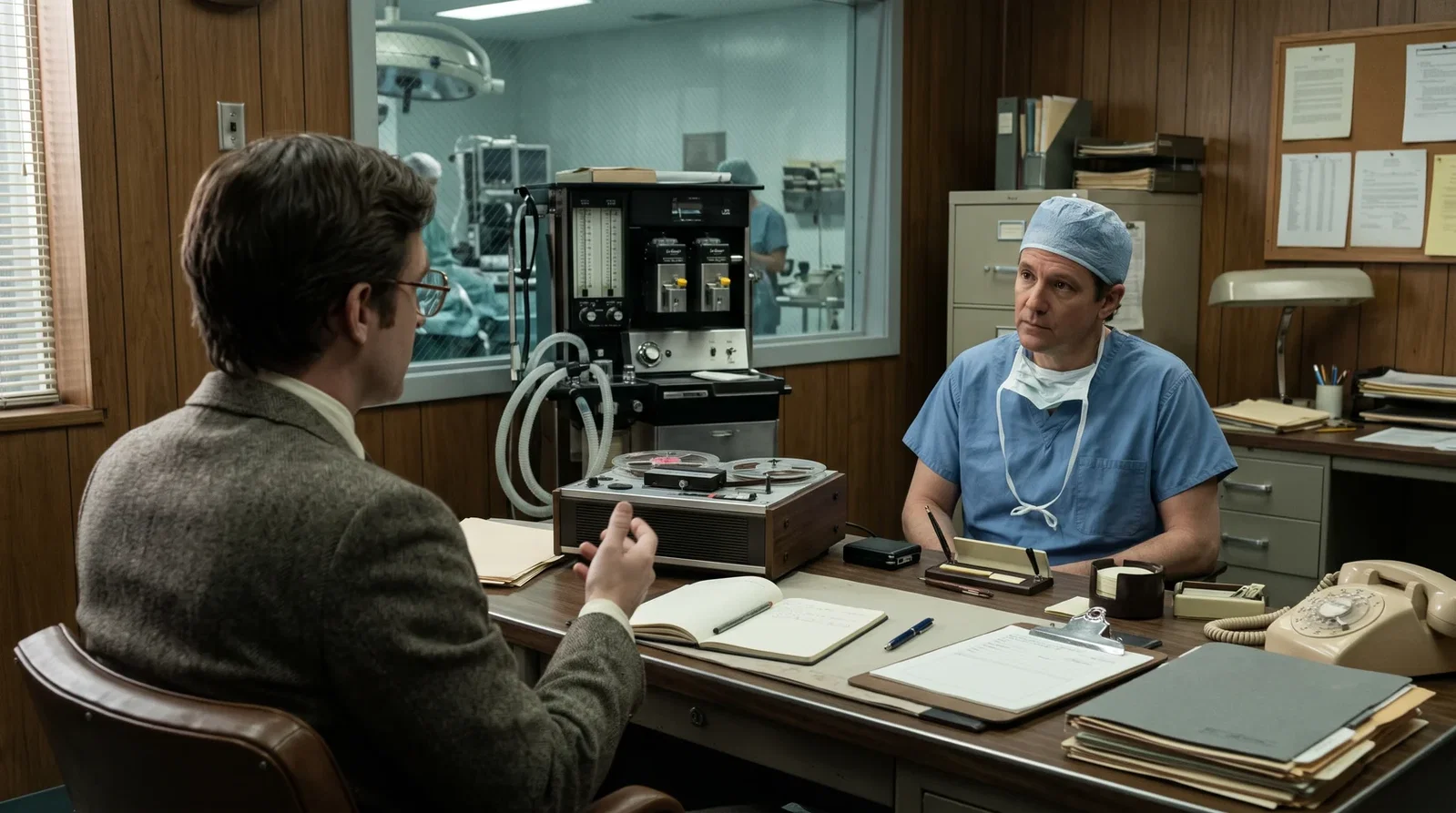
The material came from one large metropolitan teaching hospital, from staff and resident anaesthesiologists: forty seven interviews yielding descriptions of 359 preventable incidents. [2, p. 277]
The interviewing was itself designed. A series of 25 pilot interviews ran from January to May 1975 to evaluate strategies and develop a format. The interviewer had extensive professional experience with interview technique and had been trained for the work. Each interviewee was given a brief introduction, told how the data would be treated, and then asked to recount incidents, so that interviewees reported whatever they felt constituted one, with the interviewer putting prompting questions where needed. Interviews lasted about an hour to an hour and a half. [1, p. 400]
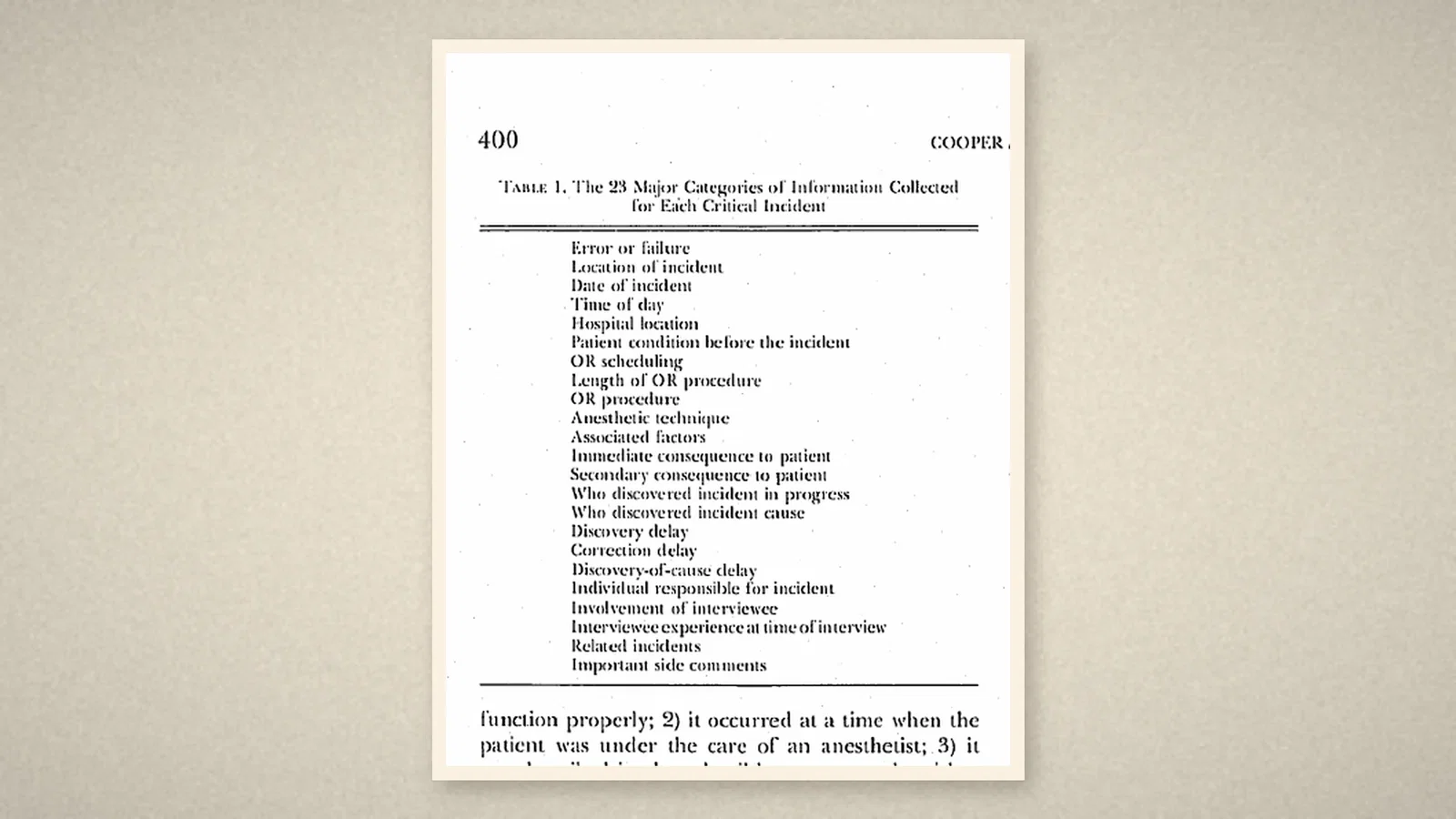
Each incident was coded under twenty three categories of information, the paper's Table 1, and the coded details were analysed by computer for trends and patterns. A category called "associated factors" was developed for circumstances that accompanied an incident without being the error itself. [1, p. 400][1, p. 403]
What the patterns showed
Two proportions are the most quoted: 82 per cent of the preventable incidents involved human error, while overt equipment failures made up only 14 per cent. Frequent human errors included breathing-circuit disconnections, inadvertent changes in gas flow and drug syringe errors. [2, p. 277]
The authors immediately qualify the second figure. A low rate of outright equipment failure does not absolve equipment: equipment design was indictable in many categories of human error, as were inadequate experience and insufficient familiarity with the equipment or with the particular operation. Other factors frequently associated with incidents were inadequate communication among personnel, haste or lack of precaution, and distraction. [2, p. 277]
How the authors regarded the method
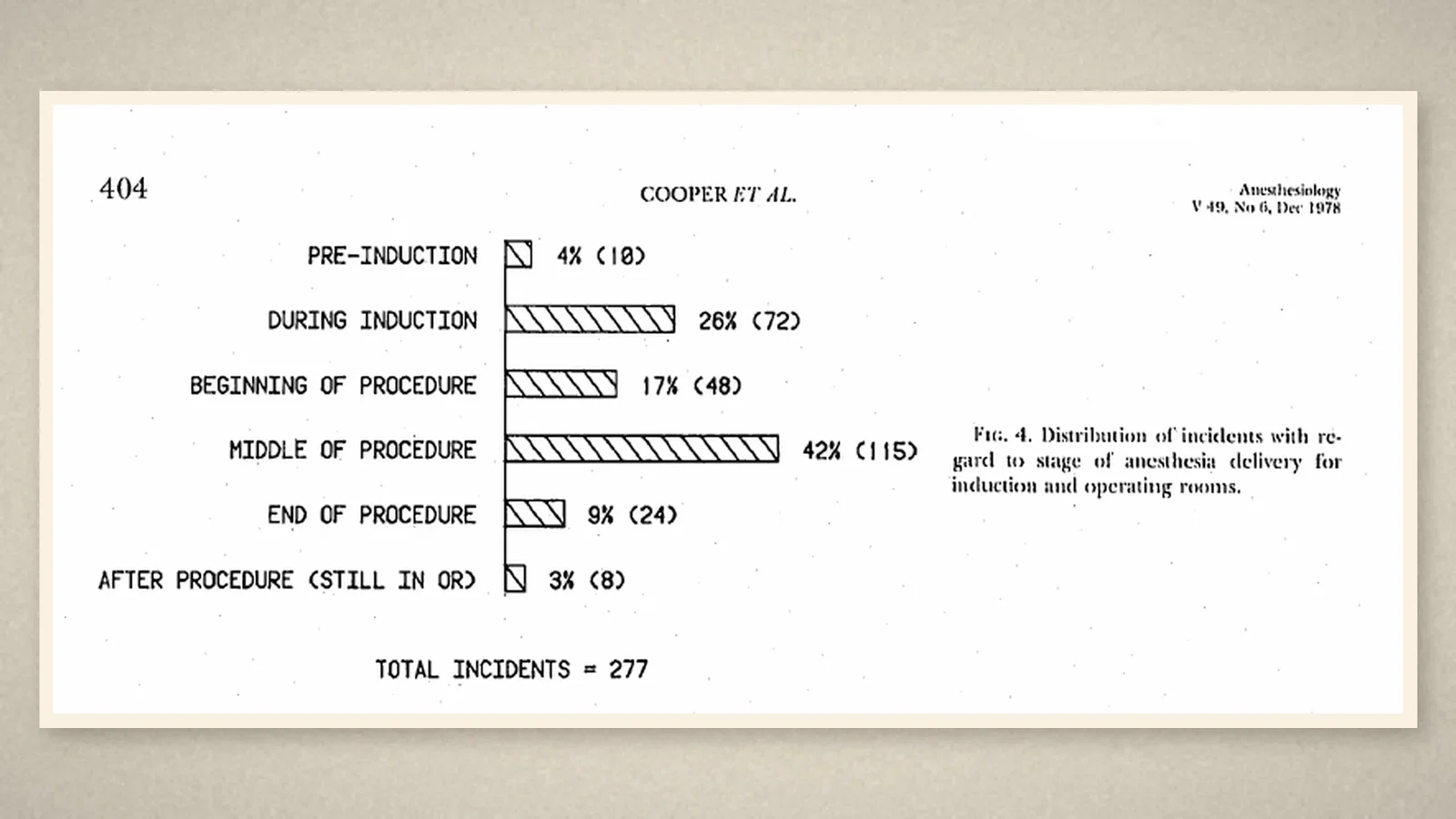
The discussion says that this application of critical-incident analysis to anaesthetic practice produced an interview and coding technique useful for monitoring anaesthesia mishaps. The kinds of incidents reported, the authors concede, would probably be familiar to an experienced anaesthetist; the value of the technique is that it offers a firmer basis for formulating and evaluating hypotheses about the aetiology of anaesthetic errors, and for designing and evaluating changes in training methods, procedures and equipment design. In this respect it permits the application of human-factors principles to anaesthesia, following successful applications in fields such as aviation. [1, p. 404]
They also set out the method's built-in problems. There are many inherent, documented problems with retrospective interview techniques, and the experimenter faces a dilemma: any attempt to keep objectivity and reproducibility by asking specific questions necessarily introduces bias, while a completely non-directed interview lowers the subject's motivation and the chance of obtaining pertinent information. The earliest interviews deliberately explored both extremes before a middle course was chosen. [1, p. 404]
Results from multi-hospital studies based on this methodology, the paper concludes, could be used for a more objective determination of priorities and for planning specific investments to decrease the risk associated with anaesthesia. [1, p. 399]
What the record shows
The paper changes the question. Not only how many patients died, but how the thing happened and what else was going on at the time. Breaking each account into codable categories let scattered personal experience be added up into patterns; and because the authors put the bias of interviewing and the weakness of retrospective data in the same paper, the prospective studies that followed knew what they had to repair.
Sources and reading limits
Read: Cooper JB, Newbower RS, Long CD, McPeek B, "Preventable anesthesia mishaps: a study of human factors", Anesthesiology, December 1978, vol. 49, no. 6, pp. 399-406 (scanned PDF obtained through institutional access), in full; and the same paper reprinted as a Classic Paper in Quality and Safety in Health Care 2002;11:277-83 (PMC1743650), used as a clean text of the same article to confirm wording.
Not covered: Flanagan's original paper on the critical-incident technique, and the mortality studies cited in the introduction; the authors' later prospective and multi-hospital work.
Limits: no drug doses are reproduced here. The percentages and counts here are study findings and are given as the paper states them. The distribution within each subcategory is in the paper's figures and is not repeated item by item.
Three illustrations are taken from the 1978 paper (p. 399, Table 1 and Figure 4). One is a diagram drawn from the text, with no people drawn.
- Cooper JB, Newbower RS, Long CD, McPeek B. Preventable anesthesia mishaps: a study of human factors. Anesthesiology. 1978;49(6):399-406. doi:10.1097/00000542-197812000-00004
- The same paper reprinted: Preventable anesthesia mishaps: a study of human factors. Qual Saf Health Care. 2002;11(3):277–282. PMC1743650
Continue exploring
Related reading connects shared questions and contexts; it does not by itself establish historical influence.
- 1977: Goldman Derives a Cardiac Risk Index for Noncardiac Surgery
- 1986: The APSF Newsletter Reports Early ASA Closed Claims Findings
Anesthesia Epochs · The Source Room · About & Editorial Method
Published November 5, 2026. Sources and reading limits are stated above. Illustrations are labelled as original source images or AI-made. Historical accounts are educational; they are not current treatment instructions.