In the first issue of the APSF Newsletter (March 1986), 'Closed Claims Study Seeks Data' by Ward described the American Society of Anesthesiologists' review, through its Professional Liability Committee chaired by Cheney, of closed malpractice claims against anaesthesiologists in the files of physician-owned insurers and the St. Paul company, each claim abstracted by a practising anaesthesiologist; the idea came from a lawyer friend of the resident Richard Solazzi, after which Solazzi and Ward reviewed a decade of Washington State files and prompted the ASA's national survey; 432 claims had been reviewed, 29 involved unrecognised oesophageal intubation causing death or brain damage, 18 of them with bilateral chest auscultation, and in a subset of 156 cases pulse oximetry and capnography were estimated to have prevented 20% of complications, almost 60% of payments.
Reading Library · Anesthesia Epochs · 中文版
Watch the education video (for clinicians)
1986: The ASA Closed Claims Study — What the Claim Files Showed · Anesthesia Epochs Education Series
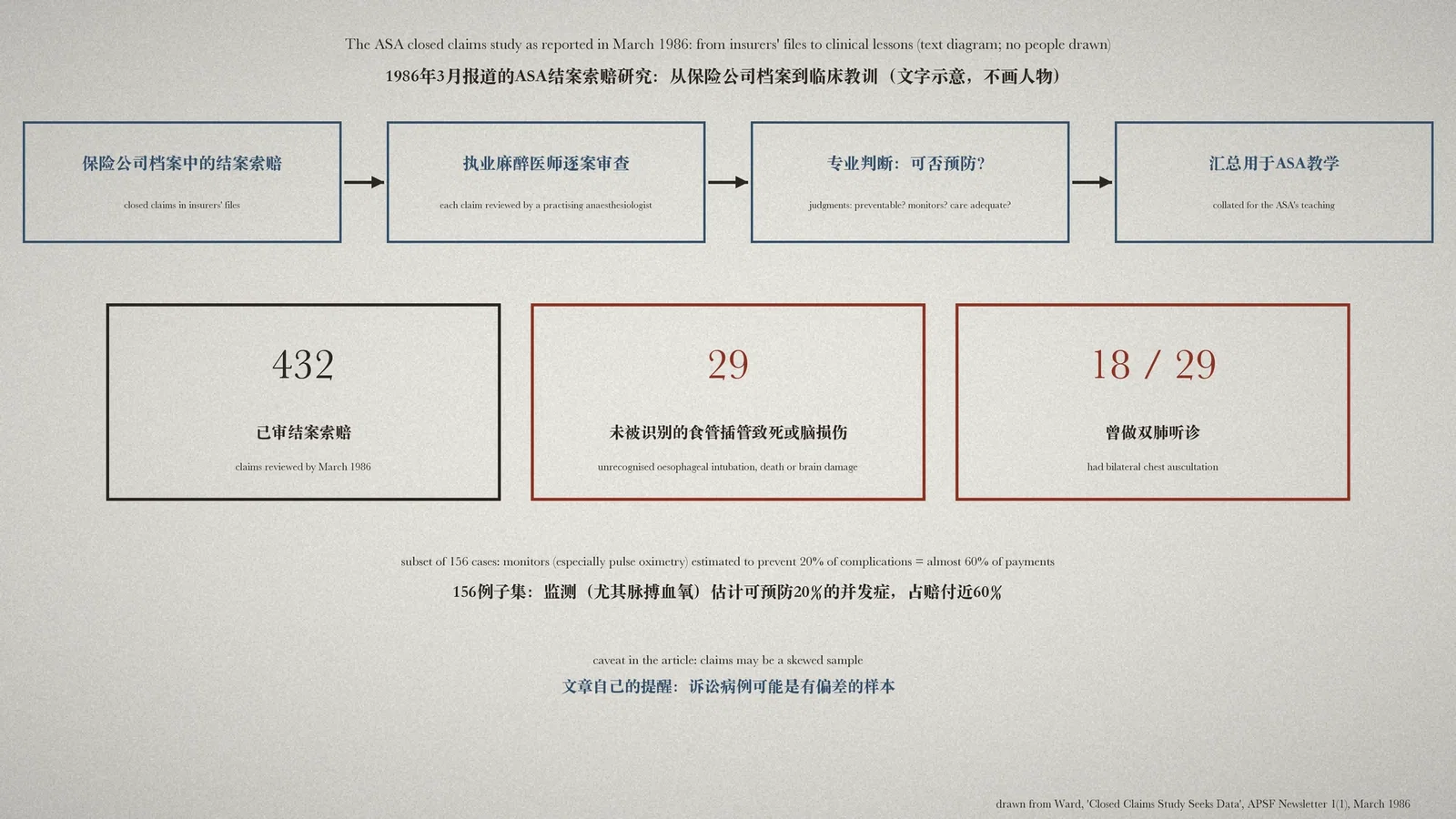
After an anaesthetic accident, the fullest record often sits not in the hospital but in an insurer's claim file. The American Society of Anesthesiologists' closed claims study set out to learn from those files. In March 1986 the opening issue of the Anesthesia Patient Safety Foundation Newsletter carried a short article on how the study began, how it worked and what it had found so far. This article reads that article. [1, contents][1, para. 1]
An opening issue
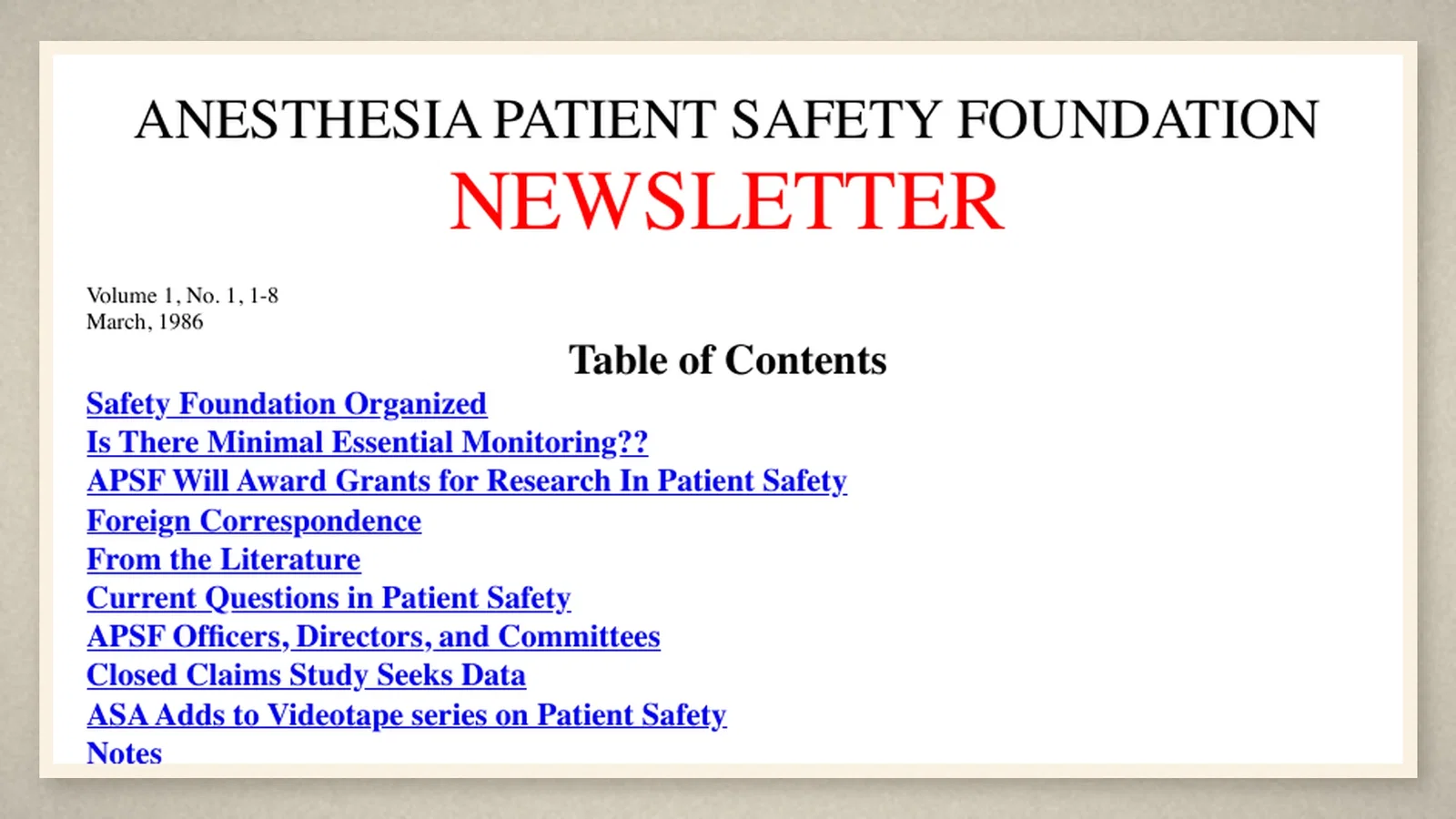
The article, "Closed Claims Study Seeks Data", appeared in volume 1, number 1 of the newsletter. It is signed Ward; the text names the committee member collating the data as Richard J. Ward, and a closing note describes Ward as professor of anesthesia at the University of Washington School of Medicine. The opening sentence states the starting point: only by knowing where the problems are can any concerted effort be made to master them, and that is the main obstacle. [1, para. 1][1, closing note]
A lawyer's suggestion
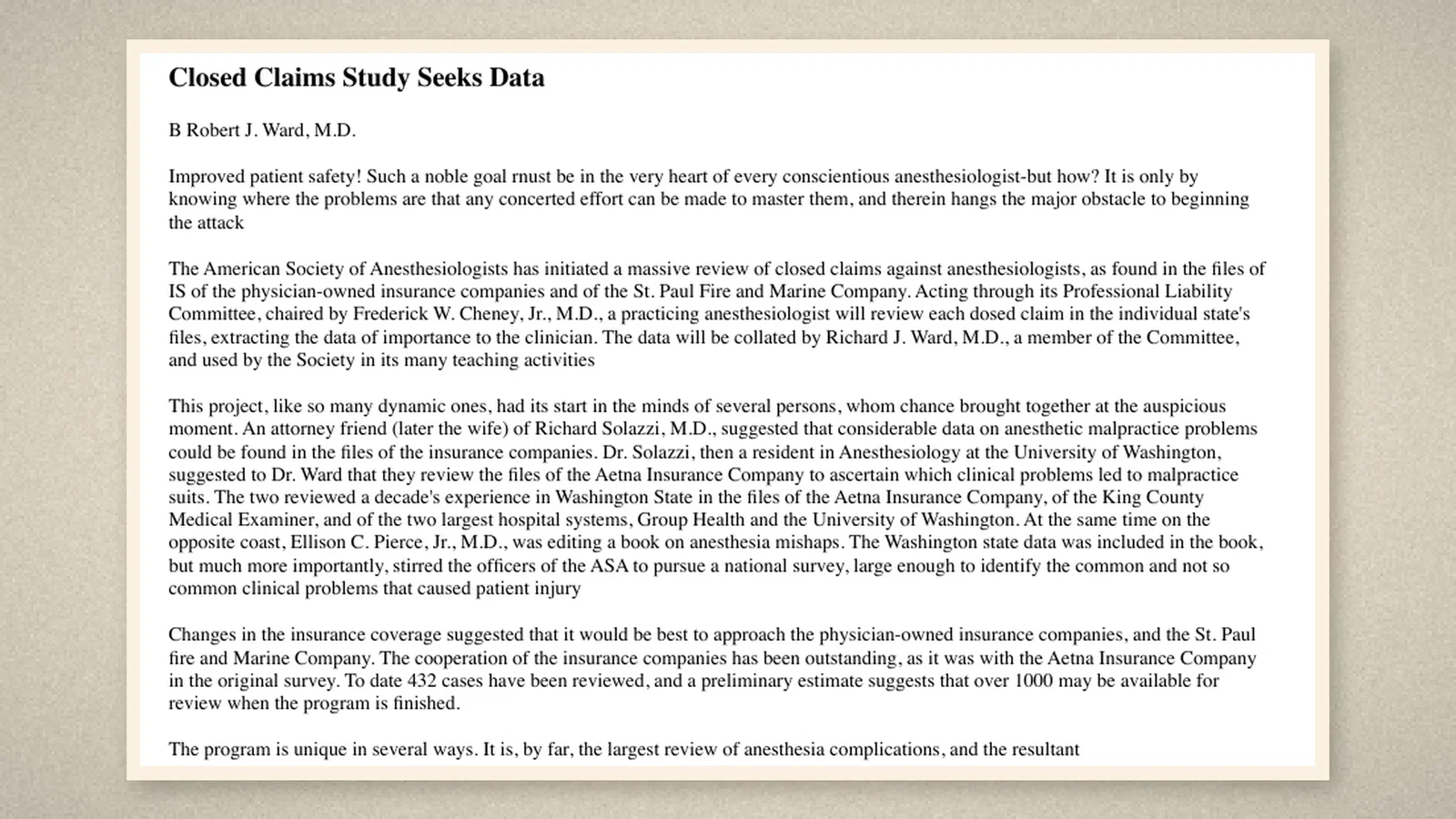
The ASA, the article says, had initiated a massive review of closed claims against anaesthesiologists in the files of physician-owned insurance companies and the St. Paul Fire and Marine Company, acting through its Professional Liability Committee, chaired by Frederick W. Cheney Jr. A practising anaesthesiologist would review each closed claim in the state's files and extract the data important to clinicians, to be collated by Ward and used in the Society's teaching. [1, para. 2]
The project began partly by chance. An attorney friend, later the wife, of Richard Solazzi, then an anaesthesiology resident at the University of Washington, suggested that insurance files held a great deal of data on anaesthetic malpractice. Solazzi proposed to Ward that they review the files of the Aetna Insurance Company to see which clinical problems led to suits, and the two reviewed ten years' experience in Washington State in the files of Aetna, the King County Medical Examiner and the two largest hospital systems. At the same time, on the opposite coast, Ellison C. Pierce Jr was editing a book on anaesthesia mishaps; it included the Washington data and, more importantly, stirred the ASA's officers to pursue a national survey large enough to identify common and uncommon causes of injury. [1, para. 3]
The insurers' cooperation had been outstanding. By then 432 cases had been reviewed, and over 1,000 were expected to be available when the programme finished. [1, para. 4]
Professional judgments
The author saw the study as unusual in several ways. It was by far the largest review of anaesthesia complications and resulting malpractice suits in America; and because practising anaesthesiologists did the reviewing, it allowed professional judgments: was the recorded preanaesthetic evaluation adequate, would better evaluation probably have prevented the complication, would currently available monitors have prevented it (even if not available at the time), was anaesthetic care adequate, was treatment of any cardiac arrest adequate, and who was responsible. These judgments took the study well beyond the usual details of anaesthetic type, complication and cost, towards the proper targets of the ASA's education. [1, paras. 5-6]
When auscultation failed
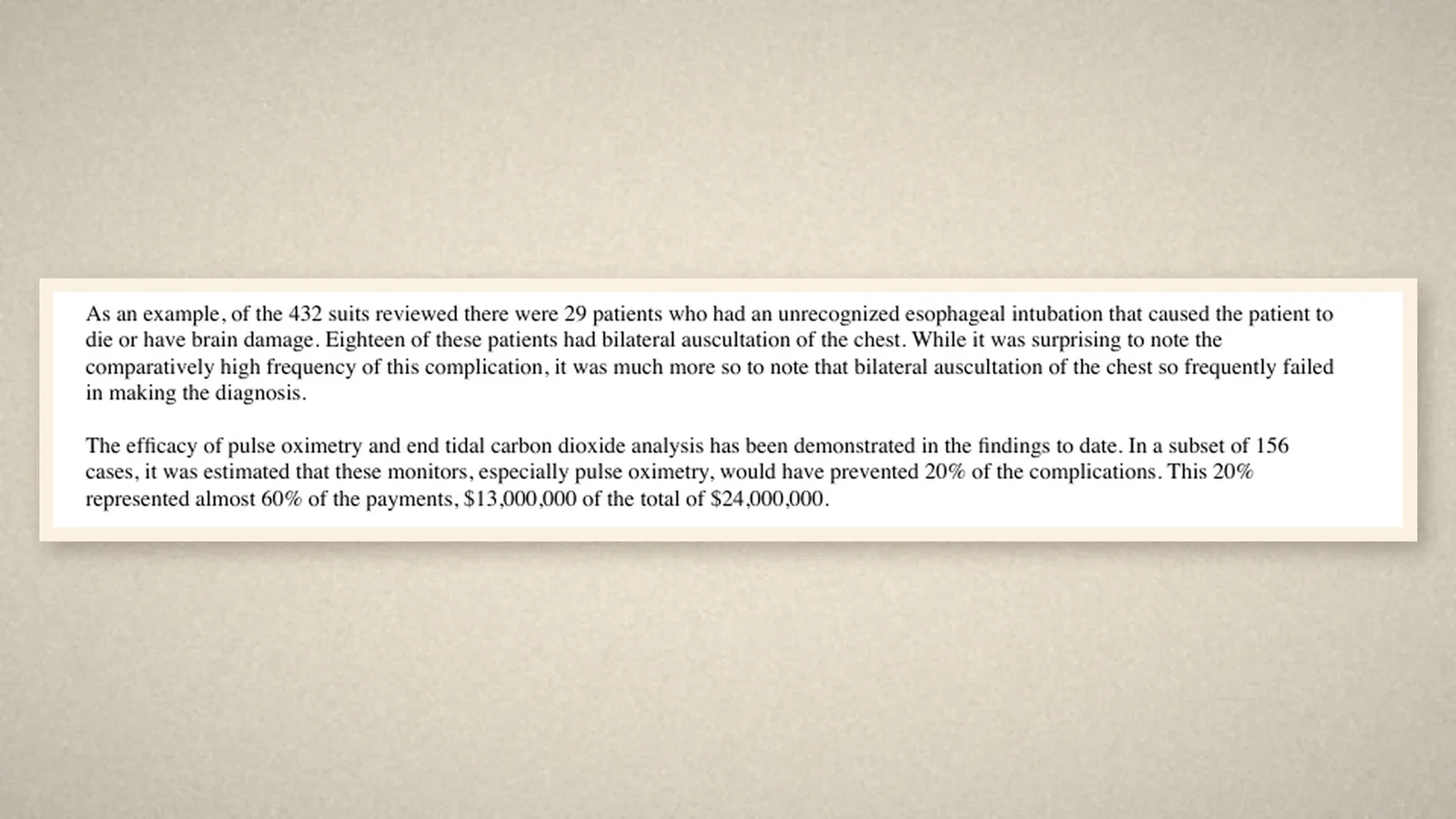
As an example, of the 432 suits reviewed, 29 patients had an unrecognised oesophageal intubation that caused death or brain damage, and 18 of them had bilateral auscultation of the chest. The comparatively high frequency of this complication was surprising; it was more surprising still that bilateral auscultation so often failed to make the diagnosis. In a subset of 156 cases, pulse oximetry and end-tidal carbon dioxide monitoring, especially pulse oximetry, were estimated to have prevented 20% of complications, and those 20% represented almost 60% of payments. Average settlements when care was judged inadequate were more than double those when it was judged adequate. [1, paras. 7-9]
The author's own caveat
The primary goal was to improve patient safety by identifying the complications of routine clinical anaesthesia and communicating them to clinicians. Recognising that claims might be a skewed population, the author described two derivative studies under consideration: compiling complications reported at morbidity and mortality conferences of training programmes, with the Society of Academic Anesthesia Chairmen, and compiling anaesthetic deaths reviewed by medical examiners. A survey by Ward and the King County medical examiner Donald Reay had found that almost half of the medical examiners reviewed all or most of the anaesthetic deaths reported to them. Data were also being shared with participating insurers that requested them. [1, paras. 10-11]
What the record shows
The closed claims study turned disputes after the fact into lessons before the fact: in the same files, lawyers looked for liability and anaesthesiologists looked for what could have been avoided. The finding that auscultation repeatedly failed to detect oesophageal intubation gave pulse oximetry and capnography a case grounded in real injuries.
Sources and reading limits
Read: "Closed Claims Study Seeks Data" in full, with the issue's table of contents, APSF Newsletter volume 1, number 1, March 1986, in the HTML edition formerly on the APSF website and archived by the Internet Archive on 17 September 2010 (the live site could not be accessed). Page images of the masthead and both pages of the article checked.
Not covered: Cheney's later accounts of the project (Anesthesiology 1999 and 2010; the publisher shows abstracts only); the original Washington State review; Pierce's book on anaesthesia mishaps.
Limits: the byline reads "Robert J. Ward" while the text names "Richard J. Ward"; this article uses "Ward" and records the discrepancy here. Settlement amounts are summarised only.
Three illustrations are taken from the newsletter issue (masthead and contents, opening of the article, findings). One is a text diagram drawn from the article, with no people drawn.
- Ward RJ. Closed claims study seeks data. APSF Newsletter. 1986;1(1), March 1986. Internet Archive copy
Continue exploring
Related reading connects shared questions and contexts; it does not by itself establish historical influence.
- 1999: To Err Is Human Holds Up Anaesthesia as a Safety Example
- 2008: WHO Introduces a 19-Item Surgical Safety Checklist
Anesthesia Epochs · The Source Room · About & Editorial Method
Published November 4, 2026. Sources and reading limits are stated above. Illustrations are labelled as original source images or AI-made. Historical accounts are educational; they are not current treatment instructions.