
The Institute of Medicine report To Err Is Human: Building a Safer Health System (National Academy Press; released 29 November 1999, copyright 2000) estimated in its executive summary, from studies in Colorado and Utah and in New York, that at least 44,000 and perhaps as many as 98,000 Americans die in hospitals each year from medical errors, more than the 8th-leading cause of death; it set a goal of halving errors in five years, laid out a four-tiered approach and named the Anesthesia Patient Safety Foundation; chapter 2 called anaesthesia an area of very impressive safety improvements, with mortality down to about one death per 200,000-300,000 anaesthetics against two per 10,000 earlier, through improved monitoring, practice guidelines and other systematic approaches; chapter 8 described anaesthesiology as a local but complex, high-risk, dynamic system with notably reduced error, crediting the pulse oximeter, standardised equipment and changes in training, and urged interdisciplinary team training including simulation.
Reading Library · Anesthesia Epochs · 中文版
Watch the education video (for clinicians)
1999: To Err Is Human — Medical Error Becomes a Number · Anesthesia Epochs Education Series
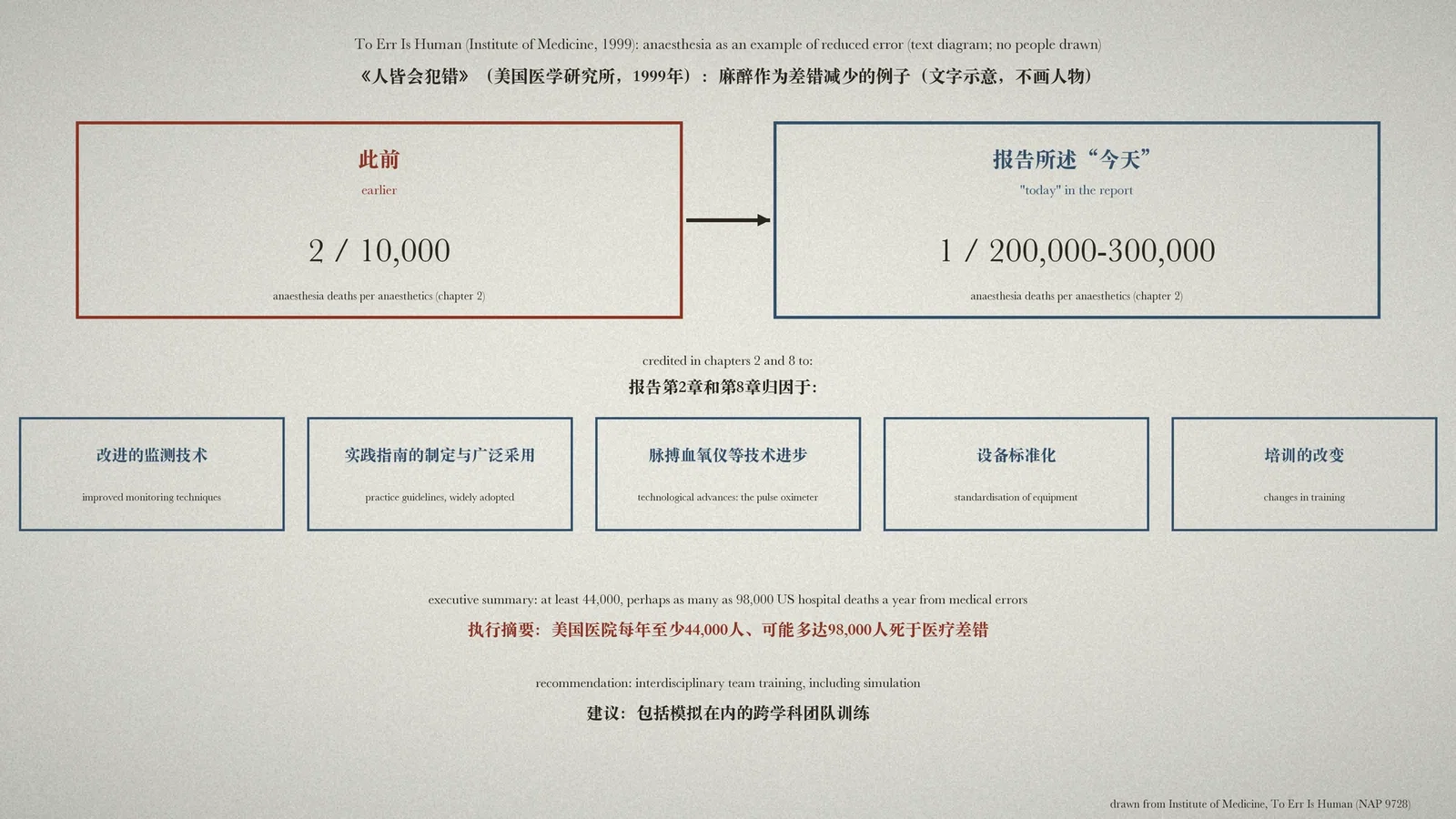
Any account of patient safety today runs into one report sooner or later: the Institute of Medicine's To Err Is Human: Building a Safer Health System. It made the idea that medical errors kill tens of thousands of people a year a public issue. In a report addressed to the whole health system, anaesthesia was singled out as a positive example: a field where error had fallen notably and where improvements in safety had been "very impressive". This article reads the executive summary and the two passages on anaesthesia. [1, p. 1][1, p. 32][1, p. 164]
One report, two years
The report was prepared by the Institute of Medicine's Committee on Quality of Health Care in America, edited by Linda T. Kohn, Janet M. Corrigan and Molla S. Donaldson, and published by the National Academy Press. The publisher's page metadata give the release date as 29 November 1999 and the copyright year as 2000; that is why it is usually cited as "Institute of Medicine 2000", while this article is placed in 1999 by the release date. [1, NAP page metadata]
The tip of the iceberg
The executive summary opens with cases that made the headlines and calls them "just the tip of the iceberg". Extrapolating from two large studies, it states that the Colorado and Utah study implies at least 44,000 Americans die each year as a result of medical errors, and that the New York study suggests the number may be as high as 98,000. Even the lower estimate exceeds the number of deaths attributable to the 8th-leading cause of death in the United States, and more people die from medical errors than from motor vehicle accidents, breast cancer or AIDS. [1, pp. 1-2]
The report defines safety as "freedom from accidental injury" and error as "the failure of a planned action to be completed as intended or the use of a wrong plan to achieve an aim". Given what was known, the committee said, it would be irresponsible to expect anything less than a 50 percent reduction in errors over five years. [1, p. 4]
The Anesthesia Patient Safety Foundation
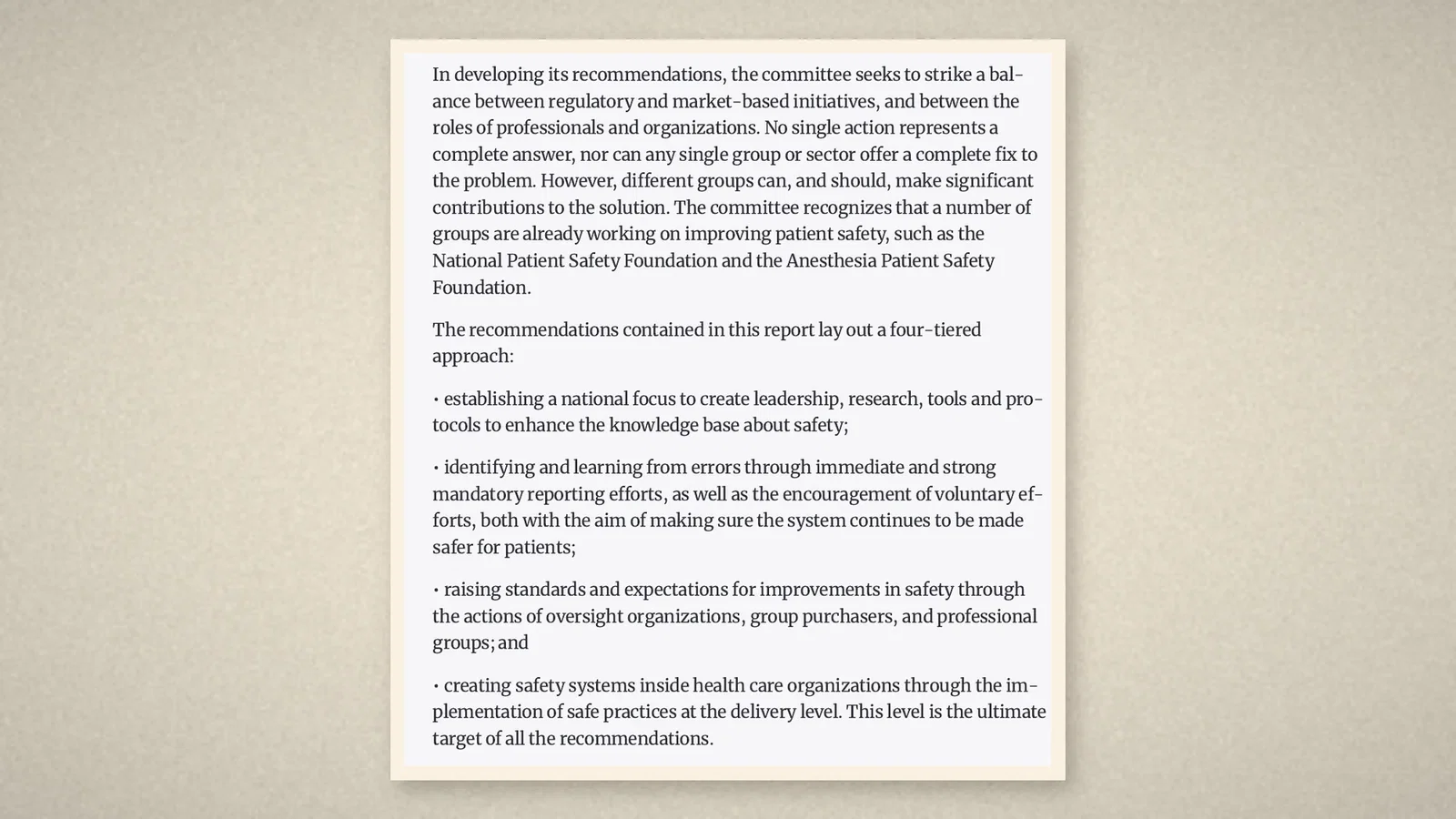
The committee recognised that a number of groups were already working on patient safety, naming the National Patient Safety Foundation and the Anesthesia Patient Safety Foundation. Its recommendations laid out a four-tiered approach: a national focus on leadership, research, tools and protocols, including a Center for Patient Safety within the Agency for Healthcare Research and Quality; identifying and learning from errors through mandatory reporting and the encouragement of voluntary reporting; raising standards and expectations through oversight organisations, group purchasers and professional groups; and creating safety systems inside health care organisations, which the report called the ultimate target of all the recommendations. [1, p. 6][1, p. 7]
Anaesthesia: "very impressive improvements"
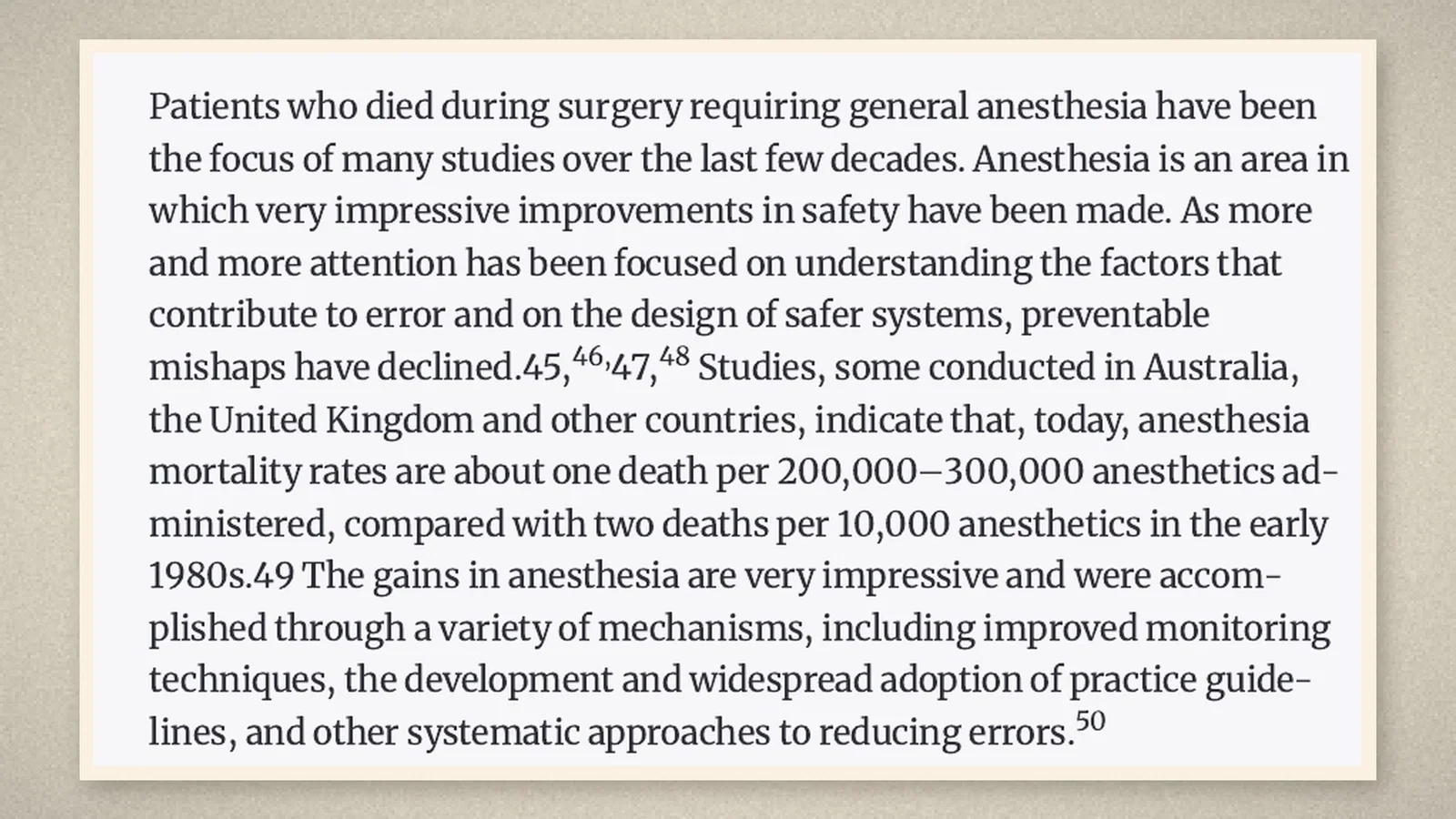
Chapter 2, on errors as a leading cause of death and injury, contains a paragraph on anaesthesia. Patients who died during surgery under general anaesthesia, it says, had long been the focus of many studies, and "Anesthesia is an area in which very impressive improvements in safety have been made": as attention turned to the factors that contribute to error and to the design of safer systems, preventable mishaps declined. Citing studies from Australia, the United Kingdom and other countries, the report put anaesthesia mortality "today" at about one death per 200,000-300,000 anaesthetics, against about two deaths per 10,000 earlier. The gains came through improved monitoring techniques, the development and widespread adoption of practice guidelines, and other systematic approaches to reducing errors. [1, p. 32]
A local safety system
Chapter 8, on creating safety systems in health care organisations, distinguishes local systems, run by a department, unit or small team, from organisation-wide ones. Its example of a local system is anaesthesiology: "a local, but complex, high-risk, dynamic patient care system in which there has been notably reduced error". [1, p. 164]
The report sums up the anaesthesiologists' experience this way. Responding to rising malpractice premiums, they confronted the need for continuing vigilance during long operations punctuated by the need for rapid problem evaluation and action; a heterogeneity of design in anaesthesia devices; fatigue and sleep deprivation; and competing institutional, professional and patient-care priorities. Through technological advances, "most notably the pulse oximeter", standardisation of equipment and changes in training, they brought about a major, sustained, widespread reduction in morbidity and mortality attributable to anaesthesia. The passage cites Gaba, Howard and Fish's 1994 book Crisis Management in Anesthesiology. [1, pp. 164-165]
The same chapter recommends interdisciplinary team training, including simulation, for staff in the emergency department, intensive care unit and operating room, drawing on aviation's crew resource management. It notes that a full operating-room simulator had been running for some years at the University of Basel, though with a limited range of procedures, and its references include Denson and Abrahamson's 1969 paper on a computer-controlled patient simulator. [1, p. 157][1, p. 177][1, p. 199]
What the record shows
To Err Is Human used anaesthesia as evidence that medical error can be reduced not only by individual care but by system measures: monitoring, standardised equipment, guidelines and training. For the history of anaesthesia, the passage is an outside summary of the specialty's safety work; for the rest of medicine, it offered a model to borrow.
Sources and reading limits
Read: Institute of Medicine, To Err Is Human: Building a Safer Health System (National Academy Press, NAP 9728), in the publisher's free read-online edition: the whole Executive Summary (pp. 1-16); the anaesthesia paragraph in chapter 2 (p. 32), with the Harvard Medical Practice Study and Colorado-Utah paragraphs; and in chapter 8 the summary of recommendations (p. 157), the passage on anaesthesiology as a local system (pp. 164-165) and the passage on simulation (p. 177), with its references (to p. 199). Page images of Executive Summary pp. 1 and 6, chapter 2 p. 32 and chapter 8 p. 164 checked. The release date and editors are taken from the publisher's page metadata.
Not covered: the report's other chapters (reporting systems, standards, medication safety); the mortality studies the report cites for anaesthesia; Gaba and colleagues' book. The Wood Library-Museum timeline entry was used only as the lead.
Limits: the two anaesthesia mortality figures are quoted by the report from other studies with differing definitions and populations, which the report does not set out; later assessments of the 44,000-98,000 estimate are outside this article.
Three illustrations are taken from the publisher's read-online pages (Executive Summary pp. 1 and 6, chapter 2 p. 32). One is a text diagram drawn from the report, with no people drawn.
- Kohn LT, Corrigan JM, Donaldson MS, editors; Institute of Medicine, Committee on Quality of Health Care in America. To Err Is Human: Building a Safer Health System. Washington, DC: National Academy Press; 2000. doi:10.17226/9728. NAP read online DOI
Continue exploring
Related reading connects shared questions and contexts; it does not by itself establish historical influence.
Anesthesia Epochs · The Source Room · About & Editorial Method
Published November 4, 2026. Sources and reading limits are stated above. Illustrations are labelled as original source images or AI-made. Historical accounts are educational; they are not current treatment instructions.