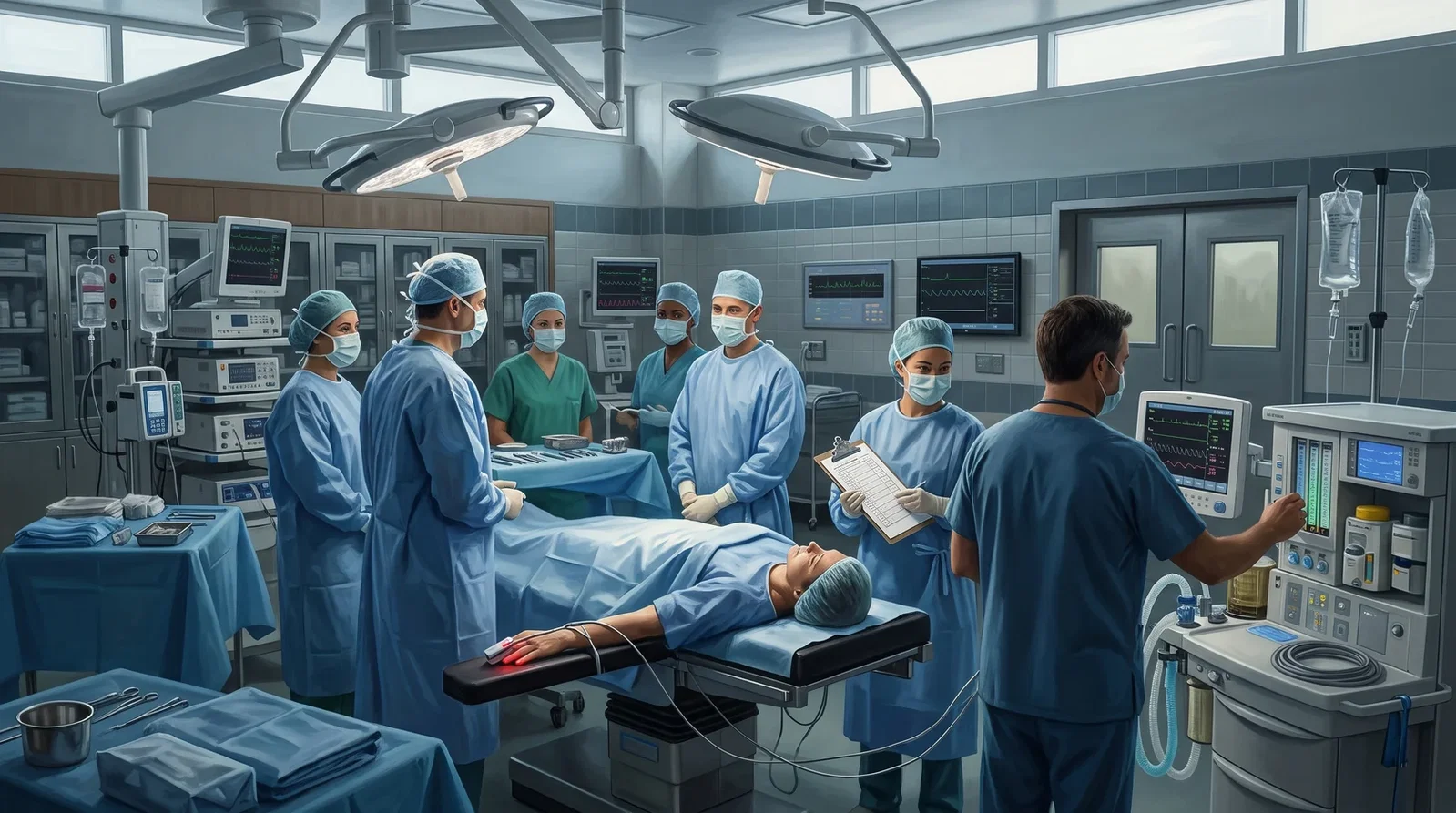
The WHO Guidelines for Safe Surgery 2009 explain that WHO Patient Safety chose surgical safety for its second Global Patient Safety Challenge in 2007-2008, prepared from autumn 2006 with nearly 100 international experts, and set ten essential objectives, the second being to prevent harm from anaesthesia; the guidelines print the WHO Surgical Safety Checklist, whose sign-in before induction confirms the anaesthesia machine and medication check and a functioning pulse oximeter, and reprint Haynes, Gawande and colleagues' NEJM study in eight hospitals in Toronto, New Delhi, Amman, Auckland, Manila, Ifakara, London and Seattle between October 2007 and September 2008, in which deaths fell from 1.5% to 0.8% and inpatient complications from 11.0% to 7.0% after the 19-item checklist was introduced.
Reading Library · Anesthesia Epochs · 中文版
Watch the education video (for clinicians)
2008: The WHO Surgical Safety Checklist — The Pause Before Induction · Anesthesia Epochs Education Series
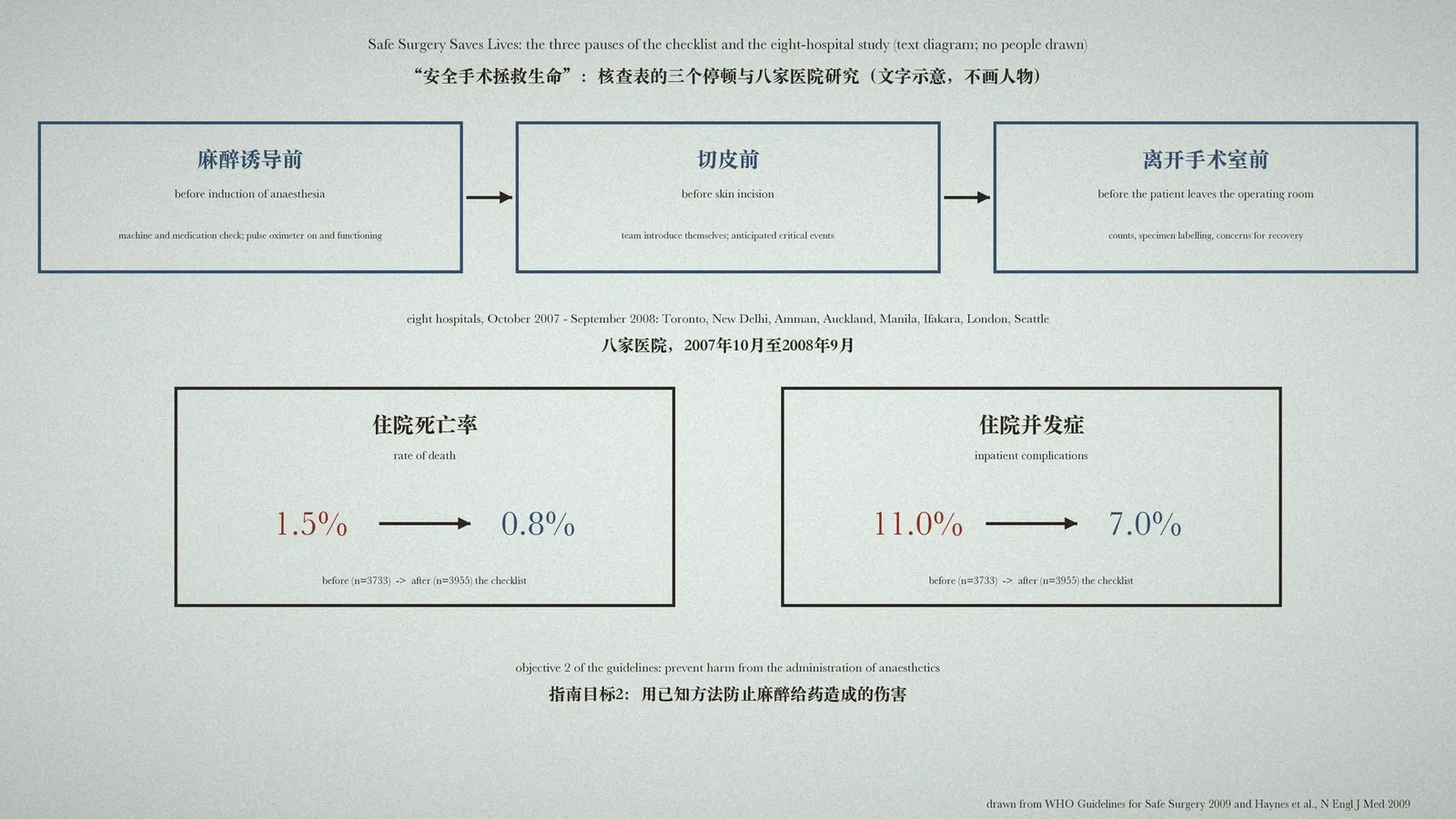
In many operating theatres today the team pauses before induction to confirm aloud the patient's identity, the operative site, the anaesthesia machine check and the pulse oximeter. Much of that pause comes from the World Health Organization's Surgical Safety Checklist. This article reads the WHO Guidelines for Safe Surgery 2009: Safe Surgery Saves Lives, and the New England Journal of Medicine study of the checklist that the guidelines reprint in an appendix. [1, cover][1, p. 2][1, p. 110]
The second Global Patient Safety Challenge
The introduction explains that WHO Patient Safety concentrates its action on Global Patient Safety Challenges: the subject chosen for the challenge of 2005-2006 was infection associated with health care, which produced guidelines on hand hygiene, and the problem area selected for the second, in 2007-2008, was the safety of surgical care. Groundwork began in autumn 2006, an international consultation met in January 2007, and expert working groups then reviewed the evidence and drafted the recommendations; nearly 100 international experts contributed, and the guidelines were piloted in each of WHO's six regions. [1, p. 2]
The guidelines describe the scale of the problem: data from 56 countries put the volume of major surgery in 2004 at an estimated 187-281 million operations, roughly one for every 25 people alive each year; in industrialised countries the death rate of inpatient surgery is 0.4-0.8%; and in parts of sub-Saharan Africa mortality during general anaesthesia has been reported as high as 1 in 150. [1, pp. 2-3]
Where anaesthesia stands
The guidelines set ten essential objectives for safe surgery. Objective 2 is that the team will use methods known to prevent harm from the administration of anaesthetics while protecting the patient from pain. Anaesthesiology, they say, has played a pioneering role in the patient safety movement and in standards for safe practice; making surgery safer means making anaesthesia services safer, especially in developing countries, through better training, safer facilities, functioning equipment, adequate drug supplies and mandatory pulse oximetry. [1, p. 15]
On pulse oximetry the guidelines are candid: no randomised controlled trial has shown that pulse oximetry or capnography changed the outcome of anaesthesia, but the death or brain damage of an otherwise healthy person from an entirely preventable mishap, such as ventilator disconnection or oesophageal intubation, is catastrophic, and the risks of these monitors are exceedingly low. The adoption of pulse oximetry by anaesthetists, they write, has been an unusual, strikingly successful example of standardisation of practice in health care. [1, p. 16]
The checklist
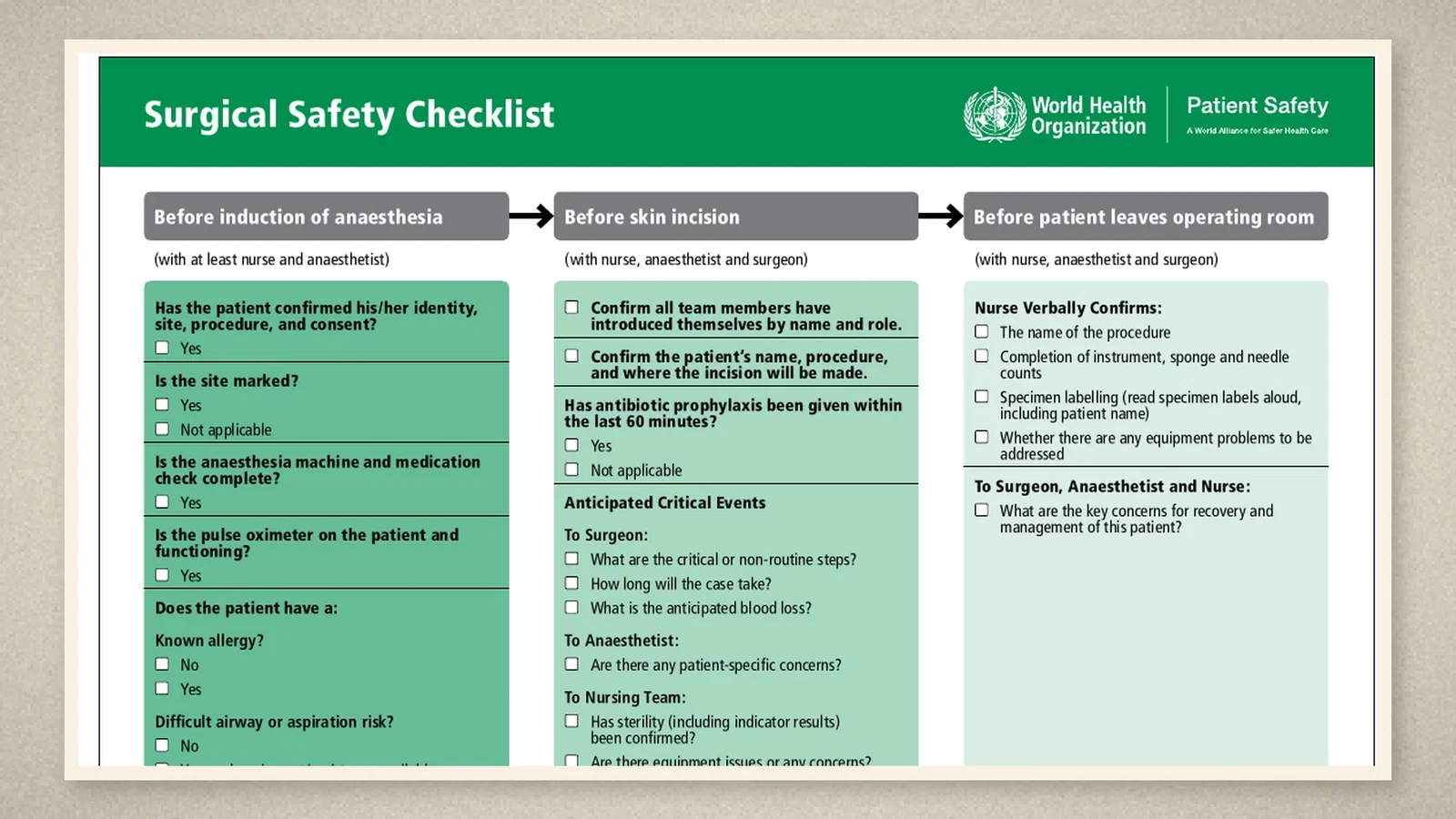
Section III prints the WHO Surgical Safety Checklist in three phases: before induction of anaesthesia (with at least the nurse and the anaesthetist), before skin incision (with nurse, anaesthetist and surgeon), and before the patient leaves the operating room. The form states that it is not intended to be comprehensive and that additions and modifications to fit local practice are encouraged. [1, p. 98]
The implementation manual explains the two anaesthesia items before induction. The checklist coordinator asks the anaesthetist to verify completion of an anaesthesia safety check, a formal inspection of the anaesthetic equipment, breathing circuit, medications and the patient's anaesthetic risk, and confirms that a pulse oximeter is on the patient and functioning, ideally with the reading visible to the team and an audible signal of pulse rate and saturation. If no functioning pulse oximeter is available, surgeon and anaesthetist should consider postponing surgery, except in urgent circumstances to save life or limb. [1, p. 102]
Eight cities, eight hospitals
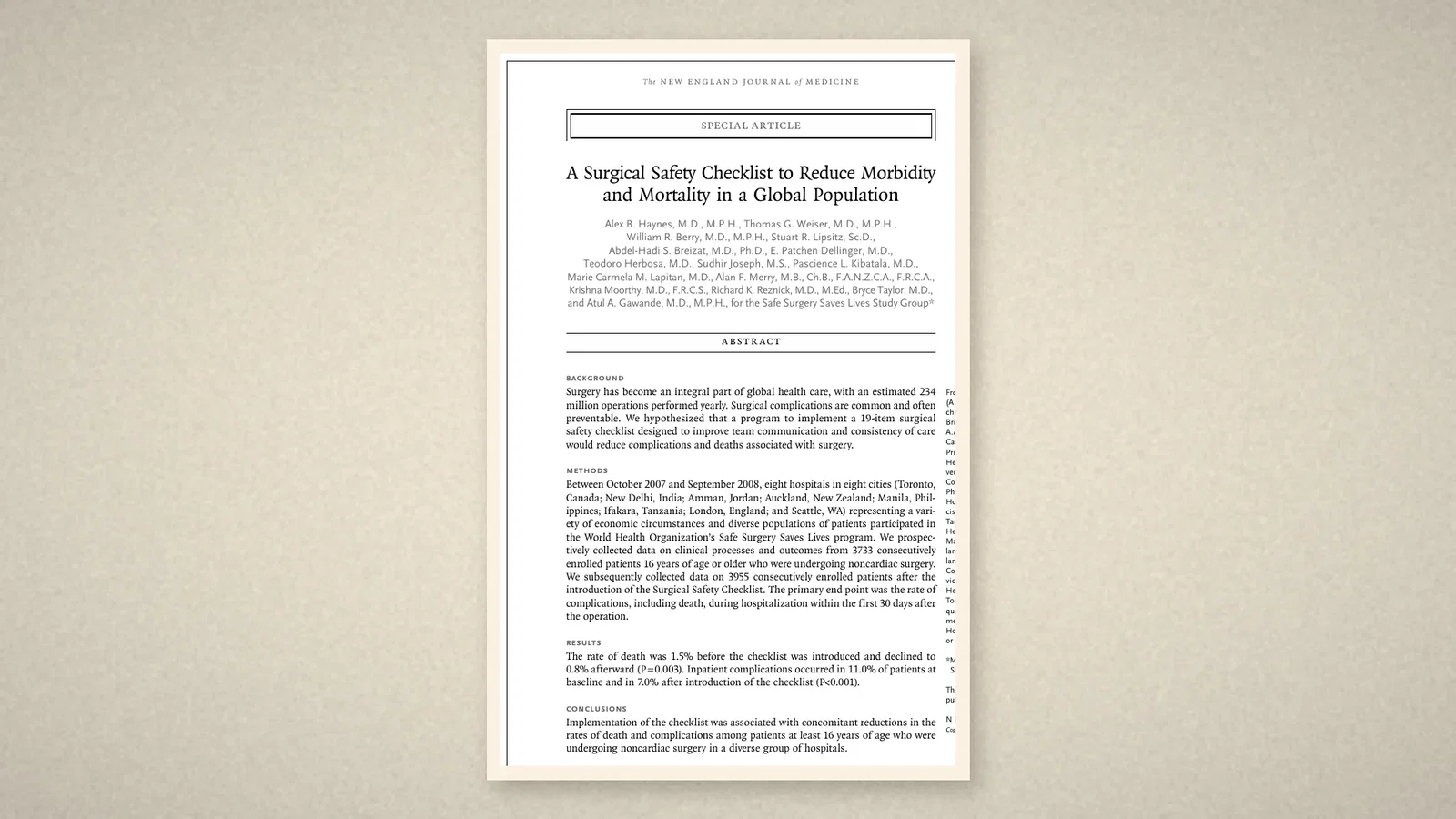
Appendix A reprints "A Surgical Safety Checklist to Reduce Morbidity and Mortality in a Global Population" by Alex B. Haynes, Atul A. Gawande and colleagues for the Safe Surgery Saves Lives Study Group, published online on 14 January 2009 and in the New England Journal of Medicine, volume 360, pages 491-499. On the basis of WHO's 2008 guidelines, the authors designed a 19-item checklist. Between October 2007 and September 2008, eight hospitals in eight cities, Toronto, New Delhi, Amman, Auckland, Manila, Ifakara, London and Seattle, representing a variety of economic circumstances and patient populations, took part. Before the checklist was introduced, 3,733 consecutive patients aged 16 or older undergoing noncardiac surgery were enrolled; afterwards, 3,955. [1, pp. 110-111]
The rate of death was 1.5% before the checklist and 0.8% afterwards; inpatient complications fell from 11.0% to 7.0%. The authors' conclusion is carefully worded: implementation of the checklist was associated with concomitant reductions in the rates of death and complications. [1, p. 110]
What the record shows
The checklist put anaesthesia's long-standing safety habits, checking the machine and the drugs and confirming the pulse oximeter, into a pause shared by the whole surgical team. It is simple enough for any operating room; its evidence comes from a before-and-after comparison rather than a randomised trial, which is worth remembering when reading it.
Sources and reading limits
Read: WHO Guidelines for Safe Surgery 2009: Safe Surgery Saves Lives (WHO IRIS 10665/44185, English PDF): the contents; Section I, introduction (the second Global Patient Safety Challenge, the guideline process and the size of the problem); the parts of Objective 2 on approaches to improving the safety of anaesthesia and on the evidence for pulse oximetry and capnography; Section III, the checklist; the implementation manual's notes on the items before induction; and Appendix A, the reprint of Haynes et al. (abstract, introduction, Table 1 and results in outline). Page images of the cover, the checklist page and the reprinted abstract checked.
Not covered: the article on the journal's website (not accessible; the WHO reprint was read instead); the NCBI Bookshelf copy (not accessible).
Limits: the study is a before-and-after comparison, and its authors claim association only; the checklist's blood-loss item and drug details are not repeated.
Three illustrations are taken from the 2009 guidelines (cover, the checklist on p. 98, the reprinted abstract on p. 110). One is a text diagram drawn from the sources, with no people drawn.
- World Health Organization. WHO Guidelines for Safe Surgery 2009: Safe Surgery Saves Lives. Geneva: WHO; 2009. Appendix A reprints: Haynes AB, Weiser TG, Berry WR, et al. A surgical safety checklist to reduce morbidity and mortality in a global population. N Engl J Med. 2009;360:491-9. WHO IRIS
Continue exploring
Related reading connects shared questions and contexts; it does not by itself establish historical influence.
- 2018: WHO and the WFSA Publish International Standards for Safe Anesthesia
- 1999: To Err Is Human Holds Up Anaesthesia as a Safety Example
Anesthesia Epochs · The Source Room · About & Editorial Method
Published November 4, 2026. Sources and reading limits are stated above. Illustrations are labelled as original source images or AI-made. Historical accounts are educational; they are not current treatment instructions.