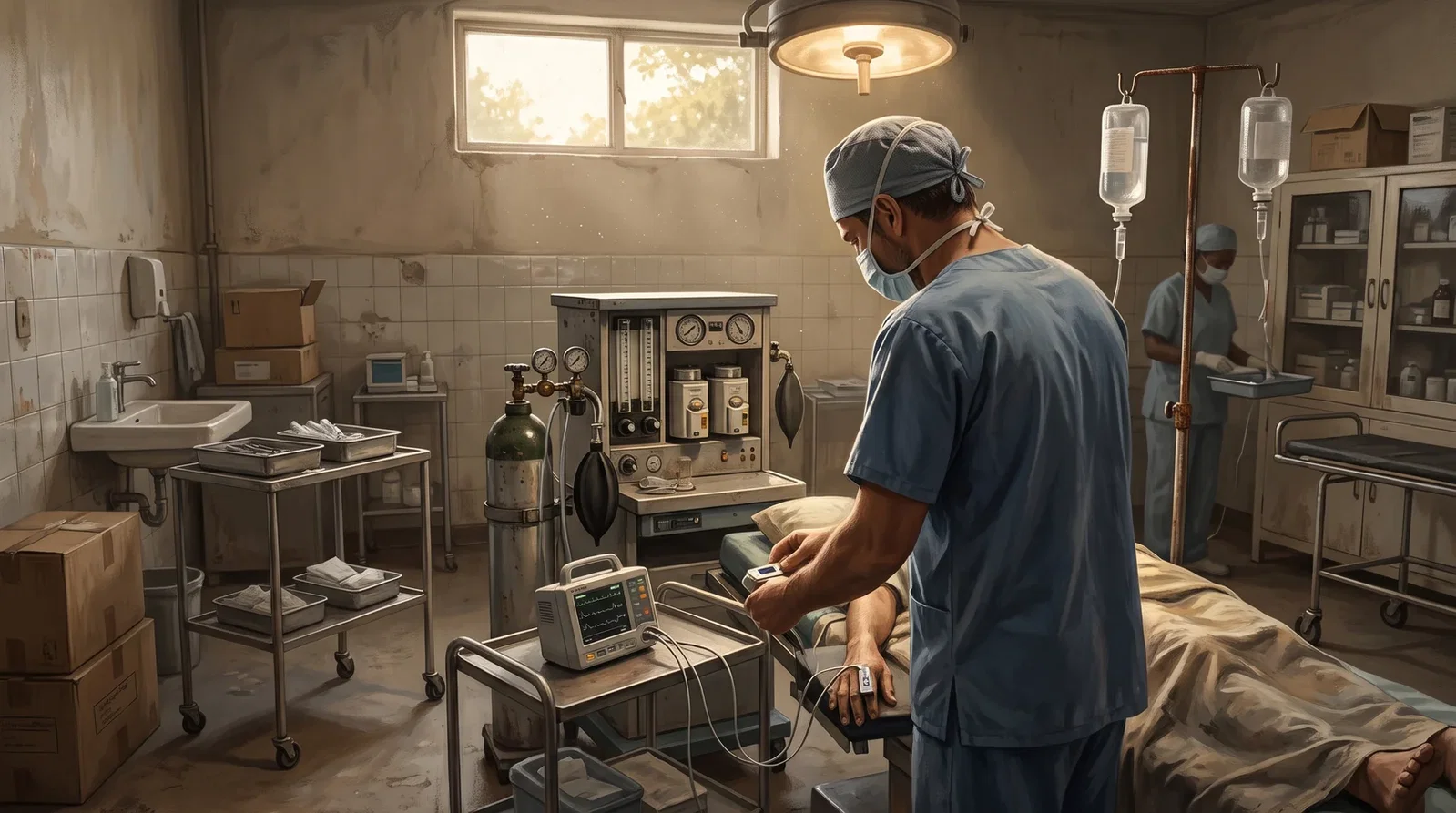
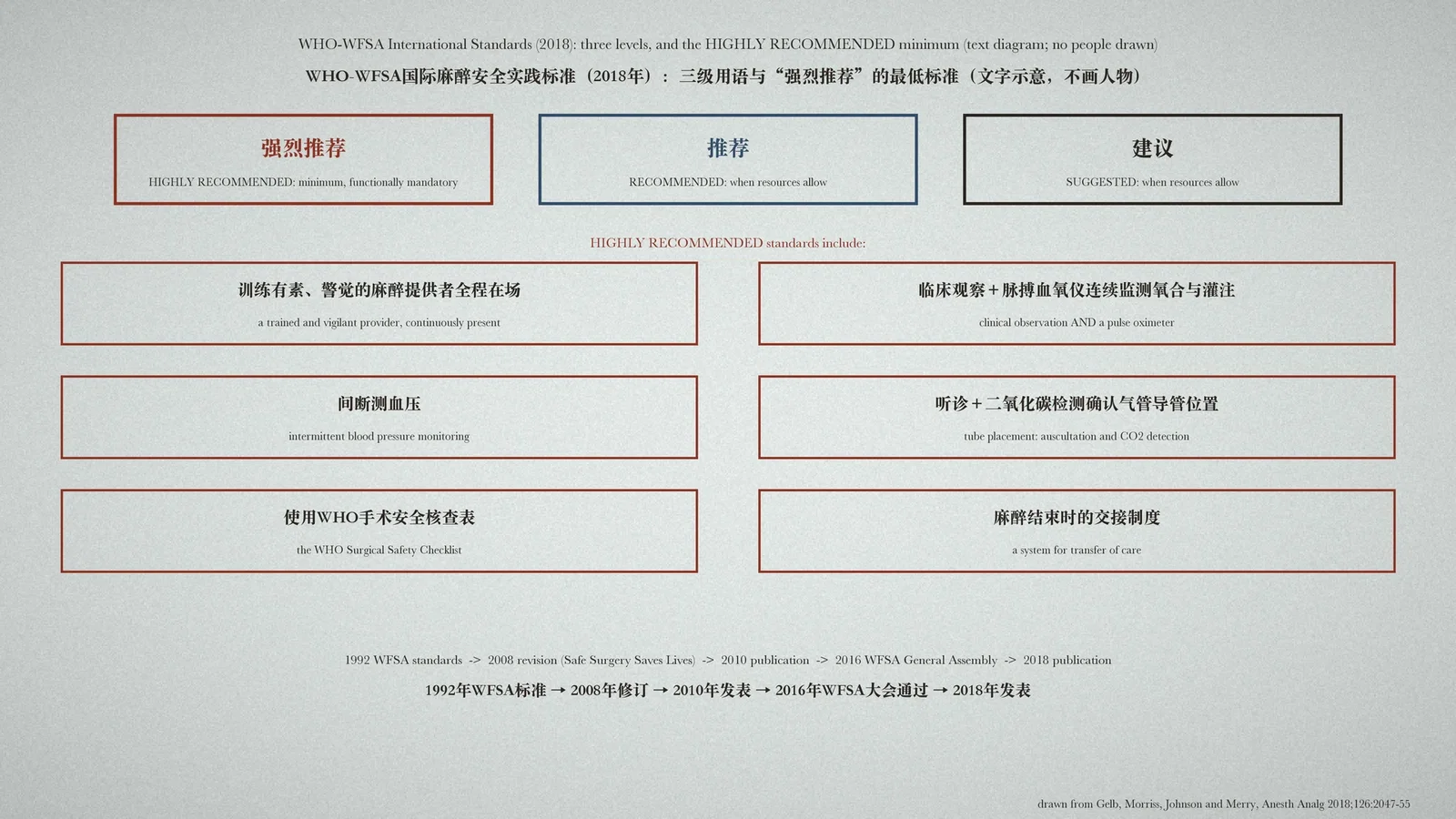
Gelb, Morriss, Johnson and Merry's 'WHO-WFSA International Standards for a Safe Practice of Anesthesia' (Anesthesia & Analgesia, June 2018) set out standards developed for the WFSA, representing anaesthesiologists in 150 countries, and WHO, endorsed unanimously by the WFSA General Assembly in 2016 and applicable to all anaesthesia providers; using WHO's levels, HIGHLY RECOMMENDED standards, the functional equivalent of mandatory standards, include a trained and vigilant provider continuously present, clinical observation plus pulse oximetry, intermittent blood pressure, auscultation and carbon dioxide detection to confirm tube placement, the WHO Surgical Safety Checklist and a system for transfer of care, and elective anaesthesia without them is unsafe and unacceptable; the paper traces the standards from 1992 through the 2010 revision and contrasts To Err Is Human's figures with anaesthesia-related mortality as high as one in 300 in low- and middle-income countries.
Reading Library · Anesthesia Epochs · 中文版
Watch the education video (for clinicians)
2018: WHO-WFSA International Standards — Where the Minimum Line Is · Anesthesia Epochs Education Series
In some countries anaesthesia-related deaths have become rare enough to be counted as one in 200,000; elsewhere the figure may be one in 300. The same specialty, with very different levels of safety. In June 2018 the World Health Organization (WHO) and the World Federation of Societies of Anaesthesiologists (WFSA) published the International Standards for a Safe Practice of Anesthesia, an attempt to draw a minimum line for any operating room in the world where anaesthesia is given. This article reads the full text as published in Anesthesia & Analgesia. [1, abstract][1, introduction]
Who wrote and who endorsed them
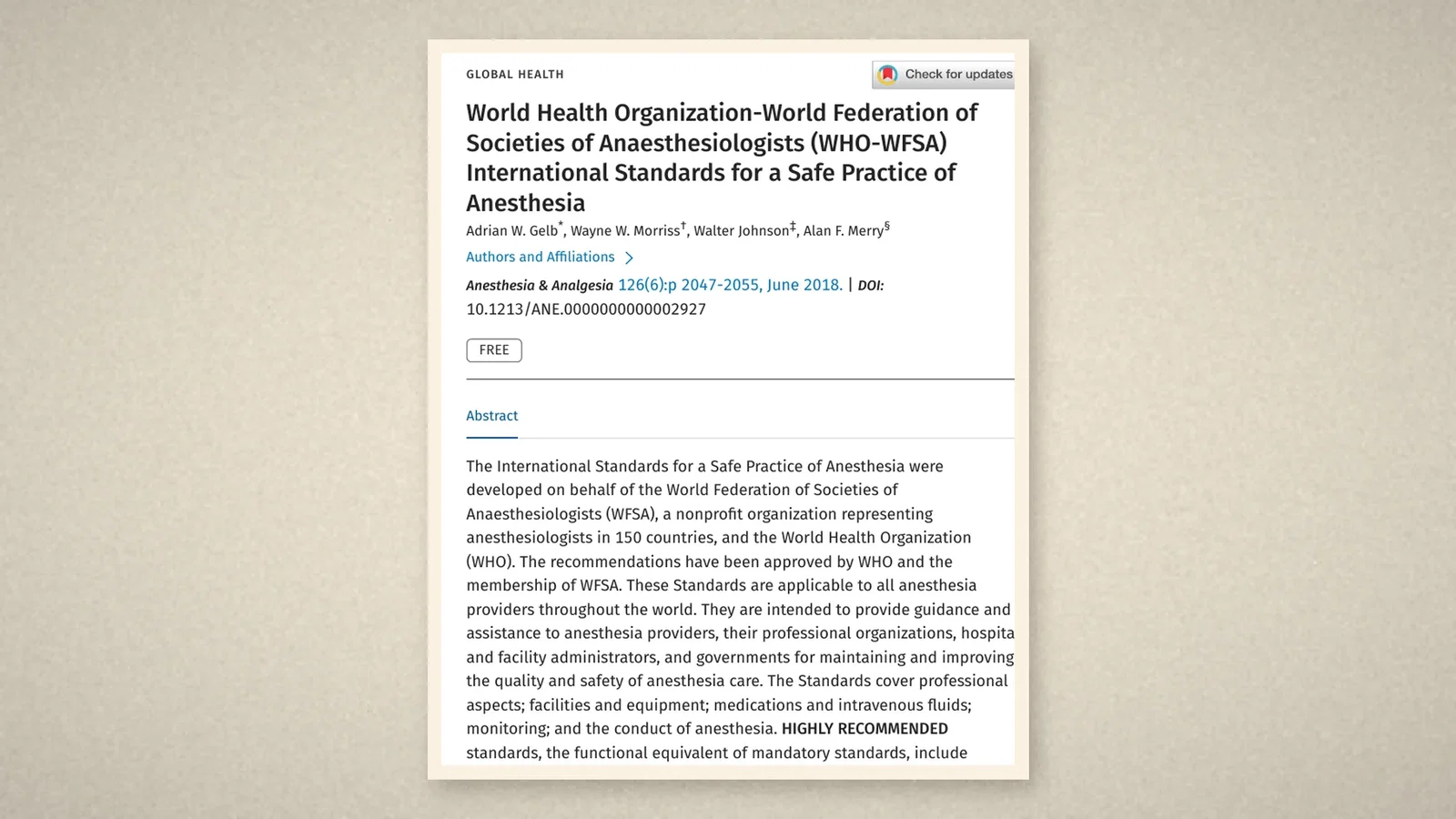
The paper, by Adrian W. Gelb, Wayne W. Morriss, Walter Johnson and Alan F. Merry, appeared in Anesthesia & Analgesia, volume 126, number 6, June 2018, pages 2047-2055. The standards were developed on behalf of the WFSA, a nonprofit organisation representing anaesthesiologists in 150 countries, and WHO, and were approved by WHO and the WFSA membership. They were presented to the WFSA General Assembly in 2016 and unanimously endorsed by all national society members present, and were reviewed by WHO's Emergency and Essential Surgical Care Programme and its essential medicines department. [1, p. 2047][1, introduction]
Two mortality figures
The paper opens with Hippocrates' "first do no harm" and recalls that leadership by anaesthesiologists in many parts of the world brought monitoring and other standards of care to high-income countries, and that the Institute of Medicine's 1999 report To Err Is Human reported anaesthesia-related mortality reduced from two per 10,000 to one in 200,000 in healthy patients. In low- and middle-income countries, it adds, anaesthesia-related mortality can be as high as one in 300. [1, introduction]
From 1992 to 2018
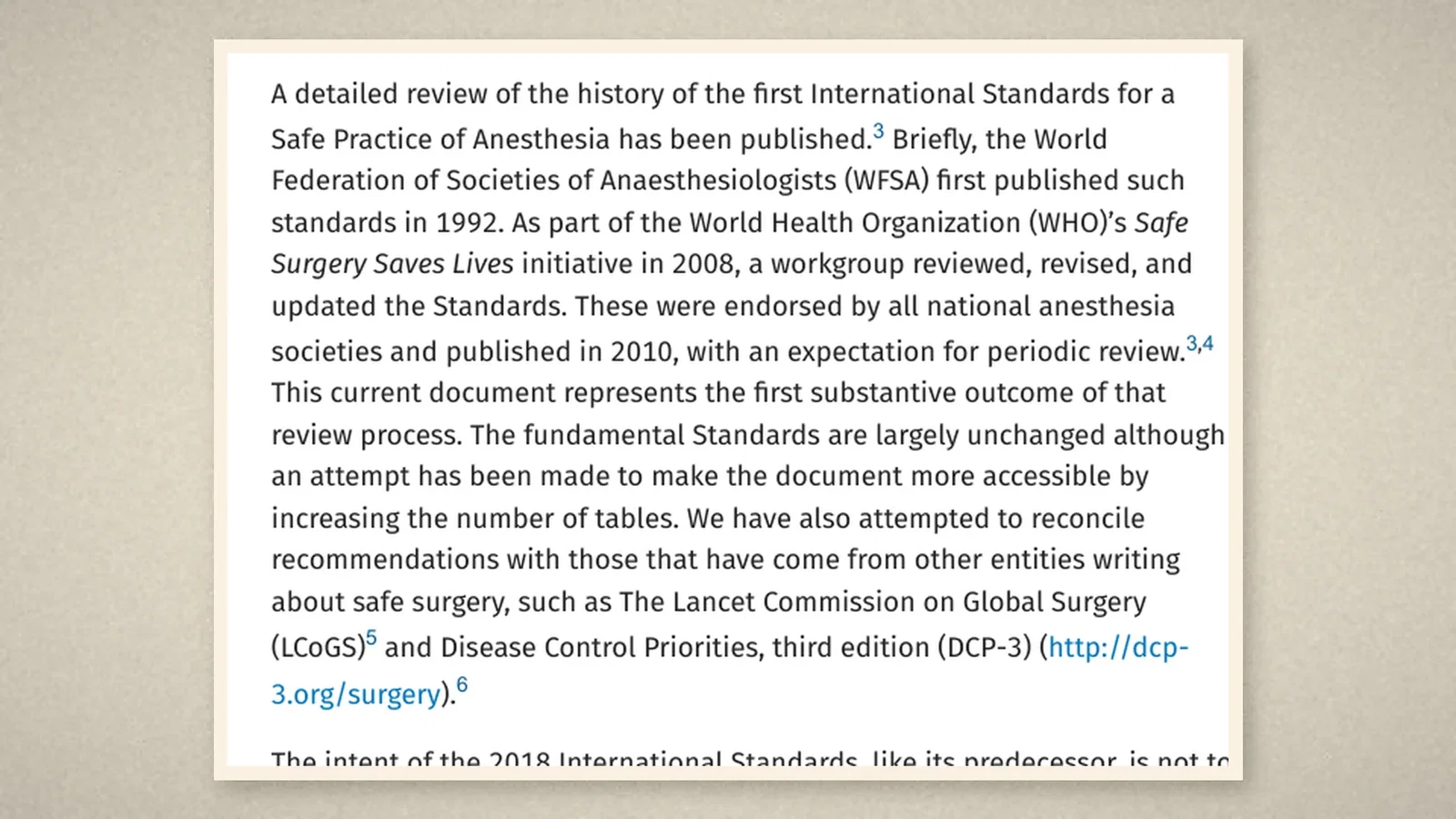
The authors summarise the history: the WFSA published such standards in 1992; in 2008, as part of WHO's Safe Surgery Saves Lives initiative, a workgroup reviewed, revised and updated them, and the revision was endorsed by all national anaesthesia societies and published in 2010, with periodic review expected; the 2018 document was the substantive outcome of that review, with the fundamental standards largely unchanged, more tables, and recommendations reconciled with the Lancet Commission on Global Surgery and Disease Control Priorities, third edition. The WFSA's own timeline records that the earlier standards were agreed by member societies and published in a 1993 supplement of the European Journal of Anaesthesiology, and that Alan Merry and Iain Wilson were involved in creating the WHO Surgical Safety Checklist. [1, introduction][2]
The standards are not meant to supersede any country's national standards; they serve mainly countries without them, defining the minimum for any facility where anaesthesia is given, and come with a parallel Anesthetic Capacity Checklist for departments, regions or countries to assess themselves. [1, introduction]
Three levels
The standards use WHO's three levels: HIGHLY RECOMMENDED, RECOMMENDED and SUGGESTED. Highly recommended standards are the minimum expected, "the functional equivalent of mandatory standards"; the other two apply when resources allow and when appropriate to the care provided. The paper is blunt: in some resource-poor settings even the highly recommended standards may not yet be met, and there anaesthesia should be restricted to procedures essential for the immediate saving of life or limb; if the highly recommended standards are not met, anaesthesia for elective surgery is unsafe and unacceptable. [1, levels of standard]
Among the guiding principles: access to safe anaesthesia for essential surgery is a basic human right and should be available to all patients irrespective of their ability to pay. Under professional status, the WFSA views anaesthesiology as a medical practice, and wherever possible anaesthesia should be provided, led or overseen by an anaesthesiologist. [1, principles][1, professional aspects]
The minimum line
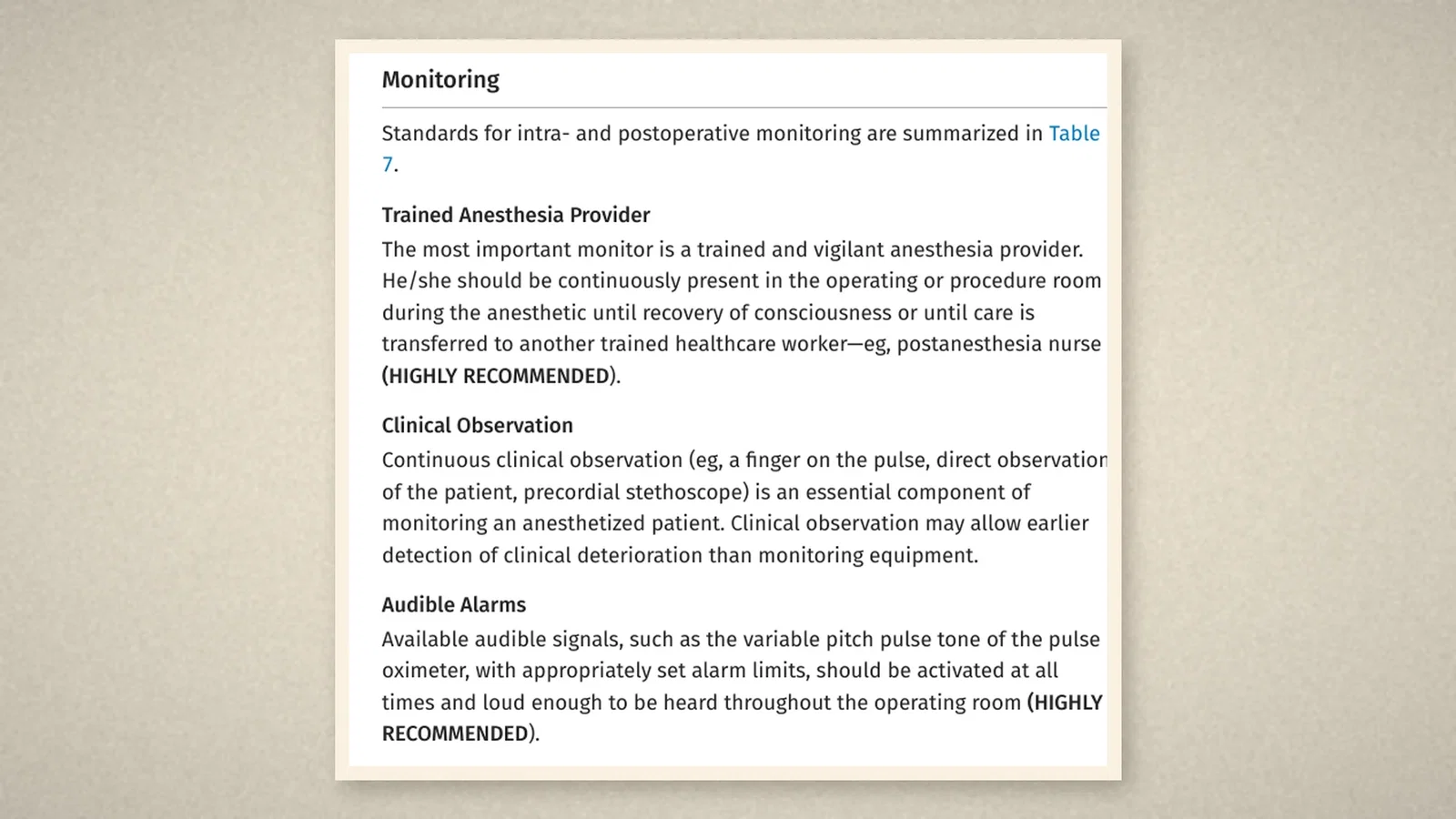
The highly recommended standards listed in the abstract include the continuous presence of a trained and vigilant anaesthesia provider; continuous monitoring of tissue oxygenation and perfusion by clinical observation and a pulse oximeter; intermittent monitoring of blood pressure; confirmation of tracheal tube placement, if a tube is used, by auscultation and carbon dioxide detection; use of the WHO Surgical Safety Checklist; and a system for transfer of care at the end of an anaesthetic. The monitoring section calls the trained and vigilant provider the most important monitor and asks that audible signals such as the variable pitch tone of the pulse oximeter be active at all times and audible throughout the room. Continuous waveform capnography was RECOMMENDED, to become highly recommended when robust and suitably priced devices are available, and manufacturers were urged to address the gap. [1, abstract][1, monitoring]
For the conduct of anaesthesia, one provider should be dedicated to each patient and present throughout; the WHO Surgical Safety Checklist brings surgeons, anaesthesia providers and nurses together for safety checks before induction, before skin incision and before the team leaves the operating room. [1, conduct of anesthesia]
What the record shows
The standards condense the safety practice that high-income countries built up over many years into a minimum line any facility can be measured against: a trained person present, then a pulse oximeter, then a checklist and a handover. They admit that many places cannot yet meet it, but refuse to treat that as a reason to lower the line.
Sources and reading limits
Read: Gelb, Morriss, Johnson and Merry, "WHO-WFSA International Standards for a Safe Practice of Anesthesia", Anesthesia & Analgesia 2018;126(6):2047-2055, in the publisher's free full text: abstract, introduction and history, principles, levels of standard and scope, professional aspects, the monitoring section and the conduct of anaesthesia (the tables are rendered as images and were not read item by item); and the WFSA history timeline entries for 1992-1993, 2008-2011 and 2016-2018. Page images of the title and abstract, the history paragraph and the monitoring section checked.
Not covered: the parallel Canadian Journal of Anesthesia publication (not accessible); the texts of the 1992/1993 and 2010 standards; the Anesthetic Capacity Checklist.
Limits: the mortality figures for high-income and for low- and middle-income countries are quoted by the paper from studies with different definitions; device settings and drug details are not repeated.
Three illustrations are taken from the publisher's page of the article (title and abstract, introduction, monitoring section). One is a text diagram drawn from the article, with no people drawn.
- Gelb AW, Morriss WW, Johnson W, Merry AF; International Standards for a Safe Practice of Anesthesia Workgroup. World Health Organization-World Federation of Societies of Anaesthesiologists (WHO-WFSA) International Standards for a Safe Practice of Anesthesia. Anesth Analg. 2018;126(6):2047-2055. doi:10.1213/ANE.0000000000002927. Full text
- World Federation of Societies of Anaesthesiologists. WFSA history timeline. Web page
Continue exploring
Related reading connects shared questions and contexts; it does not by itself establish historical influence.
Anesthesia Epochs · The Source Room · About & Editorial Method
Published November 4, 2026. Sources and reading limits are stated above. Illustrations are labelled as original source images or AI-made. Historical accounts are educational; they are not current treatment instructions.