
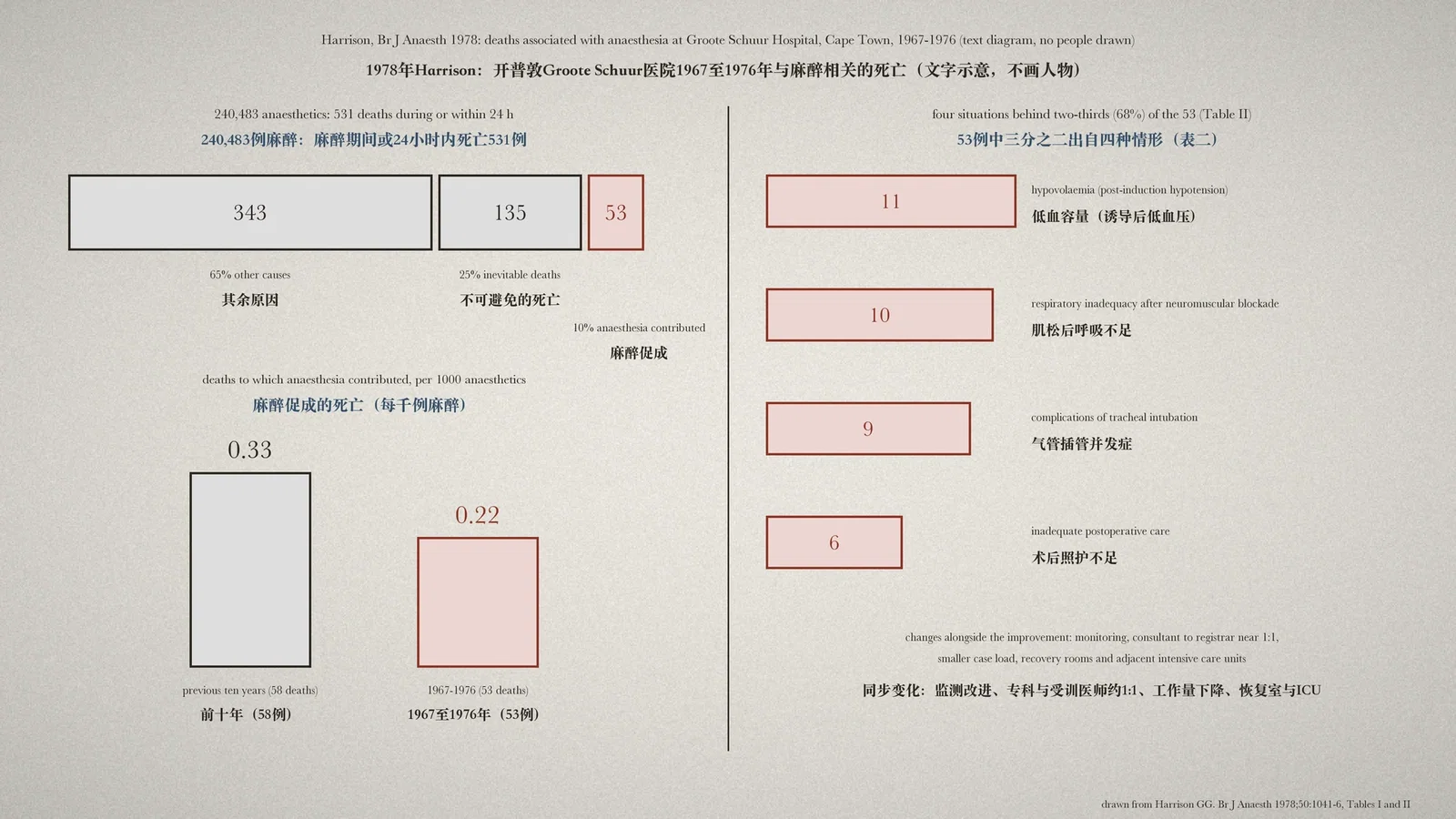
In 1978 Gaisford G. Harrison reported in the British Journal of Anaesthesia (vol. 50) a ten-year survey (1967-1976) from Groote Schuur Hospital, the principal teaching hospital of the University of Cape Town, where all mortality associated with anaesthesia had been surveyed prospectively since 1956: of 240,483 anaesthetics, 531 deaths occurred during or within 24 h of anaesthesia, and 53, judged by harsh criteria, were deaths to which anaesthesia contributed, 0.22 per 1000 (0.33 in the previous ten years) and 2.2% of total surgical mortality; two-thirds arose from four situations, complications of tracheal intubation, respiratory inadequacy after neuromuscular blockade, inadequate postoperative care and hypovolaemia, and the author linked the improvement to better monitoring, a consultant to registrar ratio near 1:1, lighter case loads and recovery rooms with intensive care.
Reading Library · Anesthesia Epochs · 中文版
Watch the education video (for clinicians)
1978: Harrison's Mortality Study — Groote Schuur, Cape Town · Anesthesia Epochs Education Series
What can one hospital learn by counting its own anaesthetic deaths year after year? Groote Schuur Hospital in Cape Town, the 1300-bed principal teaching hospital of the University of Cape Town Medical School, had surveyed all mortality associated with anaesthesia prospectively since 1956. In 1978 Gaisford G. Harrison of the University's Department of Anaesthetics reported the second decade of that work in the British Journal of Anaesthesia, vol. 50, pp. 1041-6: "Death attributable to anaesthesia: a 10-year survey (1967-1976)". This article reads that article. [1, p. 1041]
The most fundamental index of safety
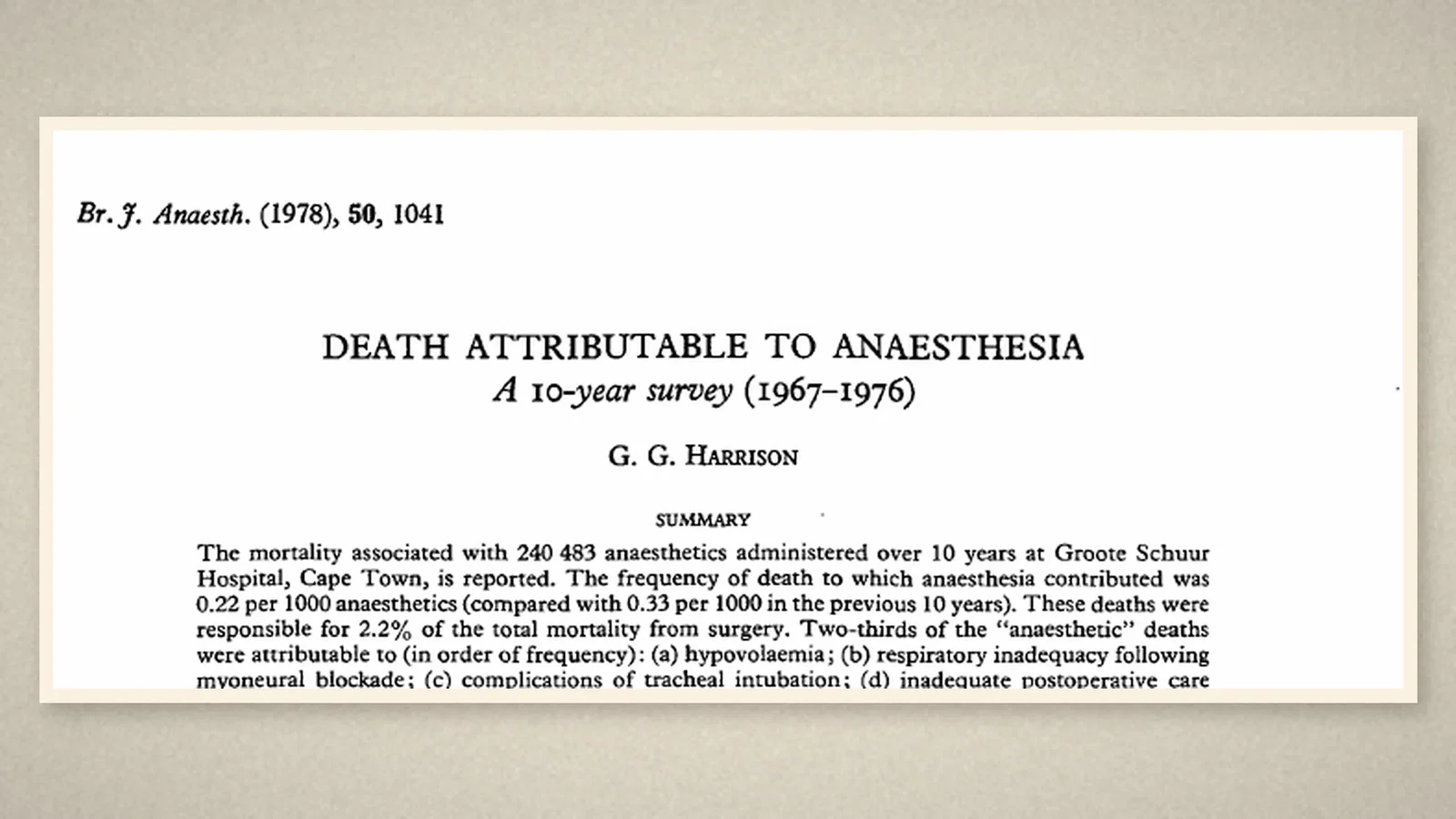
The article opens by observing that anaesthesia does not itself correct deformity or restore health, yet may be the most important adjunct to the care of the surgical patient; being non-therapeutic, above all it must be safe, and nowhere does "to do no harm" carry more force. The author proposed that the most fundamental index of that safety is how often factors related to an anaesthetic cause or contribute to a patient's death. This cannot be measured with scientific precision, but a clinical assessment of the data gives a useful measure and, more importantly, clinical lessons. [1, p. 1041]
How deaths were judged
A death associated with anaesthesia was defined as one during or within 24 h of anaesthesia, or the failure of a patient conscious beforehand to regain consciousness. The author admitted that 24 h was arbitrary and that a few late deaths, such as from aspiration and pneumonia, might be missed. For each death the anaesthetist supplied the records and an account of the anaesthetic, which were examined with the post-mortem report against three questions: was anaesthesia, or anything within the anaesthetist's responsibility, the cause or a major contributory factor; if so, what was the precise cause; and was the death preventable, what departure from accepted practice occurred, and what was the lesson. A third group, "inevitable deaths", covered the surgery of desperation and operations on the moribund, where anaesthesia could not be excluded but was necessarily and unavoidably contributory. Harsh criteria were adopted "to avoid any bias that might encourage complacency". [1, pp. 1041-2]
0.22 against 0.33
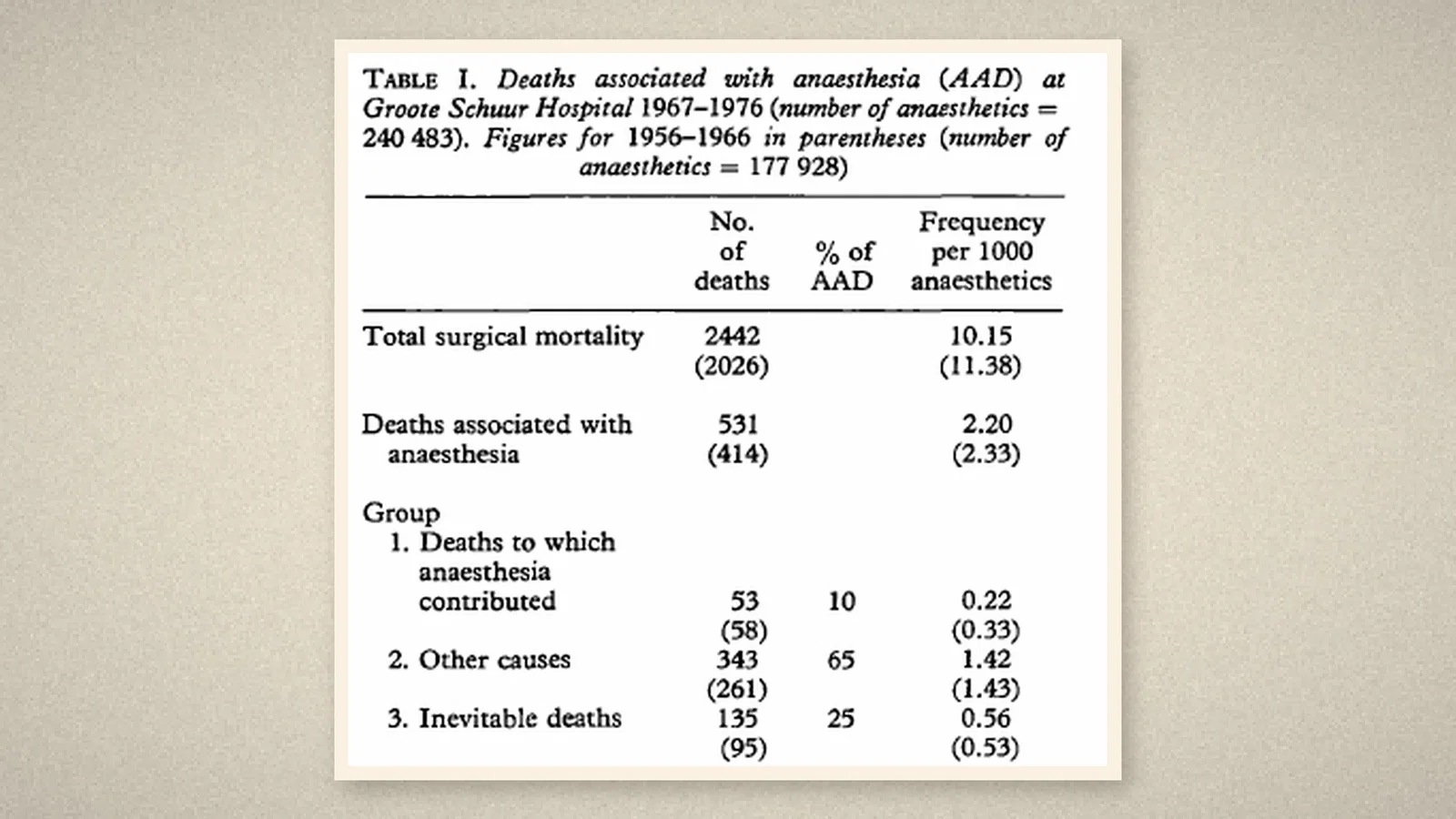
Table I gives the totals. Over 1967-1976 there were 240,483 anaesthetics and 2,442 surgical deaths. Deaths associated with anaesthesia numbered 531, or 2.2 per 1000; of these, 53 (10%) were deaths to which anaesthesia contributed, 0.22 per 1000; 343 (65%) were from other causes; and 135 (25%) were inevitable deaths. In parentheses are the figures for the previous ten years (177,928 anaesthetics): 58 deaths to which anaesthesia contributed, 0.33 per 1000. Table I and Fig. 1 date the earlier period 1956-1966; one sentence of the text gives 1957-1966. [1, p. 1042]
Seen against total surgical mortality, the author wrote, anaesthesia and its mismanagement were responsible in a preventable manner for 2.2% of it. Year by year the rate improved at first and then settled at what seemed an irreducible minimum around 0.15 per 1000. The reason was sad: although such deaths were preventable and the errors repetitive, all trainees had to be educated clinically through the same mistakes; supervision by experienced specialists helped, but the most enduring lessons came from finally accepting total clinical responsibility. [1, p. 1042]
Two-thirds from four situations
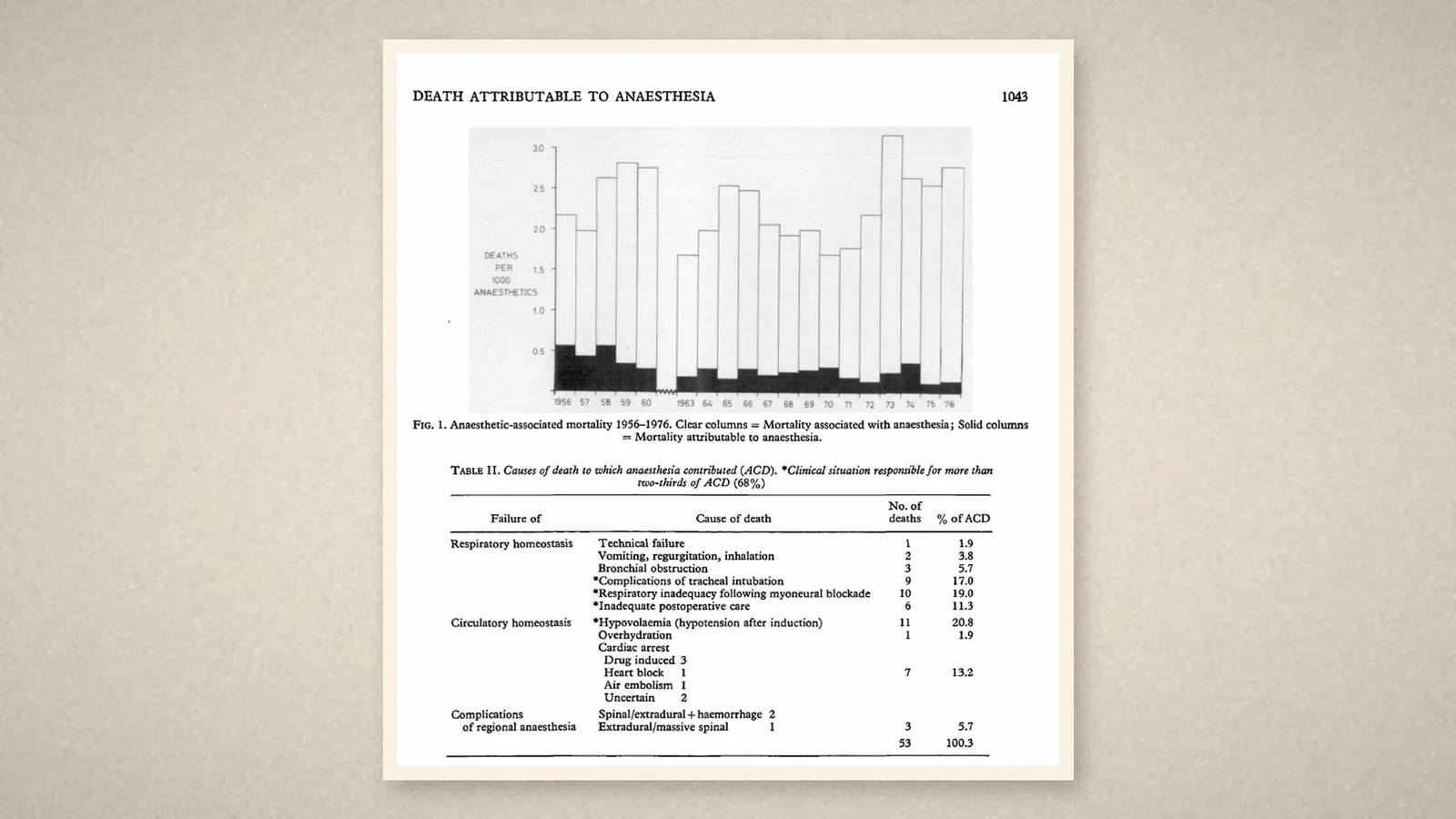
Causes were classed as failures of respiratory or circulatory homeostasis. Of the 53 patients, 27 were in good or fair condition (ASA I-II) and 26 in poor condition (ASA III-IV); 32 had emergency and 19 elective operations. Four clinical situations accounted for two-thirds (68%): [1, p. 1043]
- Complications of tracheal intubation, 9 deaths. Five followed failed intubation in the presence of an anatomical abnormality that adequate examination could have anticipated, and in each a neuromuscular blocking drug had been given before the anaesthetist was sure the trachea could be intubated and the lungs ventilated. The others followed a kinked tube, a herniated cuff and inadvertent bronchial intubation. [1, p. 1044]
- Respiratory inadequacy following neuromuscular blockade, 10 deaths. Seven were patients with severe chronic obstructive lung disease and abdominal distension from intestinal obstruction, in whom the anaesthetist hesitated to provide ventilation after operation; three were really due to overhydration and interstitial pulmonary oedema. [1, p. 1044]
- Inadequate postoperative care and observation, 6 deaths, including excess fluid after operation and an unobserved disconnection inside the nose between a catheter mount and a nasotracheal tube. [1, p. 1044]
- Hypovolaemia, 11 deaths, mostly presenting as post-induction hypotension, the commonest single situation; the precipitating factor was often thiopentone given to the sick, old and arteriosclerotic with ischaemic heart disease. The author chose to highlight the hypovolaemia because it was "eminently correctable". [1, p. 1044]
Among the inevitable deaths, cardiac surgery accounted for 45 (33.3%), and with major vascular catastrophes such as ruptured aortic aneurysm and multiple injuries with massive haemorrhage made up three-quarters. [1, p. 1045]
Where the improvement came from
The author held that statistical comparisons between different surveys were not valid and compared only with the hospital's own previous decade. There had been improvement, together with four changes: continuing improvement in routine monitoring of vital functions; a consultant to registrar ratio now approaching 1:1; a smaller case load per anaesthetist; and recovery rooms within the theatre area with adjacent intensive care units. The conclusion notes that although the rate was small, 0.22 per 1000, the 10% of anaesthesia-associated deaths in this group were basically preventable; their causes were mostly simple, a lack of simple precautions and of clinical alertness, and they recurred; and these cases were probably the tip of an iceberg of clinical mismanagement. "How many more have nearly died?" [1, pp. 1045-6]
What the record shows
The article shows one hospital tracking anaesthetic deaths prospectively over a long period under a fixed definition, and pressing each case to the question of whether it could have been prevented and what it teaches. Such surveys, the author wrote, are tedious in the extreme, but if carried out consistently they give both the clinical lessons for improving practice and the only means of measuring the safety of anaesthesia. [1, p. 1046]
Sources and reading limits
Read: Harrison GG, "Death attributable to anaesthesia: a 10-year survey (1967-1976)", British Journal of Anaesthesia 1978, vol. 50, no. 10, pp. 1041-6 (Oxford University Press PDF, obtained through institutional access), in full, including the French, German and Spanish summaries; page images of pp. 1041, 1042 (Table I) and 1043 (Fig. 1, Table II) checked.
Not covered: Harrison's 1990 papers in the South African Medical Journal on the whole 1956-1987 series (Parts I and II; abstracts only), and the 1968 South African Medical Journal papers on the first ten years cited in this article. The full series runs from 1956 to 1987; this article is limited to the 1978 report of 1967-1976, with the first period only as that report gives it.
Limits: the first period begins in 1956 in Table I and Fig. 1 and in 1957 in one sentence of the text; both are given. The issue month is not printed on the pages, so the article is dated by year. Drug doses are not repeated.
Three illustrations are taken from the 1978 article (pp. 1041, 1042 and 1043). One is a diagram drawn from the text, with no people drawn.
- Harrison GG. Death attributable to anaesthesia: a 10-year survey (1967-1976). Br J Anaesth. 1978;50(10):1041-6. doi:10.1093/bja/50.10.1041
Continue exploring
Related reading connects shared questions and contexts; it does not by itself establish historical influence.
- 1954: Beecher and Todd Count Deaths Across 599,548 Anaesthetics
- 1987: Surgeons and Anaesthetists Publish a Confidential Enquiry Into Perioperative Deaths
Anesthesia Epochs · The Source Room · About & Editorial Method
Published November 4, 2026. Sources and reading limits are stated above. Illustrations are labelled as original source images or AI-made. Historical accounts are educational; they are not current treatment instructions.