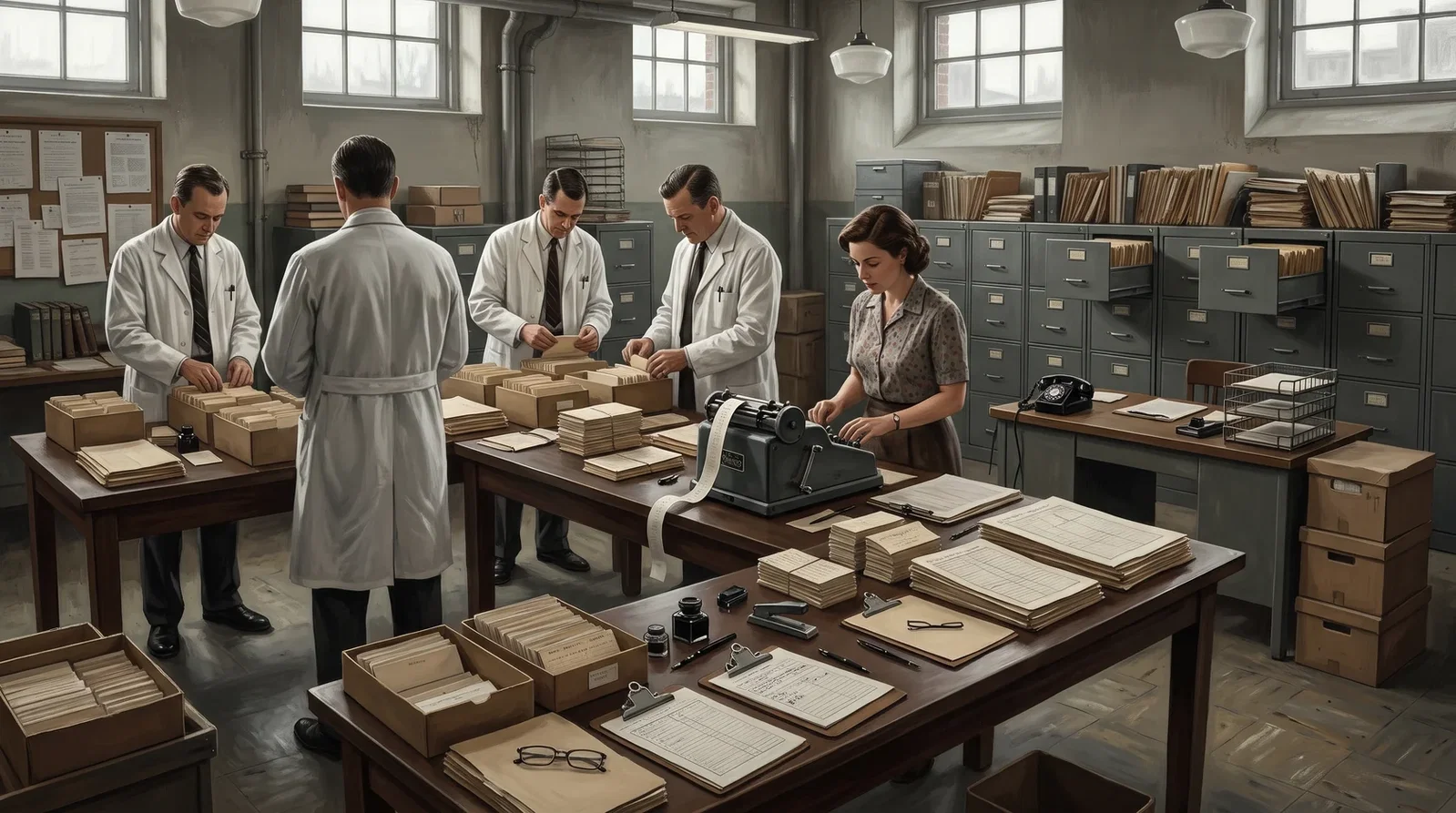
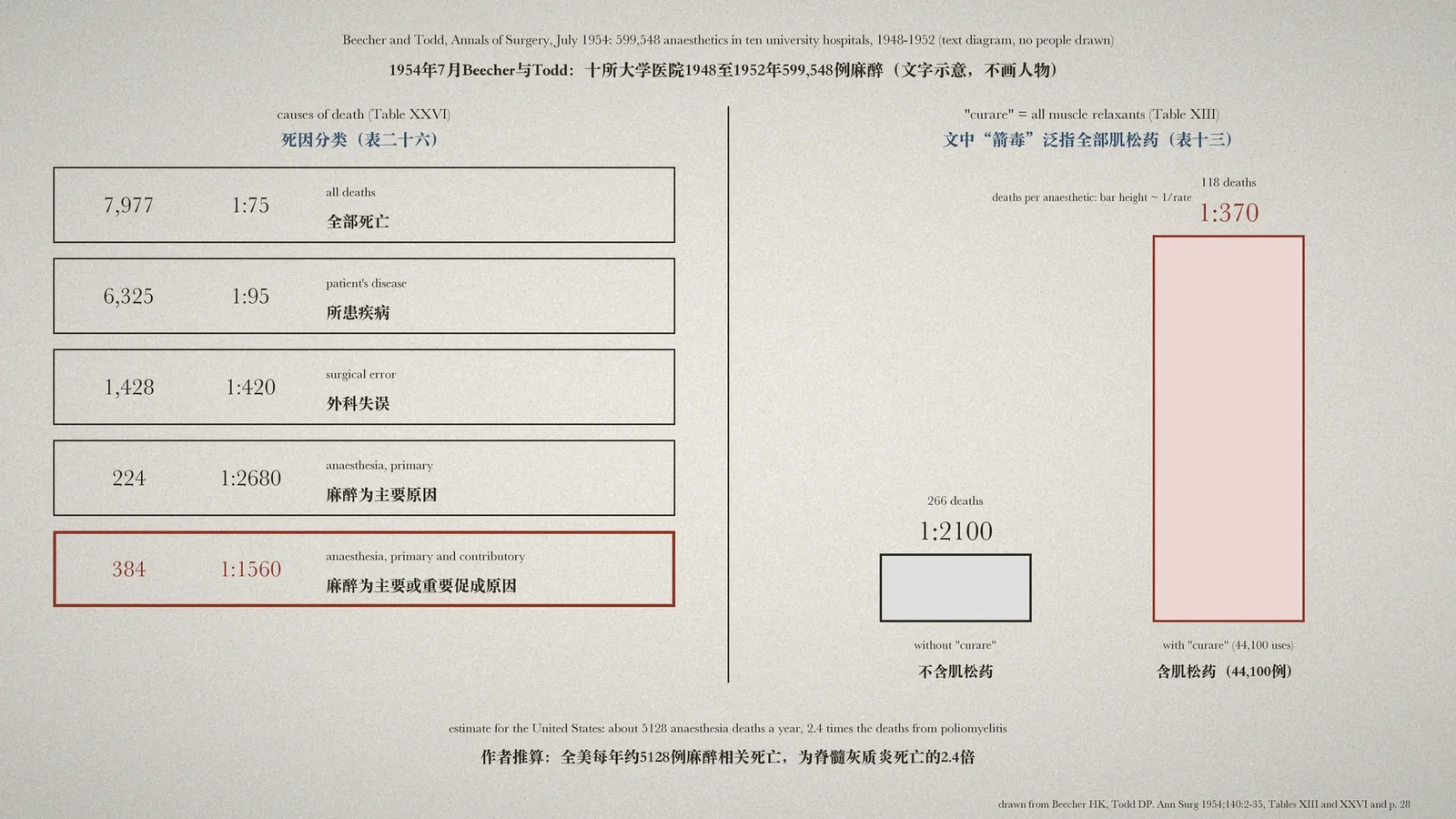
In Annals of Surgery for July 1954 (vol. 140, no. 1), Henry K. Beecher and Donald P. Todd reported a study in which teams of an anaesthetist, a surgeon and a secretary in ten US university hospitals appraised every death on the surgical services from 1948 to 1952, covering 599,548 anaesthetics: the chance of dying from any cause was 1:75; anaesthesia was the primary or an important contributory cause in 384 deaths, 1:1560 (1:2680 for primary deaths only); with 'curare', meaning all muscle relaxants, the rate was 1:370, against 1:2100 without; thiopental deaths fell steadily while the relaxant rate stayed constant; and the authors estimated 5128 anaesthesia deaths a year in the United States, 2.4 times the deaths from poliomyelitis.
Reading Library · Anesthesia Epochs · 中文版
Watch the education video (for clinicians)
1954: Beecher and Todd — Deaths Associated with Anesthesia · Anesthesia Epochs Education Series
How dangerous was anaesthesia? In the middle of the twentieth century the answer usually rested on scattered voluntary reports and personal impressions. In July 1954, Annals of Surgery (vol. 140, no. 1) gave more than thirty pages to "A study of the deaths associated with anesthesia and surgery" by Henry K. Beecher and Donald P. Todd of the Anesthesia Department of the Harvard Medical School at the Massachusetts General Hospital, subtitled "based on a study of 599,548 anesthesias in ten institutions 1948-1952, inclusive". This article reads that article. [1, p. 2]
Anaesthesia as part of surgical care
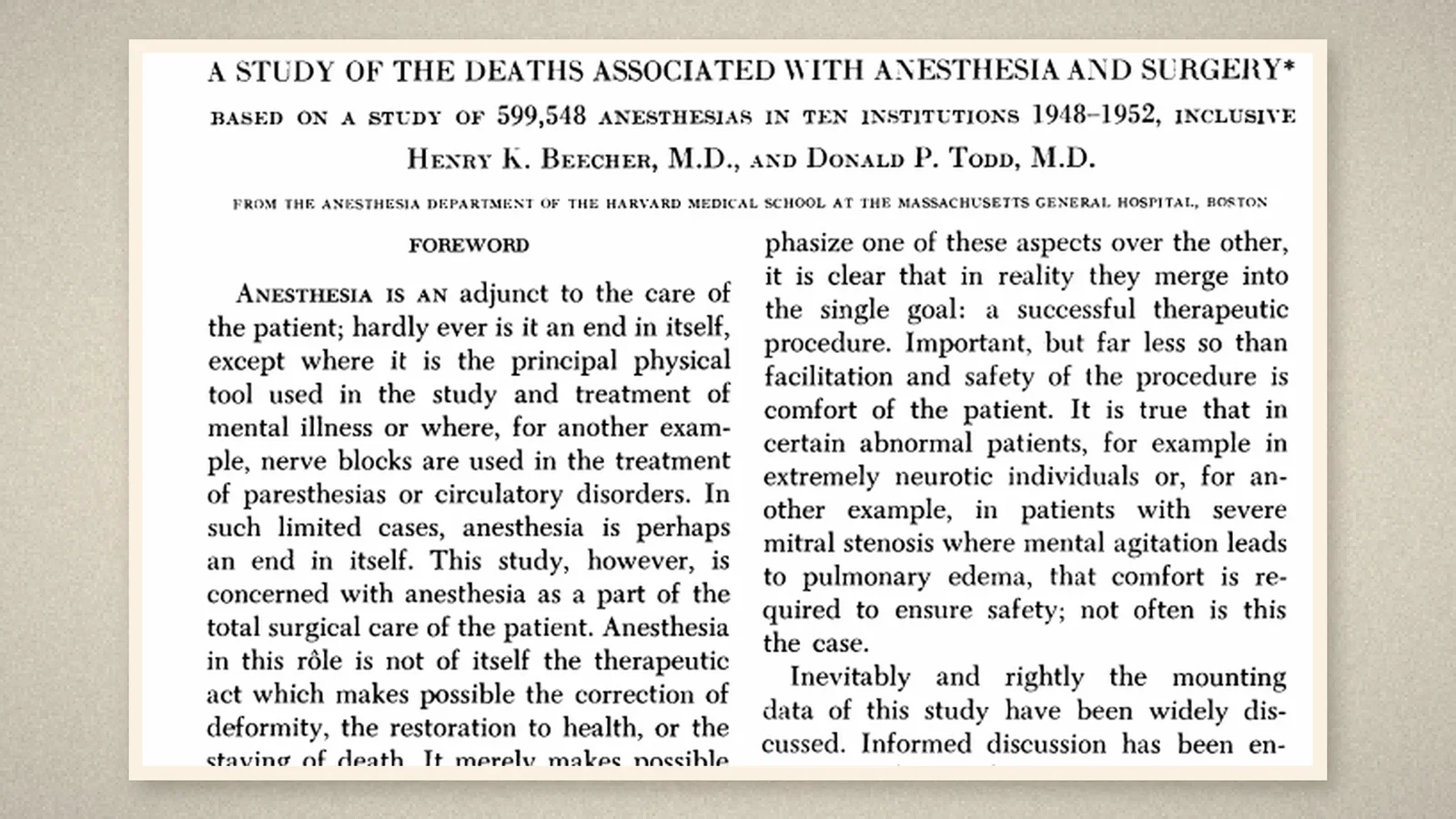
The foreword begins by calling anaesthesia an adjunct to the care of the patient, hardly ever an end in itself: it is not the therapeutic act that corrects deformity or restores health, but merely makes such acts possible. The authors set down these truisms because they believed that one of the survey's main accomplishments was to show, within a precise framework, how much responsibility anaesthesia must bear when the total care of the surgical patient fails; surgeon and anaesthetist therefore could not profitably pursue separate goals. The study was supported by the Medical Research and Development Board of the Army. [1, p. 2]
How the deaths were gathered: not voluntary reporting
Ten teams, each made up of an anaesthetist, a surgeon and a secretary, in ten university hospitals scattered across the United States, appraised every death on the surgical and surgical specialty services from 1 January 1948 to 31 December 1952. The local team decided the cause soon after each death, usually after full staff discussion. Once an institution had agreed to take part, the authors stressed, there was nothing voluntary or selective about reporting; studies of intermittently or partially reported deaths they regarded as of little use. Twenty-one physicians and 11 secretaries worked continuously for five years, 105 man-years in all. [1, pp. 3-4][1, pp. 28-9]
The authors were candid about limits: the work "best fits into the category of a survey", the data were as sound as they could make them, and the aim was to describe how things are, not how they should be. [1, p. 3]
1:75, 1:95 and 1:1560
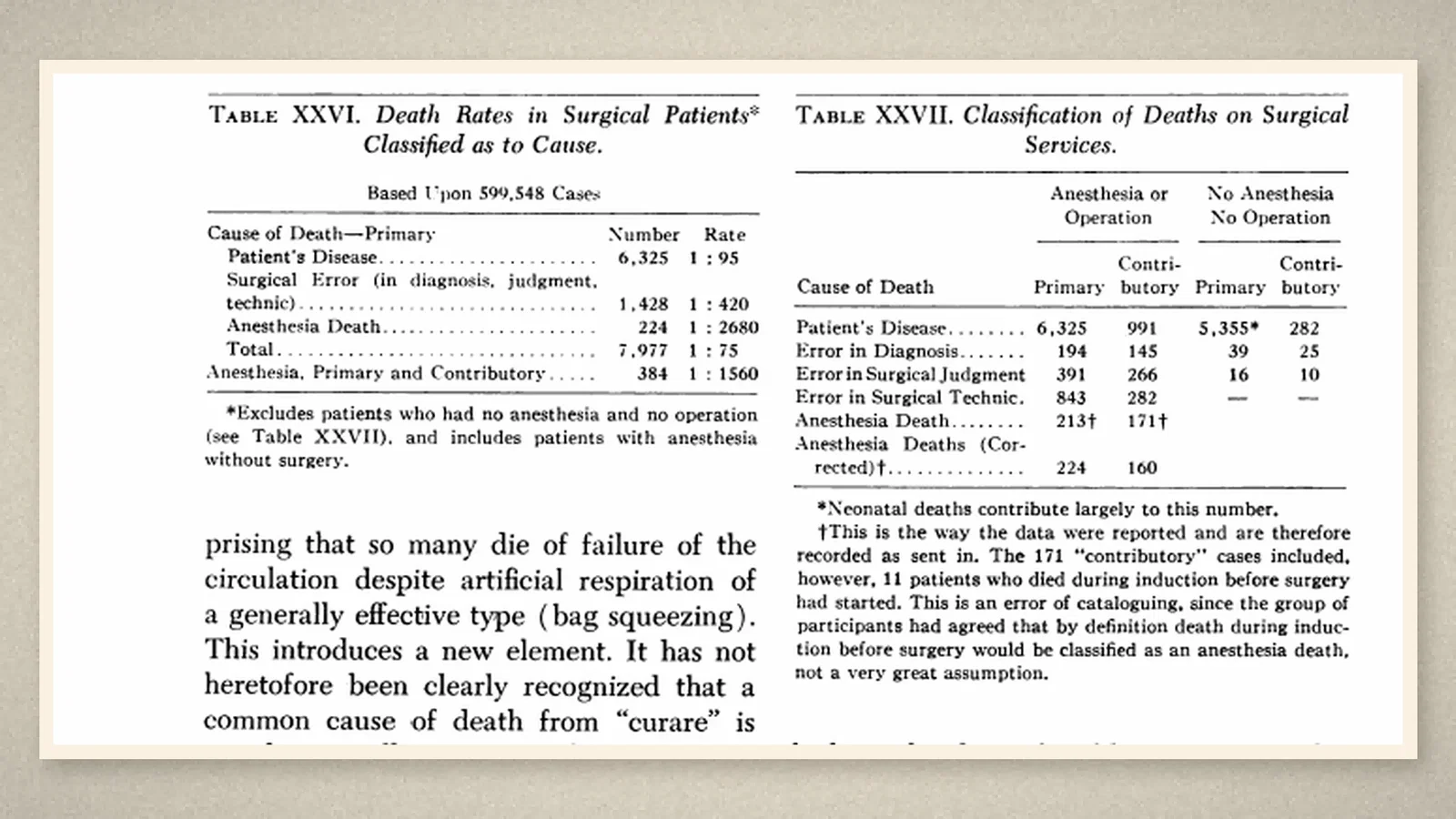
Table XXVI gives the overall picture. Among 599,548 cases there were 7,977 deaths, a chance of 1:75 of dying from any cause. The patient's disease was the primary cause in 6,325, 1:95; surgical error in diagnosis, judgment or technique in 1,428, 1:420; and anaesthesia in 224, 1:2680. Deaths in which anaesthesia was the primary or an important contributory cause totalled 384, a rate of 1:1560, the article's most quoted figure. [1, p. 22][1, p. 31]
"Curare": a six-fold difference
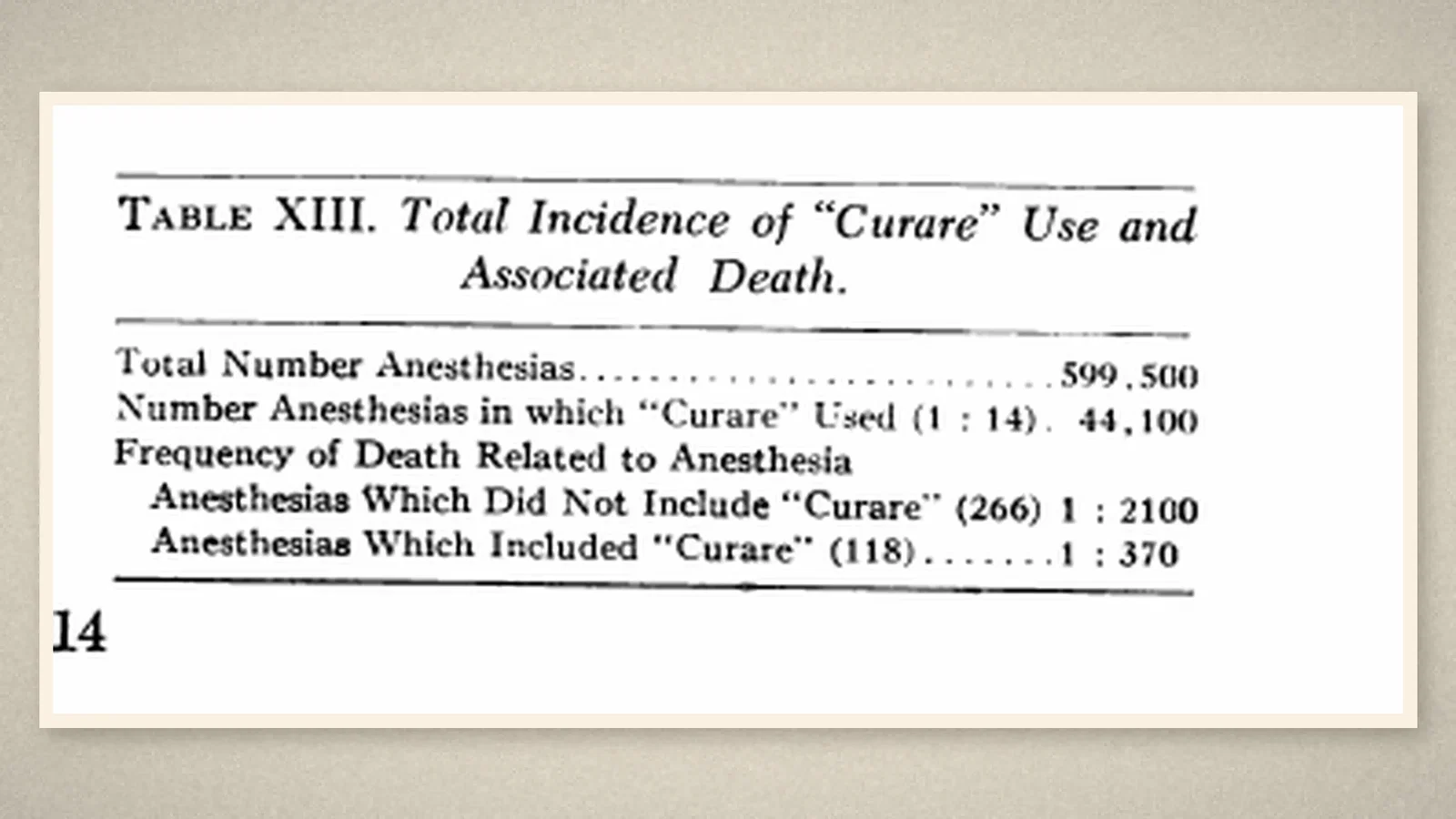
In the article "curare" means all the muscle relaxants in the study. The authors singled them out because they were new, their use was increasing rapidly and they seemed to carry hazards not yet fully understood. Table XIII shows that relaxants were used in about 1 in 14 anaesthetics, 44,100 in all; there were 118 anaesthesia deaths with them, a rate of 1:370, and 266 without them, 1:2100. [1, p. 14]
The authors handled the comparison carefully. The simple split into anaesthetics with and without "curare", they wrote, makes the relaxants look very bad, "unreasonably so", because many trivial procedures under local anaesthesia dilute the non-relaxant data; nor did they know that "curare" had killed any single patient. But a six-fold difference was a plain "stop-look sign". Over the study, the death rate associated with thiopental improved steadily while that associated with the relaxants showed a "grim constancy". Their conclusion was not a ban but further study and great caution: the relaxants then available should be considered as on trial, used only where there were clear advantages, not for trivial purposes and not as a corrective for generally inadequate anaesthesia. [1, p. 14][1, p. 22][1, p. 31]
A public-health problem
The article ends by placing anaesthesia deaths on a national scale. Making what they called a very tall assumption, that the rate in the country's 6000 reporting hospitals was no higher than in the ten excellent departments studied, the authors took about 8,000,000 anaesthetics a year and a rate of 1:1560 to reach some 5128 anaesthesia deaths a year in a population of 156,000,000, or 3.29 per 100,000, which was 2.4 times the death rate from poliomyelitis over the five years of the study. Compared with the millions spent each year on poliomyelitis research, almost nothing was spent on the hazards of anaesthesia, and the authors called anaesthesia deaths "certainly a matter for public health concern". [1, p. 28]
The summaries add that men had a disproportionately high anaesthesia death rate; that anaesthesia deaths were concentrated in the youngest and the oldest age groups, which needed study; and that the habit of combining many agents made it very hard to learn the death rate of any one agent unless the rates differed by several hundred per cent, as with the relaxants. [1, pp. 31-2]
What the record shows
The article shows a method: examine every surgical death in several hospitals at once, let surgeons and anaesthetists decide the cause together, and calculate rates under a common definition. Its 1:1560 and its relaxant comparison provoked much argument; the authors answered critics in the text itself and suggested that the discussion and self-examination might prove the study's most valuable result.
Sources and reading limits
Read: Beecher HK, Todd DP, "A study of the deaths associated with anesthesia and surgery", Annals of Surgery, July 1954, vol. 140, no. 1, pp. 2-35 (PMC1609600 PDF). Read closely: the foreword, purpose and background (pp. 2-5), the section on muscle relaxants with Tables XII-XIV (pp. 13-16), Tables XXVI and XXVII with the surrounding text (pp. 21-2), and the poliomyelitis comparison and all summaries (pp. 27-33); the agent-by-agent tables were skimmed.
Not covered: the ten institutions' own records and any list of participants beyond what the article prints; the published criticisms of the study that the authors mention.
Limits: drug doses are not repeated. This article keeps the paper's word "curare" and explains its meaning; "about six times" refers to 1:370 against 1:2100 (about 5.7 times), which the paper itself calls six-fold. The authors call the work a survey; the criteria were agreed in advance, yet one or two participants mis-catalogued deaths during induction, and the paper prints both the reported and the corrected figures.
Three illustrations are taken from the 1954 article (pp. 2, 14 and 22). One is a diagram drawn from the text, with no people drawn.
- Beecher HK, Todd DP. A study of the deaths associated with anesthesia and surgery: based on a study of 599,548 anesthesias in ten institutions 1948-1952, inclusive. Ann Surg. 1954;140(1):2-35. PMC1609600
Continue exploring
Related reading connects shared questions and contexts; it does not by itself establish historical influence.
- 1955: Beecher's War History Chapter Tracks Falling Pentothal Deaths
- 1951: Morton and Wylie Analyse 43 Deaths From Regurgitation or Vomiting
- 1966–1968: Beecher on Research Ethics and Irreversible Coma
Anesthesia Epochs · The Source Room · About & Editorial Method
Published November 4, 2026. Sources and reading limits are stated above. Illustrations are labelled as original source images or AI-made. Historical accounts are educational; they are not current treatment instructions.