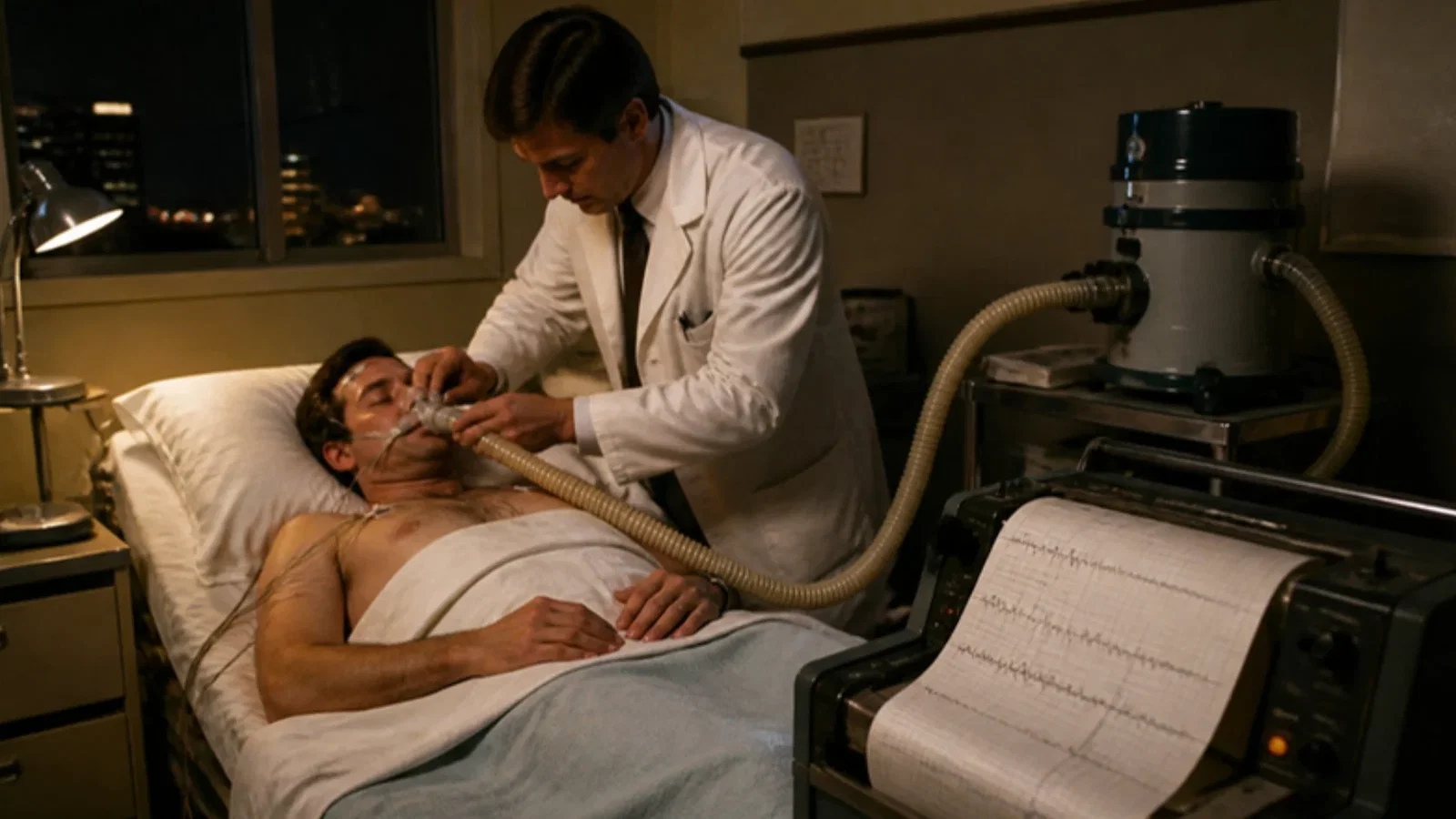
On 18 April 1981 The Lancet printed 'Reversal of obstructive sleep apnoea by continuous positive airway pressure applied through the nares' by Colin E. Sullivan, Faiq G. Issa, Michael Berthon-Jones and Lorraine Eves of the Department of Medicine, University of Sydney. The only effective treatment then, they wrote, was a tracheostomy left open at night, and the decision to do one was always difficult. The authors took sleep-related airway occlusion to be passive, the suction of inspiration drawing the tongue and soft palate against the back of the pharynx, and tested whether continuous positive pressure through the nostrils would act as a pneumatic splint. Two soft plastic tubes fitted to the nostrils led into a wide-bore tube, sealed over the nose with medical silicone rubber and fed by a variable-speed vacuum-cleaner blower in a soundproofed box. In five patients with severe disease, each studied on three whole nights, the pressure completely prevented occlusion, which could be switched off and on by raising or lowering it; each patient woke spontaneously and stayed alert all day. Two patients slept with the mask on three consecutive nights. Long-term use, the authors said, remained an open question.
Reading Library · Anesthesia Epochs · 中文版
Watch the education video (for clinicians)
1981: Nasal CPAP for Sleep Apnoea — A Pneumatic Splint · Anesthesia Epochs Education Series
Anaesthetists deal every day with an upper airway that collapses: once a patient falls asleep, the tongue and soft palate sink back. In 1981 a research group in Sydney took that problem onto the night ward. With the blower motor from a vacuum cleaner and two soft tubes fitted to the nostrils, they tried to let patients with severe obstructive sleep apnoea sleep a whole night without choking awake. The paper appeared in The Lancet of 18 April 1981. [1, p. 862]
Tracheostomy was the only answer
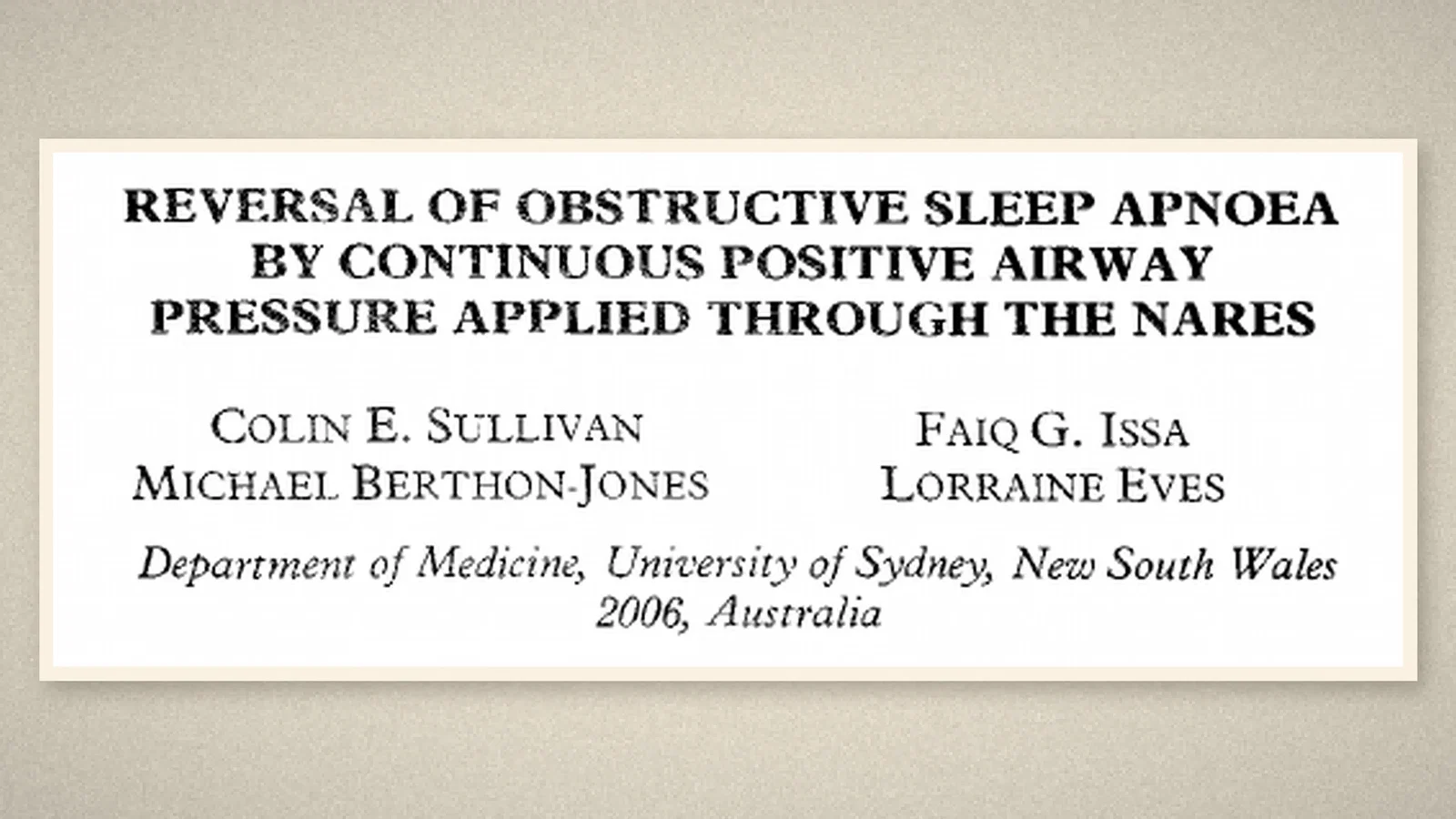
The authors were Colin E. Sullivan, Faiq G. Issa, Michael Berthon-Jones and Lorraine Eves of the Department of Medicine, University of Sydney. Obstructive sleep apnoea, their introduction said, is a common disorder. The underlying problem is sleep-induced occlusion of the oropharyngeal airway, with repeated apnoeas and severe fragmentation of sleep. The patient is often unaware of the struggle for breath at night; the main symptoms are excessive daytime sleepiness and snoring. Nightly asphyxia eventually brings arrhythmias, pulmonary hypertension and right heart failure, systemic hypertension, morning headache, intellectual and personality changes and polycythaemia, and the disease is a recognised cause of sudden "unexpected" death. [1, p. 862]
Weight loss could reduce the number of obstructions, and neck collars and respiratory stimulants were less satisfactory. The only effective treatment then available, the authors wrote, was a tracheostomy left open at night. It made the daytime sleepiness disappear at once, and life-threatening complications such as arrhythmias and cor pulmonale improved within days. But in patients without such complications, the decision to do a tracheostomy was "invariably difficult". [1, p. 862]
A passive collapse
The authors started from a mechanical hypothesis. The evidence supported the view that the sleep-related occlusion is passive: Remmers and colleagues had suggested that the subatmospheric pressure of inspiration sucks the tongue and soft palate against the back of the pharynx, and Guilleminault and colleagues had found a failure of the dilator action of the pharyngeal muscles. A person whose upper airway already has a high resistance must generate more suction to keep air flowing; as muscle tone falls in sleep the airway narrows further, more suction is needed, and at some critical point the tongue and palate are sucked onto the posterior wall and close it completely. [1, p. 862]
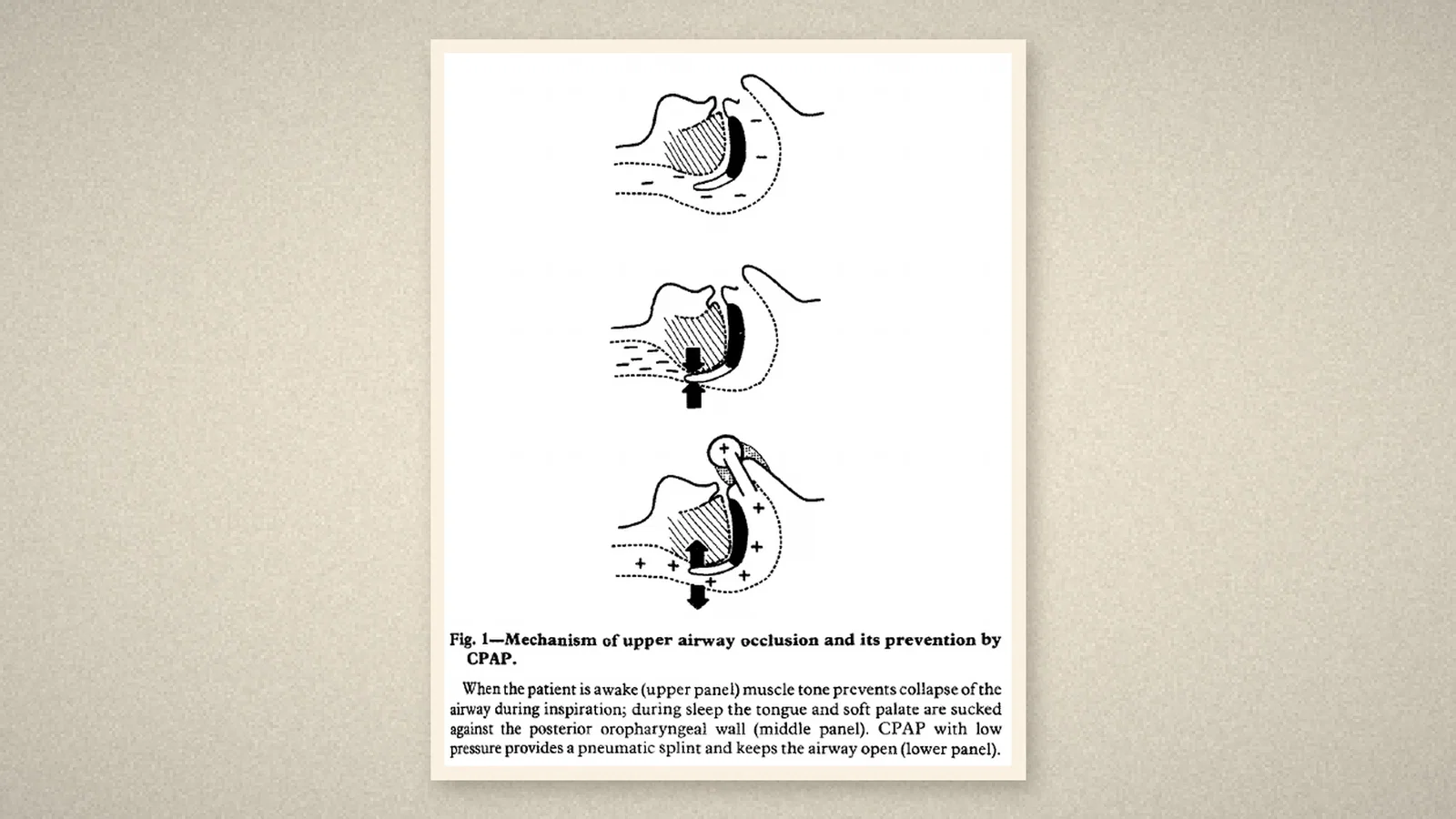
If the airway is sucked shut, it can be pushed open from inside. The hypothesis to be tested was that continuous positive airway pressure applied through the nares "would act as a pneumatic splint", pushing the soft palate and tongue forward and away from the pharyngeal wall. [1, p. 862]
A machine built round a vacuum cleaner
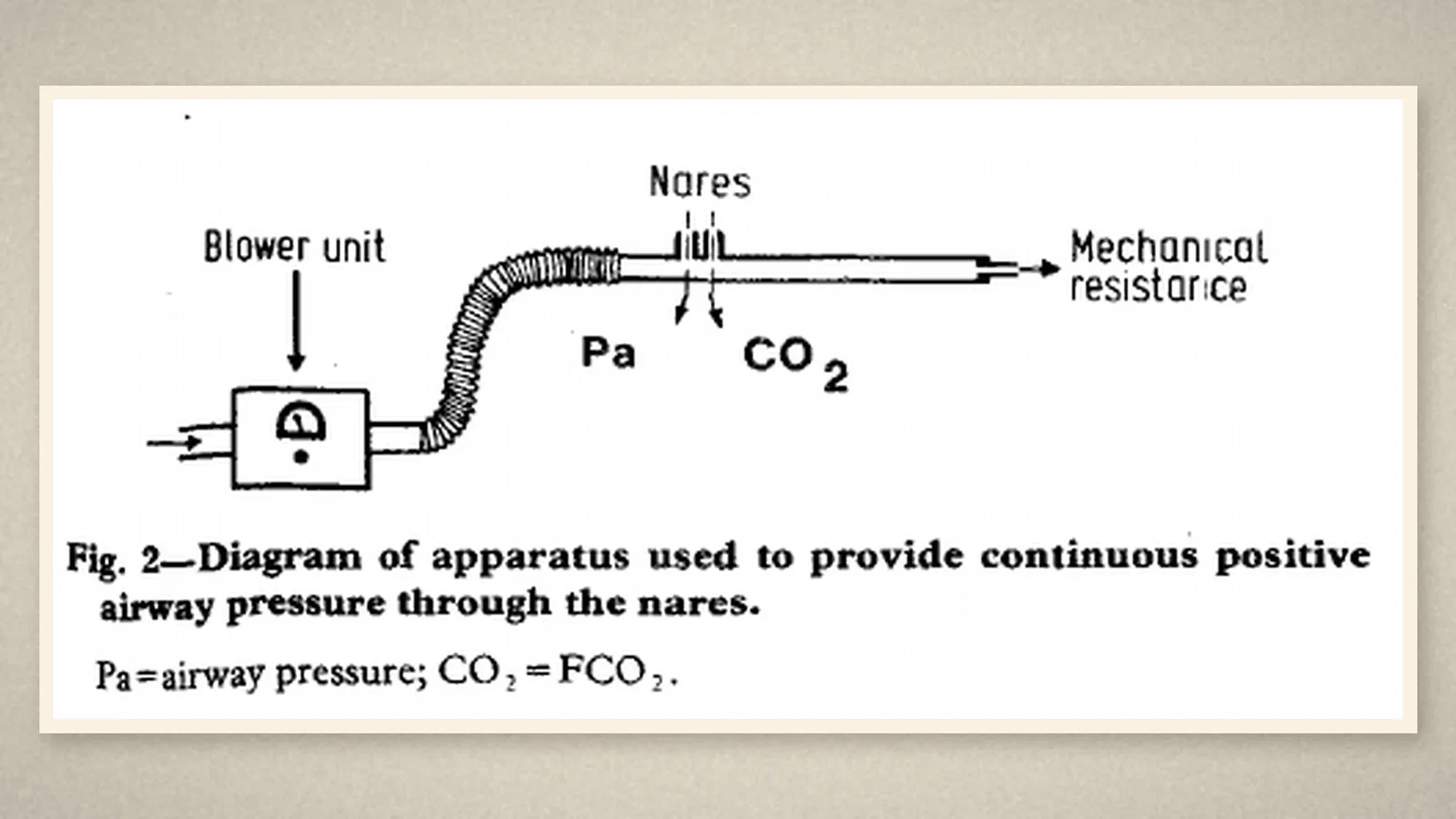
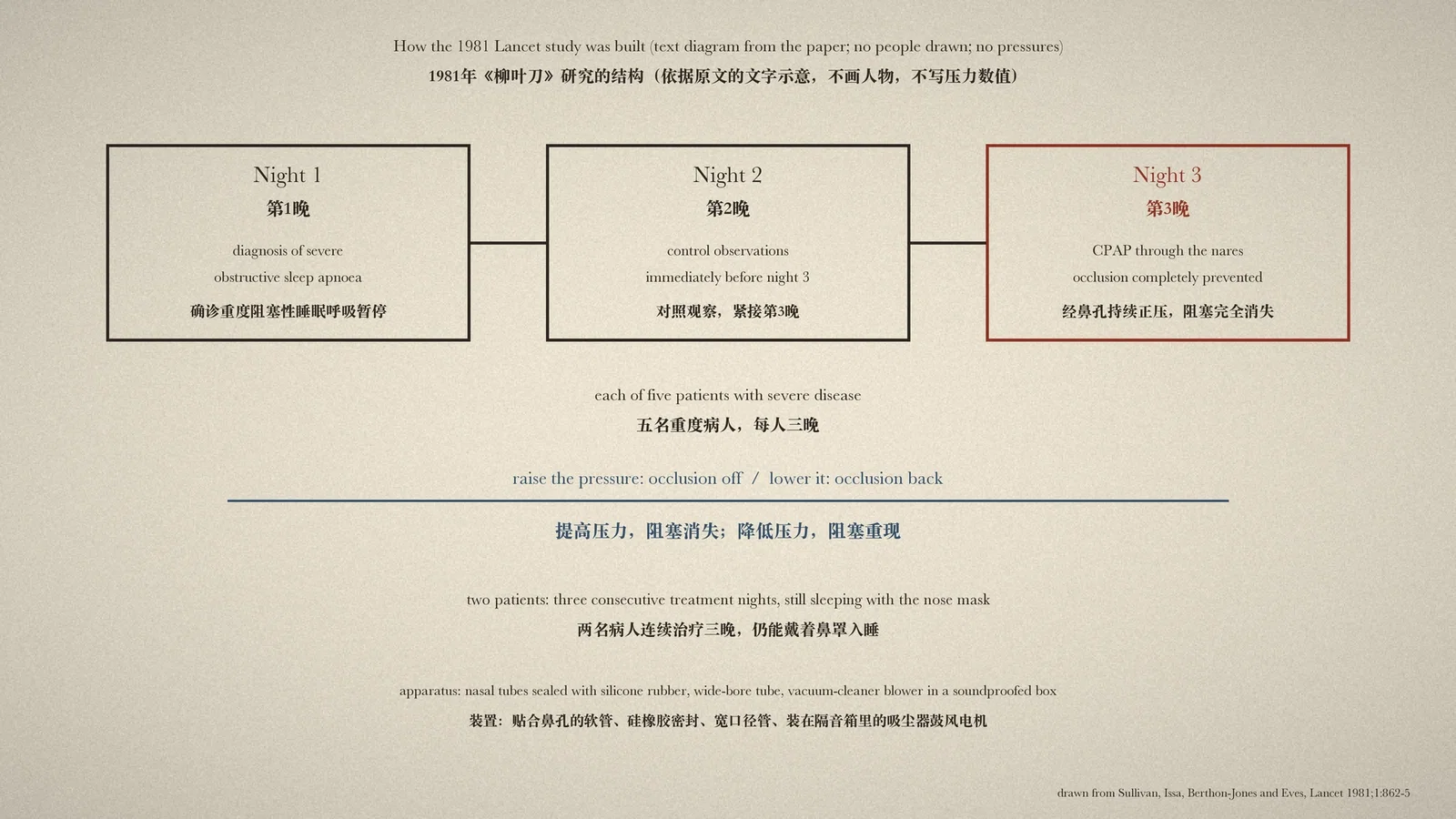
The apparatus was plain. Two soft plastic tubes were shaped to fit snugly in each nostril, and their other ends were pushed into a light wide-bore tube strapped to the face; medical-grade silicone rubber was then run over the nose and nostrils to give a comfortable seal. One end of the wide-bore tube was connected to a vacuum-cleaner blower motor with variable speed control, while the other led away and was narrowed with a mechanical resistance. Pressure was measured through one nasal tube and carbon dioxide sampled through the other. The blower sat in a box lined with acoustic material, which cut its noise to that of a fan. [1, p. 862][1, p. 863]
Each patient had three all-night studies: the first to establish the diagnosis, the second as a control night immediately before the third, during which CPAP was applied. Brain waves, muscle tone, eye movements, the electrocardiogram, ear oximetry and chest and abdominal movement were recorded on a polygraph. All five patients had long histories of loud snoring and daytime sleepiness. One had stopped working in the building trade after falling asleep on scaffolding and at the wheel; one, a company executive, fell asleep in important meetings; one had lost a clerical job after falling asleep at the desk every afternoon. Three of the five had refused tracheostomy. [1, p. 863]
Pressure on, pressure off
The control night confirmed severe obstructive sleep apnoea in all five. Continuous positive airway pressure then "completely prevented" the upper airway occlusion in each patient, and the occlusion "could be turned off and on simply by" raising or lowering the pressure. Once the right level was found, it needed no adjustment for the rest of the night. No patient had difficulty sleeping with the nose mask, and the time spent in deep non-REM sleep and in REM sleep rose sharply. [1, p. 863][1, p. 864]
The clinical response the next day, the authors wrote, was remarkable. Each patient woke spontaneously, was alert and stayed awake all day without prompting. One who had been unable to stay awake for more than a few minutes a day remained awake the whole day and watched television for several hours, something impossible for years. To see whether patients would still sleep with the mask once their sleepiness had gone, two were treated on three consecutive nights; on the third night both still slept with it. [1, p. 864][1, p. 865]
The question the authors left open
In the discussion the authors took the on-off response as proof that the therapy worked and expected the method to be "a useful adjunct". Whether long-term treatment would be practical, or whether a short course would itself reduce the obstruction, they said, "remains unanswered". They went through the theoretical drawbacks of positive pressure and pointed out that, because the pressure was applied only through the nose, the mouth would act as a blow-off valve; if pressure were lost, the patient would simply return to the usual obstruction and could breathe room air on waking, in effect a fail-safe system. Its simplicity and safety, they concluded, suggested that home use would be possible. [1, p. 865]
What the record shows
The paper put an airway problem familiar to every anaesthetist into a mechanical model that could be tested, built the device from cheap parts, and proved the point by switching the obstruction off and on with the pressure. It rests on five patients and a few nights, and the authors themselves left the long-term question open.
Sources and reading limits
Read: Sullivan, Issa, Berthon-Jones and Eves, "Reversal of obstructive sleep apnoea by continuous positive airway pressure applied through the nares", Lancet 18 April 1981;1:862-5 (summary, introduction, theoretical background, apparatus, all-night studies, clinical summaries, results, discussion, Figs 1-4 and the table; page images of pp. 862 and 863 checked). Obtained through institutional access.
Not covered: the pathogenesis studies the authors cite (by Remmers and colleagues and by Guilleminault and colleagues) and the tracheostomy literature; any later report by the same group on long-term home use; later commercial CPAP machines. The History of Anaesthesia Society timeline entry was used only as a lead, not as evidence.
Limits: some timelines date this topic to 1980; the paper read here appeared on 18 April 1981 and does not date the sleep studies. The study covers five patients with three nights each, plus two patients treated on three consecutive nights; the authors explicitly leave long-term use unanswered. Treatment pressures, flows, apnoea indices and saturations are not repeated, and page crops stop before them. Patients are not identified; their occupations are given as the paper gives them.
Three illustrations are crops of The Lancet 1981 pp. 862 and 863 (title and authors, Figs 1 and 2). One is a text diagram of the study design drawn from the paper, with no people and no pressure values.
- Sullivan CE, Issa FG, Berthon-Jones M, Eves L. Reversal of obstructive sleep apnoea by continuous positive airway pressure applied through the nares. Lancet. 1981;1:862-5. DOI
Continue exploring
Related reading connects shared questions and contexts; it does not by itself establish historical influence.
- 1978: Finucane and Kupshik Exchange a Leaking Tracheal Tube over a Stilette
- 1953: A Boy with Tetanus Is Hand-Ventilated for Seventeen Days
Anesthesia Epochs · The Source Room · About & Editorial Method
Published November 3, 2026. Sources and reading limits are stated above. Illustrations are labelled as original source images or AI-made. Historical accounts are educational; they are not current treatment instructions.