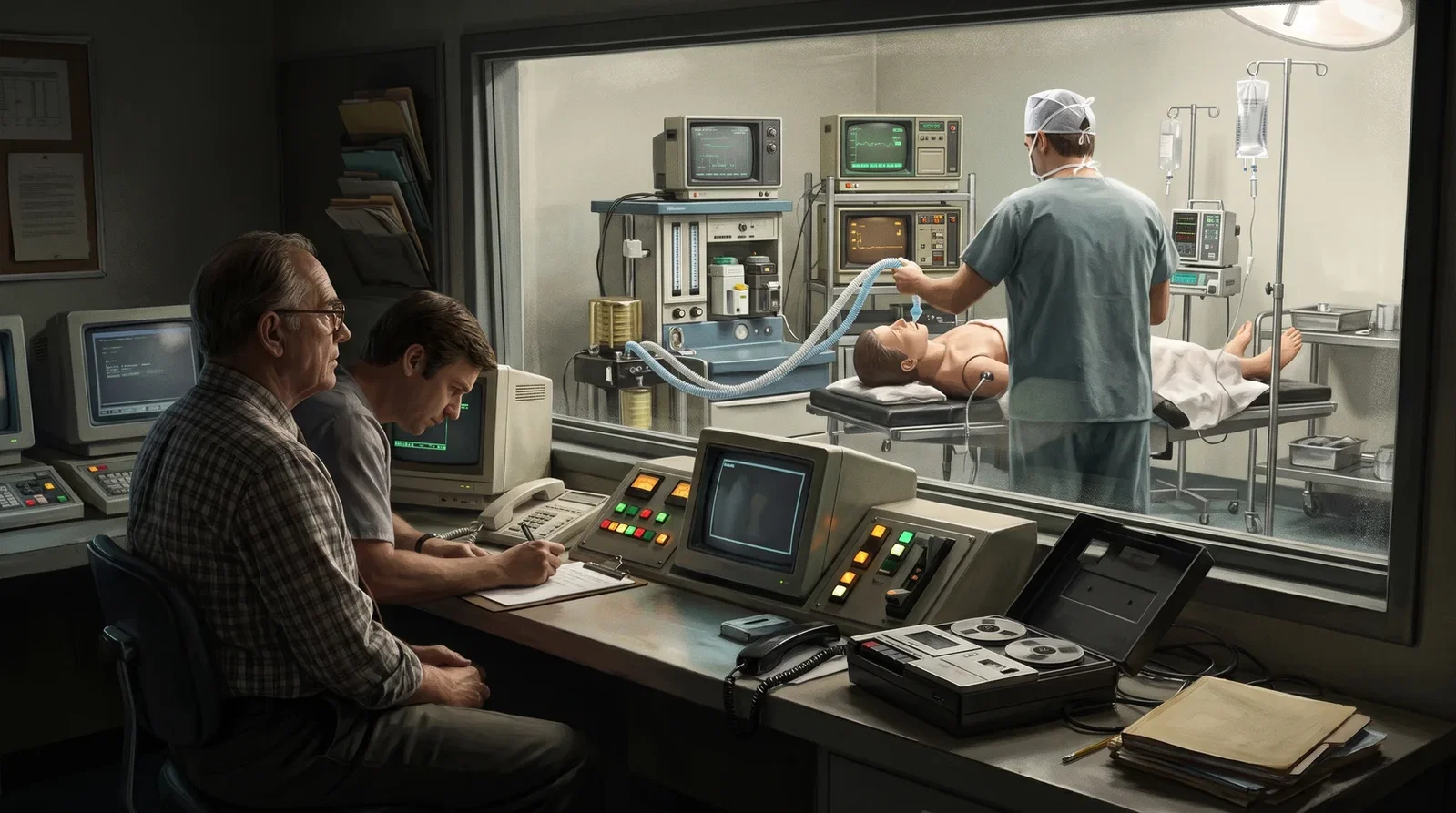
In 1988 David Gaba and Abe DeAnda fed simulated signals into real operating-room monitors and a mannequin, run from a script a director could override; a year later they used the set-up to time how nineteen trainees detected and corrected five simulated critical incidents.
Reading Library · Anesthesia Epochs · 中文版
Watch the education video (for clinicians)
1988–1989: Gaba and DeAnda — The Operating Room as a Laboratory · Anesthesia Epochs Education Series
Critical incidents in anaesthesia are rare and fast, and nobody can practise them by waiting to meet enough of them. Could the operating room be brought into a laboratory, so that such events happen when they are wanted? In September 1988 Anesthesiology, vol. 69, pp. 387-94, published "A comprehensive anesthesia simulation environment: re-creating the operating room for research and training" by David M. Gaba and Abe DeAnda; the next year the same two reported the first study made with it in Anesthesia and Analgesia. This article reads both papers. [1, p. 387][2, p. 444]
Re-creating the whole task environment
Simulation, the paper begins, is used extensively in industries that involve routine but risky activities. What the authors set out to build was a re-creation of the anaesthesiologist's task environment in a real operating room. [1, p. 387]
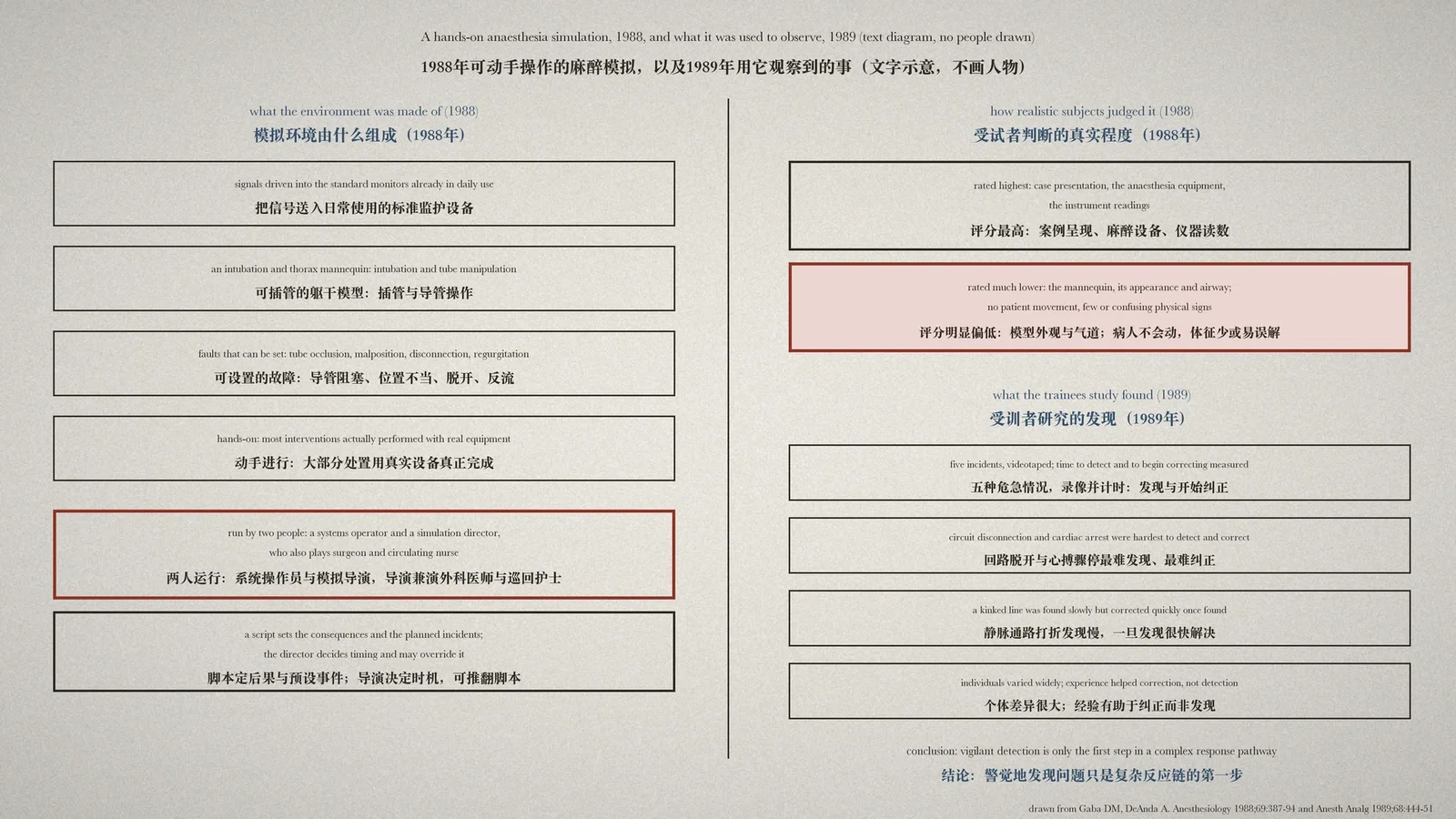
The method was to drive the ordinary monitors rather than to build a separate screen world: the electrocardiogram with arrhythmias; invasive systemic arterial, pulmonary arterial and central venous pressures, all coupled to the arrhythmias; automated cuff blood pressure; pulse oximetry; mass spectrometry; breathing-circuit spirometry; and oxygen analysis. An intubation and thorax mannequin allowed tracheal intubation and manipulation of the tube, and could simulate occlusion, malposition or disconnection of the tracheal tube, as well as regurgitation of gastric contents. [1, p. 387]
The simulation is comprehensive, the authors stress, in that it is hands-on and requires actual performance of most interventions using actual equipment, rather than a button pressed in their place. [1, p. 387]
A script and a director
Running it took two people: a systems operator and a simulation director, the director also acting as surgeon and circulating nurse. The simulator outputs were determined by a script defining the consequences of routine anaesthetic actions and the pre-established critical incidents, while decisions about timing and about overriding the script were made by the director. This control system, the authors write, offers maximum flexibility while maintaining clinical realism. [1, p. 387]
The discussion compares the environment with another simulator of the day, implemented only on a computer screen, which used a sophisticated model of physiology and pharmacology to compute responses to "drugs" and "actions" entered with a mouse. Interaction with a screen, the authors observe, is drastically different from working with actual operating-room equipment. [1, p. 391]
How realistic was it
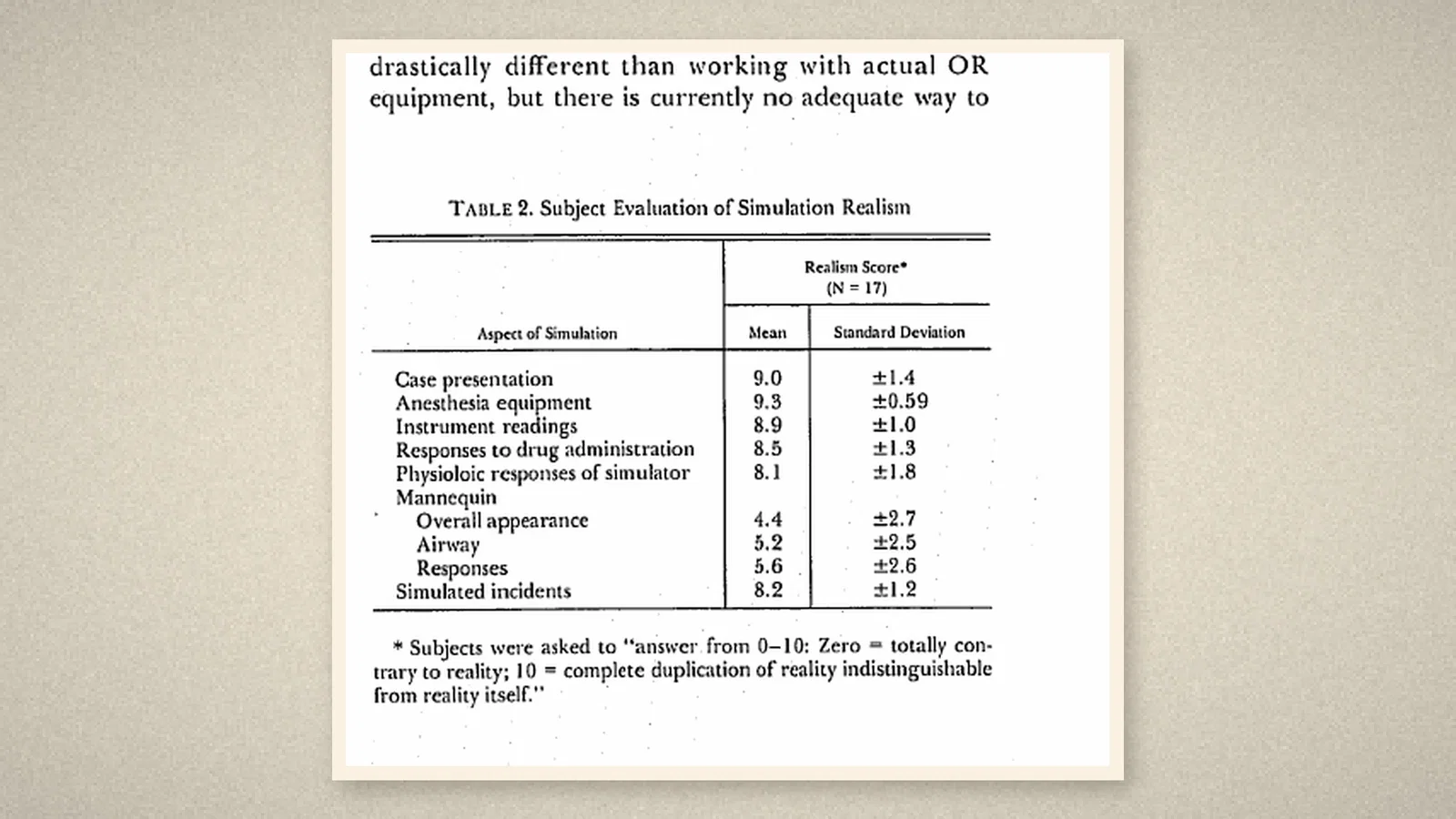
Table 2 gives the subjects' ratings of realism. Case presentation, the anaesthesia equipment and the instrument readings scored highest, with responses to drug administration and the physiological responses of the simulator close behind; the mannequin itself scored much lower, both for overall appearance and for the airway. [1, p. 391]
The abstract does not hide this: limitations in this version centred on the mannequin, for instance no patient movement and minimal or confusing physical signs, and were to be addressed in future versions. The authors add that anaesthesia simulation can be accomplished at nominal expense and has major potential for training, continuing education, certification and research. [1, p. 387]
Watching trainees respond
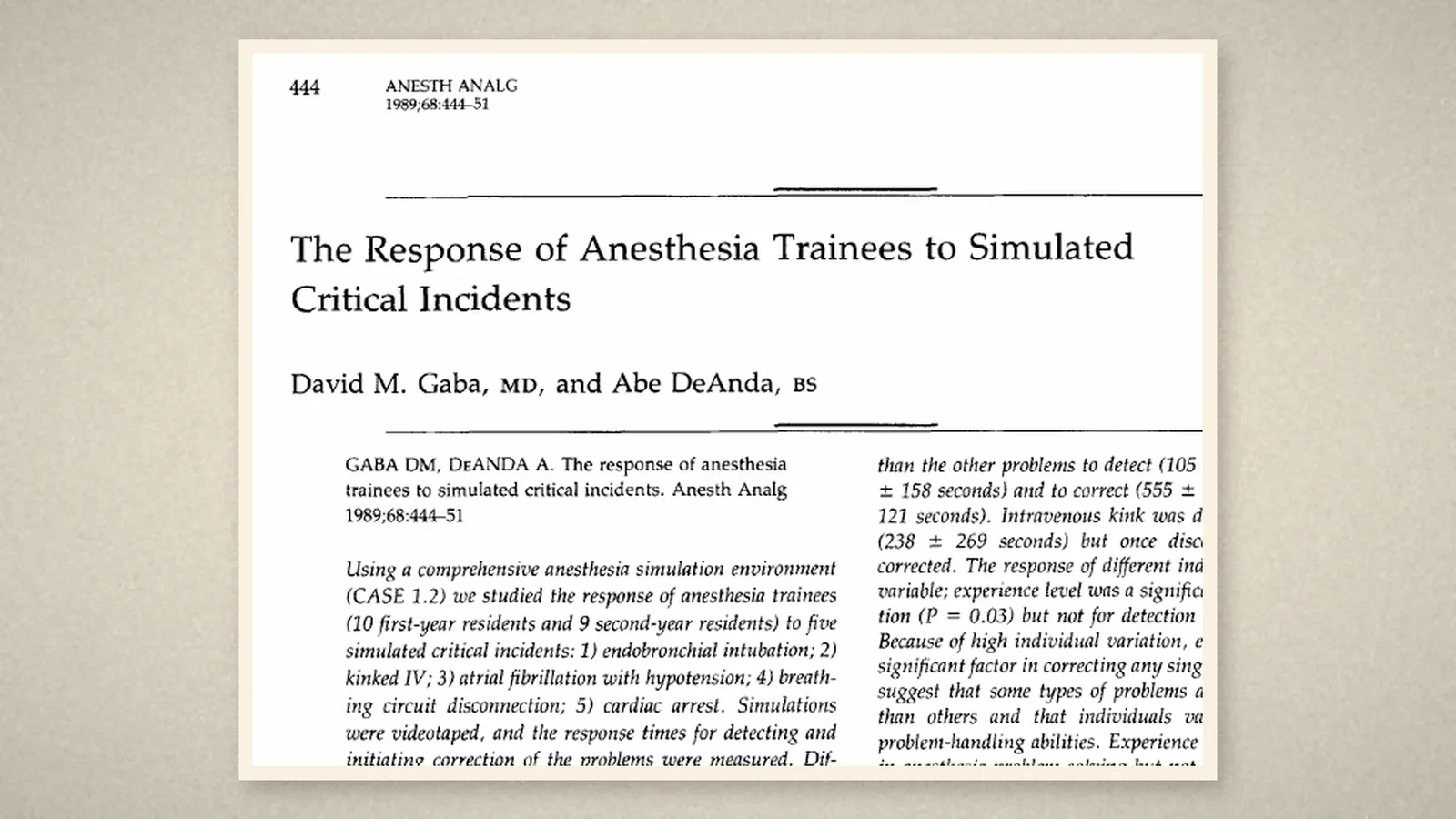
The 1989 study used the environment, there called CASE 1.2, to observe nineteen anaesthesia trainees, ten first-year and nine second-year residents, meeting five simulated critical incidents: endobronchial intubation, a kinked intravenous line, atrial fibrillation with hypotension, breathing-circuit disconnection and cardiac arrest. The simulations were videotaped, and the times to detect each problem and to begin correcting it were measured. [2, p. 444]
Different problems had significantly different response characteristics: breathing-circuit disconnection and cardiac arrest were harder than the others both to detect and to correct, while the kinked line was detected more slowly but, once discovered, was quickly put right. The response of different individuals was highly variable. Experience level was a significant factor for correction but not for detection overall, and because individual variation was so high, experience was not significant in correcting any single problem. [2, p. 444]
The conclusion is measured: the data suggest that some types of problem are harder to handle than others and that individuals vary widely in their problem-handling abilities; experience is beneficial in anaesthesia problem solving, but not in a simple fashion. Vigilant detection of problems is only the first step in a complex response pathway. [2, p. 444]
What the record shows
The two papers turn "how is a crisis handled?" into something that can be watched, timed and compared. Two choices are worth noting: the signals were fed into the monitors already in daily use, so trainees worked with real equipment, and control was shared between a fixed script and a director who could depart from it, which keeps the exercise both repeatable and responsive. The authors also wrote down what was unconvincing, a mannequin that does not move, and separated detecting a problem from solving it as two things to be measured apart.
Sources and reading limits
Read: Gaba DM, DeAnda A, "A comprehensive anesthesia simulation environment: re-creating the operating room for research and training", Anesthesiology, September 1988, vol. 69, no. 3, pp. 387-94, in full, with page images of p. 387 and the figure and table pages checked; and Gaba DM, DeAnda A, "The response of anesthesia trainees to simulated critical incidents", Anesthesia and Analgesia, April 1989, vol. 68, no. 4, pp. 444-51, in full.
Not covered: the editorial accompanying the 1988 paper in the same issue, and the original description of the screen-based simulator the discussion compares with; the later work of this laboratory.
Limits: no drug doses are reproduced here; the realism ratings and the response times are study findings, and the individual timing figures are not repeated here. The statistical detail of the 1989 study is taken as its conclusions state it.
Three illustrations are taken from the two papers (1988, pp. 387 and 391; 1989, p. 444). One is a diagram drawn from the texts, with no people drawn.
- Gaba DM, DeAnda A. A comprehensive anesthesia simulation environment: re-creating the operating room for research and training. Anesthesiology. 1988;69(3):387-94. doi:10.1097/00000542-198809000-00017
- Gaba DM, DeAnda A. The response of anesthesia trainees to simulated critical incidents. Anesth Analg. 1989;68(4):444-51. doi:10.1213/00000539-198904000-00004
Continue exploring
Related reading connects shared questions and contexts; it does not by itself establish historical influence.
- 1978: Cooper's Team Finds Human Error Behind Most Preventable Anaesthesia Mishaps
- 1968: Abrahamson and Denson Report on the Sim One Patient Simulator
Anesthesia Epochs · The Source Room · About & Editorial Method
Published November 5, 2026. Sources and reading limits are stated above. Illustrations are labelled as original source images or AI-made. Historical accounts are educational; they are not current treatment instructions.