
In April 1990 Wierda, de Wit, Kuizenga and Agoston of Groningen reported in the British Journal of Anaesthesia their first clinical observations on Org 9426, a new steroidal non-depolarizing relaxant, which developed block faster than vecuronium and gave good to excellent intubating conditions within 60 s. In December the correspondence pages carried a letter from R. P. F. Scott: the claim of no cardiovascular side effects was inappropriate, onset to maximum block was still slow, and the good conditions at one minute came mostly from thiopentone, nitrous oxide and fentanyl. Wierda and Agoston replied that the aims of the study had gone unnoticed, that one-minute intubating conditions mattered more clinically than percentage block at the thumb, and that the criticism lacked experimental evidence. In September 1992 Cooper, Mirakhur, Clarke and Boules of Belfast compared Org 9426, now called rocuronium, with suxamethonium: conditions were acceptable in most patients at 60 and 90 s, onset was faster than with existing non-depolarizing drugs but slower than suxamethonium, and Organon supplied the drug and funding.
Reading Library · Anesthesia Epochs · 中文版
Watch the education video (for clinicians)
1990: Rocuronium (Org 9426) — Intubating at One Minute? · Anesthesia Epochs Education Series
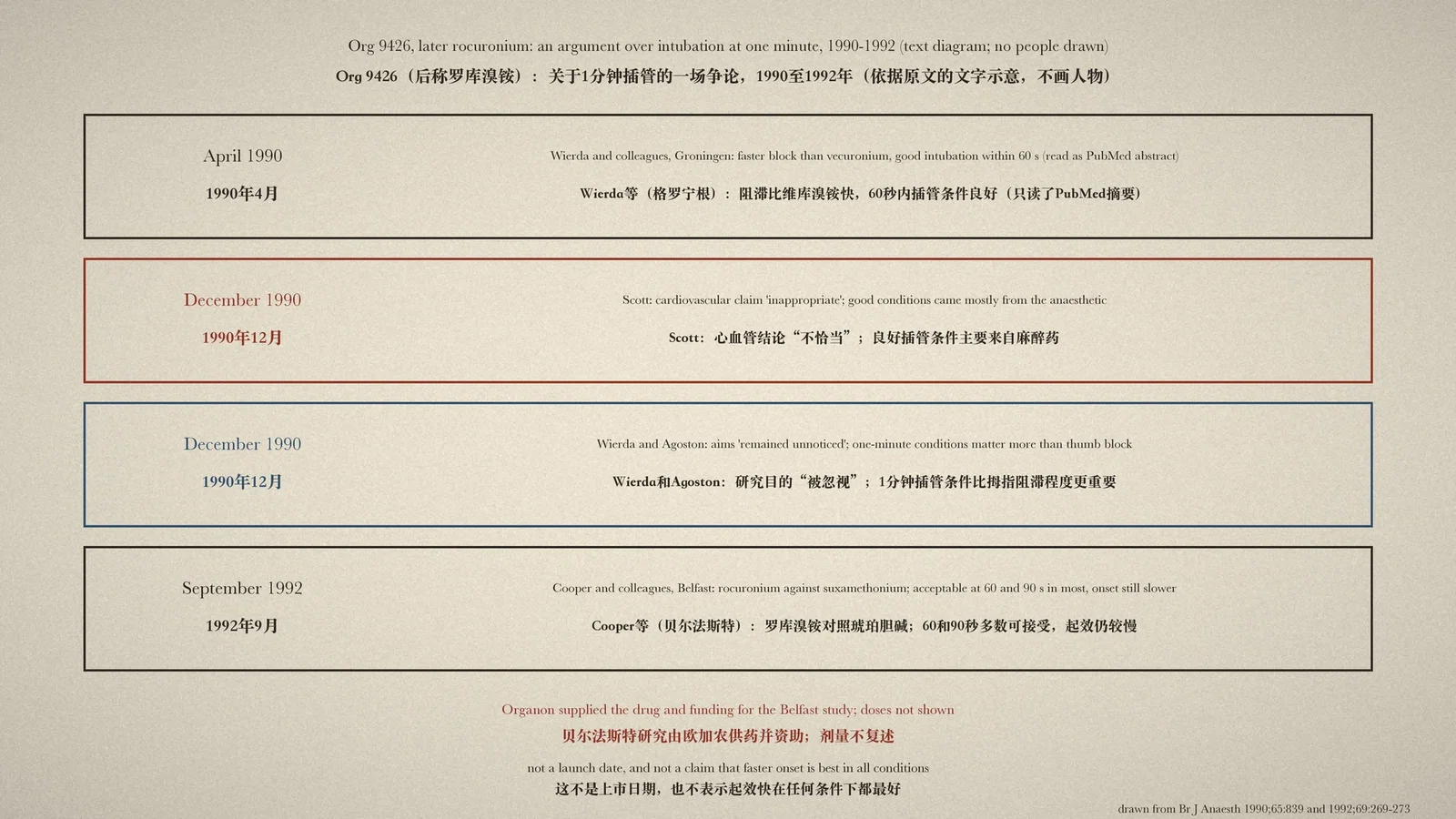
Rapid intubation needs muscles relaxed within seconds. For a long time only suxamethonium could do that, and its side effects kept anaesthetists looking for an alternative. In 1990 a new drug coded Org 9426 appeared; it would later be called rocuronium. Its first clinical report had barely been published when an argument broke out in the correspondence pages of the British Journal of Anaesthesia: were the good intubating conditions at one minute due to the drug, or to the anaesthetic? [1, p. 839][2, p. 839]
The first report
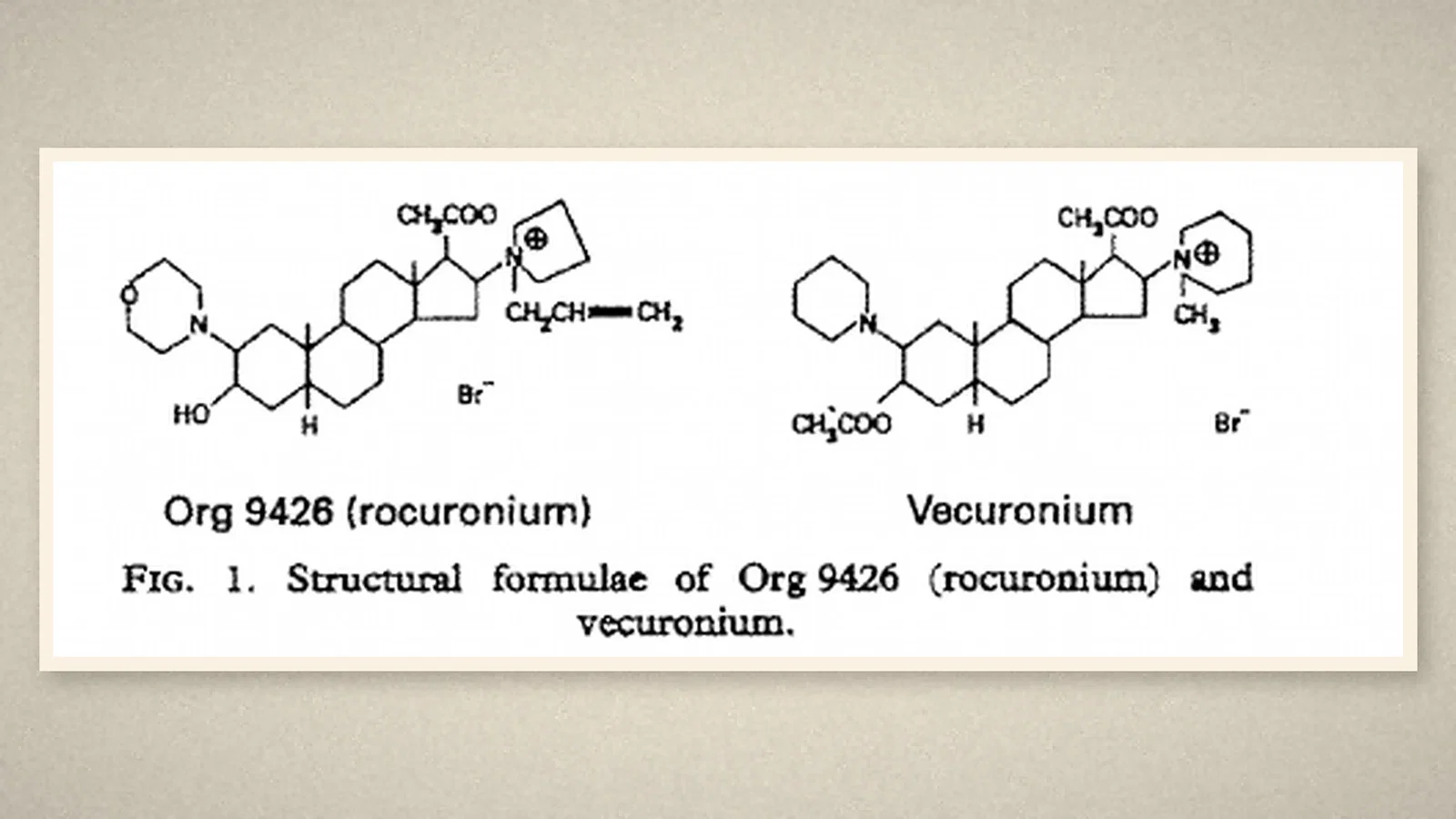
In April 1990 Wierda, de Wit, Kuizenga and Agoston of Groningen published their first clinical observations on Org 9426 in the British Journal of Anaesthesia (vol. 64). This article did not obtain the full paper and read only its PubMed abstract. According to the abstract, Org 9426 was a derivative of the 3-desacetoxy analogue of vecuronium, six to eight times less potent than vecuronium but with a faster development of block, giving good to excellent intubating conditions within 60 s; its duration and recovery index were similar to vecuronium's; no side effects were noted; and it was stable in aqueous solution. It "may have advantages" over existing non-depolarizing relaxants in the speed of good intubating conditions. [3]
Scott's challenge
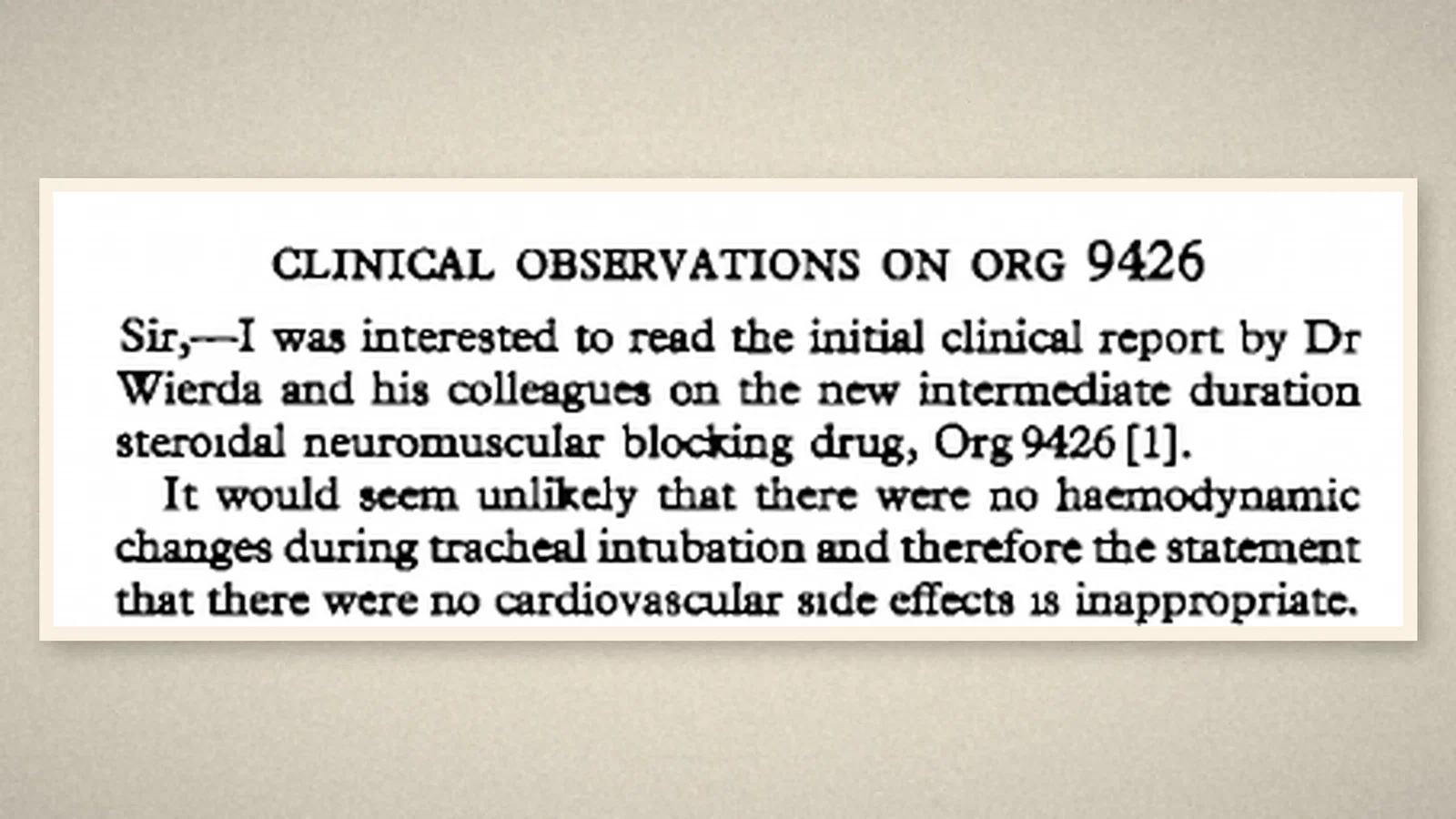
In December 1990 the correspondence page (vol. 65, p. 839), under the heading "Clinical observations on Org 9426", carried a letter from R. P. F. Scott of Salisbury. It seemed unlikely, Scott wrote, that there were no haemodynamic changes during tracheal intubation, so the statement that there were no cardiovascular side effects "is inappropriate"; cardiovascular studies of new drugs should be made during a stable period, preferably with continuous invasive monitoring. Scott also judged that an onset to maximum block of more than three minutes was slower than with larger doses of atracurium or vecuronium, and wondered whether this low-potency drug would stay free of cardiovascular effects at greater doses. [1, p. 839]
Scott disagreed most with the main conclusion, good to excellent conditions at one minute. From the reported mean time to a given degree of block, the block at one minute could not have been deep; Scott concluded that the good conditions were created mostly by thiopentone, nitrous oxide and fentanyl. The letter ended with questions: what was the block at the thumb at the moment of intubation, and what would conditions be after thiopentone and Org 9426 only? [1, p. 839]
Wierda and Agoston reply
J. M. K. H. Wierda and S. Agoston of Groningen answered on the same page. The aims of their study, they began, "apparently have remained unnoticed": it examined the potency, time course and intubating conditions of Org 9426; cardiovascular variables, like other vital signs, had been monitored routinely, and for a new drug any effects other than neuromuscular block ought to be reported. The lag time and onset were significantly shorter than with equipotent vecuronium, and the one-minute intubating conditions were invariably good to excellent, which mattered far more clinically than the percentage depression of the adductor pollicis twitch at the moment of intubation. [2, p. 839]
They added that Scott's figure for the block needed for ideal intubation rested on papers published between 1966 and 1971 and ignored later developments, and that the doubts about intubating conditions and the guesses about cardiovascular effects at larger doses came without experimental evidence and ignored the redistribution of thiopentone before the drug was given. [2, p. 839]
Two years later: against suxamethonium
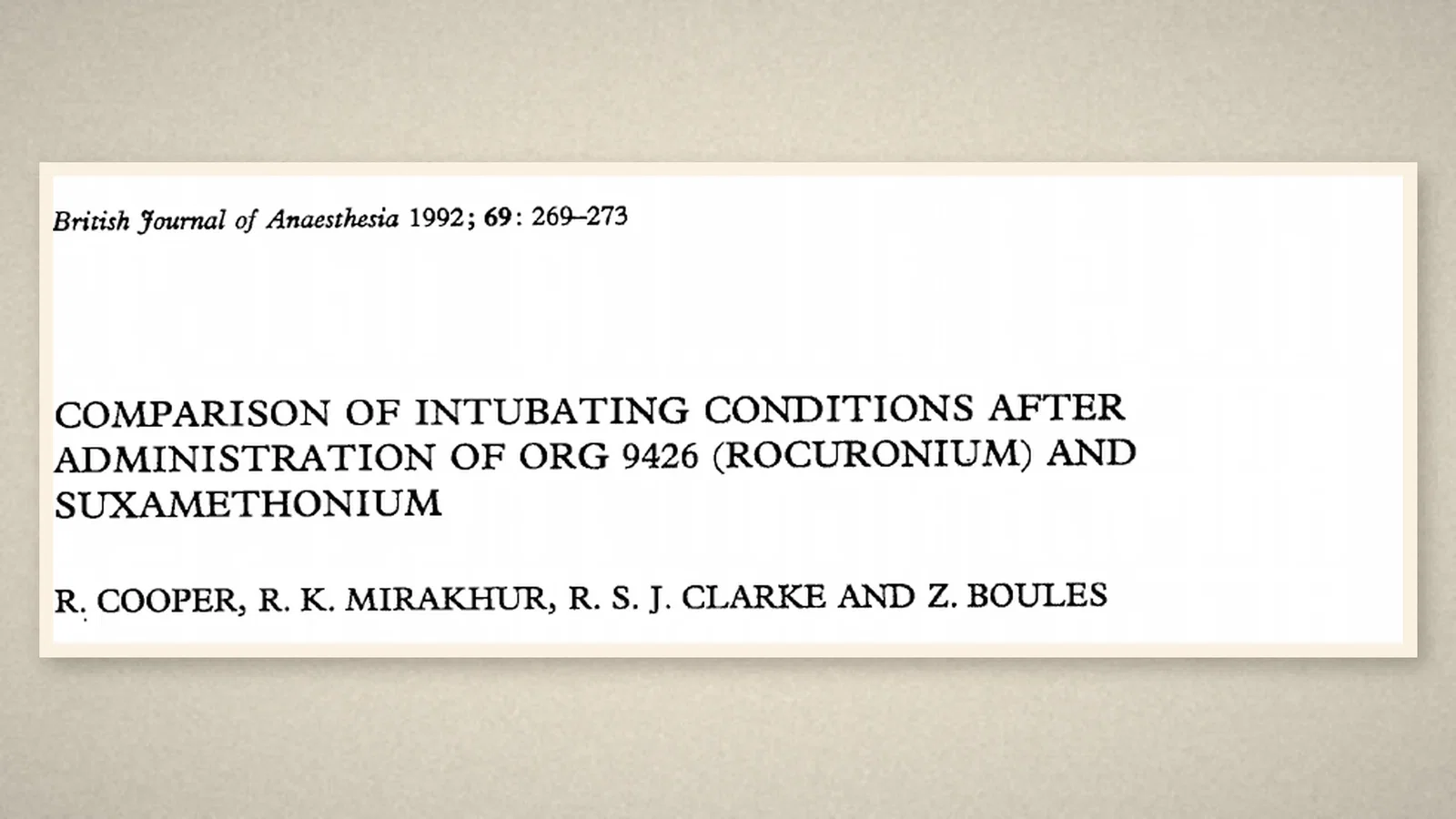
In September 1992 the journal (vol. 69, pp. 269-273) printed a paper by R. Cooper, R. K. Mirakhur and R. S. J. Clarke of the Department of Anaesthetics, Queen's University of Belfast, and Z. Boules of the Royal Victoria Hospital, whose title now gave the drug a name: "Comparison of intubating conditions after administration of Org 9426 (rocuronium) and suxamethonium". Suxamethonium, they wrote, "is currently the only available" relaxant with an onset suited to rapid tracheal intubation, but it had several side effects and was sometimes contraindicated; atracurium and vecuronium were slower, and priming or larger doses had proved either hazardous or too long-acting; a non-depolarizing drug with rapid onset and preferably shorter duration was therefore desirable. [4, p. 269]
They studied 80 adults having elective surgery, randomised to suxamethonium or Org 9426 and to intubation at 60 or 90 s, all intubations by the same experienced anaesthetist, scoring jaw relaxation, vocal cords and the response to intubation. After suxamethonium conditions were good or excellent in every patient; after Org 9426 they were acceptable in 19 of 20 at 60 s and in all at 90 s; in one patient closed vocal cords prevented intubation at 60 s, and it succeeded 60 s later. Org 9426 reached maximum block in about 90 s, slower than suxamethonium but faster than the non-depolarizing drugs then available. [4, p. 270][4, p. 271]
In the discussion the authors suggested that the rapid onset might reflect the drug's low potency and a higher molecular load at the neuromuscular junction, and pointed out that Wierda and colleagues had studied only 11 patients at the relevant dose. Organon supplied the drug and financial assistance. [4, p. 271][4, p. 272]
What the record shows
When a new drug appears, the most useful thing is often not the promotion but the questions of colleagues. Scott's letter did not dismiss Org 9426, but it pushed the next studies to put suxamethonium in the comparison.
Sources and reading limits
Read: the correspondence "Clinical observations on Org 9426" in Br J Anaesth 1990;65:839, both Scott's letter and the reply by Wierda and Agoston, in full; Cooper, Mirakhur, Clarke and Boules, Br J Anaesth 1992;69:269-73, in full (introduction, methods, results, figures, tables, discussion, acknowledgement and references); all from the open Internet Archive scans, with page images checked. The April 1990 paper by Wierda, de Wit, Kuizenga and Agoston (vol. 64, pp. 521-523) was read only as its PubMed abstract, because the open scan lacks vol. 64 no. 4.
Not covered: the full text of the April 1990 paper; Organon's discovery work on Org 9426 and the animal studies cited by Cooper and colleagues; the society timeline entry giving 1990; any record of marketing approval in any country; the later sugammadex story, told in other articles.
Limits: a 1990 paper is not a national launch date, and faster onset is not best in all conditions; this article records a debate, not a launch, and notes that onset was still slower than suxamethonium. The name rocuronium appears in the 1992 paper; the 1990 letters use only Org 9426. The Belfast study was supplied and funded by Organon. Doses, exact onset and recovery times, percentages of block and potency estimates are not repeated, and page crops stop before them. Patients are not identified.
Three illustrations are crops of the British Journal of Anaesthesia 1990, vol. 65, p. 839 (the correspondence heading and the opening of Scott's letter) and 1992, vol. 69, p. 269 (the title of Cooper and colleagues' paper and Fig. 1). One is a text diagram drawn from the sources, with no people drawn and no doses.
- Scott RPF. Clinical observations on Org 9426. Br J Anaesth. 1990;65(6):839. DOI
- Wierda JMKH, Agoston S. Clinical observations on Org 9426 [reply]. Br J Anaesth. 1990;65(6):839. DOI
- Wierda JM, de Wit AP, Kuizenga K, Agoston S. Clinical observations on the neuromuscular blocking action of Org 9426, a new steroidal non-depolarizing agent. Br J Anaesth. 1990;64(4):521-3 (PubMed abstract only). PubMed
- Cooper R, Mirakhur RK, Clarke RSJ, Boules Z. Comparison of intubating conditions after administration of Org 9426 (rocuronium) and suxamethonium. Br J Anaesth. 1992;69(3):269-73. DOI
Continue exploring
Related reading connects shared questions and contexts; it does not by itself establish historical influence.
- 1977: Crul and Booij Begin Trials of Org NC 45, Later Vecuronium
- 1951: Thesleff Brings Succinylcholine into the Operating Room
Anesthesia Epochs · The Source Room · About & Editorial Method
Published November 3, 2026. Sources and reading limits are stated above. Illustrations are labelled as original source images or AI-made. Historical accounts are educational; they are not current treatment instructions.