The WFSA's timeline dates the first edition of Update in Anaesthesia to 1991, started by Iain Wilson of the UK; by 2000 the WFSA was paying for it to be sent free to anaesthetists who could not afford it, in five languages, on paper, CD-ROM and the web.
Reading Library · Anesthesia Epochs · 中文版
Watch the education video (for clinicians)
1991–2005: Update in Anaesthesia — A Journal That Went to Its Readers · Anesthesia Epochs Education Series
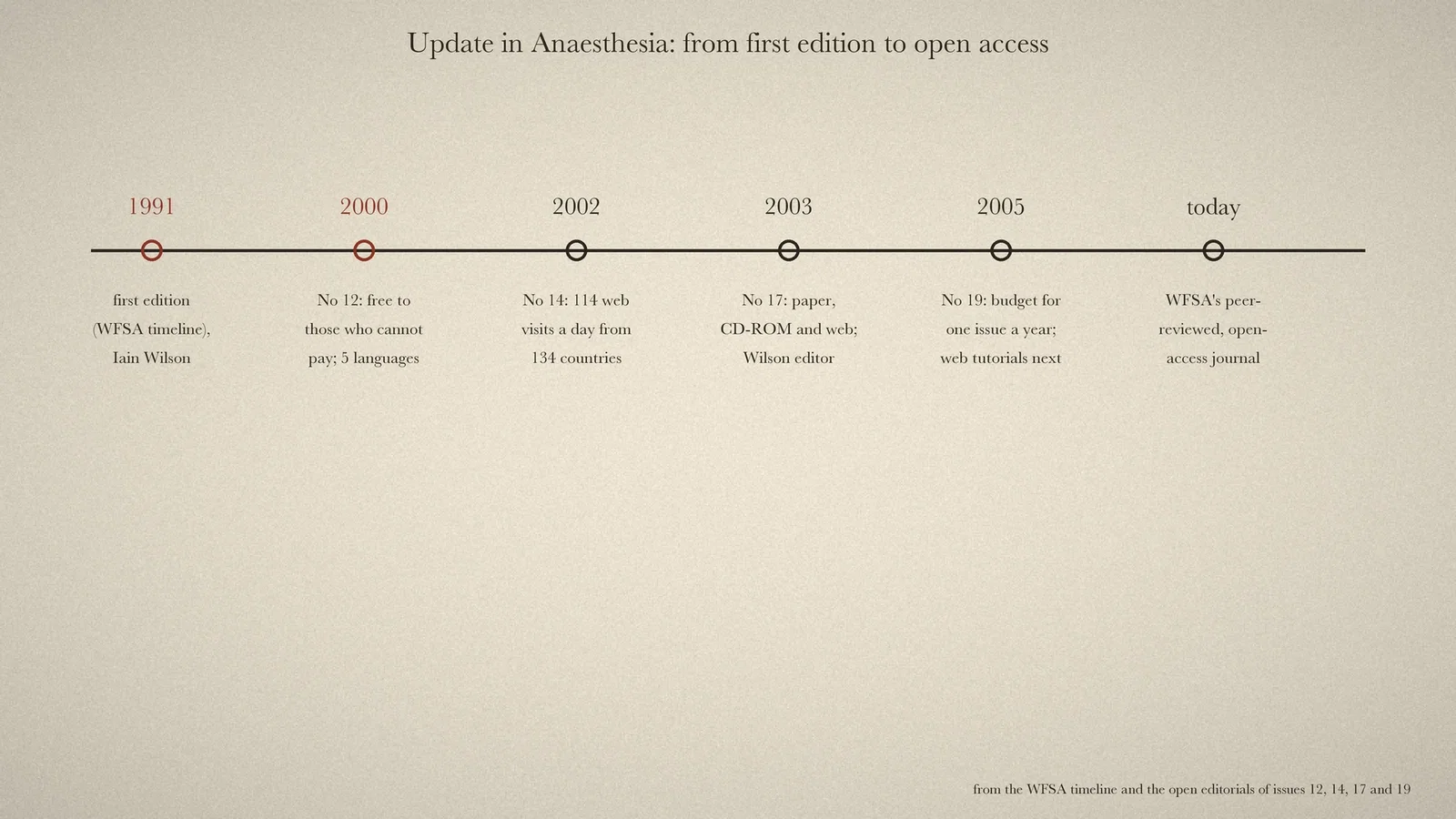
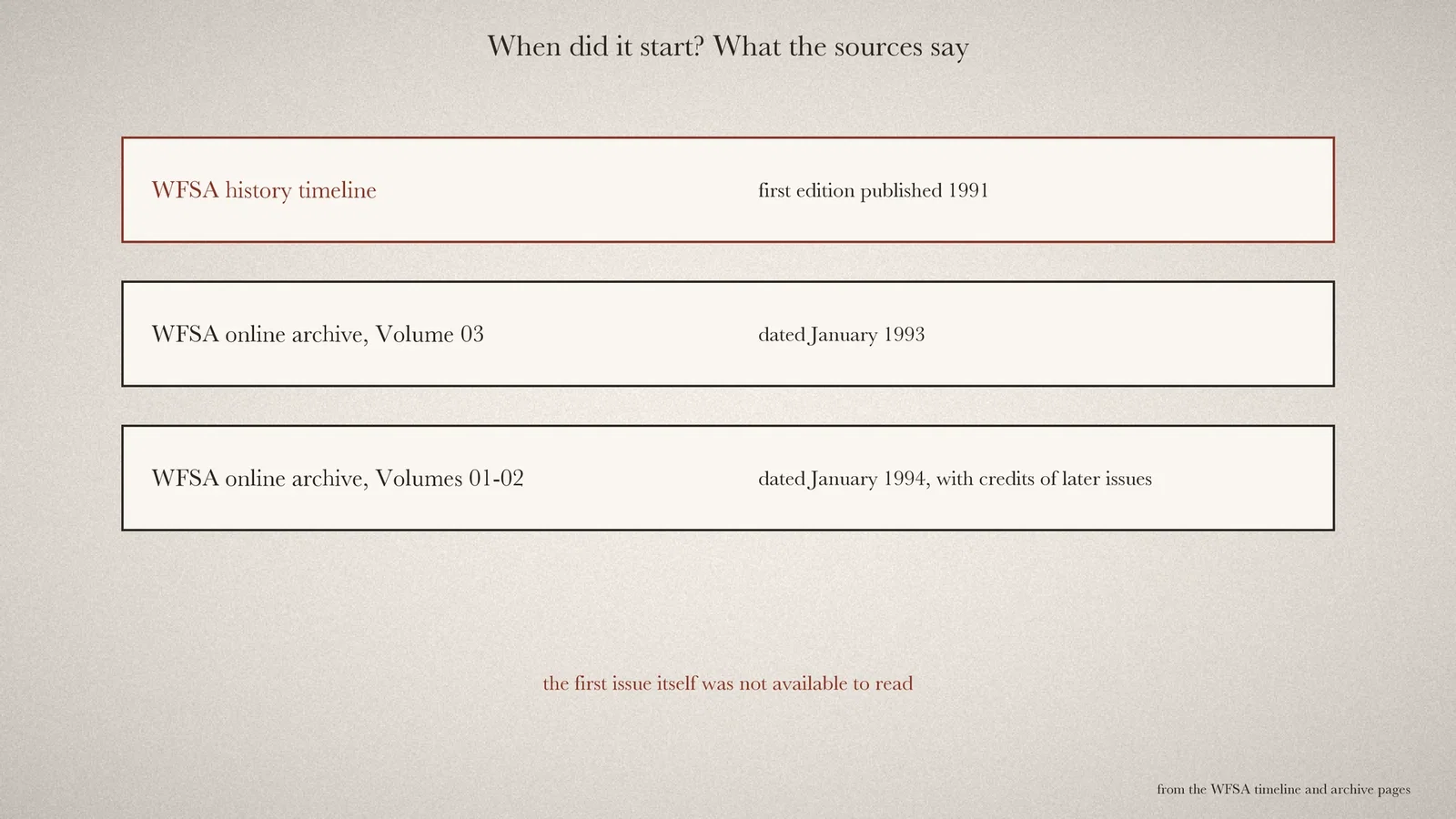
The World Federation of Societies of Anaesthesiologists (WFSA) lists, under 1991 in its history timeline: "First 'Update in Anaesthesia' edition published, instigated by Iain Wilson of the UK." [1] Today Update in Anaesthesia describes itself as "a peer-reviewed, open-access journal of the World Federation of Societies of Anaesthesiologists", with particular attention to practice in low- and middle-income settings. [8] This article follows the journal from that first edition to the middle of the 2000s, using the parts of its record that are openly available. The first issue itself was not among them.
The early volumes
The WFSA's online library lists the contents of the early volumes, though the articles themselves are behind a sign-in. One early volume, which the archive dates to "January 1993", was edited by Iain Wilson and Roger Eltringham. Its overseas editors were Jill Bem of Zambia and Henry Bukwirwa of Uganda. [2] It contained articles on spinal anaesthesia, the control of heart rate, draw-over anaesthesia and morphine, and one on "the maintenance of an aneroid sphygmomanometer". [2] The volume the archive numbers 01 includes intravenous regional anaesthesia (Bier's block), draw-over anaesthesia, haemorrhagic shock, suxamethonium and "The Oxygen concentrator". [3] These are the practical subjects of anaesthesia with simple equipment.
The archive's dates for these volumes are not consistent. It dates Volume 03 to January 1993 and Volumes 01 and 02 to January 1994. [2, 3] The editorial credits it shows for Volumes 01 and 02 name two assistant editors who, according to the journal's issue 17, joined in 2003. [3, 6] Those credits, at least, must have been copied from later issues, so the archive's metadata cannot settle when the journal began.
Free to those who could not pay
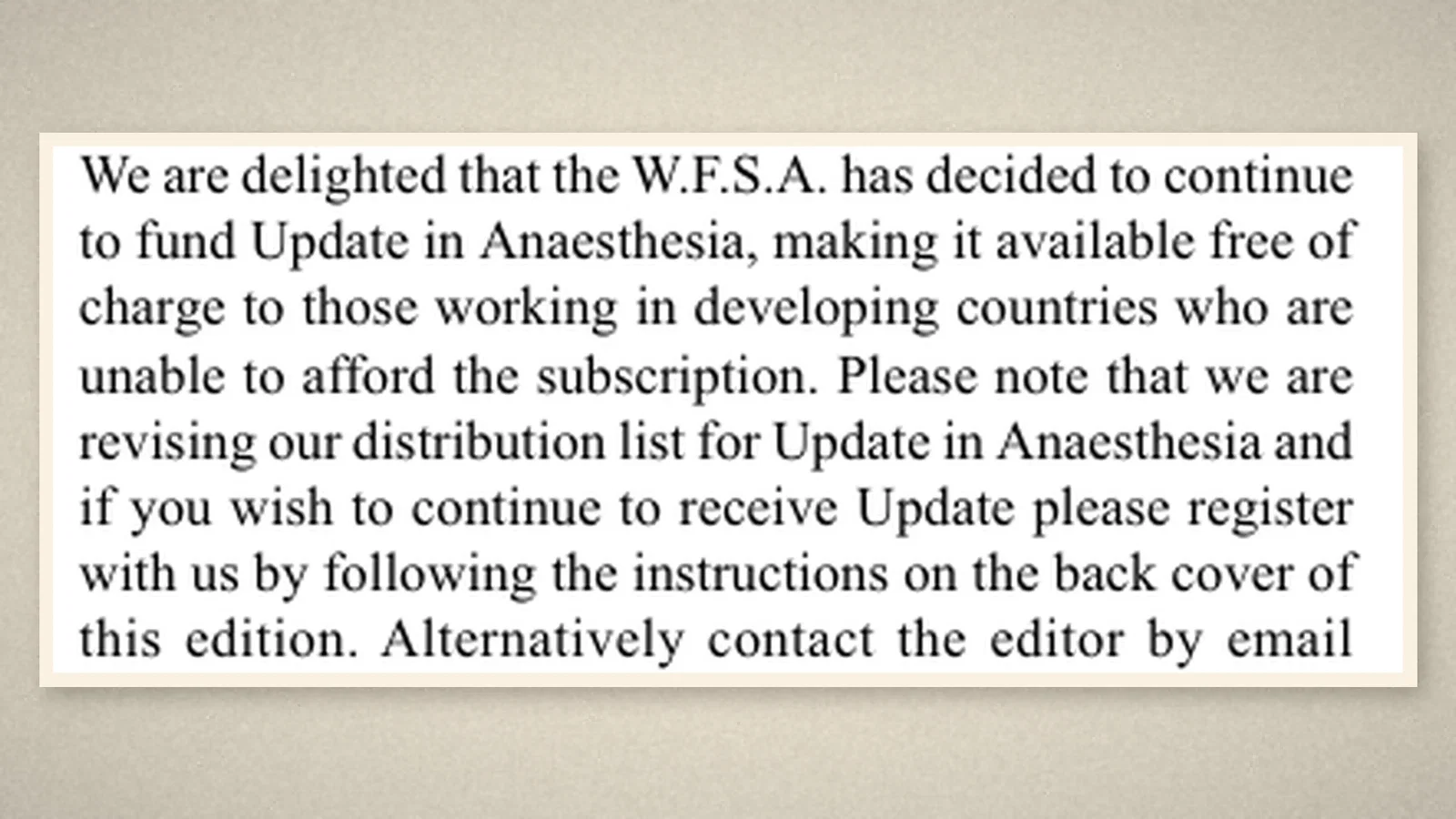
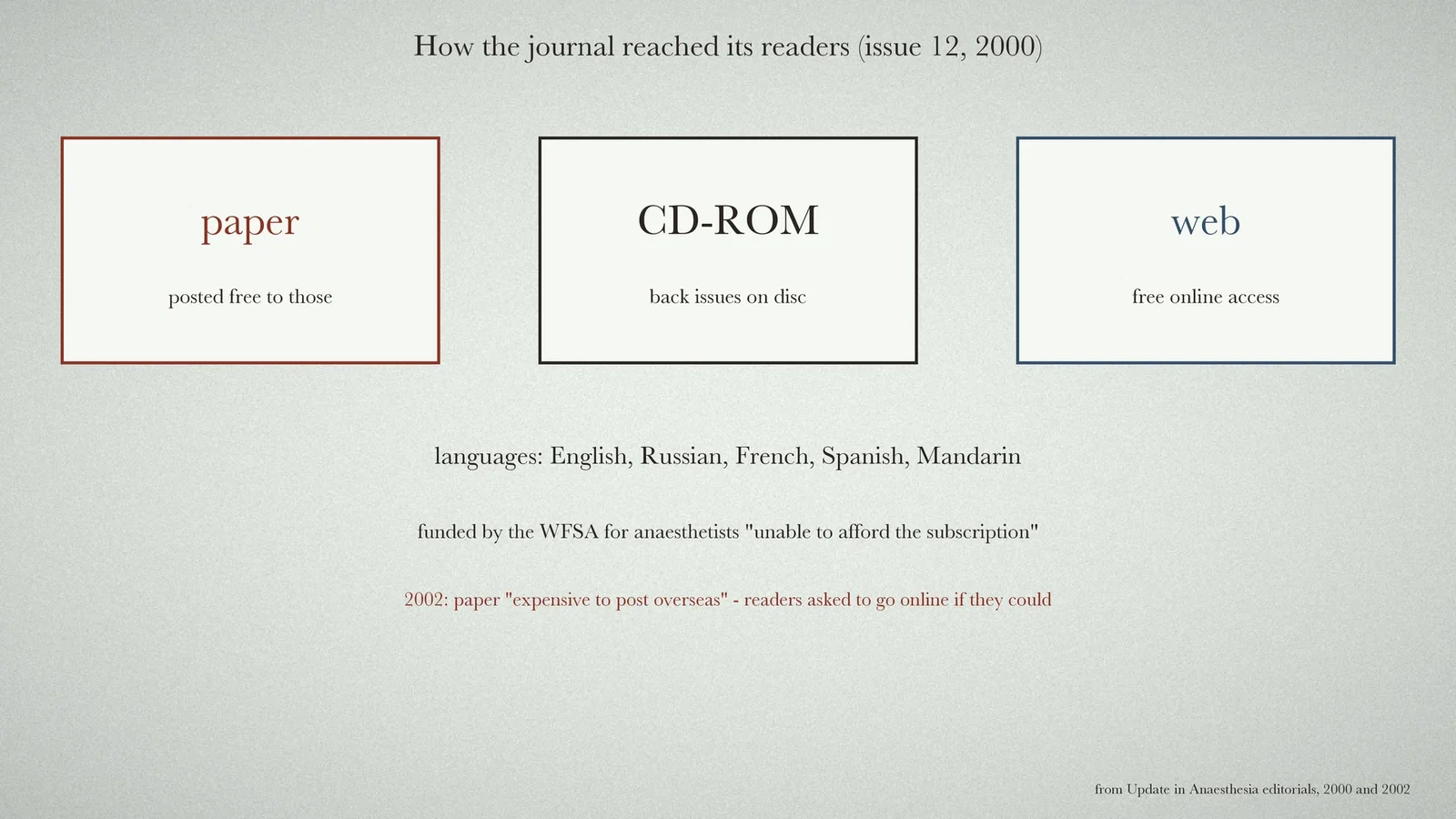
By issue 12, in 2000, the masthead read "A journal for anaesthetists in developing countries". [4, p. 1] The editorial, signed by Roger Eltringham as chairman of the WFSA publications committee and Iain Wilson as editor, said the WFSA had decided "to continue to fund Update in Anaesthesia, making it available free of charge to those working in developing countries who are unable to afford the subscription". [4, p. 1] The journal was then produced "in Russian, French, Spanish and Mandarin as well as English". The Mandarin edition was edited at Peking Union Medical College Hospital in Beijing. The English edition came on paper, on CD-ROM and on the web, and "The demand for Update has increased dramatically". [4, p. 1]
Paper, disc and web
In 2002 the editor reported that the journal's website had averaged "114 visits daily, from 134 different countries" in March, and that the Russian and French editions were now online. Readers who could use the internet or a CD-ROM were asked to do so. "The paper version is expensive to post overseas, and is produced for those anaesthetists without computer access." [5, p. 1] Issue 17, in 2003, was still edited by Wilson, with French, Spanish, Russian and Mandarin editions available. [6, p. 1] By 2005 the costs were "generously paid for by the WFSA", but the budget was limited and the journal "could only produce one journal" the previous year. Back issues were online in several languages, and a weekly "Tutorial of the Week" on the web was about to begin. [7, p. 1]
What the record shows
Update in Anaesthesia was a WFSA journal written for anaesthetists who worked with little equipment and could not pay for journals. It was posted to them free and later reached them on disc and online. Its early contents covered draw-over anaesthesia, regional blocks, oxygen concentrators and the care of simple equipment, the subjects those readers needed most.
Sources and reading limits
Read: the WFSA history timeline; the WFSA library pages for Volumes 01 and 03 (contents and credits only); the open first pages of issues 12 (2000), 14 (2002), 17 (2003) and 19 (2005), by text, with issues 12 and 19 also by page image; the journal's current "About us" page.
Not covered: the first issue and early editorials, which require a sign-in that was not used; any account by Iain Wilson of how the journal began; print runs and distribution figures. The founding year is given here as 1991 because that is the WFSA timeline's date, but the online archive's dates for the early volumes disagree with it and with each other, and the archive's credits for Volumes 01 and 02 appear to come from later issues. Zambia and Uganda appear only as the home countries of two overseas editors.
One illustration is a crop of the 2000 editorial, without its e-mail addresses or logos; three are drawn from the sources.
- World Federation of Societies of Anaesthesiologists. WFSA history timeline. Website
- WFSA Virtual Library. Update in Anaesthesia, Volume 03. Website
- WFSA Virtual Library. Update in Anaesthesia, Volume 01. Website
- Eltringham R, Wilson I. Editorial. Update in Anaesthesia. 2000;(12):1. PDF
- Wilson I. Editorial. Update in Anaesthesia. 2002;(14):1. PDF
- Wilson I. Editorial. Update in Anaesthesia. 2003;(17):1. PDF
- Editorial. Update in Anaesthesia. 2005;(19):1. PDF
- World Federation of Societies of Anaesthesiologists. Update in Anaesthesia: About us. Website
Continue exploring
Related reading connects shared questions and contexts; it does not by itself establish historical influence.
Anesthesia Epochs · The Source Room · About & Editorial Method
Published November 2, 2026. Sources and reading limits are stated above. Illustrations are labelled as original source images or AI-made. Historical accounts are educational; they are not current treatment instructions.