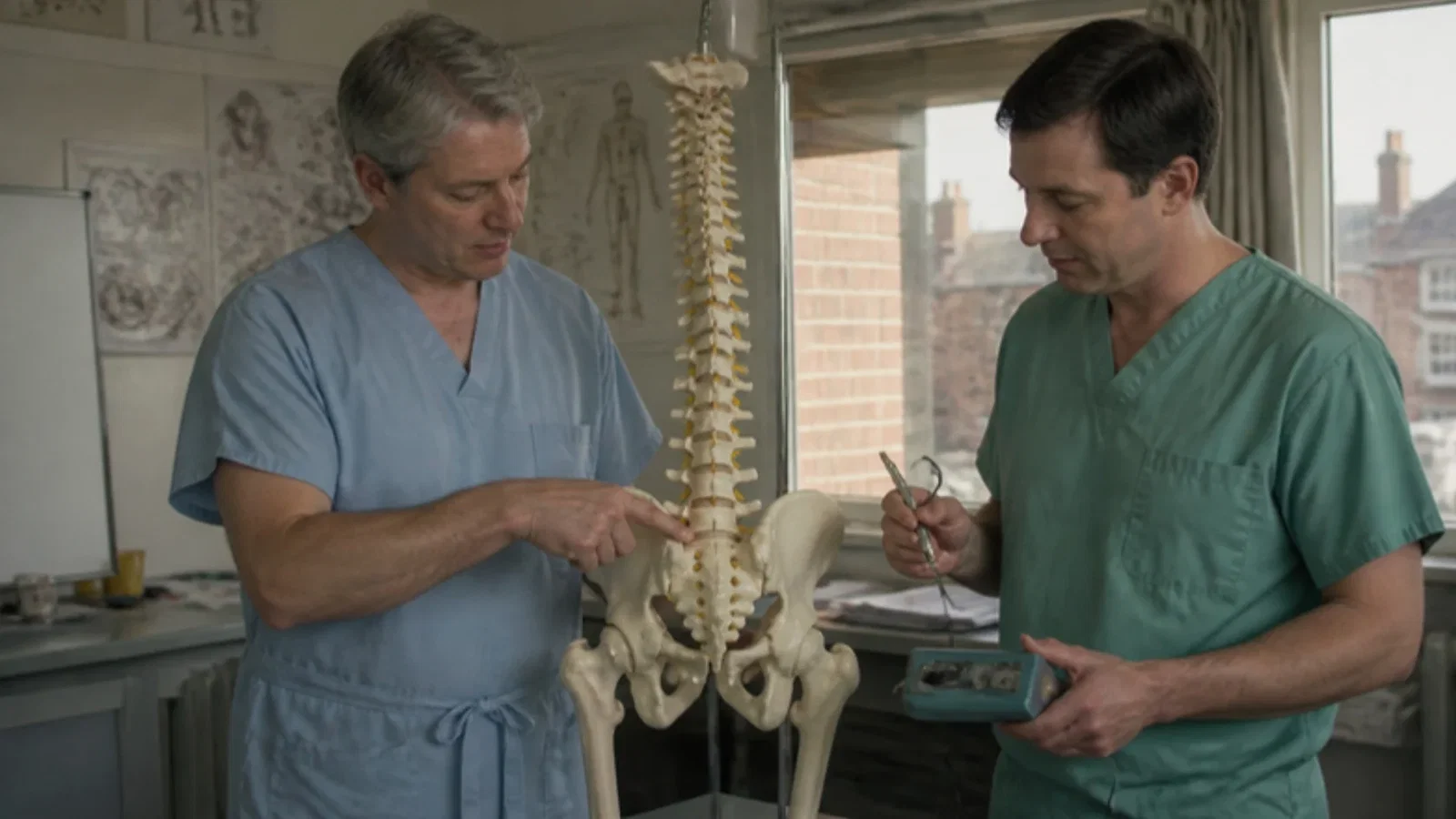
N. Y. Mansour of Kent, England, argued in the correspondence of Regional Anesthesia that Labat's posterior approach and its modifications depended on an ischial spine that cannot be located precisely from the surface; at Medway Hospital a line from the posterior superior iliac spine to the lowest point of the ischial tuberosity was used instead, entering about three fingers' breadth below the spine, before the nerve leaves the greater sciatic foramen, with a nerve stimulator; the block reached the whole sacral plexus and, with lumbar plexus block, suited hip surgery.
Reading Library · Anesthesia Epochs · 中文版
Watch the education video (for clinicians)
1993: Mansour's Parasacral Sciatic Block — A New Landmark · Anesthesia Epochs Education Series
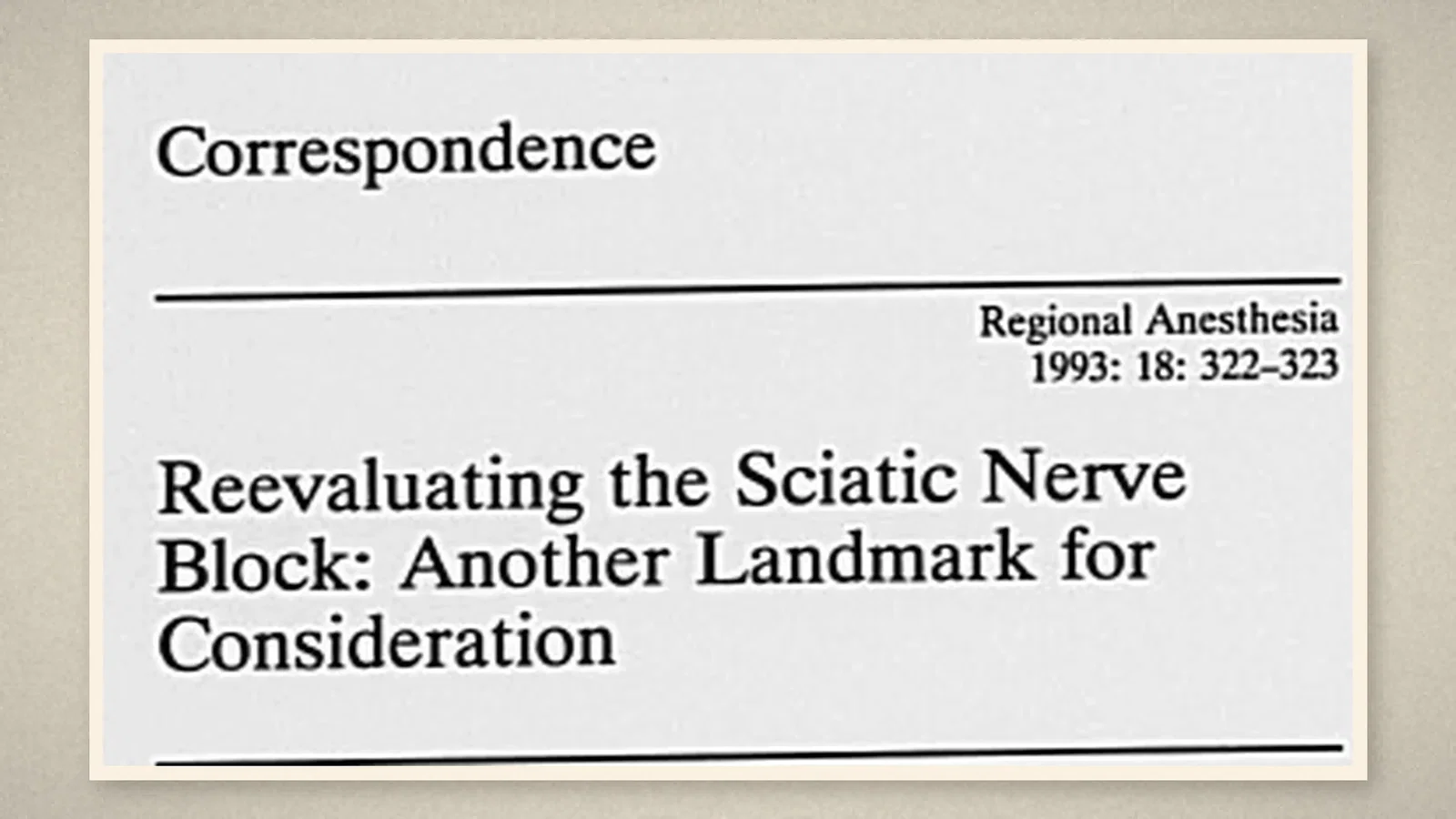
A block guided by surface landmarks is only as reliable as those landmarks. The Australian Society of Anaesthetists (ASA) timeline records under 1993: "Parasacral sciatic nerve block described", by N. Y. Mansour. This article reads Mansour's description, which appeared not as a paper but as a letter: "Reevaluating the sciatic nerve block: another landmark for consideration", in the correspondence of Regional Anesthesia for September-October 1993. [1][2]
The trouble with the ischial spine
Mansour, consultant anaesthetist at the BUPA Alexandra Hospital, Chatham, Kent, was replying to a recent article on the sciatic block. "In my opinion, low and variable success rates (33-95%) for the posterior approach—as described by Labat—and its modifications are due to dependence on blocking the nerve solely at the level of the ischial spine." Locating the ischial spine "from a series of surface lines and markings is difficult and imprecise. If the needle point misses bone, its relationship to the nerve must be in doubt." Winnie's modification, adding a line from the greater trochanter to the sacral hiatus, "offered little help". [1]
A different target
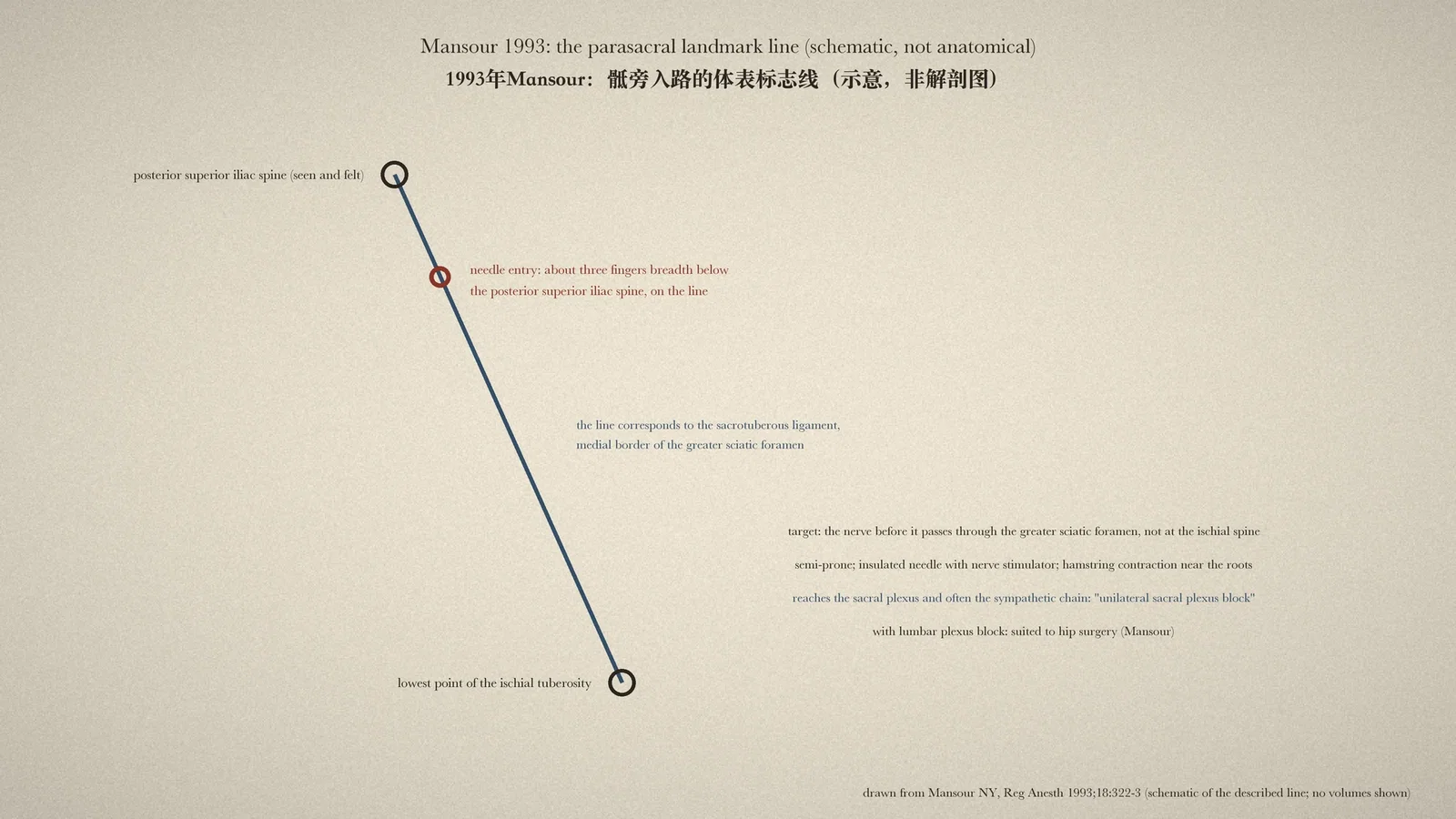
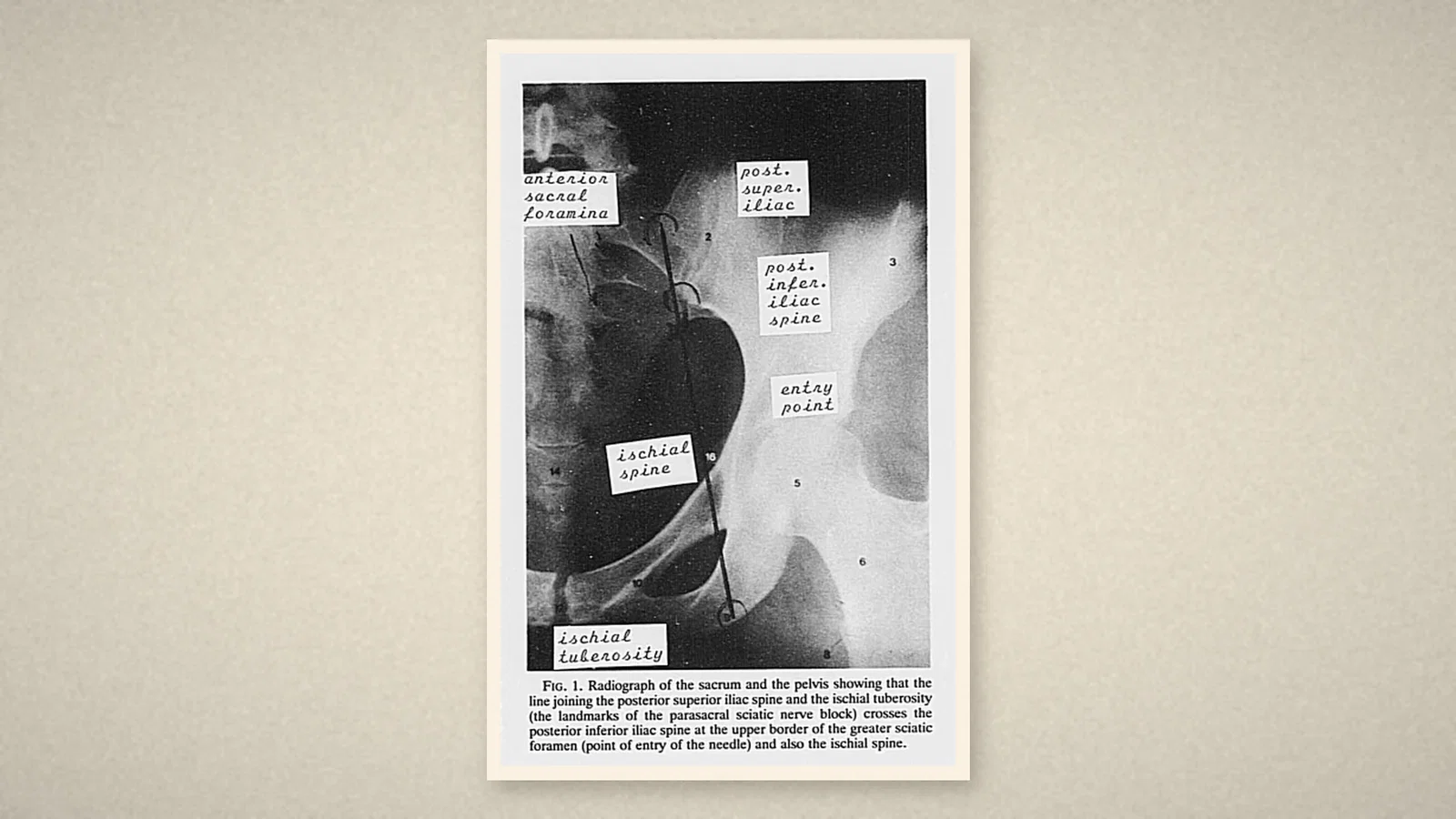
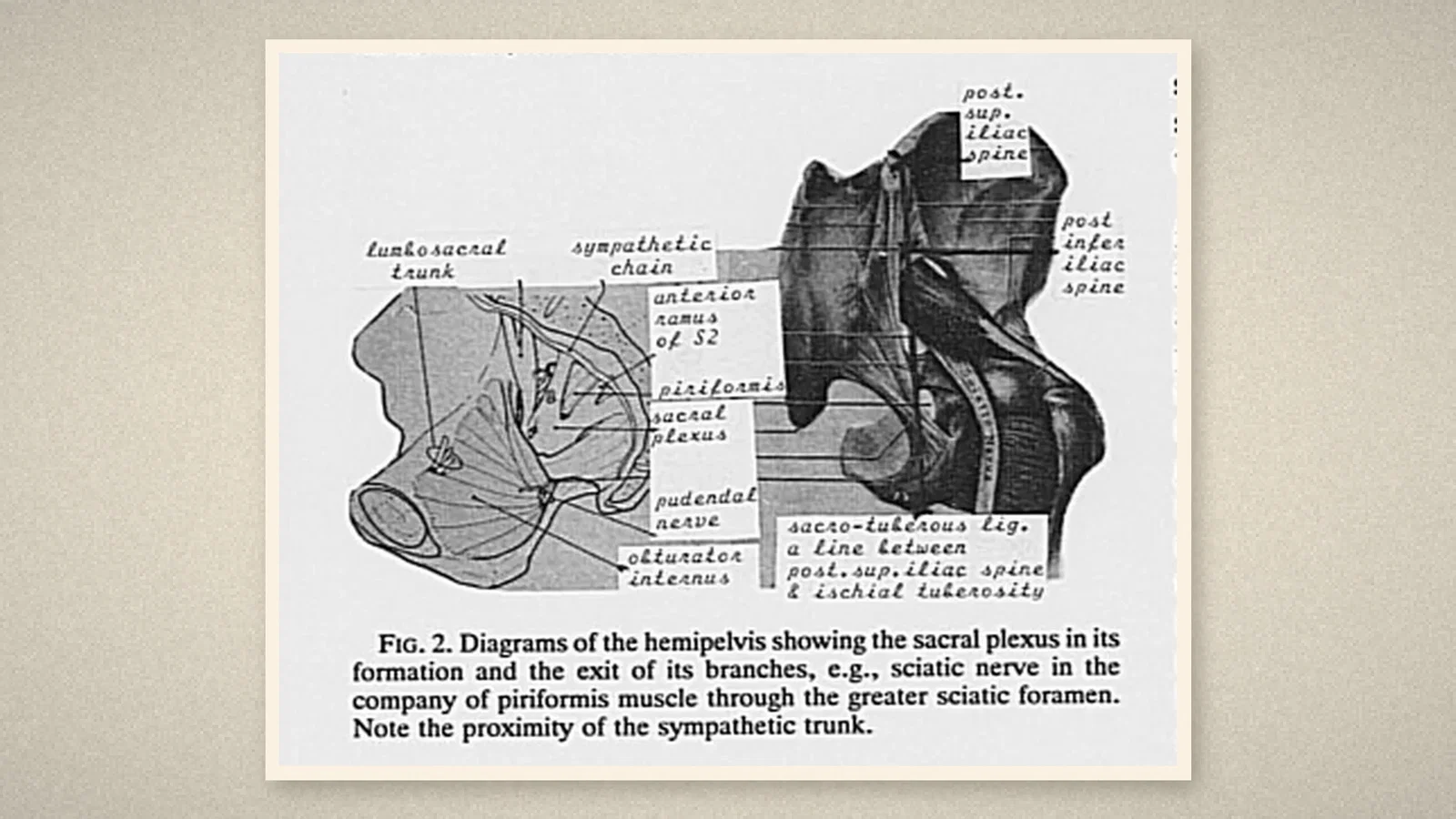
"At Medway Hospital, Kent, England, we thought we should reconsider the problem by choosing a target point that could be approached with greater precision. With the parasacral approach, the nerve is blocked before it passes through the greater sciatic foramen." The posterior inferior iliac spine cannot be palpated, but it can be found from the posterior superior iliac spine, "that can usually be seen and felt without difficulty". A line from that spine to the lowest point of the ischial tuberosity corresponds to the sacrotuberous ligament, the medial border of the greater sciatic foramen, and crosses the posterior inferior iliac spine, which lies "about three fingers breadth caudal to the posterior superior iliac spine". [1]
Technique
The patient lay as for a posterior sciatic block, but tilted further towards prone, with the side to be blocked uppermost. The line was drawn and the entry point marked on it, about three fingers' breadth below the posterior superior iliac spine. An insulated block needle connected to a nerve stimulator was inserted "perpendicular to all planes"; if it met the upper margin of the sciatic notch, it was reintroduced slightly lower on the same line until it passed into the greater sciatic foramen. "The proximity of roots of the sciatic nerve is indicated by contraction of the flexor-hamstring muscles of the knee." The injection went into a defined space between the pelvic fascia and the fascia over the piriformis, which also made a catheter easy to introduce for continuous block. [1]
More than a sciatic block
At this point, Mansour wrote, not only the origin of the sciatic nerve but "the sacral plexus with its important branches to the lower limb" would be affected, including the posterior femoral cutaneous nerve, the gluteal branches and the nerve to quadratus femoris, which also supplies the hip. The procedure "could also be termed unilateral sacral plexus blockade". Marked warmth of the feet, often noticed by staff and confirmed by skin resistance, suggested that the sympathetic chain was affected too. Mansour concluded that the block was "easier to perform and to teach with easily palpable and visible landmarks", and, combined with lumbar plexus block, "more practical for use in hip surgery". [1]
What the record shows
Mansour's letter shows a landmark technique redesigned around what can be found reliably on the surface. Two visible, palpable points define a line, and the line leads to a target where the nerves are gathered before they spread. The letter also shows the limits of such reports: it gives the anatomy and technique, but no case numbers or success rates for the new approach.
Sources and reading limits
Read: Mansour NY, letter, Reg Anesth 1993;18:322-3, in full, including Figs. 1-2; the ASA timeline entry for 1993.
Not covered: the article Mansour replied to (Chang, Lang and Yip, Reg Anesth 1993); Labat's and Winnie's original descriptions; clinical series of the parasacral block. The advantages claimed are Mansour's; the letter gives no outcome data. The 33-95% range is Mansour's summary of the posterior approach. The ASA's "described" is quoted. Local anaesthetic volumes and needle depths are not repeated. Quotations are from the English original.
Three illustrations are crops of pp. 322-3, including Figs. 1-2; one is drawn from the text.
- Mansour NY. Reevaluating the sciatic nerve block: another landmark for consideration [letter]. Reg Anesth. 1993;18(5):322-3. RAPM
- Australian Society of Anaesthetists. Anaesthesia history timeline. 2024. ASA
Continue exploring
Related reading connects shared questions and contexts; it does not by itself establish historical influence.
- 1978: A Doppler Probe Guides the Supraclavicular Brachial Plexus Block
- 1922: Gaston Labat Writes Regional Anaesthesia Down as a Specialty
Anesthesia Epochs · The Source Room · About & Editorial Method
Published November 2, 2026. Sources and reading limits are stated above. Illustrations are labelled as original source images or AI-made. Historical accounts are educational; they are not current treatment instructions.