
An English-language textbook, with a foreword by William J. Mayo and 315 original illustrations, separated regional anaesthesia from infiltration at the incision, defined field-block and nerve-block, and insisted on anatomy, proper instruments and experience.
Reading Library · Anesthesia Epochs · 中文版
Watch the education video (for clinicians)
1922: Gaston Labat's Regional Anesthesia — A Specialty in Print · Anesthesia Epochs Education Series
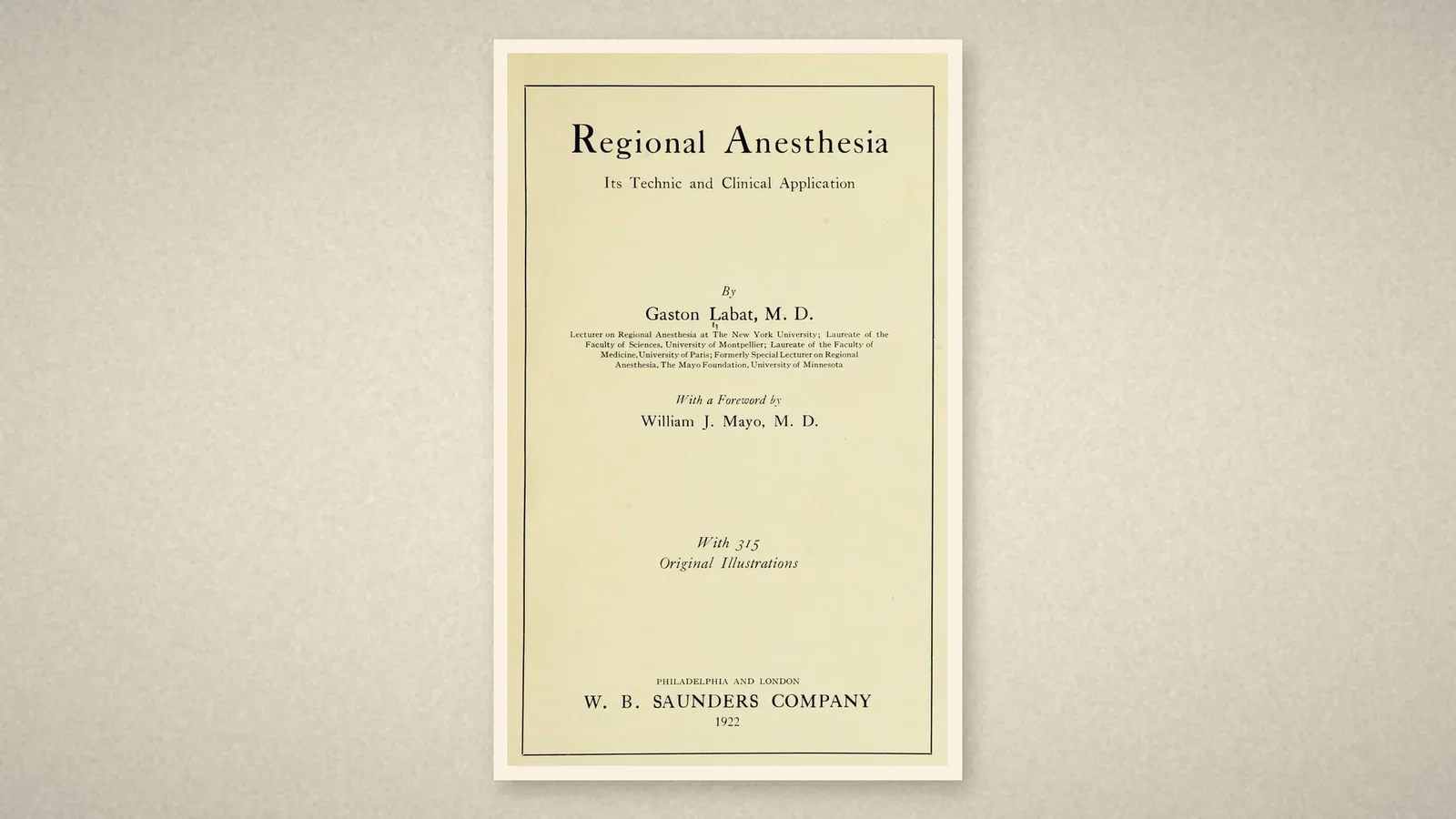
By 1922 the literature on nerve blocks ran, by one count, to some three thousand publications in a decade. In 1922 the Philadelphia publisher W. B. Saunders issued a single English-language book that tried to turn them into a teachable discipline: Regional Anesthesia: Its Technic and Clinical Application, by Gaston Labat, with a foreword by William J. Mayo and 315 original illustrations. This article reads the first printing, in the Yale Medical Library copy, through its foreword, introduction and opening chapter. [1]
The author and the sponsor
The title page describes Labat as lecturer on regional anaesthesia at New York University, laureate of the faculties of science at Montpellier and of medicine in Paris, and formerly special lecturer on regional anaesthesia at the Mayo Foundation of the University of Minnesota. In the introduction Labat thanks Charles H. Mayo for the privilege of lecturing and demonstrating at the Mayo Foundation and for the facilities used in preparing the book, and the artists of the Mayo Clinic, with an artist of the University of Paris, for the drawings. [1]
William J. Mayo's foreword is not uncritical. It opens: "Regional anesthesia has come to stay." Its progress had been slow because the anaesthetist needed accurate anatomy and high technical skill, and few surgeons had taken the time to master it. Exaggerated claims had also delayed its acceptance: post-operative lung complications, Mayo noted, were mostly embolic and "apparently as common after regional anesthesia as after general". Regional methods were very desirable in intestinal obstruction and acute sepsis, and often worked best combined with a little ether or nitrous oxide. Mayo did not expect regional anaesthesia "wholly" to displace general anaesthesia, but expected it to hold a very high position in surgery. [1]
"Experience is absolutely necessary"
Labat's introduction states the book's purpose: to give a rapid, practical knowledge of "regional anesthesia" and to teach how to use it successfully. Local infiltration was admitted to be useful for minor operations, but its possibilities in major surgery were limited. Injecting a solution at random into the tissues to be cut "requires neither skill nor experience"; regional anaesthesia, by contrast, had the features of a specialty, and a surgeon who tried it without its principles was likely to fail. "Experience is absolutely necessary." [1]
The book, Labat wrote, condensed the author's personal experience of "many thousands of cases", drawn from some three thousand publications of the preceding decade that were otherwise too scattered to use. Experience had shown that one doctor could inject a patient for another, provided both cooperated. The book set rules for anaesthetists, surgeons, assistants and operating-room nurses, insisted on adequate instruments, reviewed the anatomy of each region before its technique, and deliberately left out history and theory. Partial failures in beginners could be remedied with a few whiffs of ether or gas. [1]
Field-block and nerve-block
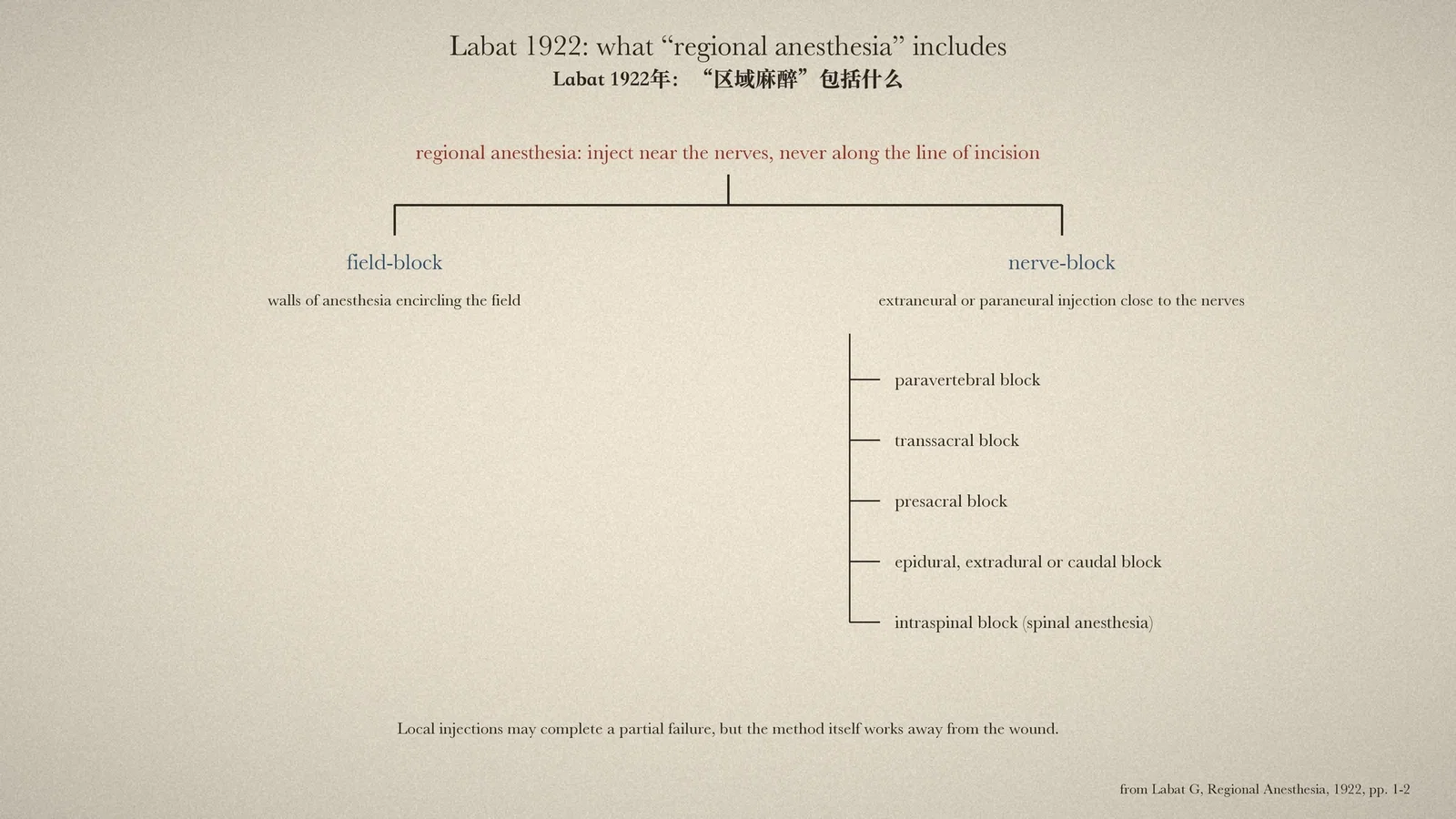
Chapter I begins with a definition. Regional anaesthesia controls pain temporarily "by interrupting the sensory nerve conductivity of any region of the body", best by injecting near the nerves that supply the operative field. It differs from local anaesthesia "in that the anesthetic fluid is never injected along the line of incision" or within the wound. Labat divided it into field-block, which creates walls of anaesthesia encircling the field, and nerve-block, extraneural or paraneural injection close to the nerves, with paravertebral, transsacral, presacral, epidural or caudal, and intraspinal forms. Spinal anaesthesia had its own chapter, as "an extensive regional anesthesia". [1]
Instruments
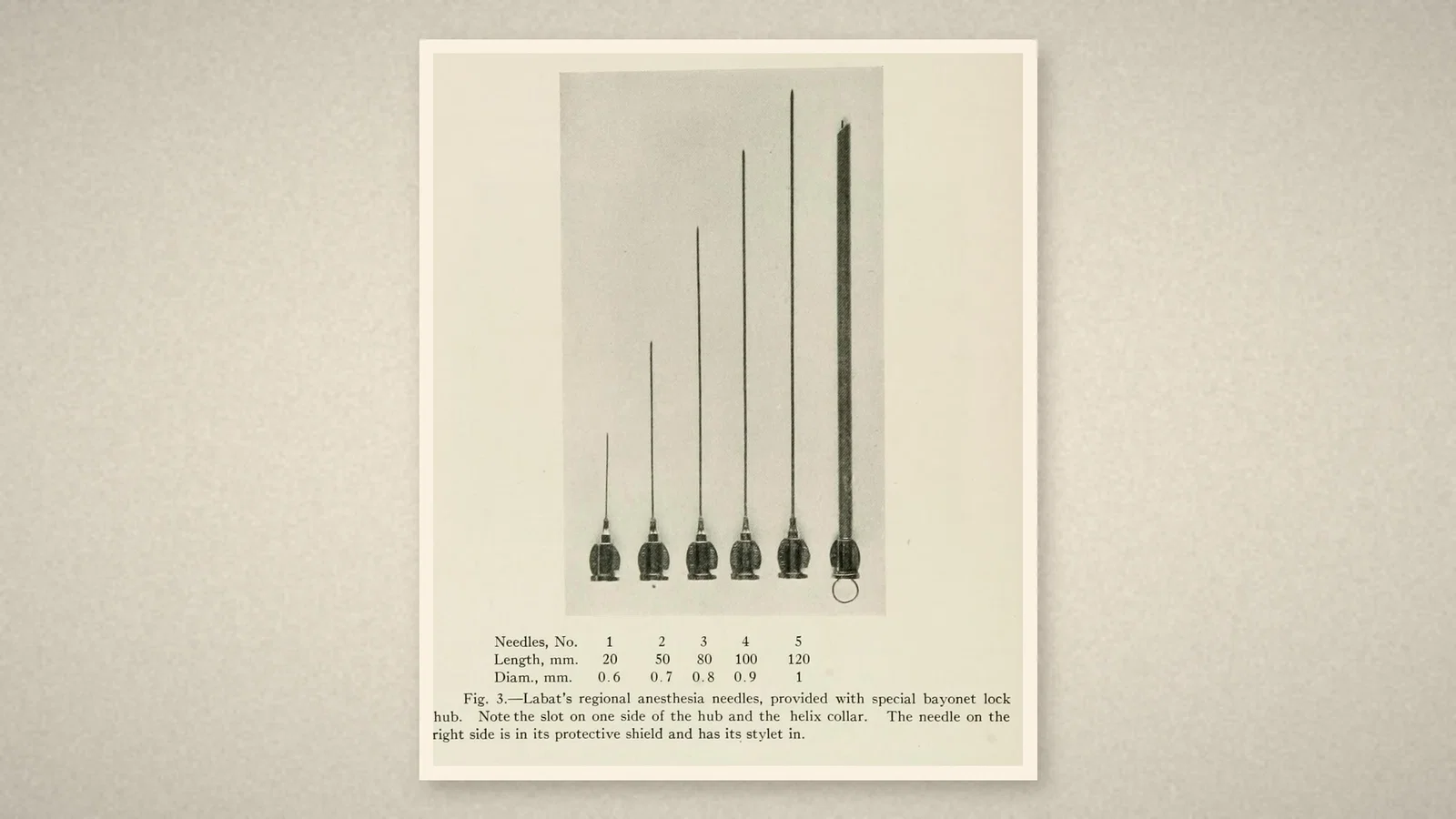
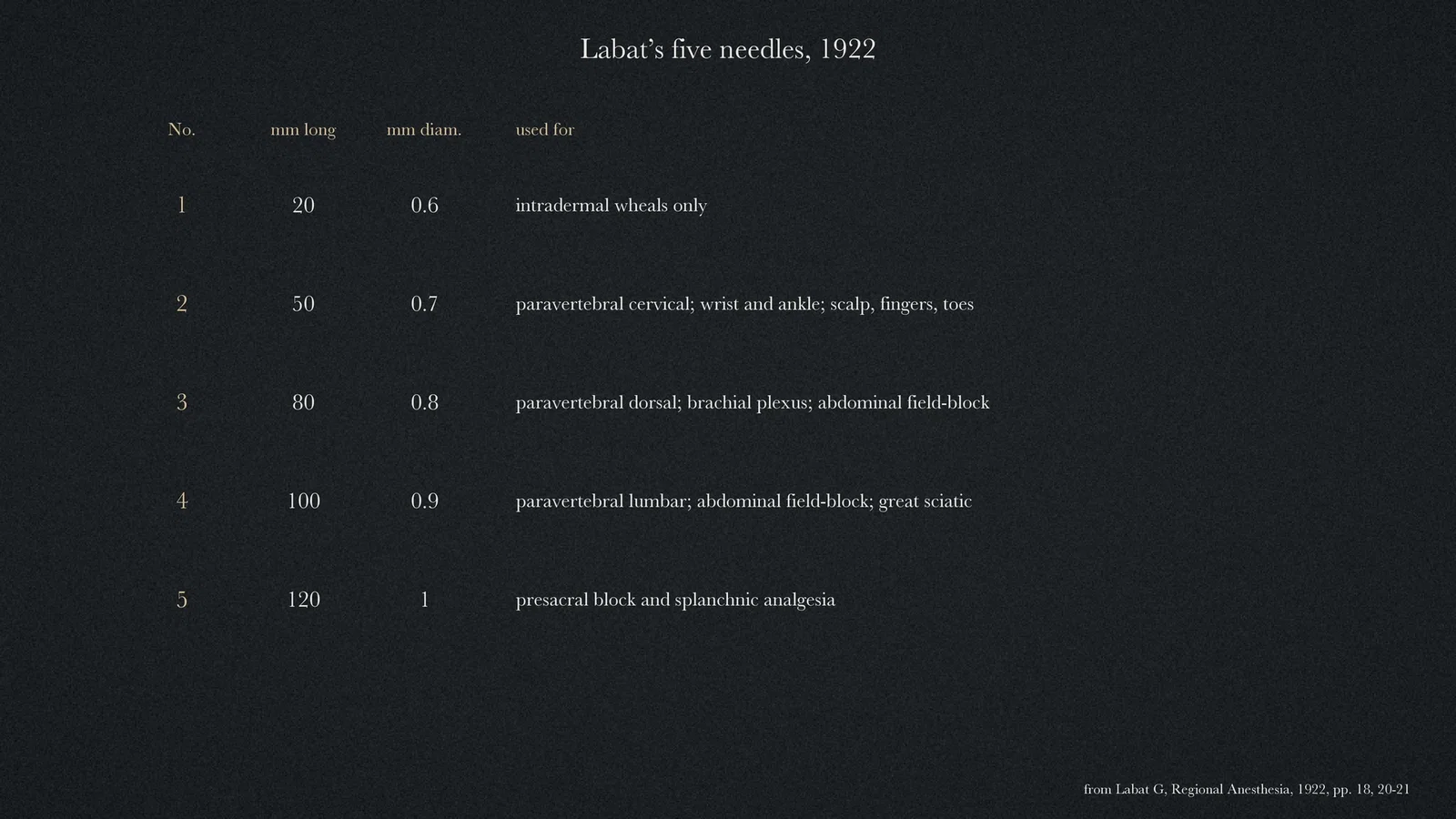
The anatomy had to be learned anew, from the operator's point of view, on the cadaver and the mounted skeleton, with attention to bony landmarks and large vessels. The instruments were specified as closely: a special syringe with a bayonet lock and five numbered needles, from a 20 mm needle for skin wheals to a 120 mm needle for presacral block and splanchnic analgesia. Novocain was the drug of choice, "six to ten times less toxic than cocain", with adrenaline added just before use. [1]
The book was reprinted: the 1924 printing records reprints in April 1923 and July 1924, and by then the title page gave Labat's post as New York University and Bellevue Hospital Medical College. [2]
What the record shows
Labat's book is a technical manual rather than a manifesto, and its sponsor's foreword already sets limits on its claims. What it fixed in print, for an English-speaking audience, was a definition that kept the needle away from the wound, a two-part classification, a standard set of instruments, and the insistence that regional anaesthesia was a skill to be learned. This article does not credit Labat with the term "regional anesthesia" or with founding any society; the 1923 date is represented here only by the book's reprint.
Sources and reading limits
Read: the 1922 printing of Labat's book (Yale copy): title page, copyright page, foreword, introduction and the opening of Chapter I; the title and copyright pages of the 1924 reprint.
Not covered: the regional chapters in detail; any primary record of a regional anaesthesia society in 1923; later editions and biographies. Labat's "many thousands of cases" is the author's own figure. Doses and needle sizes are as printed.
Two illustrations are page images from the 1922 printing; two are drawn from it.
- Labat G. Regional Anesthesia: Its Technic and Clinical Application. With a foreword by William J. Mayo. Philadelphia and London: W. B. Saunders; 1922. Internet Archive
- Labat G. Regional Anesthesia: Its Technic and Clinical Application. Reprint. Philadelphia and London: W. B. Saunders; 1924. Internet Archive
Continue exploring
Related reading connects shared questions and contexts; it does not by itself establish historical influence.
- 1912: Perthes Lets an Electric Current Find the Nerve
- 1911: Two Needles for the Brachial Plexus
- 1894: Schleich's Infiltration Anaesthesia with Very Dilute Solutions
Anesthesia Epochs · The Source Room · About & Editorial Method
Published November 2, 2026. Sources and reading limits are stated above. Illustrations are labelled as original source images or AI-made. Historical accounts are educational; they are not current treatment instructions.