
ICNARC's own description and Harrison, Brady and Rowan's open-access paper in Critical Care (2004) explain that ICNARC is an independent charity established in 1994 to improve critical care through audit, research and data services, and that its Case Mix Programme is a voluntary national comparative audit of outcomes in adult general critical care units in England, Wales and Northern Ireland, recommended by the Department of Health; trained data collectors abstract each admission prospectively to standard definitions, data are validated locally and centrally, units receive comparative reports every six months, and the identities of hospitals, units, staff and patients are kept confidential; by 2004 the database held 129,647 admissions from 128 units, with a mean APACHE II score of 16.5 and mortality of 20.3% in the unit and 30.8% at hospital discharge.
Reading Library · Anesthesia Epochs · 中文版
Watch the education video (for clinicians)
1994: ICNARC and the Case Mix Programme · Anesthesia Epochs Education Series
If two intensive care units have different death rates, does that show which is better? Not necessarily: units admit patients of different severity, and death rates differ for that reason alone. A fair comparison needs national data collected to common definitions and adjusted for case mix. The Intensive Care National Audit & Research Centre (ICNARC), established in the UK in 1994, was set up to provide it. This article reads ICNARC's own description of itself and the detailed account of its Case Mix Programme published by ICNARC staff in the open-access journal Critical Care in 2004. [1][2, introduction]
An independent organisation
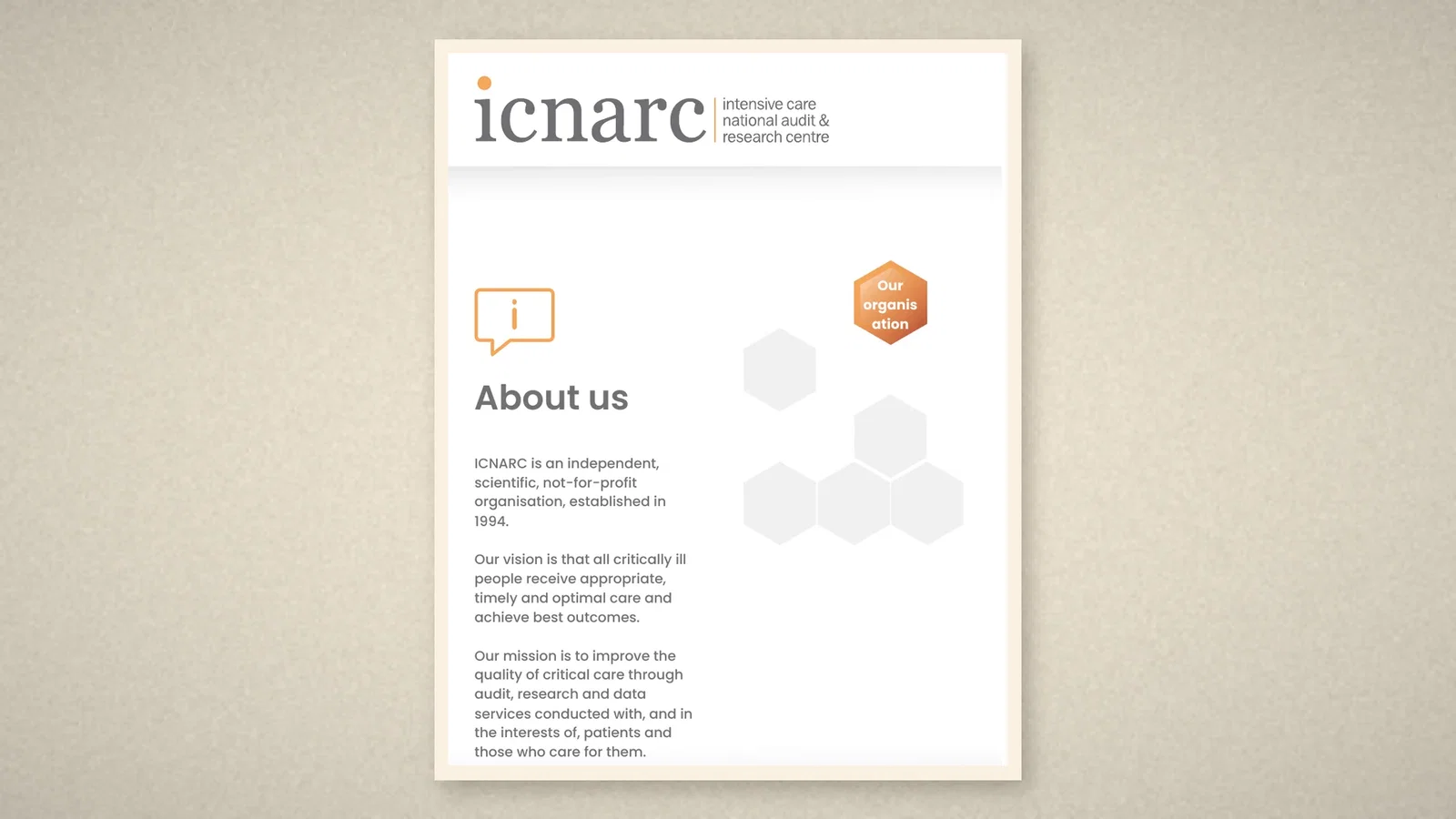
ICNARC describes itself as "an independent, scientific, not-for-profit organisation, established in 1994". Its vision is that all critically ill people receive appropriate, timely and optimal care and achieve the best outcomes; its mission is to improve the quality of critical care through audit, research and data services conducted with, and in the interests of, patients and those who care for them. [1]
In 2004 ICNARC's statisticians David A. Harrison and Anthony R. Brady and its director Kathy Rowan described ICNARC as an independent charity (registered charity number 1039417) established in 1994, coordinating a national comparative audit of patient outcomes from adult general critical care units in England, Wales and Northern Ireland: the Case Mix Programme (CMP). Data collection, they wrote, had been under way for nearly eight years, yet baseline statistics from the database had never been formally published; their paper set out to do so. Its references include Rowan's 1996 BMJ letter, "Intensive Care Society has set up a centre for national audit". [2, introduction][2, references]
Voluntary, but uniform
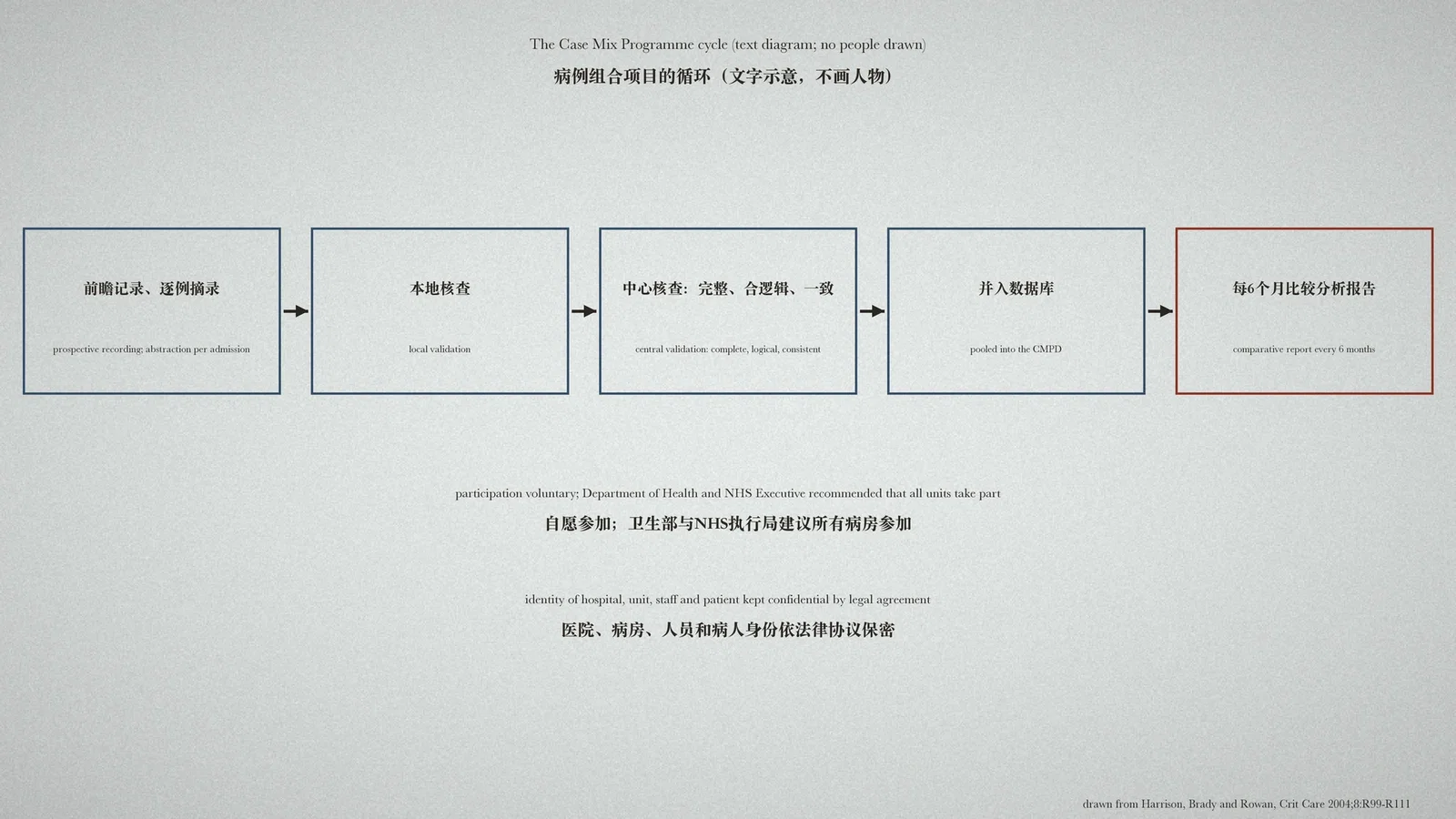
Participation in the CMP is entirely voluntary, although the Department of Health and the NHS Executive recommended that all units take part. The Audit Commission's 1998 survey found 328 intensive care or combined units in England and Wales, of which 229, about 70%, were eligible. [2, methods]
Trained data collectors record data prospectively and abstract them, usually from the notes, according to precise rules and definitions, taking around 10-20 minutes per admission. Each new unit sends a consultant, a nurse and an audit clerk to a two-day training course, and courses are held at least four times a year. Data are submitted in six-month cycles, validated locally and then centrally for completeness, illogical values and inconsistencies, with validation reports returned to units until every query is resolved, before the data are pooled into the database. Units receive a comparative analysis report for each cycle, from which they can see how they compare with others. [2, methods]
A legal agreement between ICNARC and each unit guarantees that the identity of every source, hospital, unit, staff and patient, remains confidential. [2, methods]
What the database holds
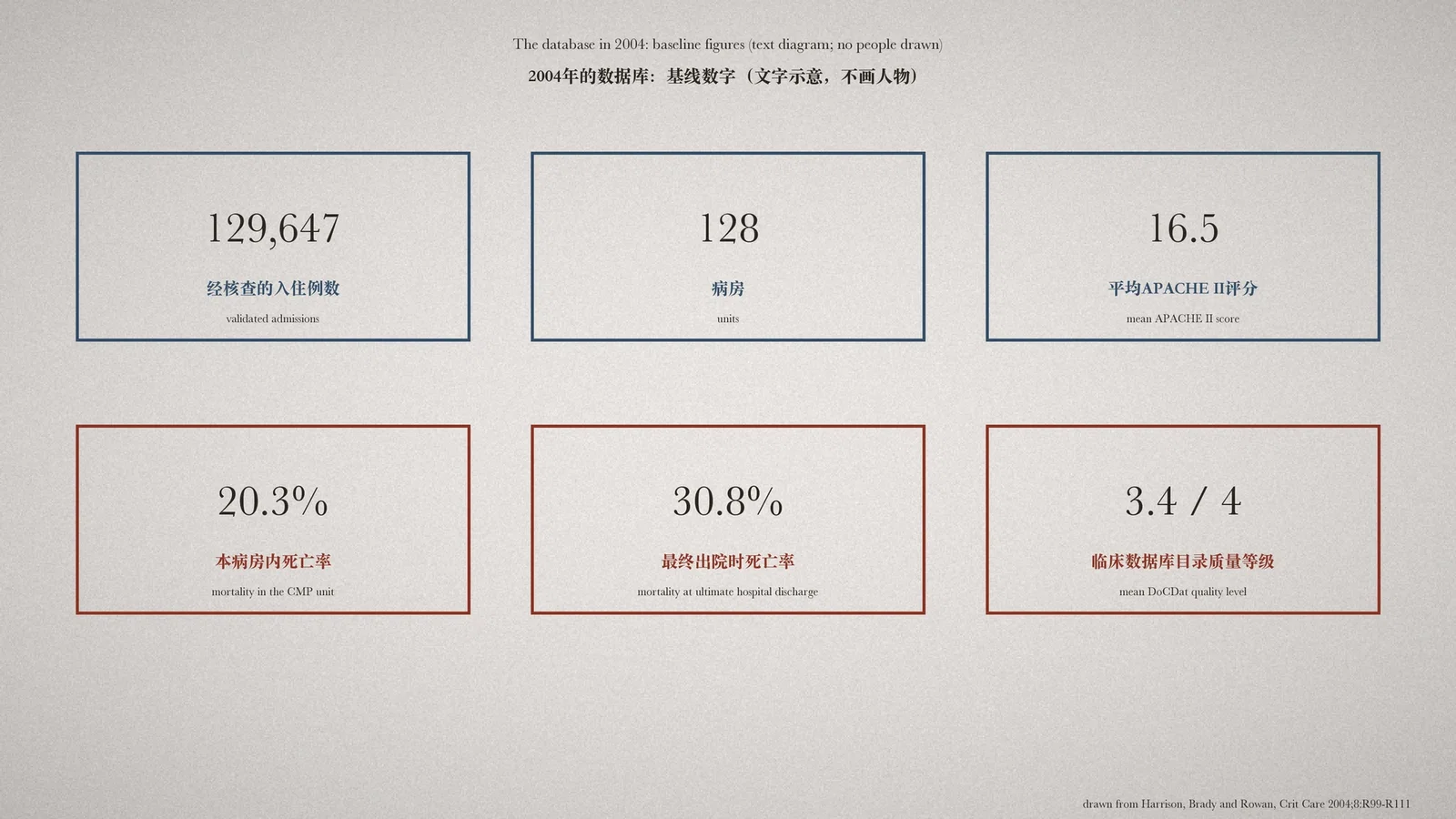
At the time of the paper the database held validated data on 129,647 admissions to 128 units. The median age was 63 years and 59% were male; the mean APACHE II score was 16.5; mortality was 20.3% in the unit and 30.8% at ultimate discharge from hospital. Against the ten criteria of the Directory of Clinical Databases, the database achieved a mean quality level of 3.4 out of 4. The authors concluded that the CMP uses rigorous methods to ensure data are complete, valid and reliable, and that the database meets the criteria for a high-quality clinical database. [2, abstract][2, conclusions]

What the record shows
ICNARC turned comparing units' outcomes into routine work with common definitions, validation, confidentiality and regular feedback. Its approach resembles that of Britain's earlier confidential enquiries into maternal and perioperative deaths: not to name and blame, but to let each unit see where it stands.
Sources and reading limits
Read: ICNARC's About us page (vision, mission and founding year; also printed to PDF to check the page); Harrison, Brady and Rowan, "Case mix, outcome and length of stay for admissions to adult, general critical care units in England, Wales and Northern Ireland: the Intensive Care National Audit & Research Centre Case Mix Programme Database" (Critical Care 2004;8:R99-R111), read in the Europe PMC open-access text: introduction, participation, data collection, validation, reporting and confidentiality, results summary, discussion and references.
Not covered: Rowan's 1996 BMJ letter (a scan without text); ICNARC's founding documents; the History of Anaesthesia Society timeline entry was used only as the lead. The 2004 paper was available only as text (the publisher's and Europe PMC's page versions could not be accessed), so only one of the four illustrations is a page image; the other three are text diagrams drawn from the paper, with no people drawn.
Limits: the authors were ICNARC staff describing their own organisation's methods; the mortality figures are descriptive statistics of the database, not an evaluation of any intervention.
- Intensive Care National Audit & Research Centre. About us. Web page
- Harrison DA, Brady AR, Rowan K. Case mix, outcome and length of stay for admissions to adult, general critical care units in England, Wales and Northern Ireland: the Intensive Care National Audit & Research Centre Case Mix Programme Database. Crit Care. 2004;8:R99-R111. doi:10.1186/cc2834. Europe PMC
Continue exploring
Related reading connects shared questions and contexts; it does not by itself establish historical influence.
Anesthesia Epochs · The Source Room · About & Editorial Method
Published November 4, 2026. Sources and reading limits are stated above. Illustrations are labelled as original source images or AI-made. Historical accounts are educational; they are not current treatment instructions.