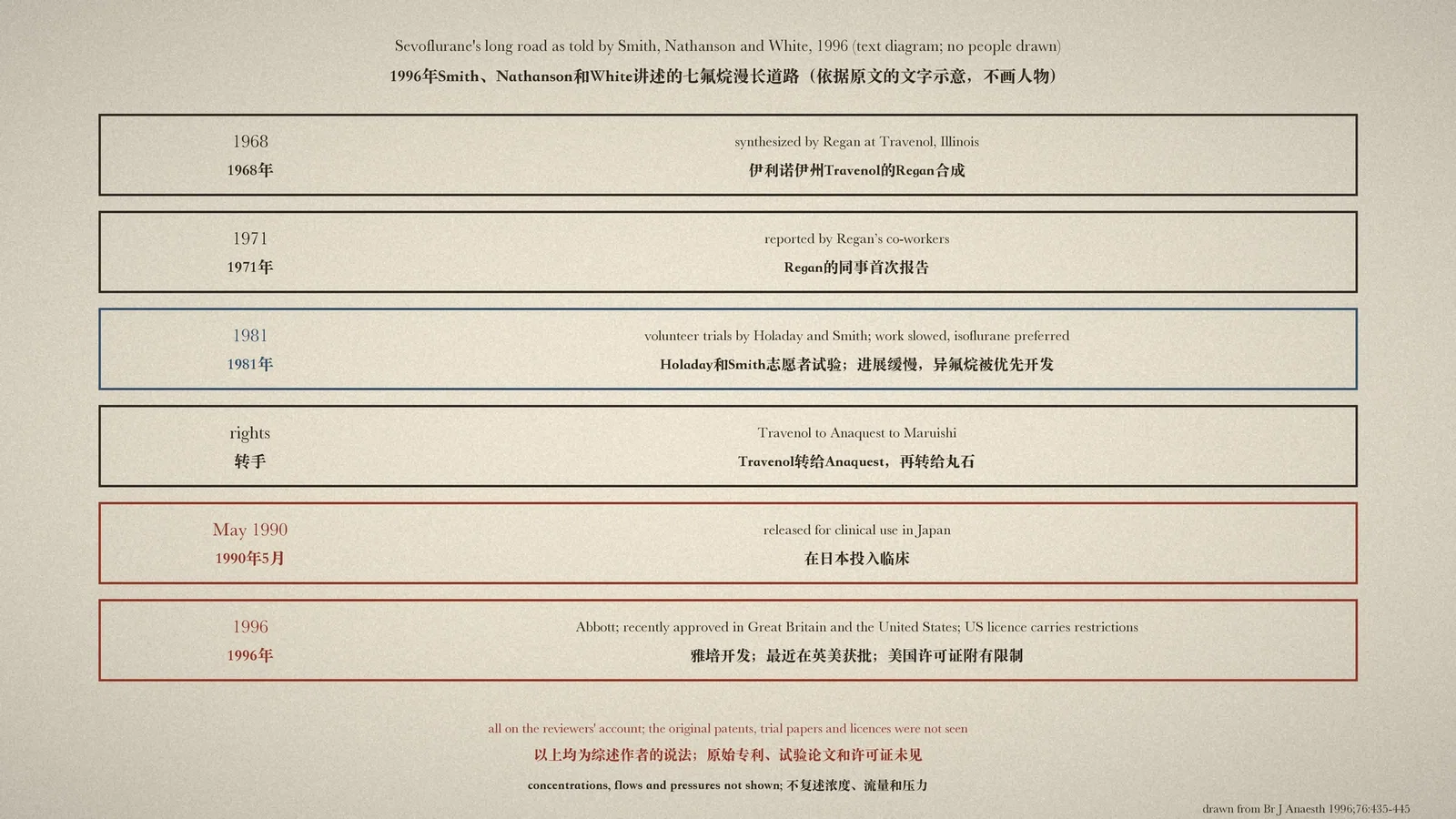
In March 1996 the British Journal of Anaesthesia printed 'Sevoflurane—a long-awaited volatile anaesthetic', a review by Ian Smith, Michael Nathanson and Paul F. White. Sevoflurane, they wrote, had been in clinical use in Japan since 1990 and had recently gained approval in Great Britain, the United States and much of the rest of the world. On their account it was synthesized in 1968 by Regan at Travenol Laboratories and reported in 1971, was slowed by apparent toxicity and problems of biotransformation and stability with soda lime, passed through Anaquest to Maruishi, was released in Japan in May 1990, and was then developed for the West by Abbott. Comparing induction, recovery, metabolism and toxicity, they judged it not the 'ideal' agent but likely to become popular in paediatric anaesthesia, advised caution in significant renal impairment and prolonged anaesthesia at very low fresh gas flows, and noted that the US product licence carried such restrictions while the UK's did not.
Reading Library · Anesthesia Epochs · 中文版
Watch the education video (for clinicians)
1996: Sevoflurane — A Long-Awaited Volatile Anaesthetic · Anesthesia Epochs Education Series
Some drugs are taken up as soon as they appear; others wait for years. Sevoflurane was one of the waiting kind. In March 1996 the British Journal of Anaesthesia printed a review whose title said as much: "Sevoflurane—a long-awaited volatile anaesthetic". Sevoflurane, the authors wrote, had been in clinical use in Japan since 1990 and had "recently gained approval" in Great Britain, the United States and much of the rest of the world. [1, p. 435]
A review
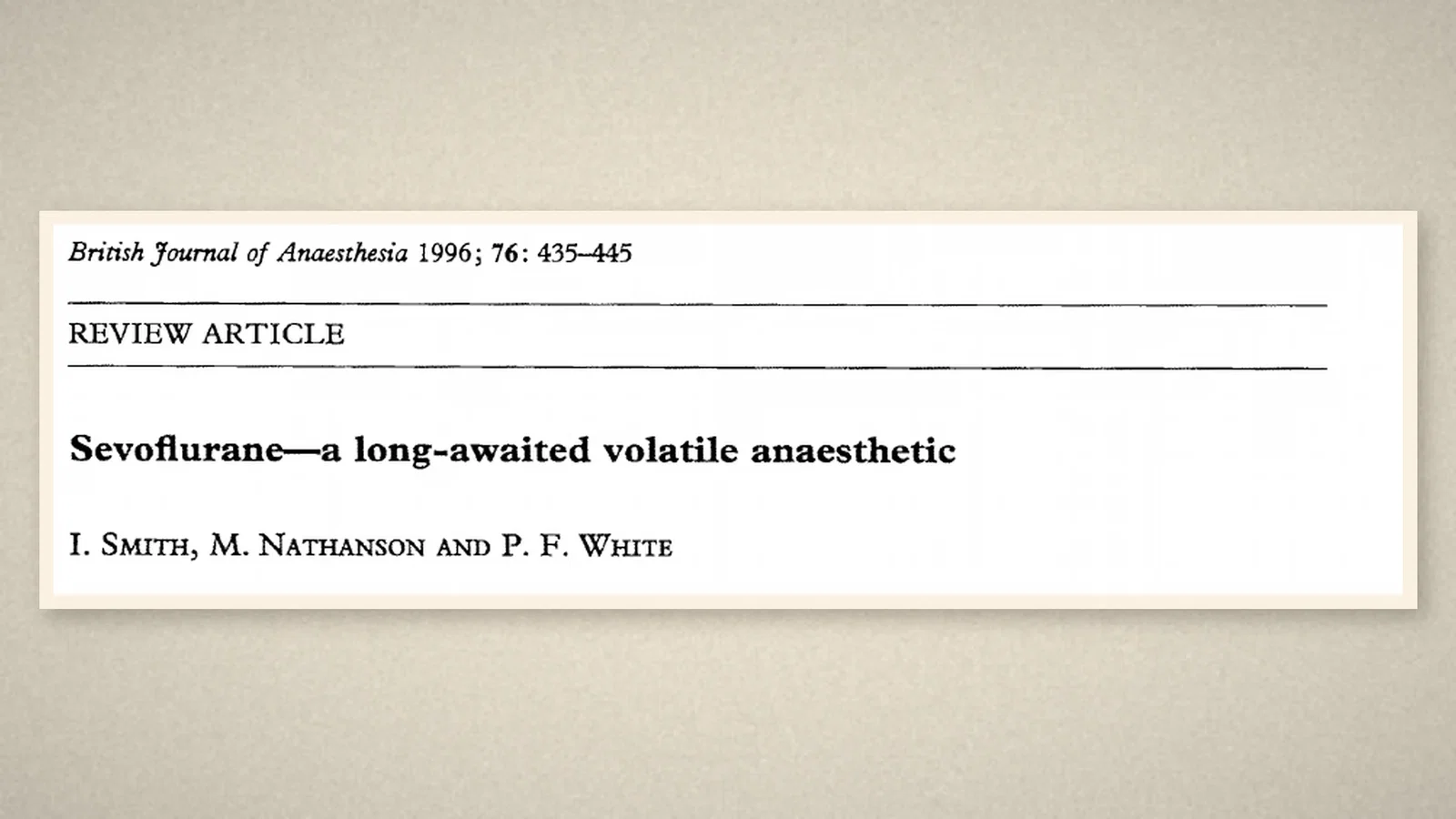
The authors were Ian Smith of Keele University and the North Staffordshire Hospitals, Michael Nathanson of the Queen's Medical Centre, University of Nottingham, and Paul F. White of the University of Texas Southwestern Medical Center in Dallas. They began with a yardstick, the "ideal" volatile anaesthetic: low solubility in blood, rapid induction, easy titration during maintenance, rapid emergence and recovery, easy delivery, and no side effects or toxicity. For comparison they took desflurane, the last new volatile anaesthetic before it, introduced in 1992: relatively insoluble and easy to titrate, but irritant to the airway and so impractical for induction, liable to cause cardiovascular stimulation when the concentration was raised quickly, and in need of unusually complex vaporizers. [1, p. 435]
From 1968 to 1990
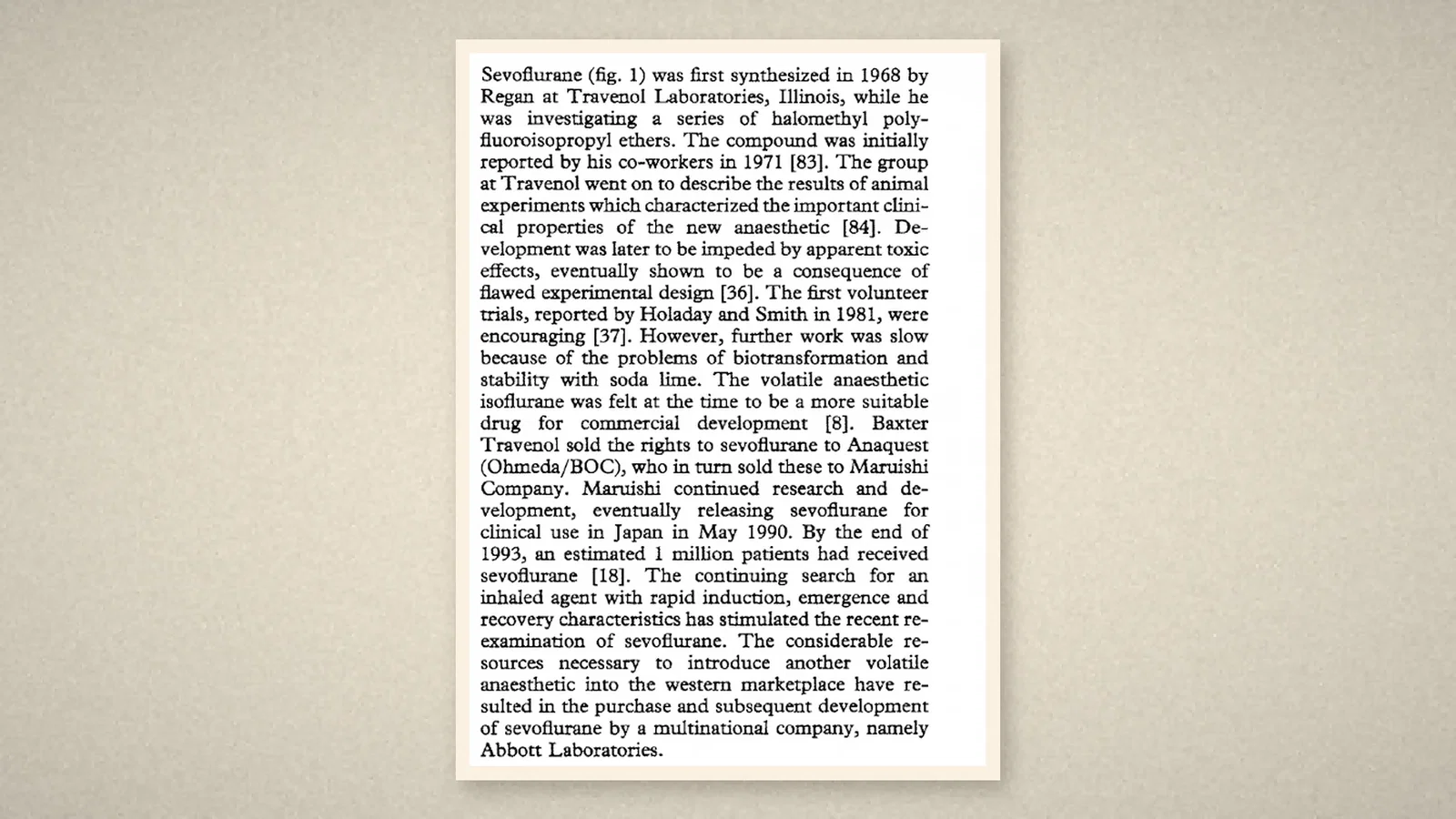
The review gave a section to the "History of sevoflurane". In the authors' telling, the search for a safe, non-inflammable inhaled anaesthetic began when chemists found that substituting fluorine for other halogens "lowers the boiling point, increases stability, and generally decreases toxicity"; McBee carried the work on with fluorine chemistry learned on the "Manhattan" atomic bomb project; and in 1951 Suckling synthesized halothane. [1, p. 435]
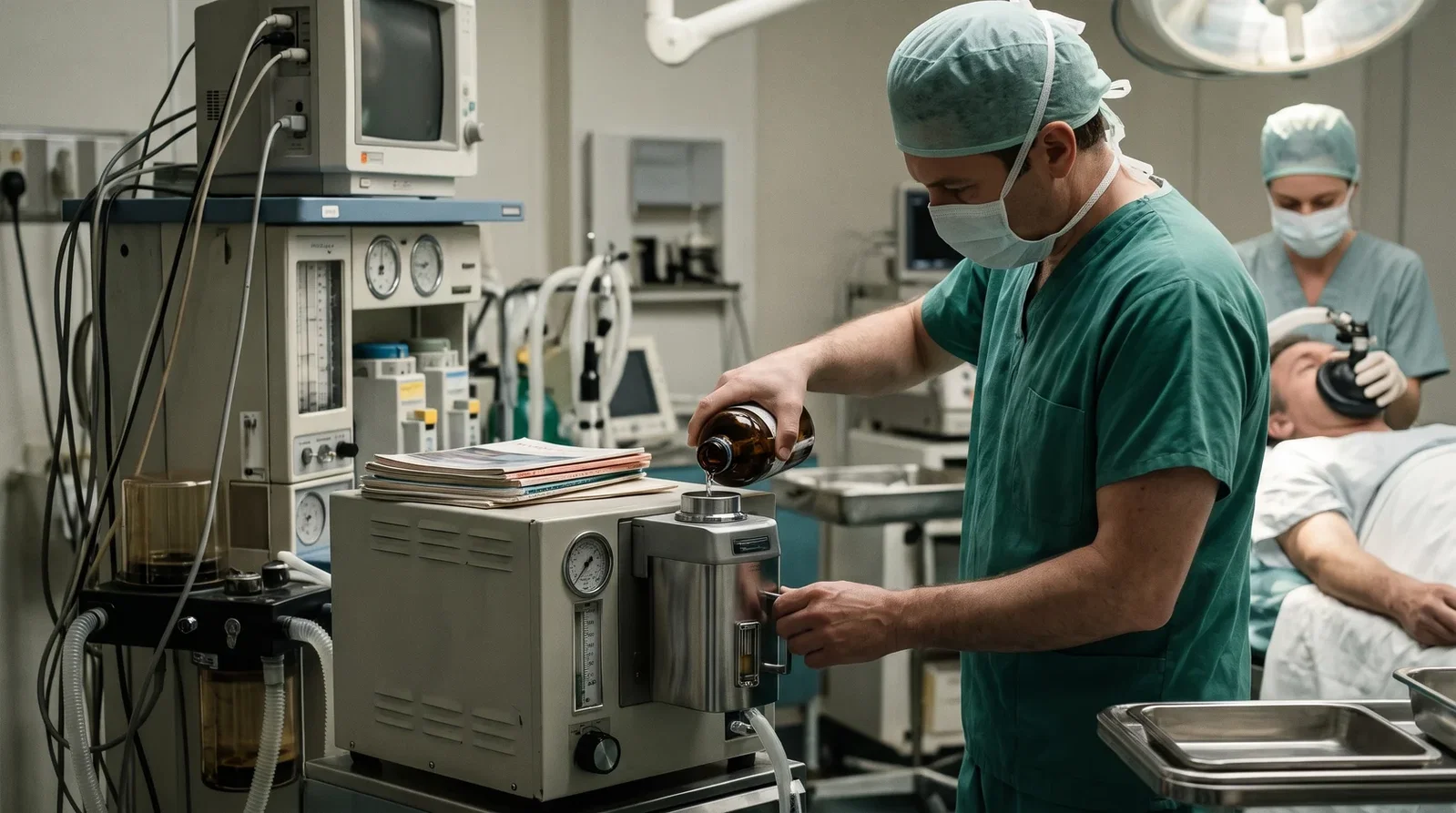
Sevoflurane itself, the review says, was synthesized in 1968 by Regan at Travenol Laboratories, Illinois, while investigating a series of halomethyl polyfluoroisopropyl ethers, and was reported by Regan's co-workers in 1971, with animal experiments from the Travenol group following. Development was then impeded by apparent toxic effects, eventually shown to be a consequence of flawed experimental design. The volunteer trials reported by Holaday and Smith in 1981 were encouraging, but progress was slow because of problems of biotransformation and stability with soda lime, and isoflurane was felt at the time to be a more suitable drug for commercial development. [1, p. 435]
So the rights changed hands: Baxter Travenol sold them to Anaquest (Ohmeda/BOC), which sold them to the Maruishi Company in Japan. Maruishi continued research and development and released sevoflurane for clinical use in Japan in May 1990; by the end of 1993, the authors estimated, about 1 million patients had received it. The resources needed to bring another volatile agent into the western marketplace led to its purchase and development by a multinational company, Abbott Laboratories. [1, p. 435]
Induction, recovery and two questions
The review then compared sevoflurane point by point with halothane, enflurane, isoflurane and desflurane: low solubility in blood and minimal airway irritation suited it to inhalational induction by mask, especially in children, and recovery was comparatively quick. [1, p. 436][1, p. 437][1, p. 438]
The authors also took two questions seriously. The first was metabolism: sevoflurane is metabolised to inorganic fluoride. From experience with methoxyflurane it had been proposed that serum fluoride above a "threshold" would damage the kidneys, but the authors argued that renal toxicity was not an inevitable consequence of exceeding it, and that a hypothesis built to explain methoxyflurane should not be applied to every anaesthetic without supporting data. The second was the reaction with carbon dioxide absorbents: sevoflurane is degraded by soda lime and Baralyme, producing under clinical conditions mainly compound A, which is toxic in rats, though the studies they cited suggested that clinical concentrations were well below those toxic to animals; and among about 1 million patients in Japan there had been no reports of serious adverse reactions or significant hepatic or renal toxicity. [1, p. 440][1, p. 441][1, p. 442]
Conclusion: not ideal, but worth the wait
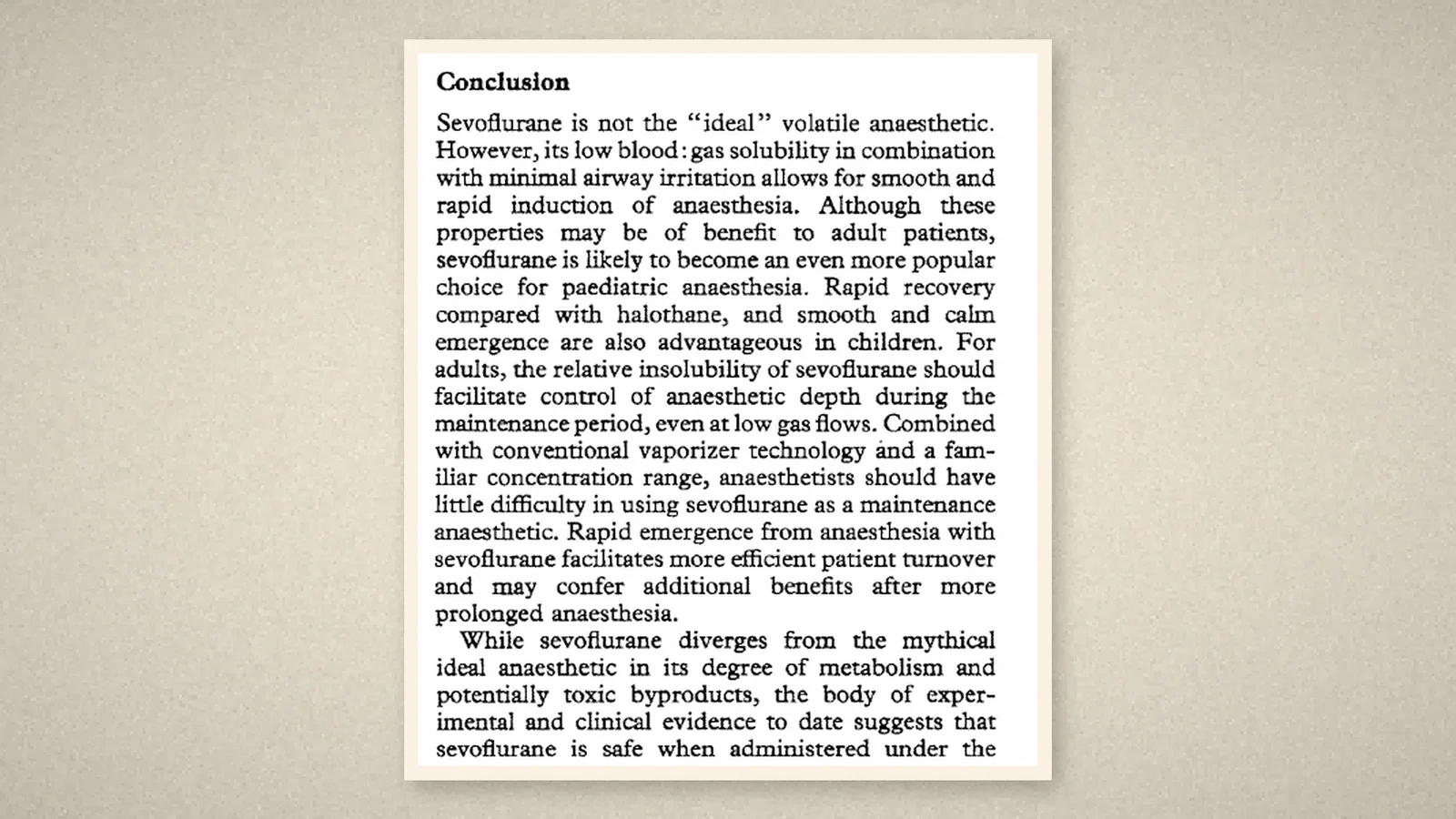
The conclusion was plain. Sevoflurane "is not the 'ideal' volatile anaesthetic", but its low blood solubility and minimal airway irritation allowed smooth and rapid induction, and it was likely to become an even more popular choice for paediatric anaesthesia; rapid emergence would help patient turnover. The evidence suggested it was safe under usual clinical conditions, though more work was needed for low-flow or closed circuits and chronic renal insufficiency. [1, p. 443]
For the present, the authors advised caution in patients with significantly impaired renal function and for prolonged anaesthesia at very low fresh gas flows, and pointed out that the USA product licence "contains just such restrictions", although similar limitations had not been applied in the UK. Its relative cost was unknown. Even so, they expected "the long-awaited arrival of this volatile agent" to prove a most useful addition to clinical anaesthesia. [1, p. 443]
What the record shows
From synthesis to British and American theatres, sevoflurane took almost thirty years, passed through several companies and carried for a while a reputation for toxicity that turned out not to be its own. The same drug arrived with different licences on either side of the Atlantic, as new drugs often do.
Sources and reading limits
Read: Smith, Nathanson and White, "Sevoflurane—a long-awaited volatile anaesthetic", Br J Anaesth 1996;76:435-45, in full (history, physical properties, induction, maintenance, recovery, metabolism and toxicity, conclusion and the start of the reference list), from the open Internet Archive scan of the volume, with page images checked; and the PubMed record of the review.
Not covered: any US or UK licensing document for sevoflurane; the society timeline entry giving 1995; Regan's synthesis, the 1971 report and the Travenol animal studies; Holaday and Smith's 1981 volunteer trials; Maruishi's Japanese approval record (told in a separate article on its 1990 approval in Japan); the compound A and fluoride studies the review cites.
Limits: the review calls the British and US approvals recent but gives no dates; the 1995 date in some timelines was not verified, and the article is dated to the review's publication in March 1996. The history is the reviewers' secondary account and was not checked against the original papers; no funding statement was seen. Concentrations, flows, pressures, boiling point, vapour pressure, partition coefficients, fluoride and compound A levels are not repeated, and page crops stop before them. Patients are not identified. Any statement of a first in the history section is the reviewers', not made in this article's own voice.
Three illustrations are crops of the British Journal of Anaesthesia 1996, vol. 76, p. 435 (title and authors; the history in the right column) and p. 443 (the conclusion in the left column). One is a text diagram drawn from the review, with no people drawn and no doses or concentrations.
- Smith I, Nathanson M, White PF. Sevoflurane—a long-awaited volatile anaesthetic. Br J Anaesth. 1996;76(3):435-45. DOI
Continue exploring
Related reading connects shared questions and contexts; it does not by itself establish historical influence.
Anesthesia Epochs · The Source Room · About & Editorial Method
Published November 3, 2026. Sources and reading limits are stated above. Illustrations are labelled as original source images or AI-made. Historical accounts are educational; they are not current treatment instructions.