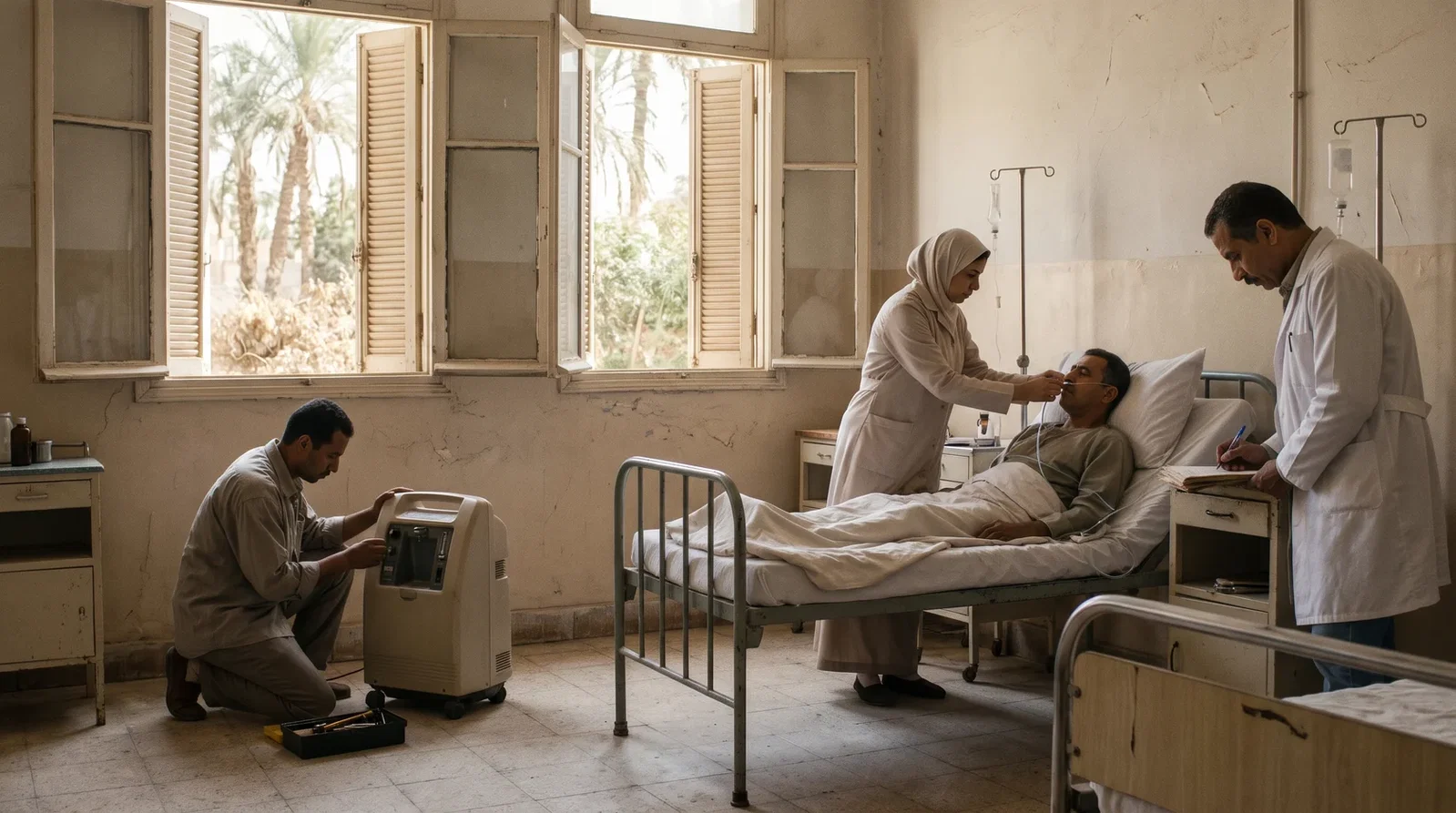
On 8 June 1996 The Lancet printed 'Field trial of oxygen concentrators in upper Egypt' by Michael Dobson and David Peel of the Nuffield Department of Anaesthetics, John Radcliffe Hospital, Oxford, and Nagwa Khallaf of the National ARI Program, Cairo. Technical problems in developing countries, they wrote, often need more than technological solutions: many small rural hospitals lacked reliable oxygen, and concentrators offered a solution, 'but simply sending out machines is ineffective'. Cylinder oxygen was costly and often lost in transit; in 1989 WHO and the World Federation of Societies of Anaesthesiologists had agreed performance criteria for concentrators in developing countries, and only three machines had passed them all. From 1993, with Egypt's Ministry of Health, WHO and USAID, concentrators were installed in district hospitals of Upper Egypt with registered users, travelling technicians, a field co-ordinator, an Arabic manual and logbooks. After a year all 22 machines inspected were in use, mainly for acute respiratory infection and low birthweight, and the one fault had been repaired locally. The authors also recorded the human problems: machines kept for when cylinders ran out, one installed in a cupboard, dusty filters with spares nowhere to be found.
Reading Library · Anesthesia Epochs · 中文版
Watch the education video (for clinicians)
1996: Oxygen Concentrators in Upper Egypt — More Than Machines · Anesthesia Epochs Education Series

For a rural hospital short of oxygen, a concentrator looks like a ready answer: plug it in and it separates oxygen from the air. But what happens once the machine arrives? In 1996 two authors from an Oxford anaesthetic department and a colleague in Cairo reported in The Lancet on the first year of a field trial in Upper Egypt, and their answer was that the machine alone is far from enough. [1, p. 1597]
The trouble with cylinders
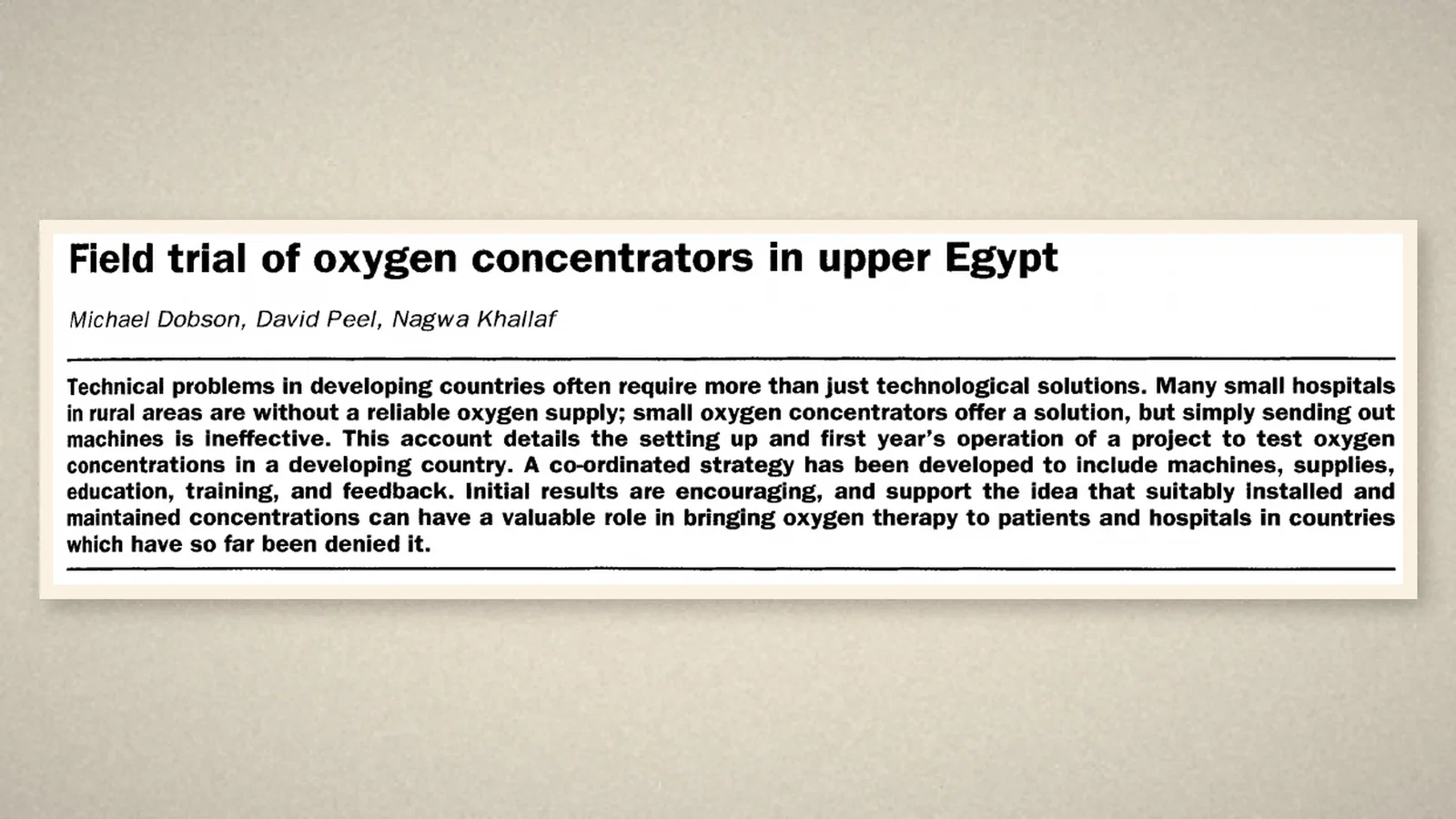
On 8 June 1996 The Lancet (vol. 347) printed "Field trial of oxygen concentrators in upper Egypt" by Michael Dobson and David Peel of the Nuffield Department of Anaesthetics, John Radcliffe Hospital, Oxford, and Nagwa Khallaf of the National ARI Program in Cairo. The abstract opened: "Technical problems in developing countries often require more than just technological solutions." Many small rural hospitals had no reliable oxygen supply, and small concentrators offered a solution, "but simply sending out machines is ineffective". [1, p. 1597]
The introduction set out the problem with cylinders: oxygen made by energy-hungry liquefaction is expensive, cylinders sometimes have to be bought rather than rented, transport is costly, and "many cylinders are lost in transit". Concentrators separate oxygen from room air using little power and had first been used in industrialised countries as a cheap supply for patients at home. In 1989 the World Health Organization and the World Federation of Societies of Anaesthesiologists agreed performance criteria for concentrators to survive conditions in developing countries; many makers had submitted machines since, and so far only three had passed every test. Concentrators had been introduced successfully in Malawi and elsewhere, but no controlled field trial had examined both the machines and their use by different health workers. [1, p. 1597]
A system of technology
In 1993, with support from Egypt's Ministry of Health (Child Survival Project), WHO and the United States Agency for International Development, a project began to install concentrators in district hospitals, train technicians to install, inspect, service and repair them, and use a detailed reporting system to follow each machine over five years. Compared with cylinders, the authors calculated, a concentrator could pay for itself within months. [1, p. 1597]
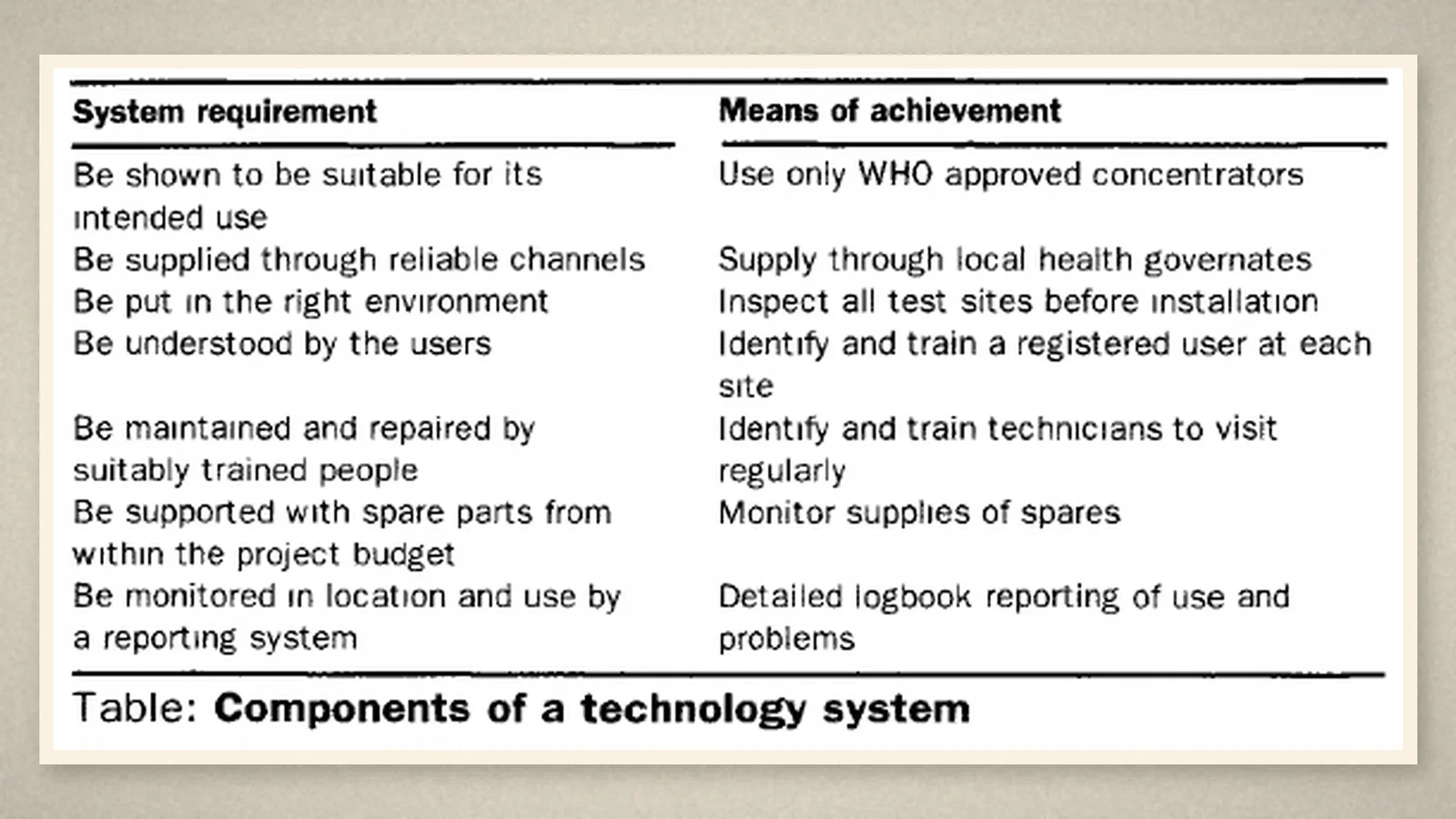
Such a project, the authors stressed, "involves not just buying machines, but setting up a system of technology", and they tabulated its components: machines suited to their use, meaning WHO-approved models only; supply through reliable local channels; inspection of every site before installation; a trained registered user at each site; technicians who visit regularly; spare parts within the budget; and detailed logbooks of use and problems. Introducing such a system to a developing country was likely to fail without them. The team therefore included the clinical users, a registered user in each hospital, travelling technicians, a field co-ordinator, trainers, agency representatives and an overall co-ordinator. [1, p. 1597]
The Ministry of Health chose Upper Egypt, where infant mortality from pneumonia and acute respiratory infection was high and better oxygen supply would complement existing programmes. Summer heat, humidity and dust, together with staff new to the technology, made it, in the authors' words, "a severe but realistic test for any technology". [1, p. 1597]
Training, logbooks and visits
The field co-ordinator was a bioengineer with experience of medical equipment. Machines were bought from the three WHO-approved models, each shipped with two years of essential spares. Technicians chosen by the Ministry, none of whom had worked with concentrators before, attended a training course in the field area, and working together the participants produced "a clear Arabic translation of the manual"; a fault-finding and repair course followed a year later. Each hospital named a registered user, mostly paediatricians. Every machine came with a pre-printed Arabic logbook recording use, faults and the technicians' inspections, whose completed pages the technicians carried back to the field co-ordinator; those who collected the data received a small payment. [1, p. 1598]
After one year
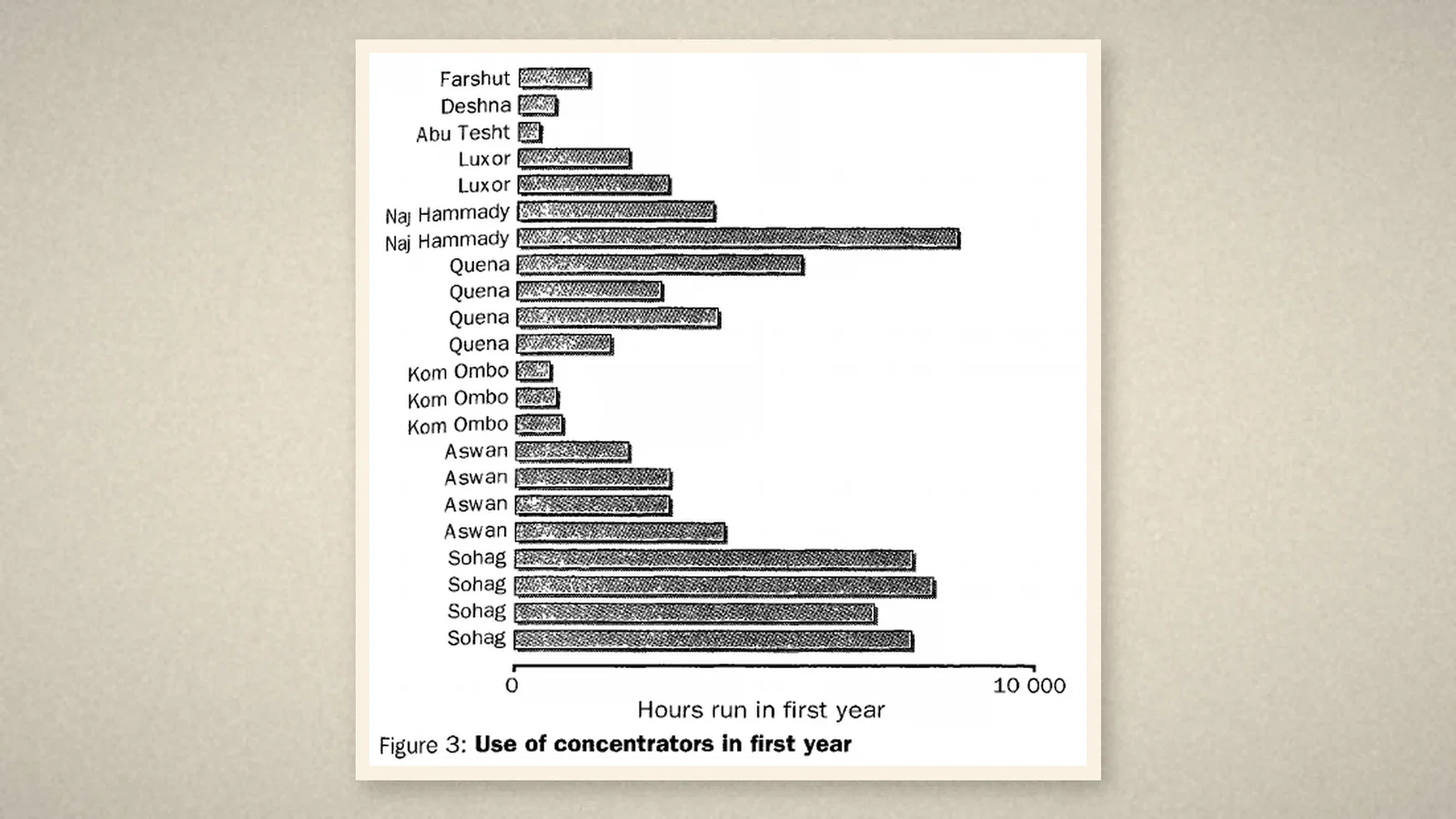
The first major review came in January 1995. In nine hospitals the registered users were interviewed and 22 machines and their logbooks inspected. "The concentrators had been well accepted and all had been used"; the smallest hospitals used them least, while in larger ones, many caring for premature babies, they had run almost continuously since installation. Acute respiratory infection and low birthweight were the main reasons for oxygen therapy. Of the 22 machines, one had developed a fault that the local technicians repaired, another was mended at the training course, and two flowmeter faults were probably user error. Day-to-day running was entirely in local hands. [1, p. 1598][1, p. 1599]
The authors were just as concerned with human factors. In a few hospitals the users protected their new machines by running them only when cylinder supplies failed, which hampered the trial and wasted the dearer oxygen. Users were sometimes confused by humidifiers, tubing, incubators, masks and prongs, so an Arabic explanatory sheet was added. One machine had been installed inside a wooden cupboard in a room not used for patients. Many were dusty and needed new filters, but the spare filters originally supplied could not be found. [1, p. 1599]
The conclusion: "Too many aid projects have failed because technology (often untested) is dumped on users who are untrained and unsupported in its use." Intensive local monitoring and supervision were the key features of this project. Concentrators were not a universal replacement for cylinders, needing backup power or a few emergency cylinders, but they could greatly increase the oxygen available in district hospitals. [1, p. 1599]
What the record shows
This short report turned an equipment question into a question about systems: standards, training, maintenance, records, spare parts and people, each indispensable. It also recorded, without embarrassment, the machine in the cupboard and the missing filters.
Sources and reading limits
Read: Dobson, Peel and Khallaf, "Field trial of oxygen concentrators in upper Egypt", Lancet 1996;347:1597-9 (the whole report: abstract, introduction, design of the trial with the table of system components, training, records, inspection visits, findings after one year with Figs 1-4, performance, users' problems, conclusion and acknowledgements; page images checked). Obtained through institutional access.
Not covered: the 1989 WHO/WFSA concentrator criteria and the WHO test schedule the authors cite; the Malawi reports; later reports of the five-year trial. The 2025 retrospective noted earlier for this topic was used only as a lead.
Limits: some citations give the volume as 348; Crossref and the printed page give vol. 347 (8 June 1996). This is the authors' own account of their project's first year, without a comparison group; usage figures come from machine timers and logbooks. Power use, output oxygen concentrations, flows and litres produced are omitted, and page crops stop before them. Patients are not identified.
Three illustrations are crops of The Lancet 1996 pp. 1597 and 1599 (title and abstract, the table of system components, Figure 3). One is a text diagram drawn from the paper, with no people drawn.
- Dobson M, Peel D, Khallaf N. Field trial of oxygen concentrators in upper Egypt. Lancet. 1996;347:1597-9. DOI
Continue exploring
Related reading connects shared questions and contexts; it does not by itself establish historical influence.
- 1978: Cooper and Colleagues Report a Microprocessor-Based Anaesthesia Machine Prototype
- 1983: Yelderman and New Test a Finger Pulse Oximeter in Volunteers
Anesthesia Epochs · The Source Room · About & Editorial Method
Published November 3, 2026. Sources and reading limits are stated above. Illustrations are labelled as original source images or AI-made. Historical accounts are educational; they are not current treatment instructions.