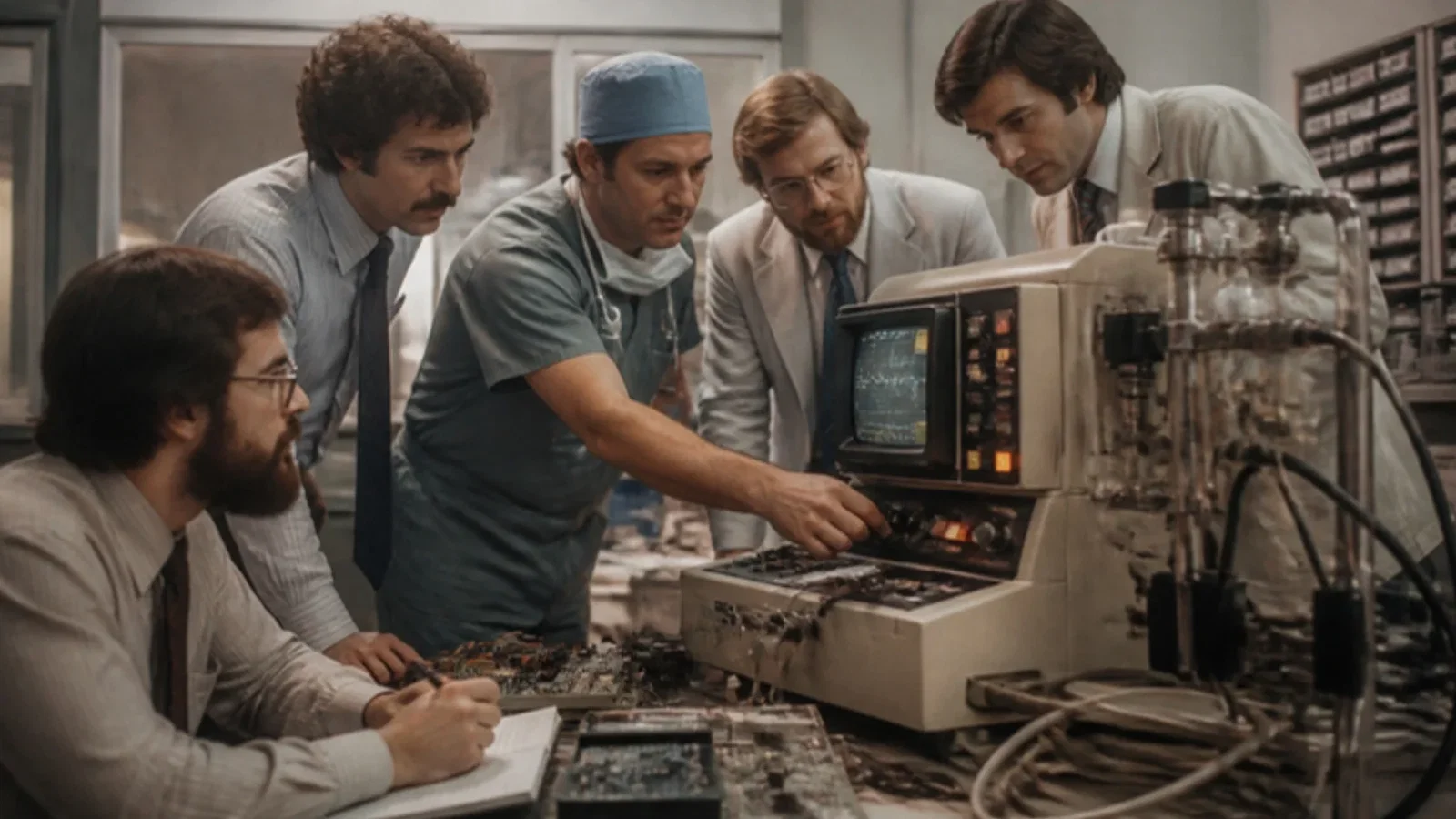
In November 1978 Anesthesiology (vol. 49, no. 5) printed 'A new anesthesia delivery system' by Jeffrey B. Cooper, Ronald S. Newbower, Jeffrey W. Moore and Edwin D. Trautman of the Bioengineering Unit of the Anaesthesia Department, Harvard Medical School at the Massachusetts General Hospital, accepted on 27 February 1978, with parts presented in 1975 and 1976. Anaesthesia machines, they wrote, were not dissimilar to those of the first third of the century, surrounded by a haphazard clutter of boxes and wires that encouraged rather than discouraged human error. Asking what one would do designing a system afresh, they built a prototype of 'on-off' devices with few moving parts: binary-weighted digital valves for oxygen and nitrous oxide, a modified automobile fuel injector pulsing liquid anaesthetic into the gas stream, and an Intel 8080 microprocessor that read sensors, checked safety and showed sixteen prioritised alarm messages. The console was detachable, with an anaesthetic cut-off button, a disconnection alarm, a mechanical oxygen flush and battery back-up. Sensors served safety checks, not control; wary of software changes, the authors had delayed human trials in favour of laboratory and animal work.
Reading Library · Anesthesia Epochs · 中文版
Watch the education video (for clinicians)
1978: The Boston Anesthesia System — Support, Not Preoccupy · Anesthesia Epochs Education Series

In 1978 an anaesthesia machine still looked, at heart, much like one built generations earlier: a row of flowmeters, some knobs, a vaporiser, and around it a growing pile of separate monitors and cables. A bioengineering group at the Massachusetts General Hospital in Boston argued that the trouble lay not in any one part but in a system that had never been designed as a system. That November they described in Anesthesiology a prototype built from scratch. [1, p. 310]
Machines that invite error
In November 1978 Anesthesiology (vol. 49, no. 5) printed "A new anesthesia delivery system" by Jeffrey B. Cooper, Ronald S. Newbower, Jeffrey W. Moore and Edwin D. Trautman of the Bioengineering Unit of the Anaesthesia Department, Harvard Medical School at the Massachusetts General Hospital. It was accepted on 27 February 1978; parts had been presented at engineering meetings in New Orleans in September 1975 and Boston in November 1976, and as an exhibit at the ASA meeting in San Francisco in October 1976. [1, p. 310]
The introduction was blunt. "Today's anesthesia machines are not dissimilar to those introduced in the first third of this century": mechanical assemblies with inherent hazards and limitations. The system around them had evolved "in a haphazard and incoherent manner", gave little technical support in long and difficult operations, and its proliferation of devices, displays and controls "often encourages rather than discourages human error". Neither the system nor many of its parts reflected known human-factors principles; improvements had been narrow responses to particular safety problems, and new ideas arrived as separate boxes that cluttered the operating room further. [1, p. 310]
Designing it afresh
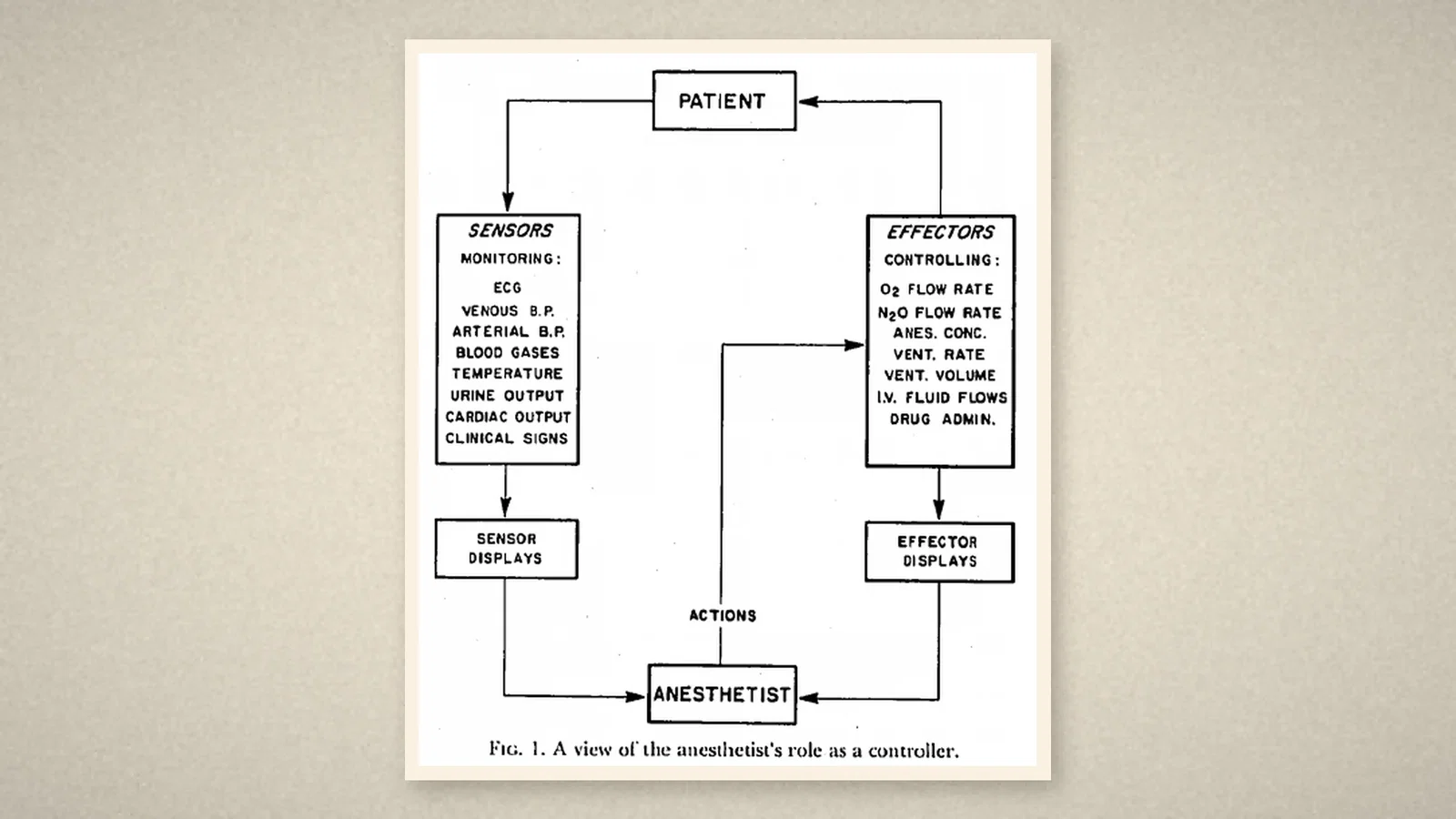
So the authors asked: if one were to design an anaesthesia system afresh, what principles would one adopt? Their Fig. 1 put the anaesthetist at the centre of a control loop, receiving the patient's state through sensors and displays and acting through effectors. The performance of this system, they wrote, must be watched as closely as the patient; technological aids must be "rugged, reliable, failsafe, and effective"; the operating room is hostile to technical devices; and communication between people and machine must work with a minimum of attention. [1, p. 310]
Electronics, they concluded, were unavoidable, but a hybrid that grafted new electronics onto traditional mechanics would not be reliable. The prototype was therefore built entirely from "on-off" devices with few moving parts and no potentiometers or servomotors; flow calibration depended on fixed orifices rather than moving parts; and sensors were used for safety checks and monitoring and did not control critical functions. [1, p. 311]
Digital valves, a fuel injector and a microprocessor
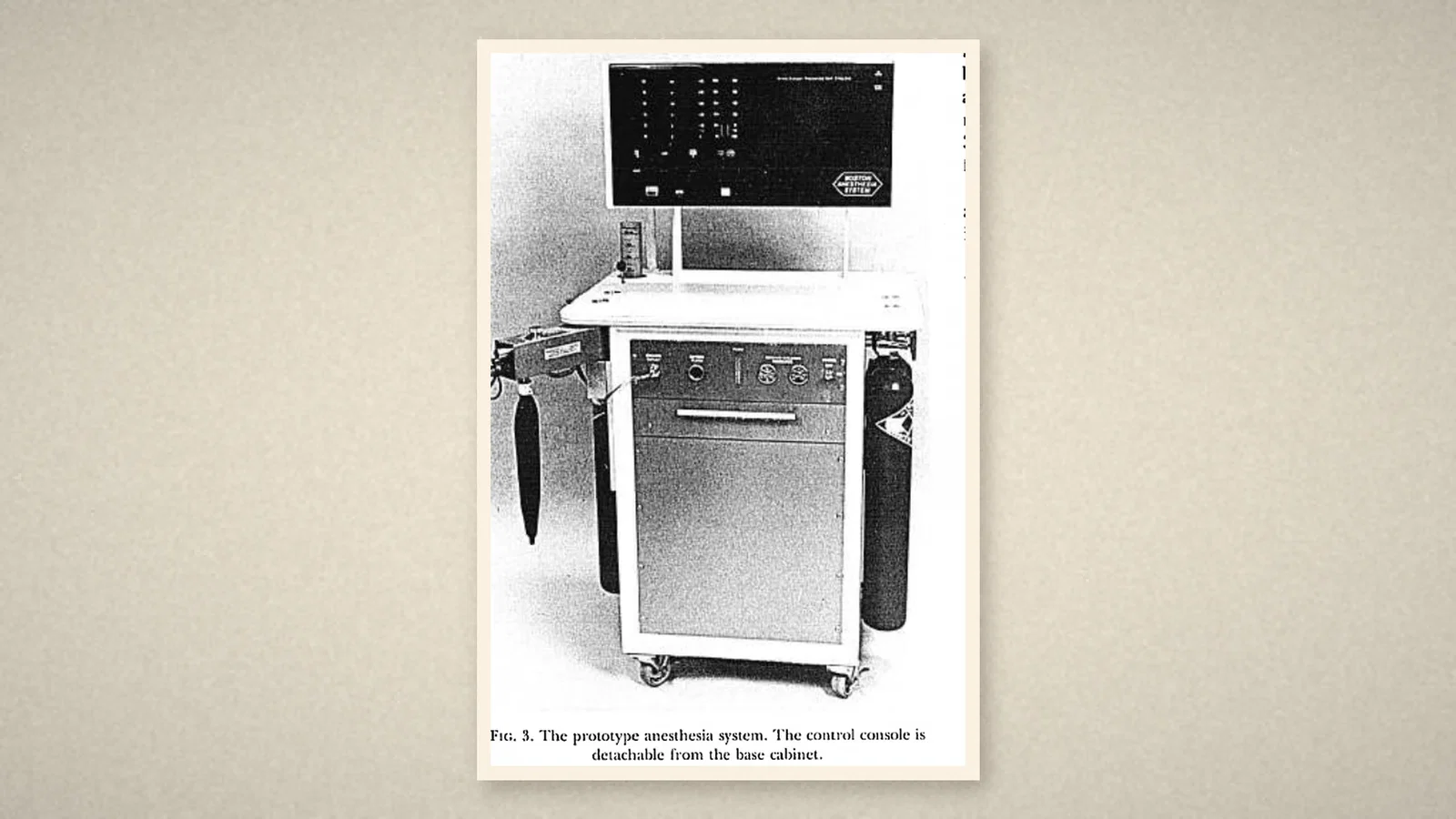
Each of oxygen and nitrous oxide was metered by a digital flow controller: a bank of calibrated orifices "weighted in a binary fashion", each opened or closed by a solenoid, so that the bank could be driven directly by a binary word from the microprocessor. Each orifice was designed as a sonic nozzle, so that flow was essentially independent of pressure changes downstream. Liquid anaesthetic was pulsed straight into the gas stream by a modified automobile fuel injector and vaporised completely in a copper coil. The liquid came in prefilled, interchangeable plastic canisters with a magnetically coded key to prevent mix-ups, which the authors imagined being filled only by a manufacturer, so that liquid agents would be handled as carefully as compressed gases. The whole was run by a controller based on an Intel 8080 microprocessor. [1, p. 314][1, p. 315]
On the console, settings appeared as illuminated bar graphs adjusted by increment switches; the authors called this proportioning scheme experimental, possibly less prone to the mental errors of separate flowmeters, and switchable to a conventional format in seconds. A round button cut off the anaesthetic unambiguously; another armed a ventilation alarm that watched airway pressure and warned of a disconnection or failure to ventilate. The console could be detached and placed wherever suited the anaesthetist. A roughly calibrated rotameter on the base was there "to lend assurances to a skeptical user"; the oxygen flush was mechanical, a back-up for life support if the electronics failed; and a battery covered mains failure. [1, p. 311][1, p. 312]
Alarms in order of priority
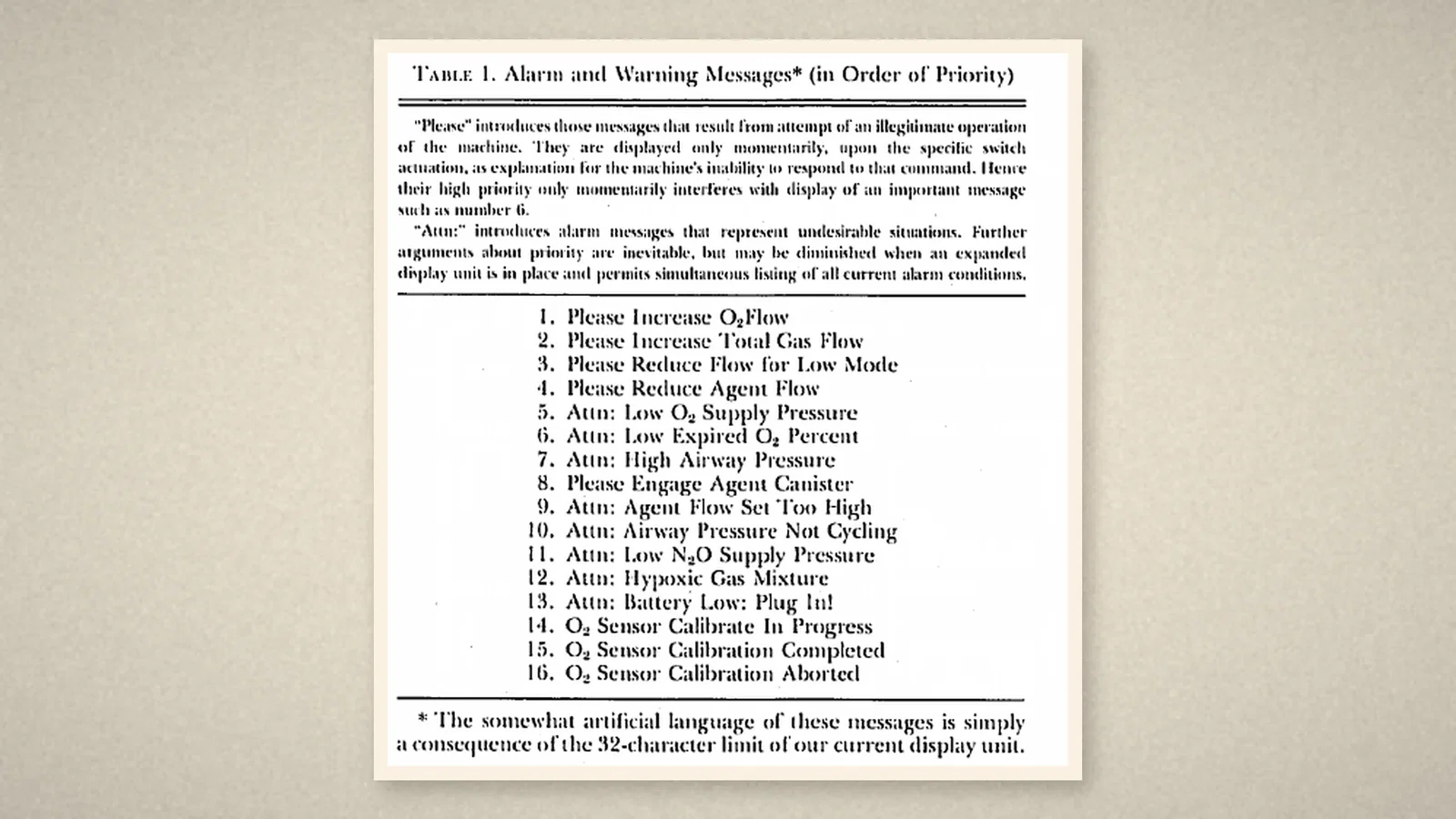
The system could show any of sixteen warning messages. When an unsafe condition arose or the user tried an improper action, a message appeared at the top right of the console with an audible signal; when several problems coexisted, the one needing the most immediate action was shown first, then the next. The authors suggested that physiological alarms could eventually pass through the same system, solving the problem of "a multiplicity of nonspecific and competitive alarms" in anaesthesia instruments. [1, p. 312][1, p. 313][1, p. 314]
The authors' own caution
Flexibility was the strength of a programmed controller, but the authors warned that "the ease of modification of software can be a snare": every change had to be evaluated carefully so as not to compromise safety or accuracy, since small changes could have large effects. For that reason they had delayed trials in human subjects until all significant modifications were complete, relying on continual laboratory testing and extensive animal studies. [1, p. 316]
In the discussion they foresaw integrated monitoring, automated record keeping and new teaching methods, while admitting that the system so far monitored no patient variable besides airway pressure and expired oxygen; it was not meant for flammable agents; and it had been hardened against electrosurgical interference. Replacing the traditional machine with an electronic system, they wrote, "will introduce risks and unknowns", and acceptance would depend on a record of clinical reliability that could only begin with production-engineered versions; the prototype itself had proved reliable despite rough shipment around the country. [1, p. 317][1, p. 318]
What the record shows
The paper's weight lies in its starting point: treating the anaesthesia machine as part of the whole control system between anaesthetist and patient, and redesigning it around human factors instead of adding yet another box. It was a prototype that had not yet been used on patients, and the authors set out the risks themselves.
Sources and reading limits
Read: Cooper, Newbower, Moore and Trautman, "A new anesthesia delivery system", Anesthesiology 1978;49:310-8 (the whole paper: abstract, introduction, design and operation, alarm functions with Table 1, subsystems, breathing circuit, discussion and Figs 1-6). Obtained through institutional access.
Not covered: the Wood Library-Museum video; the authors' 1975 chapter on human factors in the anaesthesia machine and their 1976 conference paper on the microprocessor design; later versions of the system and any clinical evaluation.
Limits: the name "Boston Anesthesia System" comes from a video title without a year; the paper read here calls it simply "a new anesthesia delivery system" and a prototype, and this article does not present that name as the paper's own. When the paper was written the system had not been used on people; the authors report laboratory and animal work only. Gas flows, concentrations, pressures, volumes and costs are not repeated, and page crops stop before control ranges; the bar-graph display figure with its scales is not shown.
Three illustrations are crops of Anesthesiology 1978 pp. 311, 312 and 314 (Fig. 1, Fig. 3, Table 1). One is a text diagram of the design rules drawn from the paper, with no people drawn.
- Cooper JB, Newbower RS, Moore JW, Trautman ED. A new anesthesia delivery system. Anesthesiology. 1978;49:310-8. DOI
Continue exploring
Related reading connects shared questions and contexts; it does not by itself establish historical influence.
- 1962: Epstein, Lee and Colleagues Report a Fail-Safe Against Anoxic Gas Mixtures
- 1983: Yelderman and New Test a Finger Pulse Oximeter in Volunteers
Anesthesia Epochs · The Source Room · About & Editorial Method
Published November 3, 2026. Sources and reading limits are stated above. Illustrations are labelled as original source images or AI-made. Historical accounts are educational; they are not current treatment instructions.