In January and May 1996 the British Journal of Anaesthesia (vol. 76) printed two Astra-funded clinical trials of ropivacaine. Eddleston, Reynolds and colleagues in Manchester, London and Newcastle compared ropivacaine with bupivacaine, double-blind, in 104 women requesting extradural analgesia in labour; existing local anaesthetics all had significant disadvantages, they wrote, serious maternal cardiotoxicity after inadvertent intravenous bupivacaine had been reported in the USA, and ropivacaine was a new aminoamide, a single enantiomer (the S isomer), less toxic than bupivacaine in preclinical studies; the two drugs gave comparable analgesia with no detectable adverse effect on the neonate. Turner and colleagues in hospitals across Australia and New Zealand studied postoperative extradural infusions in 151 patients after hip or knee arthroplasty or cruciate ligament reconstruction, calling ropivacaine the first enantiomerically pure local anaesthetic; it improved analgesia over patient-controlled morphine alone, though higher rates brought more motor block and urinary retention.
Reading Library · Anesthesia Epochs · 中文版
Watch the education video (for clinicians)
1996: Ropivacaine — An S-Enantiomer in Labour and After Joint Surgery · Anesthesia Epochs Education Series
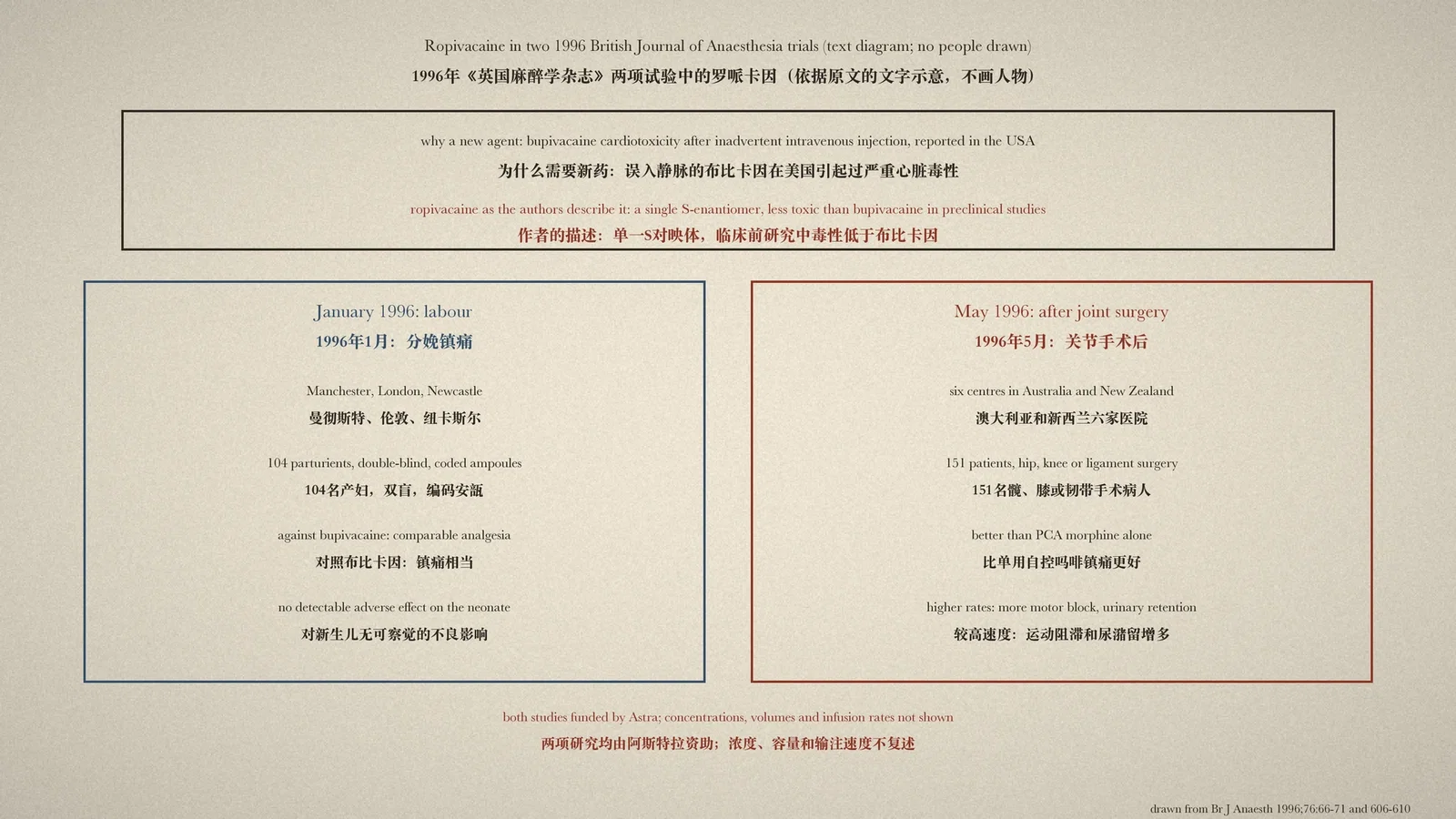
For extradural analgesia, bupivacaine had long been the mainstay. It worked well, but carried one worrying risk: injected into a vein by mistake, it could cause cardiotoxicity that was hard to reverse. In 1996 the British Journal of Anaesthesia (vol. 76) printed two clinical trials of a new local anaesthetic, ropivacaine, one in the labour ward and one after joint surgery. Both introductions presented the new drug as a close relative of bupivacaine that kept only one of a pair of mirror-image molecules. [1, p. 66][2, p. 606]
An old problem in the labour ward
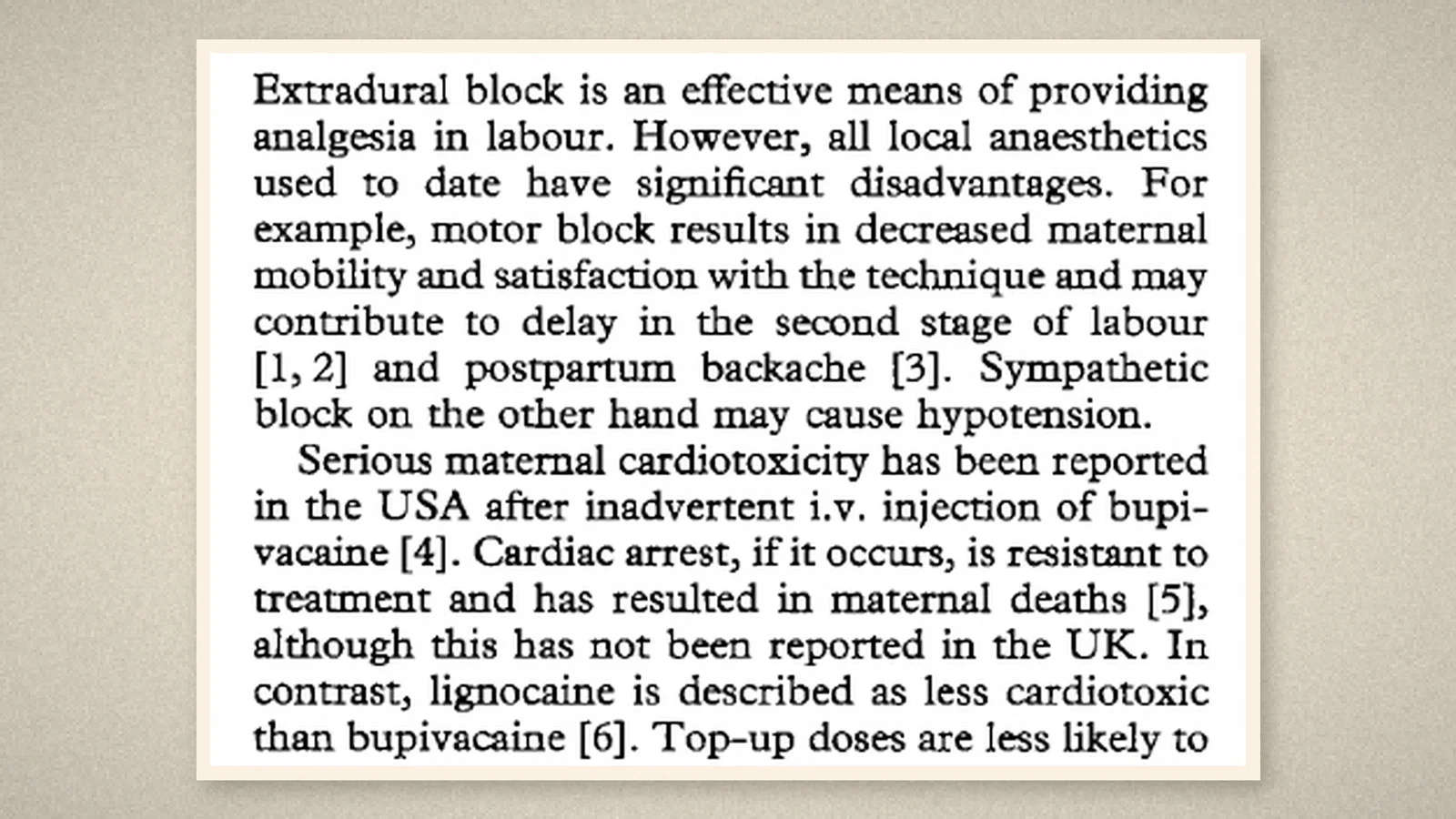
In January 1996 the journal (pp. 66-71) printed a double-blind study by J. M. Eddleston, F. Reynolds and four colleagues from the Manchester Royal Infirmary, St Thomas' and Guy's Hospitals in London and the Freeman Hospital, Newcastle, comparing ropivacaine and bupivacaine at the same concentration for extradural analgesia in labour; it had been accepted on 3 August 1995. [1, p. 66]
The introduction began with the old problems: all local anaesthetics used to date "have significant disadvantages". Motor block reduces maternal mobility and satisfaction and may delay the second stage; sympathetic block may cause hypotension. Serious maternal cardiotoxicity had been reported in the USA after inadvertent intravenous bupivacaine; cardiac arrest, if it occurred, was resistant to treatment and had caused maternal deaths, "although this has not been reported in the UK". Lignocaine was less cardiotoxic, but repeated doses accumulated and caused tachyphylaxis. [1, p. 66]
A mirror-image molecule
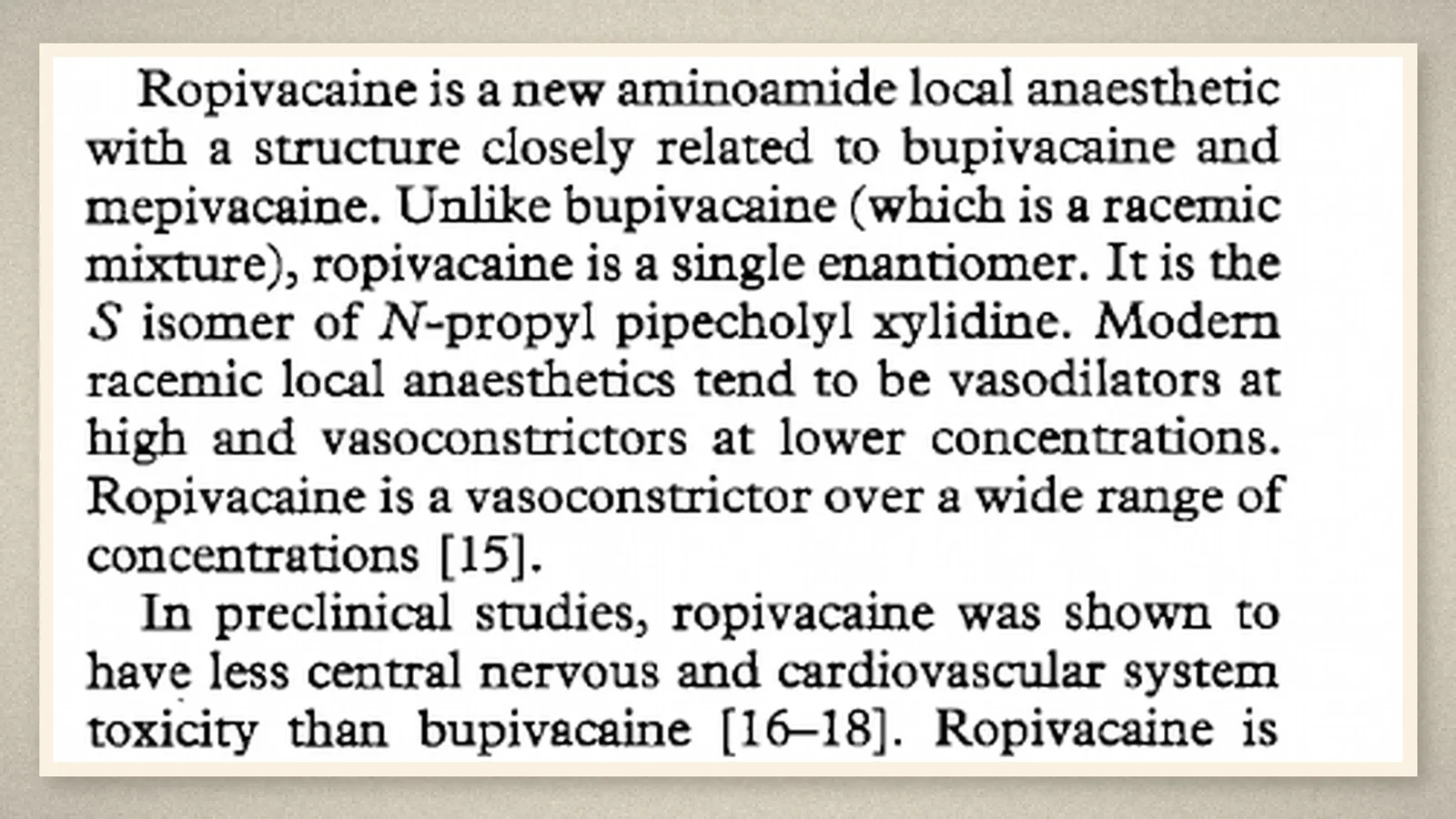
The authors then introduced ropivacaine: a new aminoamide local anaesthetic closely related to bupivacaine and mepivacaine, but, unlike racemic bupivacaine, "a single enantiomer", the S isomer of N-propyl pipecholyl xylidine. It was a vasoconstrictor over a wide range of concentrations; in preclinical studies it showed less central nervous and cardiovascular toxicity than bupivacaine; its greater selectivity for sensory fibres should mean less motor block; and inadvertent intravenous injection should have fewer cardiac sequelae, though the threshold for convulsions was similar. All of this suggested, they wrote, that ropivacaine "may be superior to bupivacaine in obstetric analgesia". [1, p. 66][1, p. 67]
104 women in labour
One hundred and four parturients requesting extradural analgesia were randomised, with the drugs in coded ampoules. Women given bupivacaine needed more top-up doses; the onset and quality of analgesia, the level of sensory block and maternal satisfaction were similar; motor block was slightly but not significantly less with ropivacaine; spontaneous vaginal delivery was more frequent with ropivacaine; and Apgar scores, umbilical acid-base status and neurological and adaptive capacity scores of the babies did not differ. At this concentration, the authors concluded, the two drugs gave comparable pain relief in labour "with no detectable adverse effect on the neonate". Astra Pain Control AB of Sweden supported the study. [1, p. 66][1, p. 69][1, p. 70]
After joint surgery
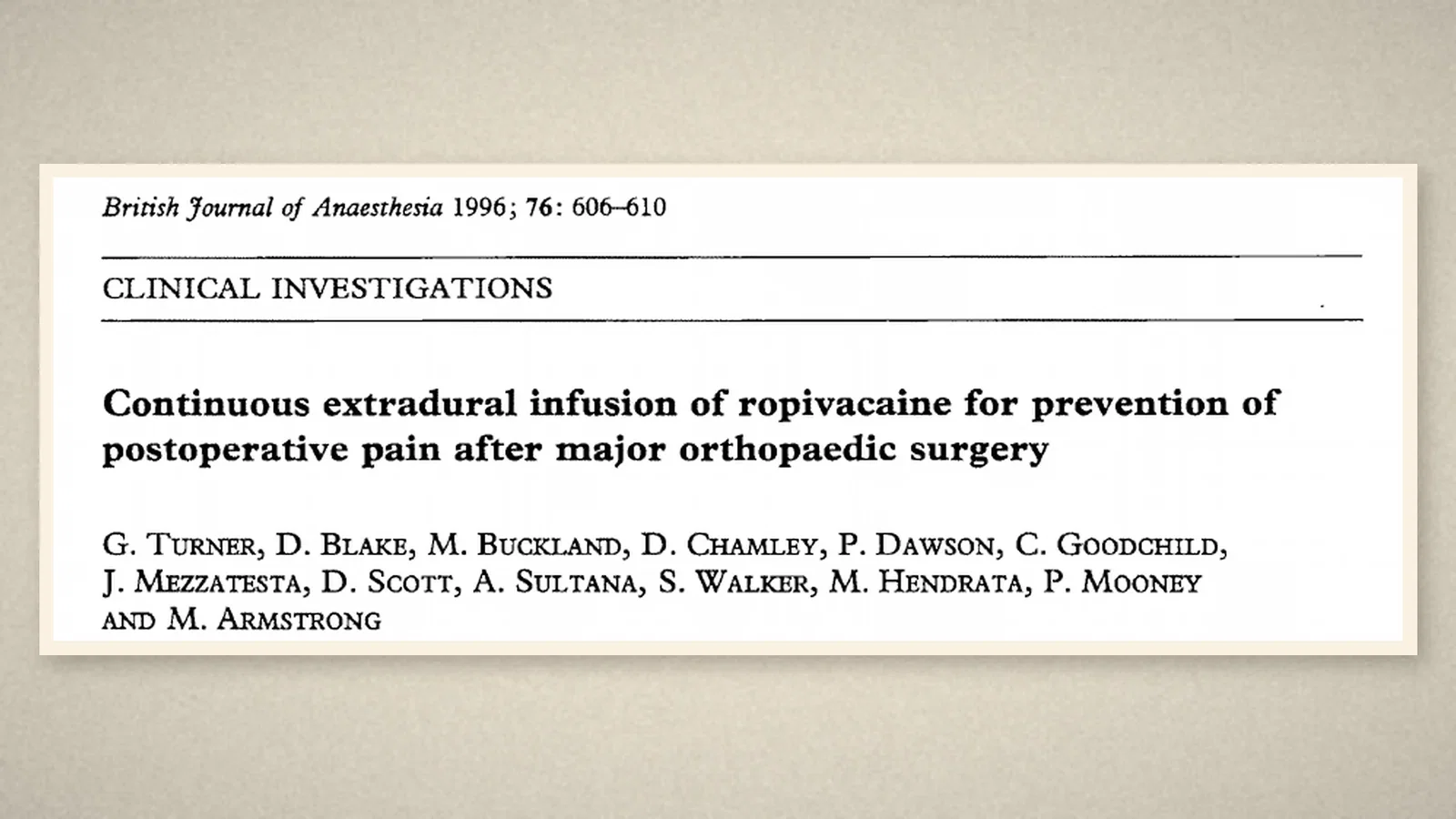
In May 1996 the same volume (pp. 606-610) printed a multicentre study by G. Turner and twelve colleagues in six hospitals in Australia and New Zealand, with correspondence from the Royal Perth Hospital; it had been accepted on 4 January 1996. Of 151 patients having total hip or knee arthroplasty or cruciate ligament reconstruction, five groups received postoperative extradural ropivacaine infusions and one acted as a control, all with intravenous patient-controlled morphine. [2, p. 606]
This introduction was blunter: ropivacaine is a new long-acting local anaesthetic of the same homologous series as bupivacaine and mepivacaine, "the first enantiomerically pure local anaesthetic", existing as the S-enantiomer, with a lower potential for central nervous and cardiovascular toxicity than bupivacaine in animals and preclinical studies and fewer such changes in volunteers after intravenous infusion. Extradural ropivacaine with patient-controlled morphine gave better pain relief and lower morphine use than morphine alone, but the higher infusion rates brought more motor block and urinary retention without significantly better analgesia. Astra Pharmaceuticals funded the study. [2, p. 606][2, p. 609][2, p. 610]
What the record shows
The ropivacaine story starts from bupivacaine's cardiotoxicity: the wish for a local anaesthetic as long-acting but less dangerous to the heart, met by keeping only one of a pair of mirror-image molecules. Both papers found it useful, and both were paid for by the company that made it.
Sources and reading limits
Read: the labour study by Eddleston, Holland, Griffin, Corbett, Horsman and Reynolds, Br J Anaesth 1996;76:66-71, and the orthopaedic multicentre study by Turner and twelve colleagues, Br J Anaesth 1996;76:606-10, both in full (summary, introduction, methods, results, tables and figures, discussion, acknowledgements and references), from the open Internet Archive scan of the volume, with page images checked; and the PubMed records of both papers.
Not covered: any regulatory or company record of the launch of ropivacaine (Naropin); the society timeline entry giving 1996; Astra's discovery and preclinical work and the animal and volunteer toxicity studies cited; Albright's 1979 report of cardiac arrest after bupivacaine and the other cardiotoxicity reports cited by Eddleston and colleagues; Reynolds' 1991 editorial on ropivacaine.
Limits: the 1996 "introduction" date in some timelines was not verified; the article is dated to the January 1996 publication of the labour study. Statements on enantiomeric purity, toxicity and selectivity are the authors' summaries of earlier work; "the first enantiomerically pure local anaesthetic" is Turner and colleagues' claim, not this article's. Both studies were funded by Astra, the maker of ropivacaine. Concentrations, volumes, infusion rates, percentages and scores are not repeated in the text, and page crops stop before them; the original title of the first paper, which contains a concentration, is cited as published. Patients and babies are not identified.
Three illustrations are crops of the British Journal of Anaesthesia 1996, vol. 76, p. 66 (left and right columns of the introduction) and p. 606 (title and authors of Turner and colleagues). One is a text diagram drawn from the papers, with no people drawn and no concentrations or doses.
- Eddleston JM, Holland JJ, Griffin RP, Corbett A, Horsman EL, Reynolds F. A double-blind comparison of 0.25% ropivacaine and 0.25% bupivacaine for extradural analgesia in labour. Br J Anaesth. 1996;76(1):66-71. DOI
- Turner G, Blake D, Buckland M, Chamley D, Dawson P, Goodchild C, Mezzatesta J, Scott D, Sultana A, Walker S, Hendrata M, Mooney P, Armstrong M. Continuous extradural infusion of ropivacaine for prevention of postoperative pain after major orthopaedic surgery. Br J Anaesth. 1996;76(5):606-10. DOI
Continue exploring
Related reading connects shared questions and contexts; it does not by itself establish historical influence.
- 1957: Bupivacaine Appears as Compound No. 11 in a Chemistry Paper
- 2011: The FDA Approves Liposomal Bupivacaine (Exparel)
Anesthesia Epochs · The Source Room · About & Editorial Method
Published November 3, 2026. Sources and reading limits are stated above. Illustrations are labelled as original source images or AI-made. Historical accounts are educational; they are not current treatment instructions.