In 1997 Anaesthesia published 'The Oxyvent. An anaesthetic machine designed to be used in developing countries and difficult situations' by R. J. Eltringham of Gloucestershire Royal Hospital and A. Varvinski of Archangelsk Medical Academy: a drawover system, a Penlon Manley Multivent ventilator, a DeVilbiss oxygen concentrator modified to supply compressed air as well, and two oxygen cylinders on a simple trolley. With electricity the concentrator supplies oxygen and drives the ventilator; if power fails a cylinder drives it; if oxygen fails the reverse; and with neither, anaesthesia can still be given with air and hand-worked bellows. The ASA timeline dates the concept of the Glostavent, initially the Oxyvent, to 1997.
Reading Library · Anesthesia Epochs · 中文版
Watch the education video (for clinicians)
1997: The Glostavent — When the Power Goes · Anesthesia Epochs Education Series
Most anaesthetic machines are designed on an unspoken assumption: the oxygen pipeline and the electricity will be there. In 1997 two anaesthetists, one in Gloucester and one in Archangelsk, described a machine built on the opposite assumption, that either or both would fail, and that anaesthesia would have to go on anyway. [1]
The graveyard of apparatus
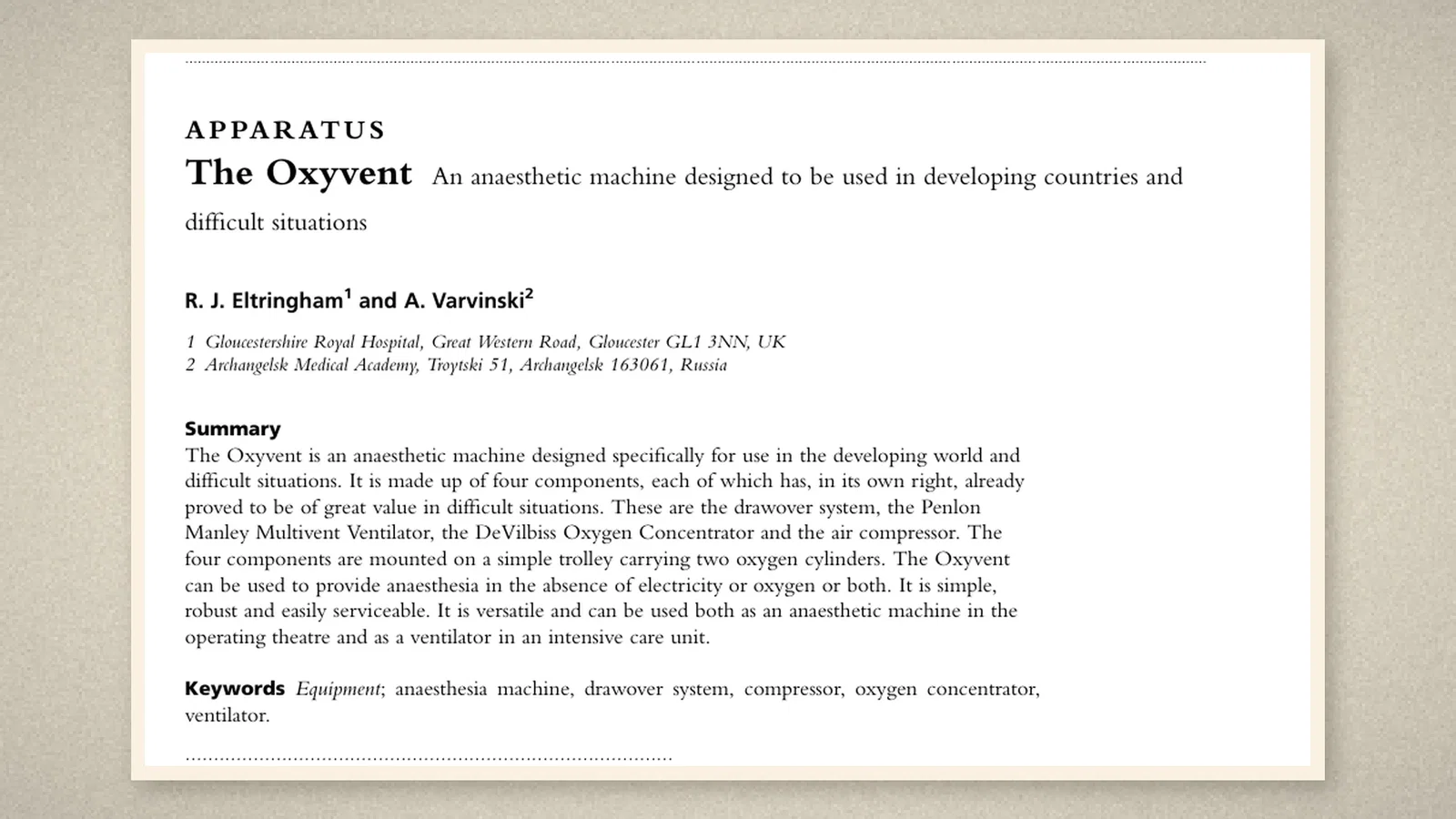
"The Oxyvent. An anaesthetic machine designed to be used in developing countries and difficult situations", by R. J. Eltringham of Gloucestershire Royal Hospital and A. Varvinski of Archangelsk Medical Academy, appeared in Anaesthesia in 1997. "In many regions of the world anaesthetics are administered by health workers with limited training, unreliable supplies and inadequate and poorly serviced equipment." A machine for those places had to be robust, easy to understand, need little maintenance, be repairable with local skills, and keep working if compressed gas or electricity failed. Sophisticated machines sent there had usually been "expensive failures": at the first fault they were "consigned to the graveyard of anaesthetic apparatus gathering dust in store rooms around the world". [1, p. 668]
Four parts on a trolley
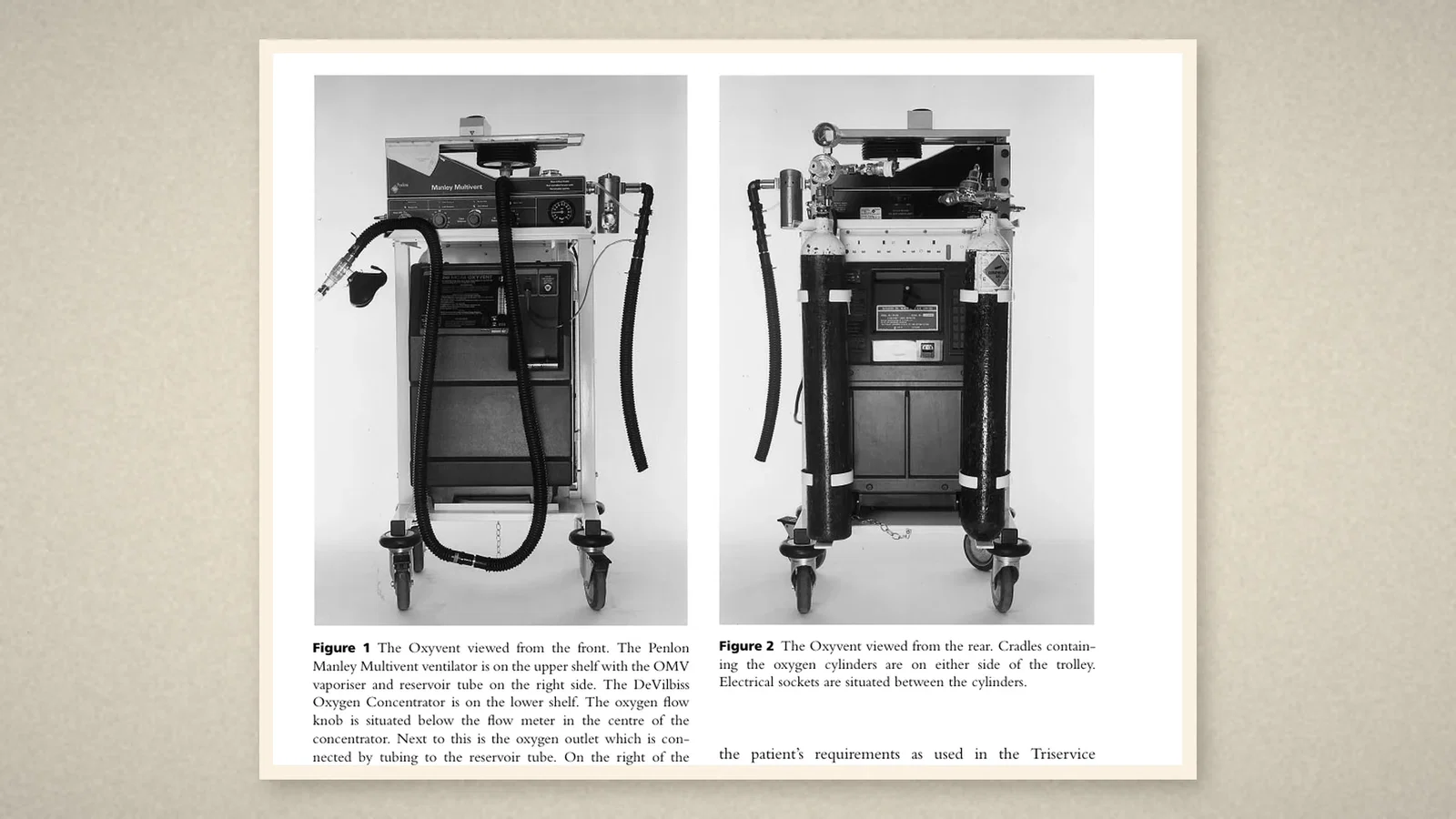
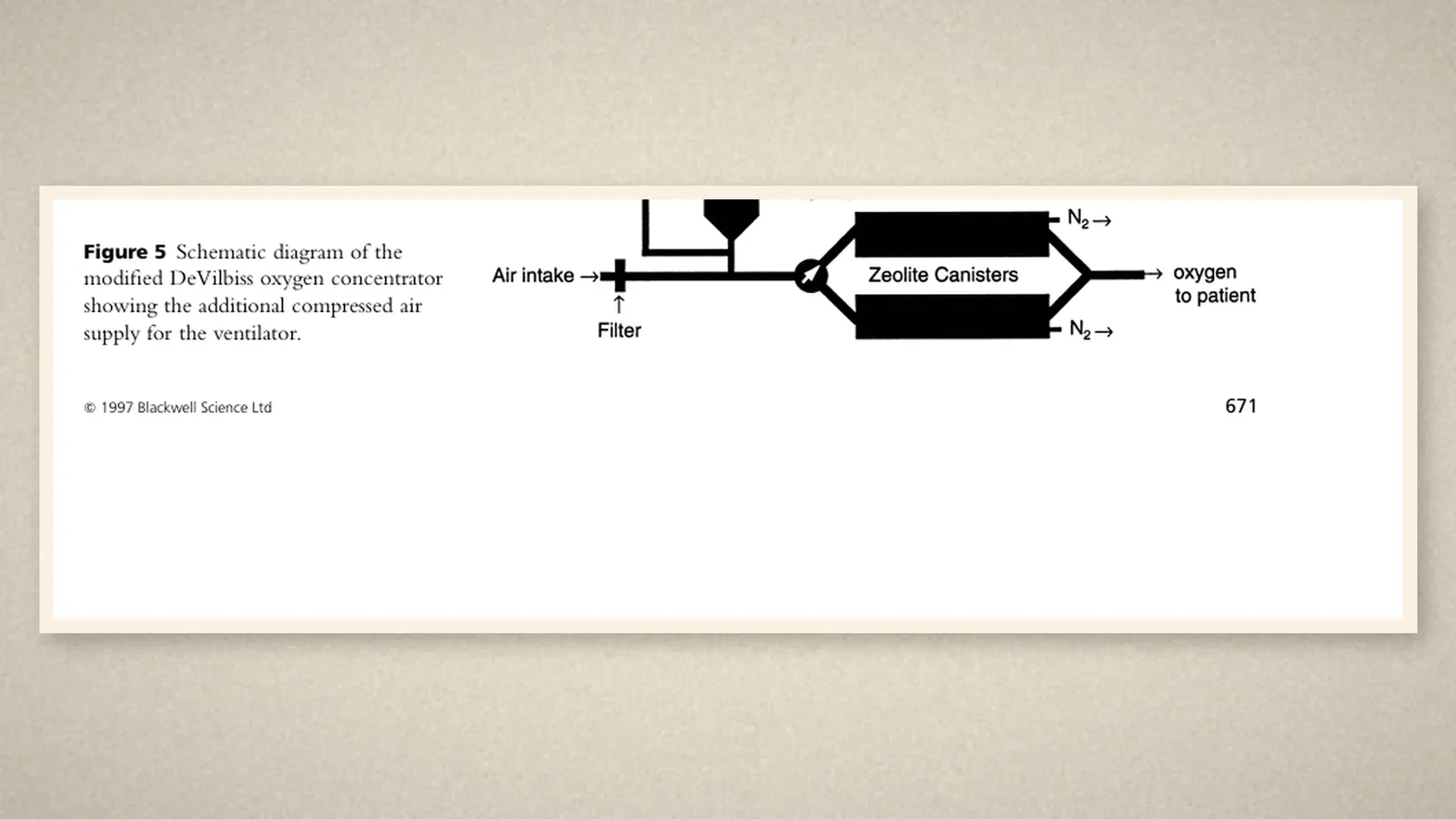
The Oxyvent was "made up of four components, each of which has, in its own right, already proved to be of great value in difficult situations". The drawover system used "atmospheric air being used as the carrier gas", with a modified Oxford Miniature Vaporiser and Oxford Inflating Bellows. The Penlon Manley Multivent ventilator, a mechanical version of the bellows, could be driven by any compressed gas, had only three controls and a battery for power cuts; when oxygen drove it, the same oxygen could then be fed to the inspired gas, so that it was "used twice". The DeVilbiss oxygen concentrator, which strips nitrogen from air with zeolite, was modified to send compressed air from a second outlet to the ventilator: "an alternative source of power is automatically built into the Oxyvent at no extra cost". Two oxygen cylinders rode at the back. [1, pp. 668-71]
When things fail
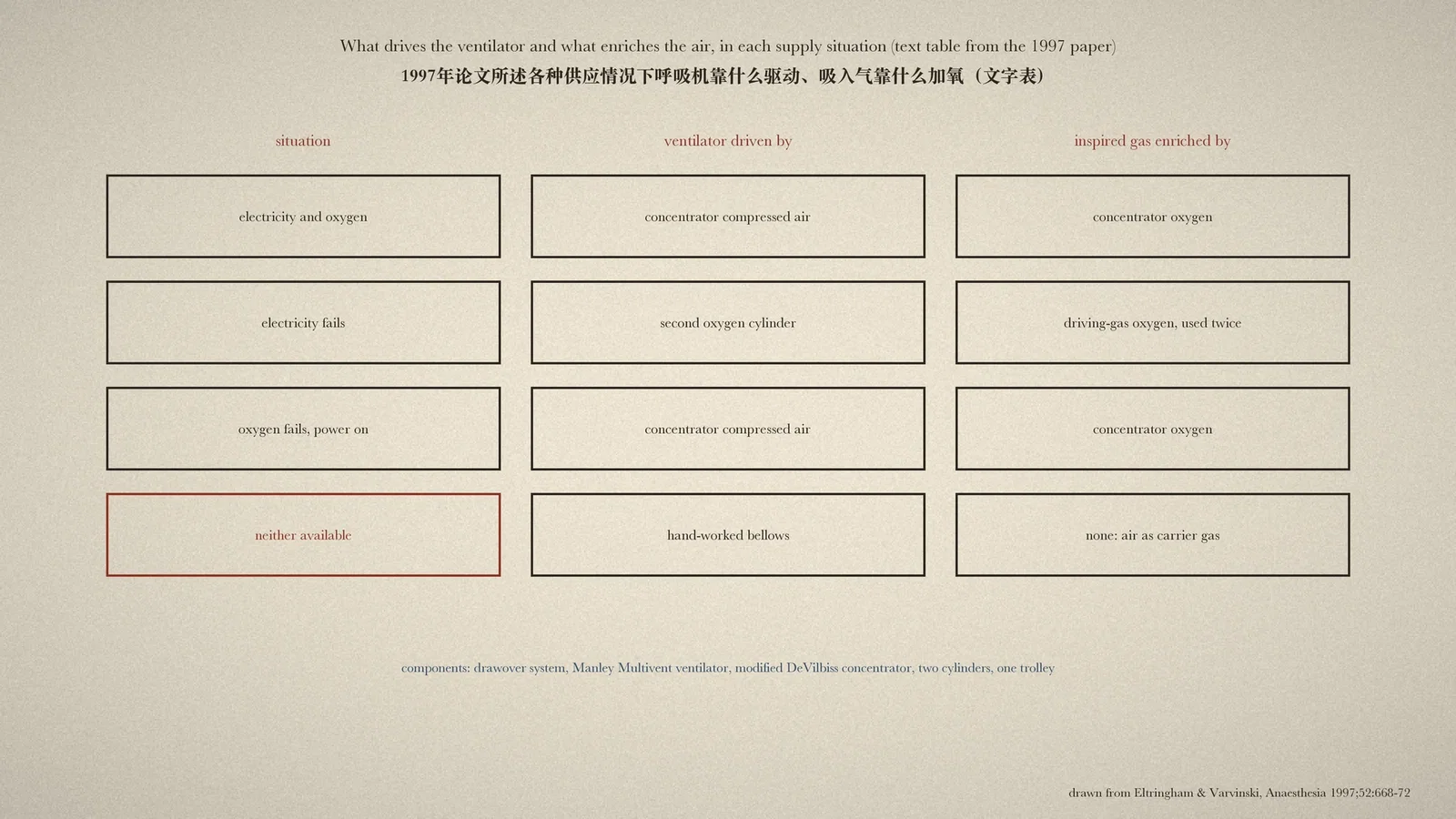
The paper's most important passage is a list of failures. With electricity, the concentrator's air drives the ventilator and its oxygen enriches the inspired gas. "If the supply of electricity is interrupted, the flow of compressed air ceases and the low-pressure alarm sounds on the ventilator"; the second cylinder is turned on and ventilation continues. If oxygen fails while electricity remains, the process runs in reverse. And "in the event of neither oxygen nor electricity being available anaesthesia can still be administered safely using air as the carrier gas", with the bellows worked by hand. [1, p. 671]
The authors concluded that the Oxyvent was simple, robust, easily serviceable and versatile, usable in theatre with any breathing system and any size of patient or as a ventilator in intensive care, and that "most important of all it can continue to function in the event of interruption in the supply of either oxygen or electricity or both". It was available from Penlon. [1, p. 671]
The timeline's account
The Australian Society of Anaesthetists (ASA) timeline lists under 1997 "The concept of the Glostavent (initially called Oxyvent) anaesthetic machine developed" by Roger J. Eltringham, adding that Andrei Varvinski, a former Russian serviceman, suggested the oxygen concentrator and that an engineer, Robert C. Neighbour, helped develop it. It describes the result as a machine costing about one-sixth of first-world machines, in use in over 70 countries, the latest version being the Glostavent Helix. [2, p. 85]
What the record shows
An anaesthetic machine designed from the failure backwards. Instead of adding features, the authors asked what had to keep working when the power and the oxygen went, and assembled parts that each already answered that question. The result was not a new invention so much as a new arrangement, and its measure was the operating theatre where nothing else would run.
Sources and reading limits
Read: Eltringham and Varvinski, Anaesthesia 1997;52:668-72, in full (an Internet Archive copy of the article PDF with page images of all five pages); the ASA timeline 2024, p. 85.
Not covered: the papers cited by the authors on drawover anaesthesia, the Manley Multivent and oxygen concentrators; later descriptions of the machine as the Glostavent; the manufacturer's literature; any study of its cost or spread.
Limits: the 1997 paper uses the name Oxyvent; the name Glostavent, Robert Neighbour's part, the one-sixth cost, the 70 countries and the Glostavent Helix are the ASA's statements. The Internet Archive copy was uploaded by a third party; its pagination matches the journal. Flows, pressures, oxygen concentrations and running times are not repeated. No claim of first is made. Quotations are from the English original.
Three illustrations are crops of the 1997 paper; one is drawn from it.
- Eltringham RJ, Varvinski A. The Oxyvent. An anaesthetic machine designed to be used in developing countries and difficult situations. Anaesthesia. 1997;52:668-72. Internet Archive
- Australian Society of Anaesthetists. Anaesthesia history timeline. 2024:85. ASA
Continue exploring
Related reading connects shared questions and contexts; it does not by itself establish historical influence.
Anesthesia Epochs · The Source Room · About & Editorial Method
Published November 3, 2026. Sources and reading limits are stated above. Illustrations are labelled as original source images or AI-made. Historical accounts are educational; they are not current treatment instructions.