
The Australian Society of Anaesthetists timeline records celecoxib marketed in 1998, rofecoxib (Vioxx) launched in 1999 and withdrawn in 2004 after evidence of a high risk of stroke and myocardial infarction with long-term high-dose use, and parecoxib refused US approval in 2005; the FDA Center for Drug Evaluation and Research's COX-2 information page of 2005, preserved in the Wayback Machine, records the regulatory side: Merck's voluntary worldwide withdrawal of Vioxx, an advisory recommending limited use of COX-2 inhibitors, the request that Pfizer withdraw valdecoxib, and a boxed warning on cardiovascular events and gastrointestinal bleeding for every prescription NSAID.
Reading Library · Anesthesia Epochs · 中文版
Watch the education video (for clinicians)
1998: COX-2 Inhibitors — Rofecoxib Withdrawn and NSAID Boxed Warnings · Anesthesia Epochs Education Series
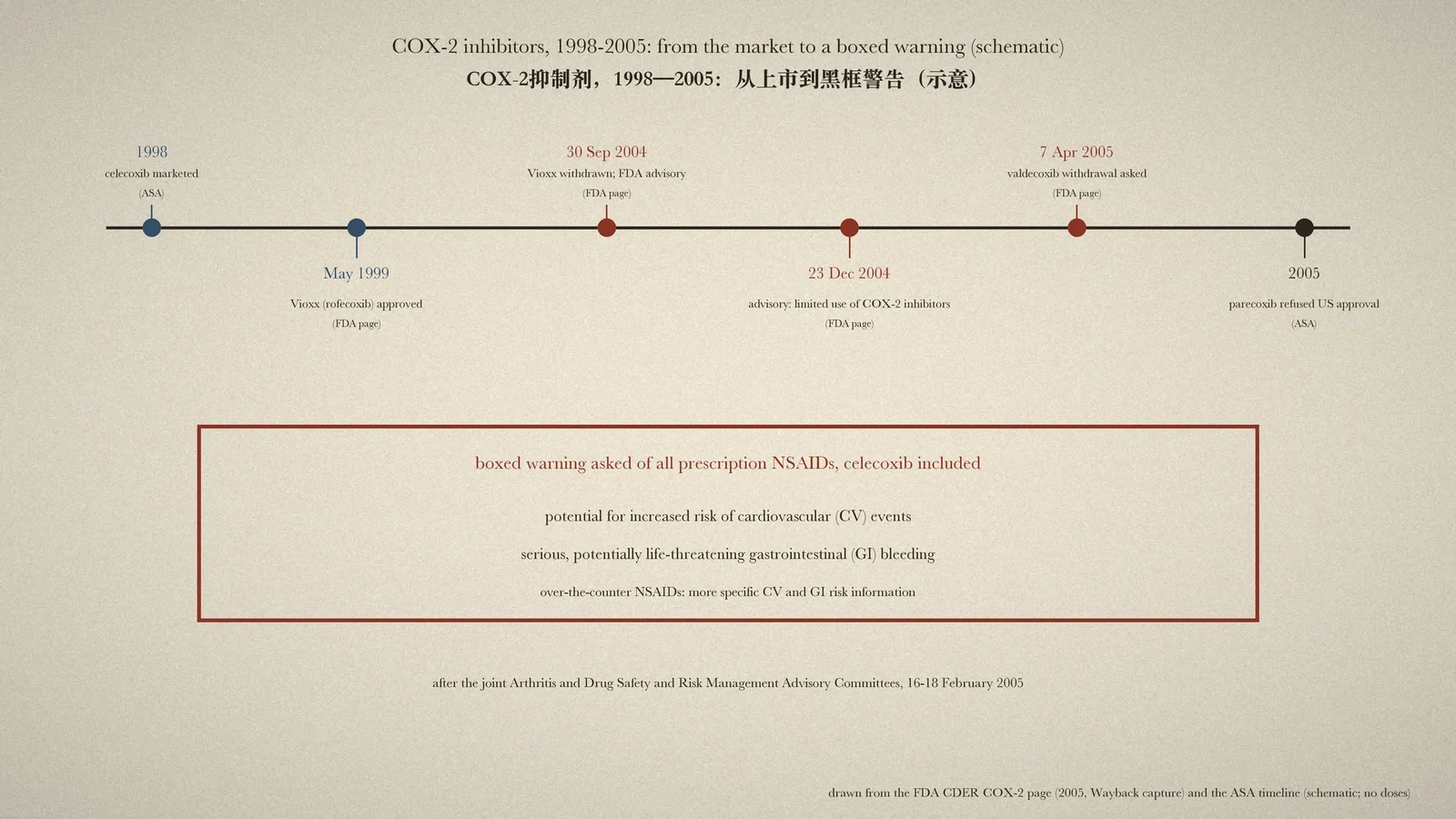
Within a few years of reaching the market, the selective COX-2 inhibitors became a lesson in how a drug's risks can come to light only after it is in wide and long use. The Australian Society of Anaesthetists (ASA) timeline marks four steps. Under 1998: "First COX-2 inhibitor marketed (celecoxib)", attributed to Pfizer. Under 1999: "Rofecoxib (Vioxx) launched onto the market", attributed to Merck. Under 2004: "Rofecoxib (Vioxx) withdrawn from the market", attributed to the FDA "following evidence of high risk of stroke and myocardial infarction with long-term high-dosage use". Under 2005: "Parecoxib refused approval in the USA by FDA". [2, pp. 85, 88]
This article reads the regulatory side of that story in one contemporary document: the information page that the Center for Drug Evaluation and Research (CDER) of the US Food and Drug Administration kept on "COX-2 Selective (includes Bextra, Celebrex, and Vioxx) and Non-Selective Non-Steroidal Anti-Inflammatory Drugs (NSAIDs)". The page was created on 7 April 2005 and updated on 18 July 2005; it is read here as the Internet Archive preserved it on 30 October 2005. [1, p. 5]
Vioxx
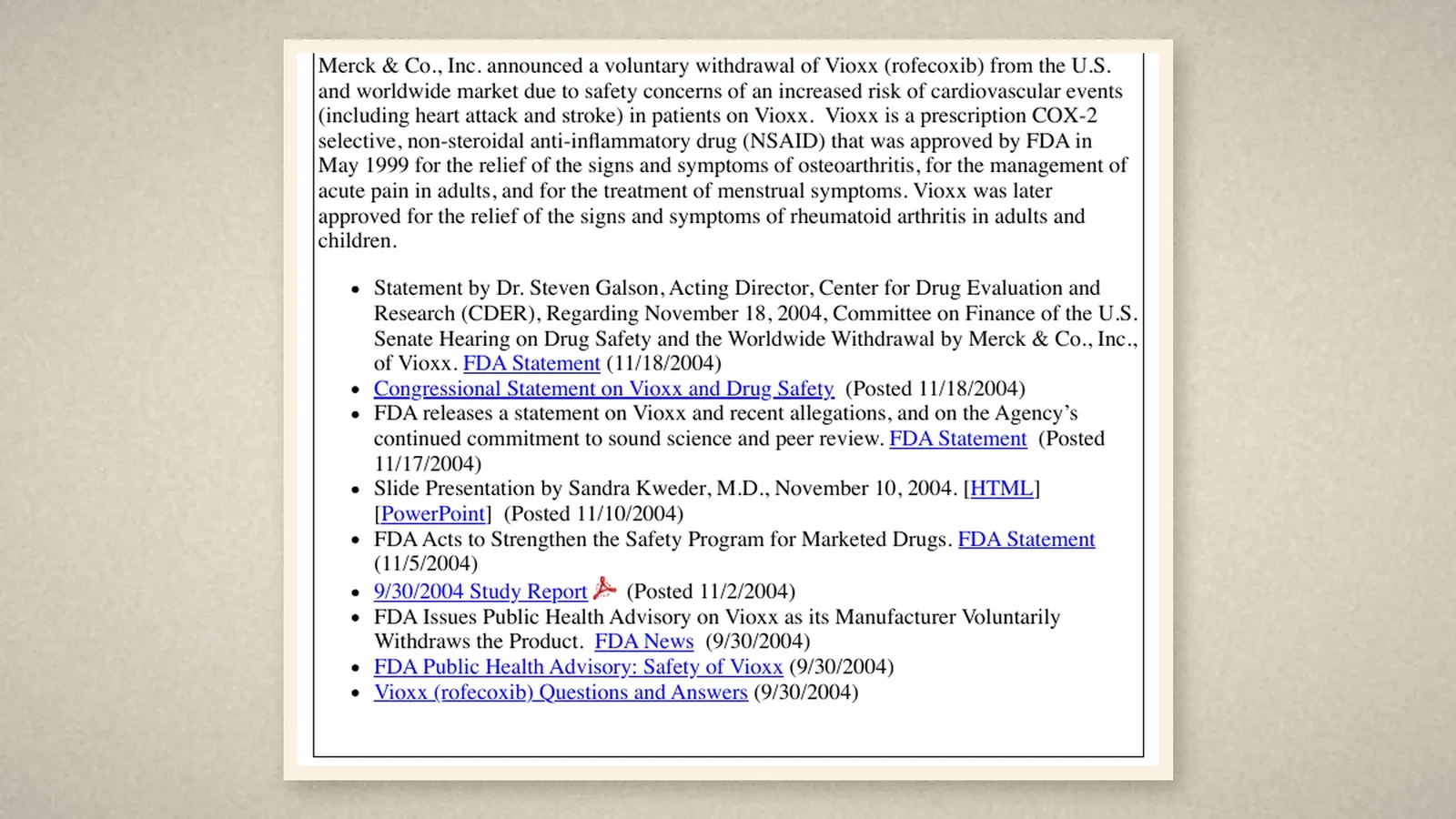
The page describes Vioxx as a prescription COX-2 selective NSAID "approved by FDA in May 1999" for the signs and symptoms of osteoarthritis, the management of acute pain in adults and menstrual symptoms, and later approved for rheumatoid arthritis in adults and children. It then records the end: "Merck & Co., Inc. announced a voluntary withdrawal of Vioxx (rofecoxib) from the U.S. and worldwide market due to safety concerns of an increased risk of cardiovascular events (including heart attack and stroke) in patients on Vioxx." [1, pp. 3-4]
Beneath that paragraph the page lists what followed: a public health advisory and questions and answers on 30 September 2004, the day of the withdrawal; a study report posted in November; a statement on strengthening the safety program for marketed drugs; a slide presentation by Sandra Kweder; a statement "on Vioxx and recent allegations"; and a statement by Steven Galson, acting director of CDER, for a hearing of the US Senate Committee on Finance on drug safety and "the Worldwide Withdrawal by Merck & Co., Inc., of Vioxx" on 18 November 2004. [1, p. 4]
The question moves to the class
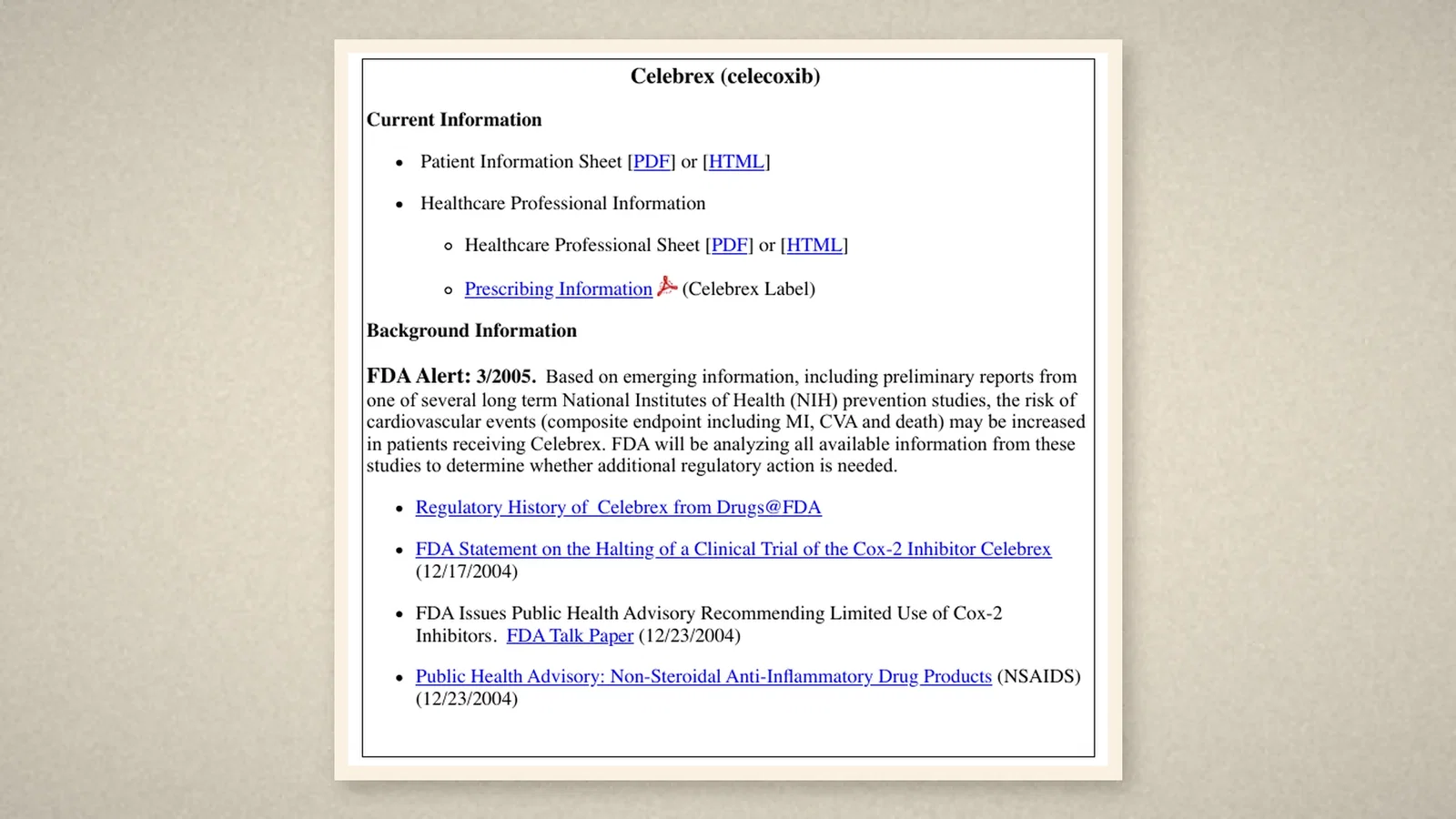
The withdrawal of one drug left the others in question. The Bextra (valdecoxib) section lists a strengthening of warnings in December 2004, and the Celebrex (celecoxib) section lists an "FDA Statement on the Halting of a Clinical Trial of the Cox-2 Inhibitor Celebrex" on 17 December 2004. On 23 December 2004 the FDA issued a public health advisory "Recommending Limited Use of Cox-2 Inhibitors". An FDA alert of March 2005 explained the concern about celecoxib: preliminary reports from "one of several long term National Institutes of Health (NIH) prevention studies" suggested that the risk of cardiovascular events, a composite of myocardial infarction, stroke and death, "may be increased in patients receiving Celebrex". [1, pp. 2-3]
The decision of April 2005
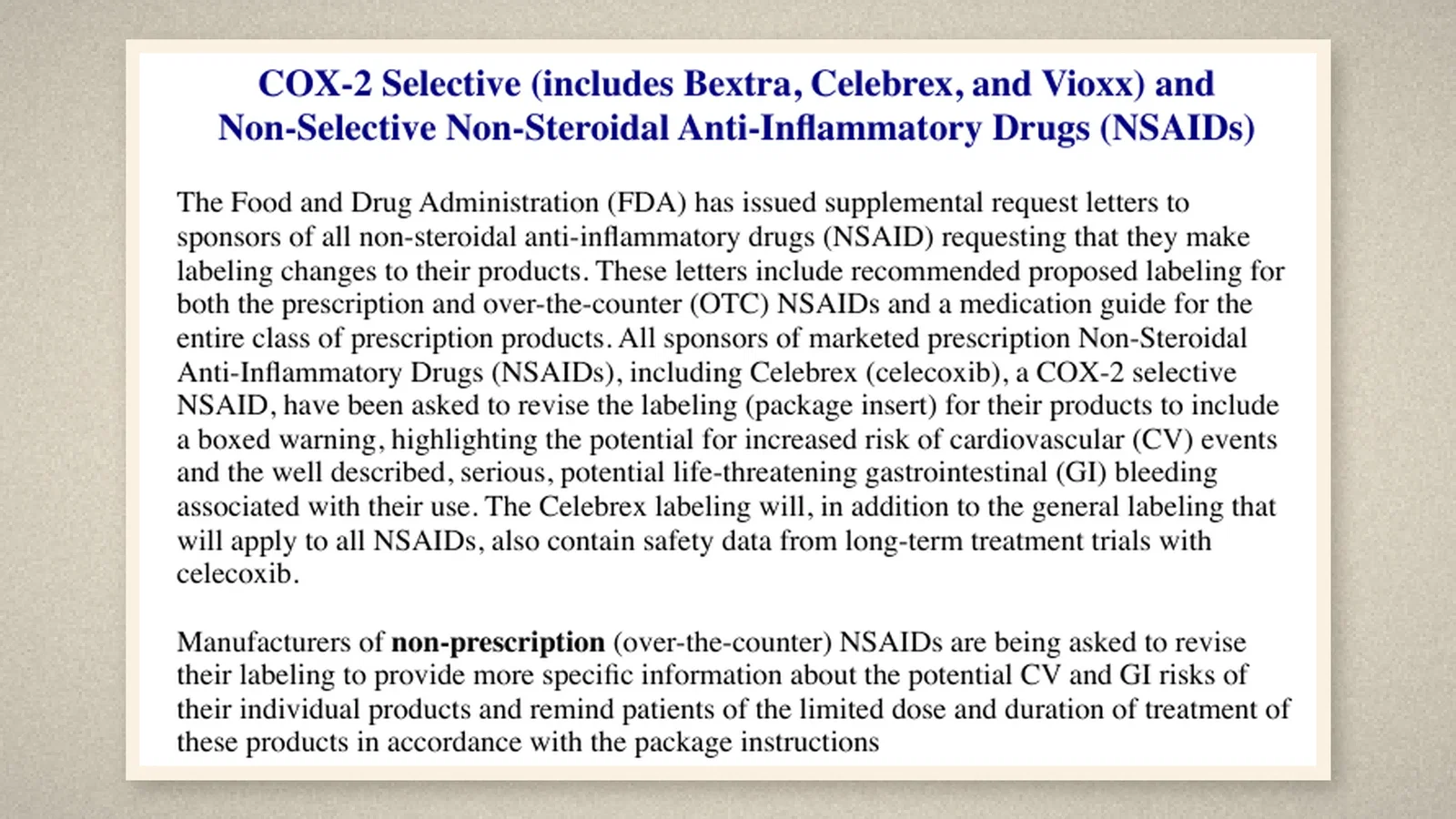
The FDA's Arthritis and Drug Safety and Risk Management Advisory Committees met jointly on 16-18 February 2005. A decision memo was issued on 6 April, and on 7 April 2005 the FDA "asked Pfizer to voluntarily remove Bextra (valdecoxib) from the market". For the drugs that remained, the agency chose labelling rather than removal, and applied it to the whole class, not only to the COX-2 inhibitors. All sponsors of marketed prescription NSAIDs, "including Celebrex (celecoxib)", were asked to revise their package inserts "to include a boxed warning", highlighting "the potential for increased risk of cardiovascular (CV) events" and "the well described, serious, potential life-threatening gastrointestinal (GI) bleeding associated with their use". A medication guide was prepared for the whole class of prescription products, and the Celebrex label was also to carry safety data from long-term trials. [1, pp. 1-2]
Over-the-counter NSAIDs were included too. Their manufacturers were asked to give more specific information on cardiovascular and gastrointestinal risk and to remind patients of the limited dose and duration of treatment. After comments from industry, revised letters and a revised labelling template for these products followed in July 2005. In reaching these decisions, the page says, CDER considered "the risk/benefit profile for each of the drugs", the regulatory histories, the advisory committee documents and votes, and material from other stakeholders. [1, pp. 1-2]
Why it matters to anaesthesia
NSAIDs are part of perioperative analgesia, and the table at the foot of the FDA page lists the familiar agents, among them ketorolac (Toradol), next to the three COX-2 inhibitors. The page makes two lasting points plain: a warning about cardiovascular risk that began with selective drugs was applied to non-selective NSAIDs as well, and the long-known risk of gastrointestinal bleeding was written into the same boxed warning. [1, pp. 4-5]
What the record shows
The page is a regulator's record kept while events were happening: dated links, short summaries and a decision laid out for prescribers and the public. It shows the sequence from a single withdrawal to a warning across the whole class. It does not show the evidence itself, and this article does not claim to.
Sources and reading limits
Read: the FDA CDER COX-2 information page in full, from the Internet Archive capture of 30 October 2005, saved as a PDF (text layer, with page images of printout pp. 1, 3 and 4); the ASA timeline entries for 1998, 1999, 2004 and 2005.
Not covered: the documents linked from the page, including the advisories, questions and answers, study report, statements and slides of 2004, the decision memo of April 2005, the supplemental request letters, labelling template and medication guide; the FDA approval letters for celecoxib and rofecoxib; the FDA records on parecoxib. None could be obtained. For the same reason, the clinical trials behind the withdrawal and the Celebrex alert are not named or described here, and no risk figures are given. The ASA's "First COX-2 inhibitor marketed" is quoted as the ASA's; this article makes no "first" claim. The ASA gives the reason for withdrawal as "long-term high-dosage use"; the FDA page says only an increased risk of cardiovascular events. The parecoxib entry rests on the ASA alone. A later ASA entry on fabricated celecoxib studies belongs to another article. Doses are not repeated.
Three illustrations are crops of the FDA page (printout pp. 1, 3 and 4); one is drawn from the sources.
- U.S. Food and Drug Administration, Center for Drug Evaluation and Research. COX-2 selective (includes Bextra, Celebrex, and Vioxx) and non-selective non-steroidal anti-inflammatory drugs (NSAIDs). Created 7 Apr 2005, updated 18 Jul 2005. Archived 30 Oct 2005. Internet Archive
- Australian Society of Anaesthetists. Anaesthesia history timeline. 2024. ASA
Continue exploring
Related reading connects shared questions and contexts; it does not by itself establish historical influence.
- 1961: Boots Files for the Phenylpropionic Acids, Including Future Ibuprofen
- 1993: Kehlet and Dahl Make the Case for Balanced Analgesia
Anesthesia Epochs · The Source Room · About & Editorial Method
Published November 2, 2026. Sources and reading limits are stated above. Illustrations are labelled as original source images or AI-made. Historical accounts are educational; they are not current treatment instructions.