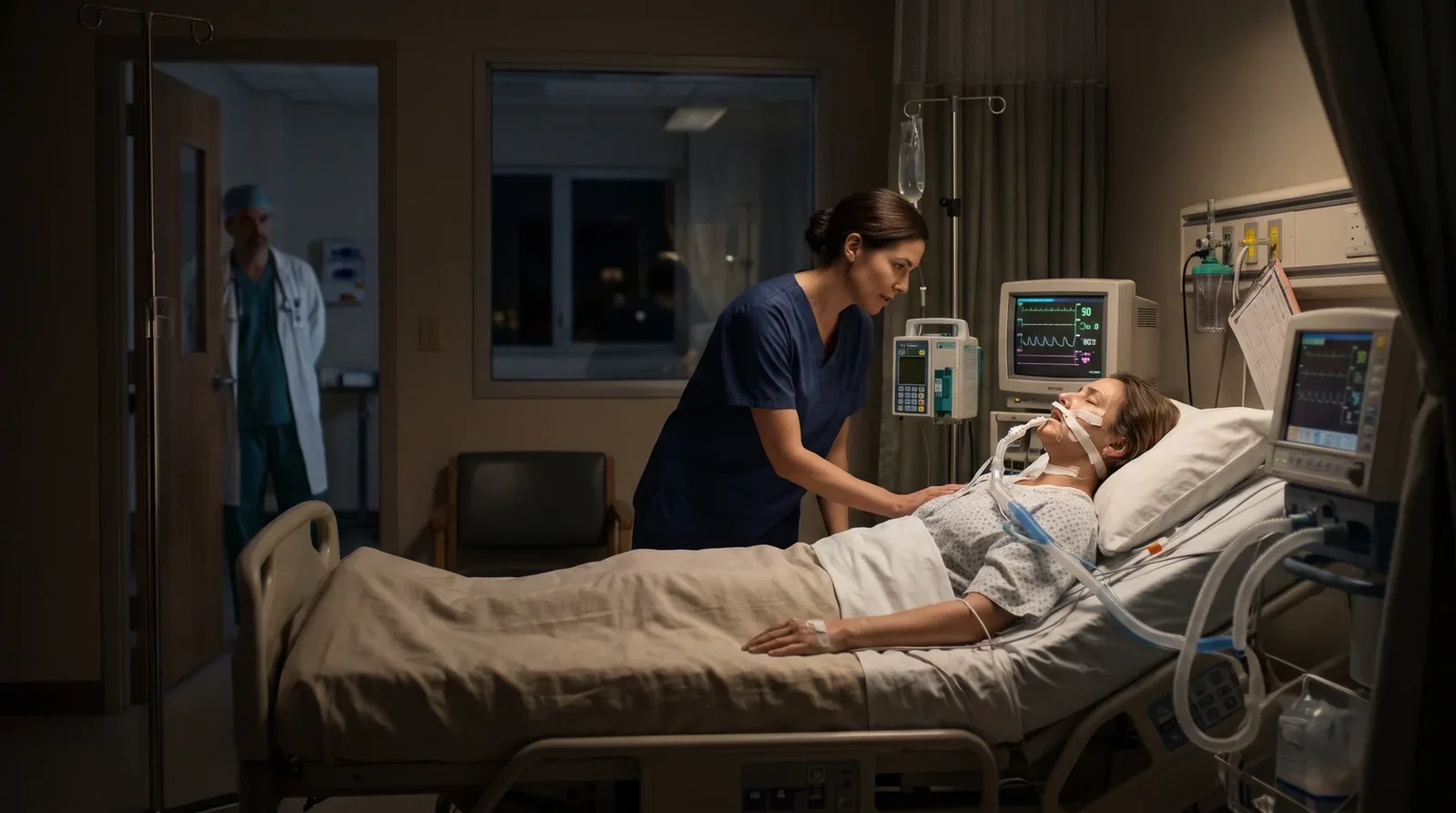
Abbott Laboratories submitted its new drug application for dexmedetomidine injection (Precedex, NDA 21-038) to the US FDA on 18 December 1998. A division memorandum in the FDA review file, written by Cynthia G. McCormick to John K. Jenkins on 30 November 1999, set out the basis for approval: dexmedetomidine was the dextro-enantiomer of the veterinary sedative medetomidine and a selective alpha-2 agonist, developed mainly as a sedative by continuous infusion in intensive care, and a unique feature seen in phase I was adequate sedation with ease of arousal and no persisting central effects once aroused. Two randomised, double-blind, placebo-controlled multicentre trials measured sedation indirectly by the rescue midazolam or propofol needed, with a direct comparison added at the division's request; safety data combined the original Japanese programme with Abbott's work. The memo recommended approval for ICU sedation by infusion for up to 24 hours, with post-marketing studies of longer infusion, metabolites, children and the very elderly. FDA's 2022 review gives the initial approval as 17 December 1999, extended to procedural sedation of non-intubated adults on 17 October 2008.
Reading Library · Anesthesia Epochs · 中文版
Watch the education video (for clinicians)
1999: Dexmedetomidine (Precedex) — FDA Approval for ICU Sedation · Anesthesia Epochs Education Series
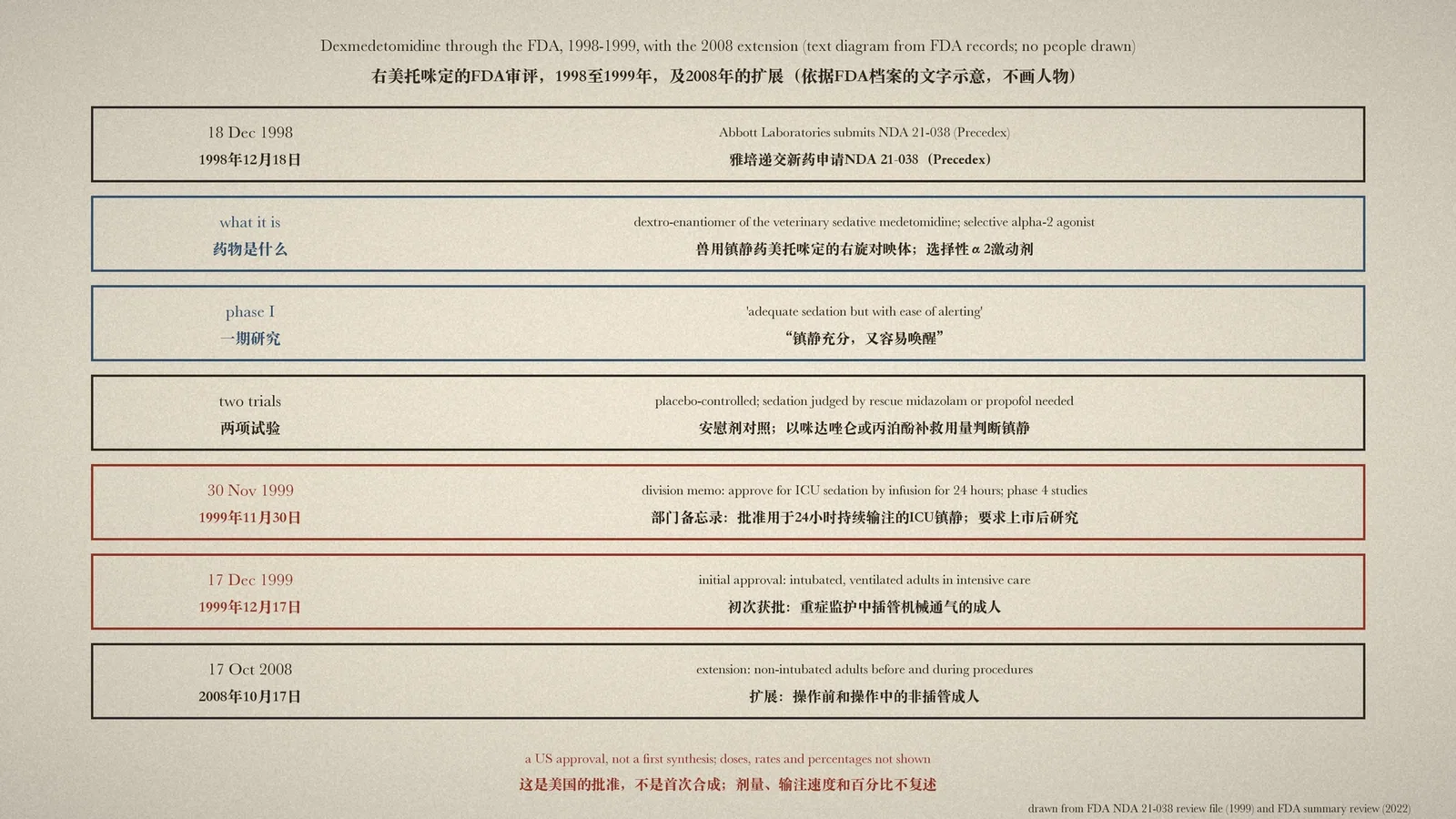
Sedation in intensive care often means a trade-off: patients should be calm and tolerate the tracheal tube, yet be easy to wake for examination. On 17 December 1999 the US Food and Drug Administration approved a new sedative, dexmedetomidine, sold as Precedex, for intubated and mechanically ventilated adults in intensive care. The FDA's public review file contains a division memorandum explaining why. [1, PDF p. 5][2, p. 8]
A new drug application
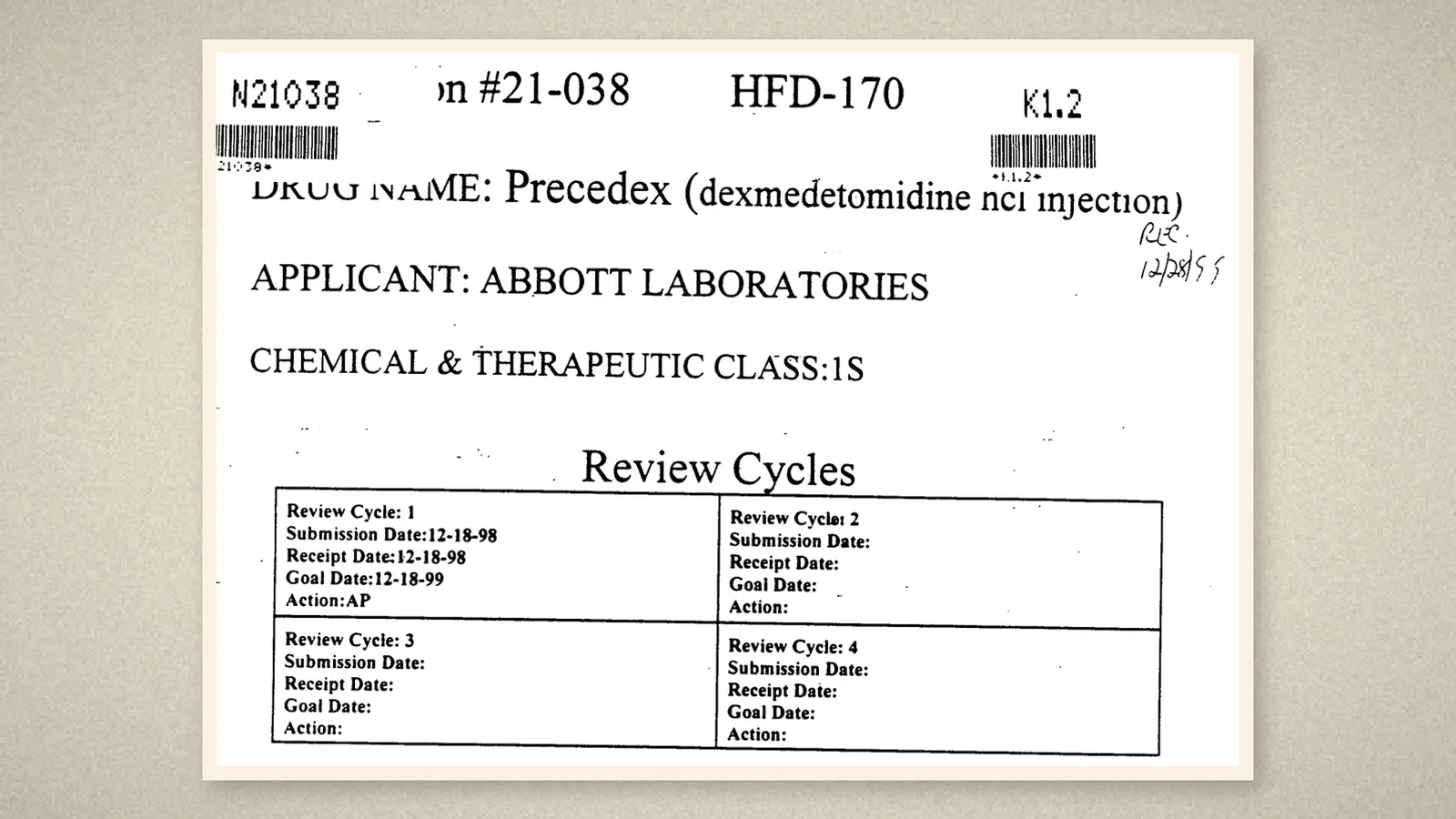
The cover of the review file reads: application 21-038, drug name Precedex (dexmedetomidine HCl injection), applicant Abbott Laboratories; first review cycle, submission and receipt on 18 December 1998, goal date 18 December 1999, and in the action box "AP", approval. The medical reviewer was Patricia Hartwell, alongside reviewers for chemistry, pharmacology and toxicology, biopharmaceutics, biometrics, abuse liability and microbiology. [1, PDF p. 2][1, PDF p. 3]
How the memo described the drug
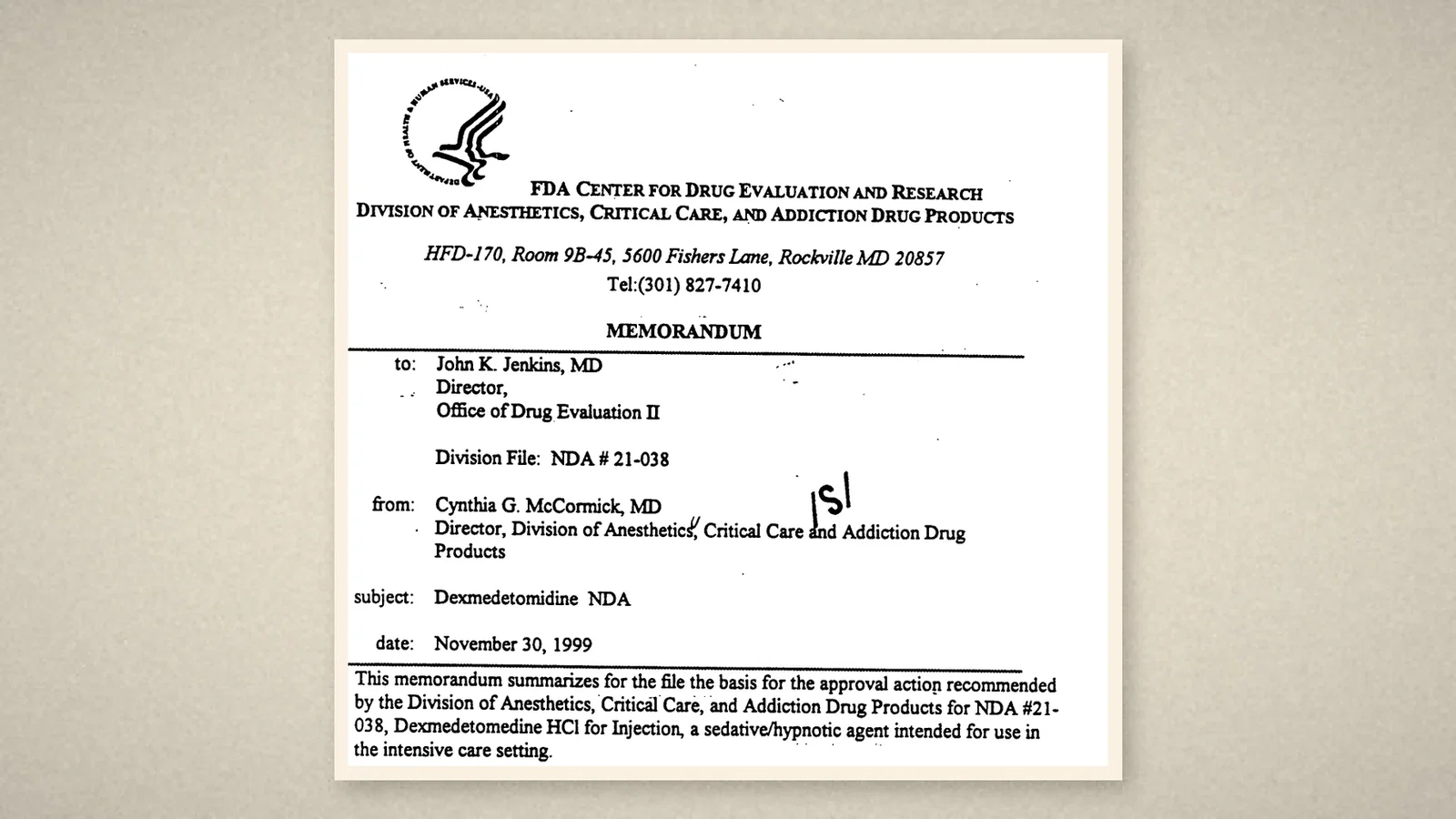
On 30 November 1999 Cynthia G. McCormick, director of the Division of Anesthetics, Critical Care, and Addiction Drug Products at the FDA's Center for Drug Evaluation and Research, wrote to John K. Jenkins, director of the Office of Drug Evaluation II, to summarise "for the file the basis for the approval action recommended" by the division. Dexmedetomidine, a sedative/hypnotic intended for intensive care, was "the dextro-enantiomer of the racemic mixture, medetomidine" and a selective alpha-2 adrenoreceptor agonist; a footnote added that medetomidine was a veterinary sedative widely available in Europe and approved in the US. It had anxiolytic, analgesic and sedative activity in animal models; in humans it was developed primarily for sedation and studied by continuous intravenous infusion in intensive care. It had been expected to act like clonidine, another alpha-2 agonist used as an anaesthetic adjuvant. [1, PDF p. 5]
The memo singled out one observation: "A unique feature of dexmedetomidine as a sedative which was observed in phase I studies was its property of providing adequate sedation but with ease of alerting and without persisting central effects, once the patient is aroused." [1, PDF p. 6]
Two trials, and how sedation was proved
The efficacy evidence came from two randomised, double-blind, double-dummy, placebo-controlled multicentre trials of similar design. They did not measure sedation head to head; instead they compared how much rescue medication was needed to reach a specified level on the Ramsay sedation scale, midazolam in one trial and propofol in the other. At the division's request a second prospective primary analysis compared directly the proportion of patients who kept the target sedation with no rescue. In both trials patients given placebo needed significantly more rescue drug and more morphine, and time to extubation did not differ. Dexmedetomidine, the memo concluded, was clearly the primary agent and an effective sedative. [1, PDF p. 6][1, PDF p. 7][1, PDF p. 8]
Reservations about safety
The memo also set out what was uncertain. Chronic dosing in animals was associated with hepatic toxicity, and the two major human glucuronide metabolites, absent in rats and dogs, had never been studied in animals. The clinical safety database combined the "Japanese original development program" with Abbott's later data; in placebo-controlled trials the common adverse events more than twice as frequent as with placebo were hypotension, hypertension and bradycardia. The available studies suggested an abuse potential lower than some scheduled products. [1, PDF p. 8][1, PDF p. 9][1, PDF p. 11]
"Will not have use limited to this population"
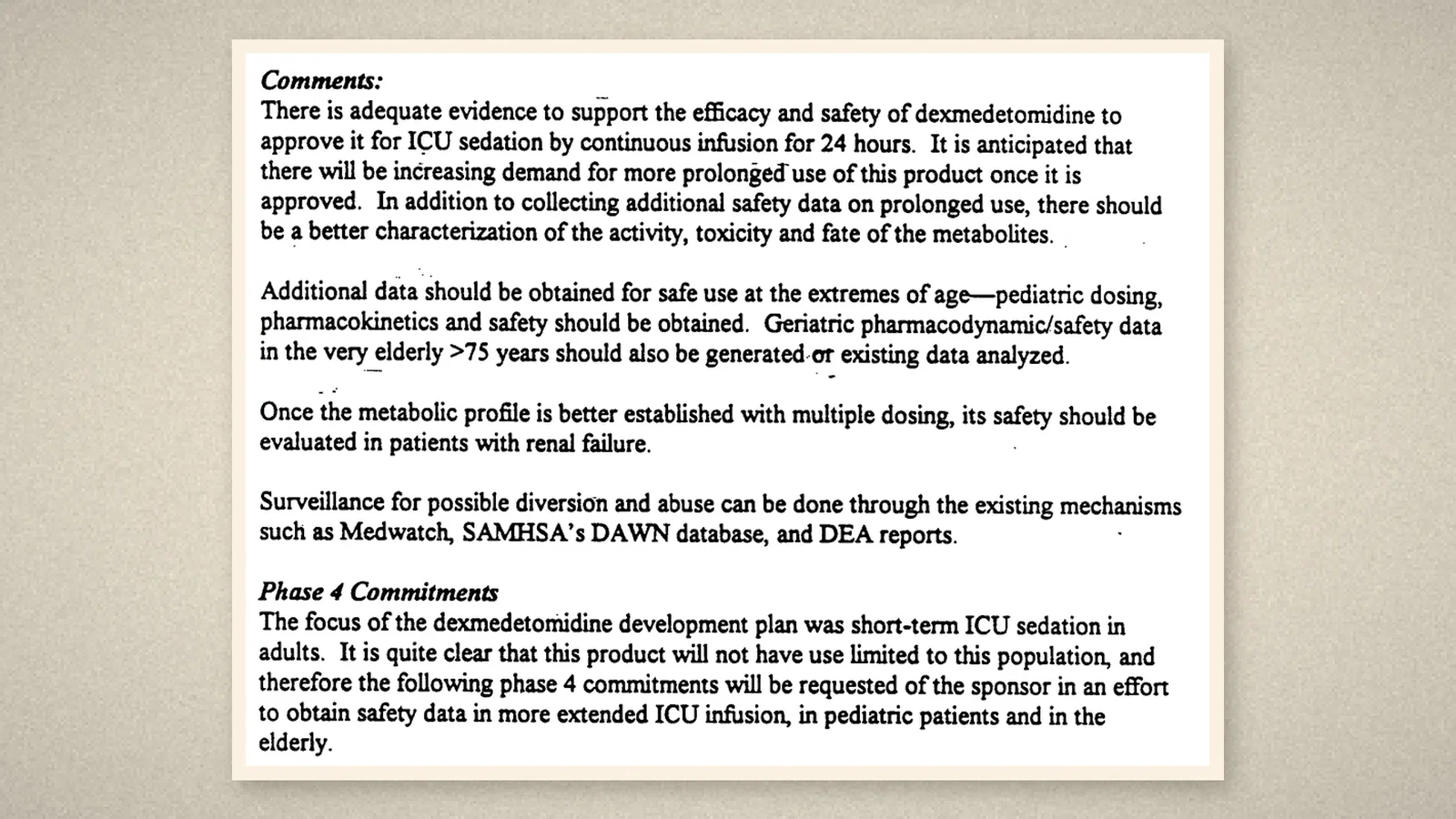
The memo's comment was that there was adequate evidence to approve dexmedetomidine "for ICU sedation by continuous infusion for 24 hours". But it anticipated "increasing demand for more prolonged use of this product once it is approved"; the development plan had focused on short-term adult ICU sedation, and "it is quite clear that this product will not have use limited to this population". The FDA therefore requested post-marketing studies of longer infusion, metabolite toxicity, and safety in children, the very elderly and patients with renal impairment. The recommended action was approval of dexmedetomidine as an adjunctive medication for ICU sedation. [1, PDF p. 13][1, PDF p. 14]
The later record
More than twenty years later, the FDA's summary review of Hospira's paediatric supplement, dated 16 December 2022, recalled that Precedex, a selective alpha-2 agonist, "was initially approved on December 17, 1999", for sedation of intubated and mechanically ventilated adults during treatment in an intensive care setting, and that on 17 October 2008 it was approved for sedation of non-intubated adults before and during surgical and other procedures. [2, p. 8]
What the record shows
This memorandum shows a new sedative entering the intensive care unit: evidence from placebo-controlled trials that measured sedation indirectly through rescue drugs, an approval limited to 24 hours, and reviewers who already expected clinicians to take it much further.
Sources and reading limits
Read: the FDA's public review file for NDA 21-038 (Precedex), Medical Review(s) Part 1 (a 46-page scan), pages 1-14: the CDER cover, the action package cover and tables of contents, and the full ten-page division memorandum from McCormick to Jenkins dated 30 November 1999 (background, efficacy, nonclinical and clinical safety, abuse liability, comments, phase 4 commitments and recommended action). Also read: the FDA's 2022 summary review for NDA 021038 Supplement 028, pages 1-9, whose background section records the 1999 and 2008 approvals.
Not covered: pages 15-46 of the 1999 medical review (Dr Hartwell's detailed review); the 1999 approval letter and label; the statistical, pharmacology and other discipline reviews; the California Society of Anesthesiologists history essay on the discovery of dexmedetomidine; the Finnish discovery and Japanese development history; the original trial publications.
Limits: the 1999 adult ICU indication differs from the 2008 extension, and this is a US approval date, not a first synthesis; this article keeps them apart. The approval date is taken from the FDA's 2022 summary, not from the 1999 letter; the 1999 file shows a goal date of 18 December 1999 and action AP. Doses, infusion rates, percentages and trial patient counts are not repeated, and page crops stop before them. Patients are not identified. "Unique feature" is the memo's wording.
Three illustrations are crops of the FDA NDA 21-038 review file (the action package cover, the first page of the memo and page 9 of the memo). One is a text diagram drawn from the FDA records, with no people drawn and no doses.
- US Food and Drug Administration. NDA 21-038 Precedex (dexmedetomidine hydrochloride) injection. Medical Review(s), Part 1. Center for Drug Evaluation and Research; 1999. PDF
- US Food and Drug Administration. Cross-Discipline Team Leader and Division Director Summary Review for Regulatory Action, NDA 021038 Supplement 028 (Precedex, Hospira). 16 December 2022. PDF
Continue exploring
Related reading connects shared questions and contexts; it does not by itself establish historical influence.
- 1987: Two Trials Find Flumazenil Reverses Midazolam, but Sedation Returns
- 1974: Roche Patents the Compounds That Include Midazolam
Anesthesia Epochs · The Source Room · About & Editorial Method
Published November 3, 2026. Sources and reading limits are stated above. Illustrations are labelled as original source images or AI-made. Historical accounts are educational; they are not current treatment instructions.