
The British Journal of Anaesthesia 2003, vol. 91, no. 2, pp. 170-4, carried 'Age-related iso-MAC charts for isoflurane, sevoflurane and desflurane in man' by R. W. D. Nickalls of the City Hospital, Nottingham, and W. W. Mapleson of the University of Wales College of Medicine, Cardiff. The motivation, the authors state, was the difficulty of estimating a patient's total age-related MAC in a clinical setting. That MAC falls with age had long been known; the charts were built on Mapleson's 1996 meta-analysis of the available MAC data, one chart for each of three common volatile agents, covering the clinically useful range of MAC and ages from childhood to great age, and put in a form convenient for practising anaesthetists. Each chart carries additional scales for two commonly used nitrous oxide concentrations, so that its contribution to the total can be included. The practical value, the discussion says, is twofold: the charts show clearly how age can guide the choice of end-expired concentration, and they allow a consistent total MAC to be maintained when the inspired nitrous oxide concentration is changed. The authors are explicit that this rests on the principle that the effects of inhalational agents are additive, which has not been proved conclusively but is the best working hypothesis, and they warn that when nitrous oxide is withdrawn and the volatile agent increased, tissue solubility makes the arterial and brain concentrations lag behind the end-expired reading, so that anaesthesia may lighten briefly.
Reading Library · Anesthesia Epochs · 中文版
Watch the education video (for clinicians)
2003: Iso-MAC Charts — Nickalls and Mapleson · Anesthesia Epochs Education Series
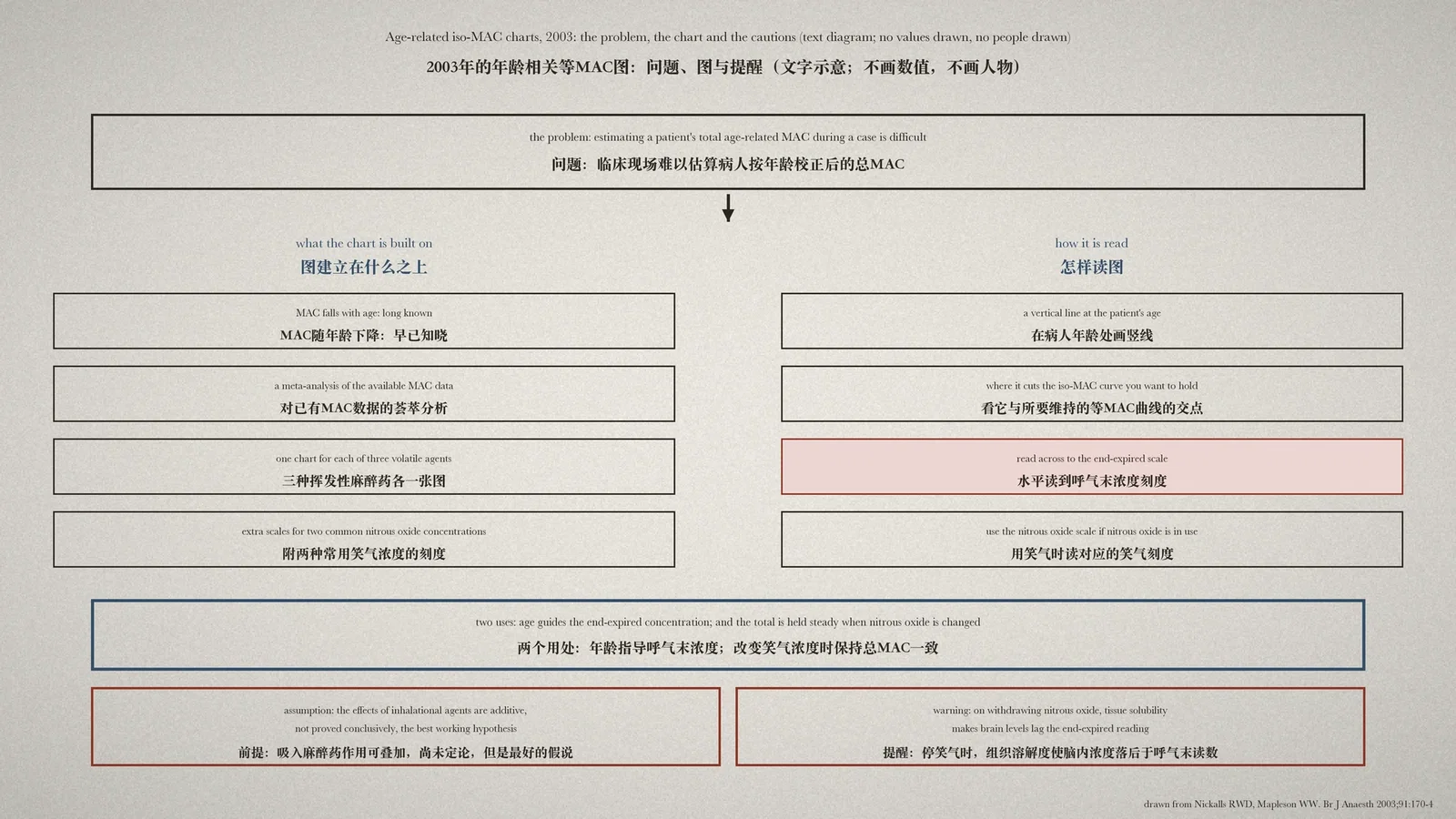
That MAC falls with age has long been known. In theatre, though, with an elderly patient or a child in front of you, converting that into what should be maintained right now is not easy, and it becomes harder still when nitrous oxide is also in use. In 2003 the British Journal of Anaesthesia, vol. 91, no. 2, pp. 170-4, published "Age-related iso-MAC charts for isoflurane, sevoflurane and desflurane in man" by R. W. D. Nickalls of the City Hospital, Nottingham, and W. W. Mapleson of the University of Wales College of Medicine, Cardiff. This article reads that paper. [1, p. 170]
The motivation: the sum cannot be done at the bedside
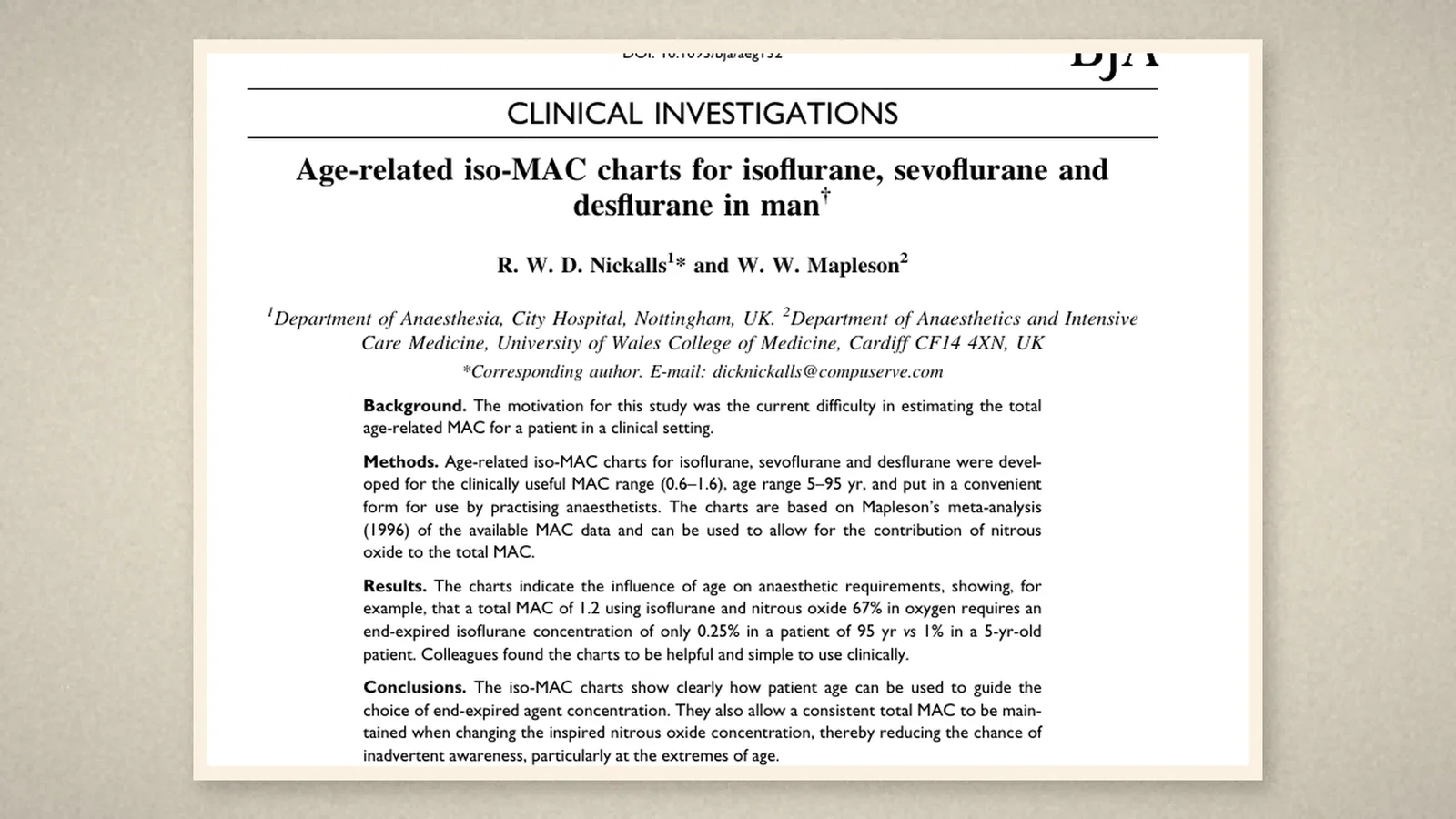
The abstract states the motivation at once: the current difficulty of estimating the total age-related MAC for a patient in a clinical setting. [1, p. 170]
The text first sets the concept straight. MAC is the minimum alveolar concentration at one atmosphere that prevents movement in half of patients exposed to a surgical incision, and it has long been known to decrease with age. In 1996 Mapleson reported a meta-analysis of the available MAC data, and the charts in this paper are built on that analysis. [1, p. 170]
Making it into a usable chart
The authors drew one chart for each of three volatile agents then in common use, covering the clinically useful range of MAC and ages from childhood to great age, and deliberately put them in a form convenient for practising anaesthetists. Besides the scale for the agent carried in pure oxygen, or an oxygen-air mixture, each chart carries additional scales for two commonly used nitrous oxide concentrations, so that the contribution of nitrous oxide to the total can be included. [1, p. 170]
Reading one is direct: draw a vertical line at the patient's age, see where it cuts the iso-MAC curve you want to hold, and follow across to the end-expired scale, using the nitrous oxide scale if nitrous oxide is in use. [1, p. 171]
The authors add that they envisage the charts being updated periodically as more MAC data become available. [1, p. 172]
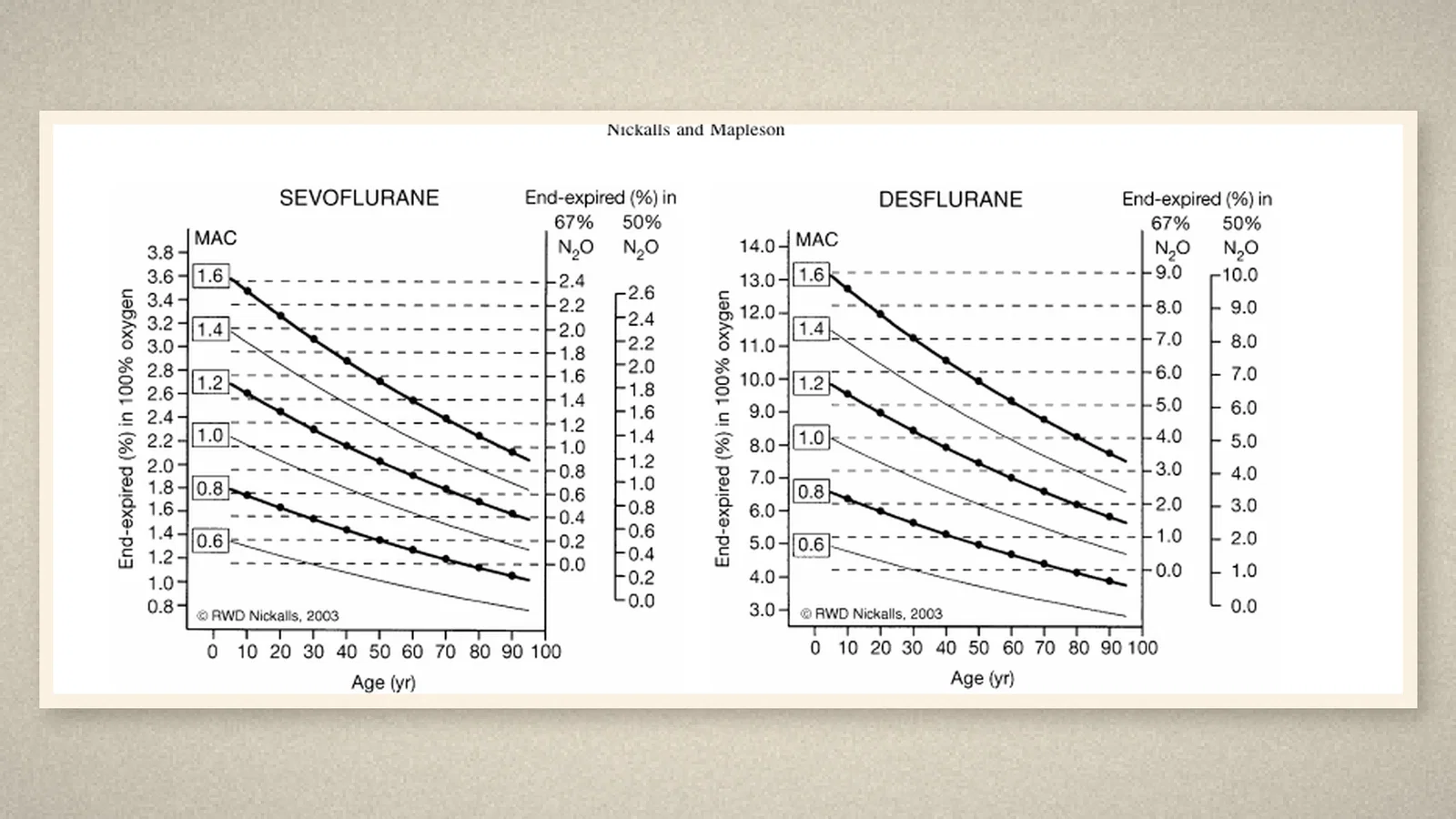
Two uses
The discussion puts the practical value at two things. First, the charts show clearly and easily how patient age can guide the choice of end-expired concentration, whether the volatile agent is carried in oxygen, in an oxygen-air mixture, or with either of the two common nitrous oxide concentrations. Second, they allow a consistent total MAC to be maintained when the fractional inspired nitrous oxide is changed. [1, p. 172]
The second is a common situation: sometimes nitrous oxide must be reduced or stopped for surgical reasons, in ear or bowel surgery for instance, and the chart then shows directly how far the end-expired concentration of the volatile agent must rise to hold the total. [1, p. 172]
Because the variation of MAC with age is often underestimated by clinicians, the authors note, the charts are particularly useful at the extremes of age; and since they make an age-adjusted figure easy to determine during a case, they have the potential to reduce the chance of inadvertent awareness, again particularly at the extremes of age. [1, p. 170][1, p. 172]
The assumption and the warning the authors state
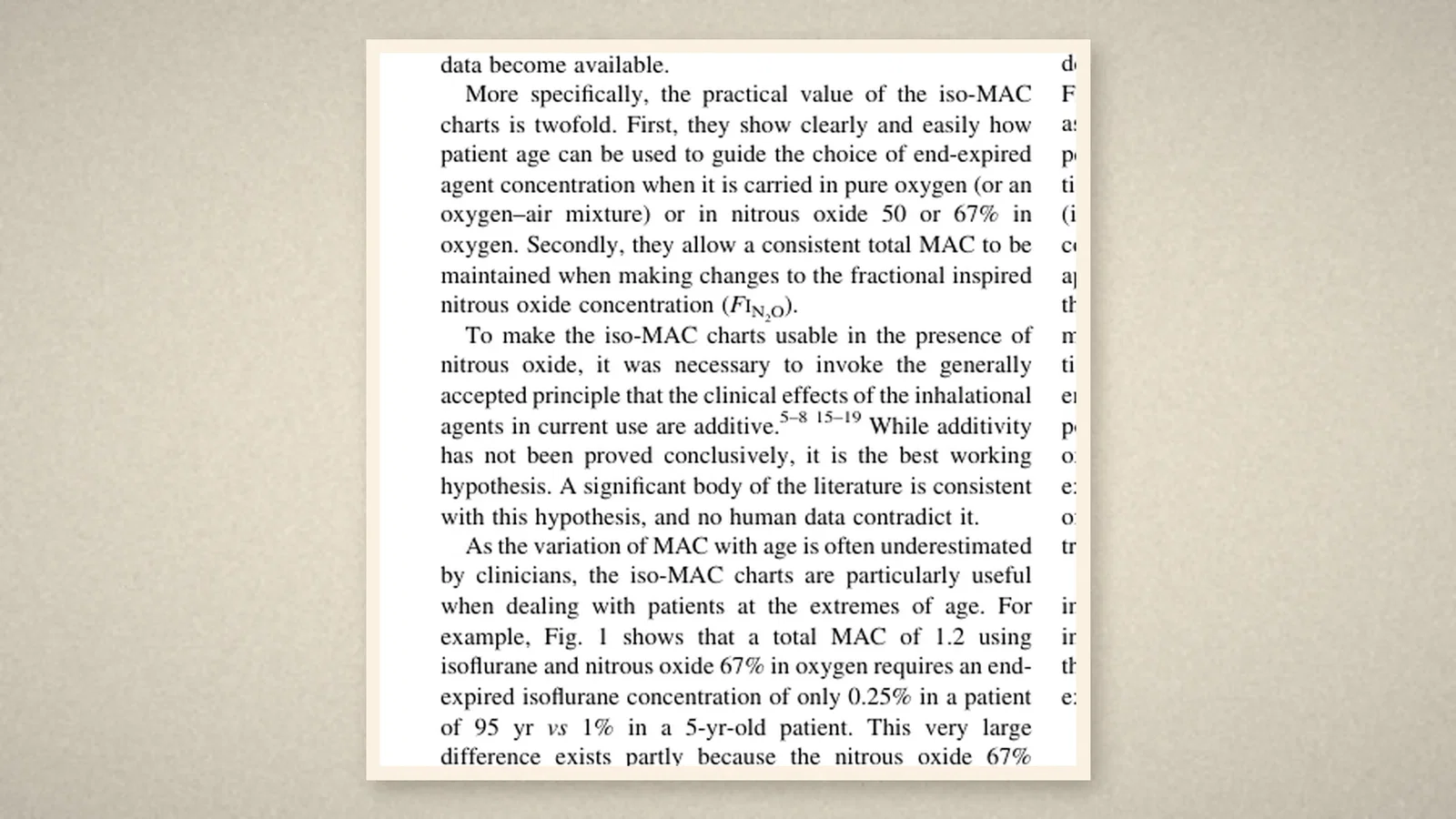
To make the charts usable in the presence of nitrous oxide it was necessary to invoke the generally accepted principle that the clinical effects of the inhalational agents in current use are additive. The authors do not present this as settled: additivity has not been proved conclusively, they write, but it is the best working hypothesis, a significant body of the literature is consistent with it, and no human data contradict it. [1, p. 172]
The second caution concerns time. When the inspired nitrous oxide is decreased and the volatile agent increased, the greater solubility of the volatile agent in the tissues means that the rise of arterial and brain concentrations towards the new end-expired value is slower than the corresponding fall in nitrous oxide. Anaesthesia may therefore lighten briefly despite the higher end-expired reading, unless a still higher concentration is used for the first few minutes. [1, p. 172]
The abstract closes by reporting that colleagues found the charts helpful and simple to use clinically. [1, p. 170]
What the record shows
The paper turns existing knowledge into a usable instrument. That MAC falls with age was old; additivity was an accepted assumption; the data came from an existing meta-analysis. What the authors added was a way to combine all three into something that can be read at a glance during a case, with the assumption it rests on and the trap in using it written into the same paper. It pairs with the introduction of the measure itself: one gives a comparable scale, the other calibrates that scale to the patient in front of you.
Sources and reading limits
Read: Nickalls RWD, Mapleson WW, "Age-related iso-MAC charts for isoflurane, sevoflurane and desflurane in man", British Journal of Anaesthesia 2003, vol. 91, no. 2, pp. 170-4 (Oxford University Press PDF, obtained through institutional access), in full, including the abstract, the construction of the charts, the worked reading, the discussion, the appendix and the references; the page images were checked, including the three charts.
Not covered: Mapleson's 1996 meta-analysis on which the charts rest, and the primary MAC studies gathered in it.
Limits: no agent concentrations, chart readings or dose figures are reproduced here; differences are given in direction and in relative terms, such as an elderly patient needing a far lower end-expired concentration than a child for the same total. The scale shifts for each agent are in the paper's appendix and are not repeated.
Three illustrations are taken from the 2003 paper (p. 170, the two charts on p. 172, and the discussion passages on p. 172). One is a diagram drawn from the text, with no people drawn and no numerical values shown.
- Nickalls RWD, Mapleson WW. Age-related iso-MAC charts for isoflurane, sevoflurane and desflurane in man. Br J Anaesth. 2003;91(2):170-4. doi:10.1093/bja/aeg132
Continue exploring
Related reading connects shared questions and contexts; it does not by itself establish historical influence.
Anesthesia Epochs · The Source Room · About & Editorial Method
Published November 5, 2026. Sources and reading limits are stated above. Illustrations are labelled as original source images or AI-made. Historical accounts are educational; they are not current treatment instructions.