In October 2005 the Apparatus section of Anaesthesia (vol. 60, no. 10) printed 'Initial anatomic investigations of the I-gel airway: a novel supraglottic airway without inflatable cuff' by Richard M. Levitan of Albert Einstein Medical Center and W. C. Kinkle of the Hospital of the University of Pennsylvania, Philadelphia, presented at the Difficult Airway Society meeting in Leicester in November 2004 and accepted on 1 April 2005. Laryngeal masks, the authors wrote, rely on an inflatable cuff that can hamper insertion and positioning, fold down the epiglottis and compress tissue and nerves. The I-gel, made by Intersurgical of Wokingham, has a mask of gel-like thermoplastic elastomer shaped to the perilaryngeal anatomy, with no cuff. In 65 fresh, non-embalmed cadavers at a University of Maryland facility, with 73 optical-stylet endoscopies, 16 neck dissections and six lateral radiographs, a full glottic view was seen in 44 insertions, part of the glottis in 70 of 73, and the bowl covered the laryngeal inlet in every dissection and radiograph. The authors noted that the I-gel was not the first anatomically preshaped supraglottic airway, the SLIPA preceding it, that cadavers differ from anaesthetised patients, and that the maker paid for the study.
Reading Library · Anesthesia Epochs · 中文版
Watch the education video (for clinicians)
2005: The i-gel — No Cuff, Just Shape · Anesthesia Epochs Education Series

After the laryngeal mask, supraglottic airways mostly followed one idea: a ring-shaped cuff that is inflated to wedge around the larynx and make a seal. In 2005 an emergency physician and a nurse from Philadelphia reported in Anaesthesia on a device that went the other way: no inflation, just a soft gel shaped like the region around the larynx. Before trying it on patients, they put it into 65 fresh cadavers and looked from inside, from outside and from the side to see exactly where it came to rest. [1, p. 1022]
What is wrong with an inflatable cuff
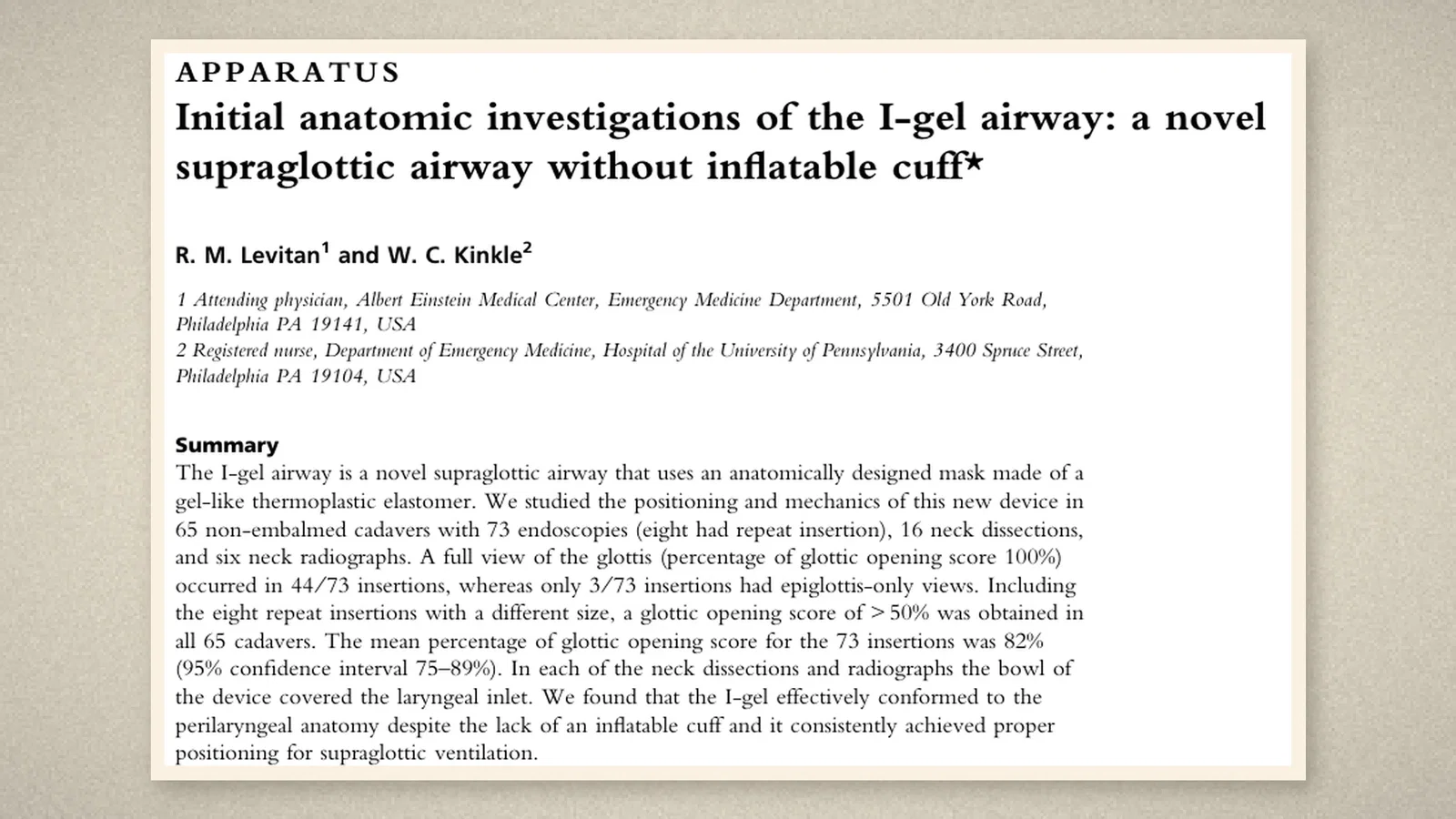
In October 2005 the Apparatus section of Anaesthesia (vol. 60, no. 10) printed "Initial anatomic investigations of the I-gel airway: a novel supraglottic airway without inflatable cuff" by Richard M. Levitan, an attending physician in emergency medicine at Albert Einstein Medical Center, Philadelphia, and W. C. Kinkle, a registered nurse in emergency medicine at the Hospital of the University of Pennsylvania. It had been presented at the Difficult Airway Society meeting in Leicester on 26 November 2004 and was accepted on 1 April 2005. [1, p. 1022]
The introduction listed the drawbacks of inflatable cuffs. The laryngeal mask and similar devices use a cuff to wedge into the upper oesophagus and seal around the larynx, but inflation can affect how they go in, where they sit and how they work. On insertion, the deflated leading edge can catch the edge of the epiglottis and fold it down. The laryngeal mask performs best when semi-inflated; inflating to the recommended volumes stiffens the mask, reduces its conformity to the surrounding structures and lowers the effective seal, and can even push its wedge-shaped tip out of the upper oesophagus. Inflatable masks can also cause tissue distortion, venous compression and nerve injury, and some materials absorb anaesthetic gases, raising the pressure on the mucosa. [1, p. 1022]
A soft gel shaped like the larynx
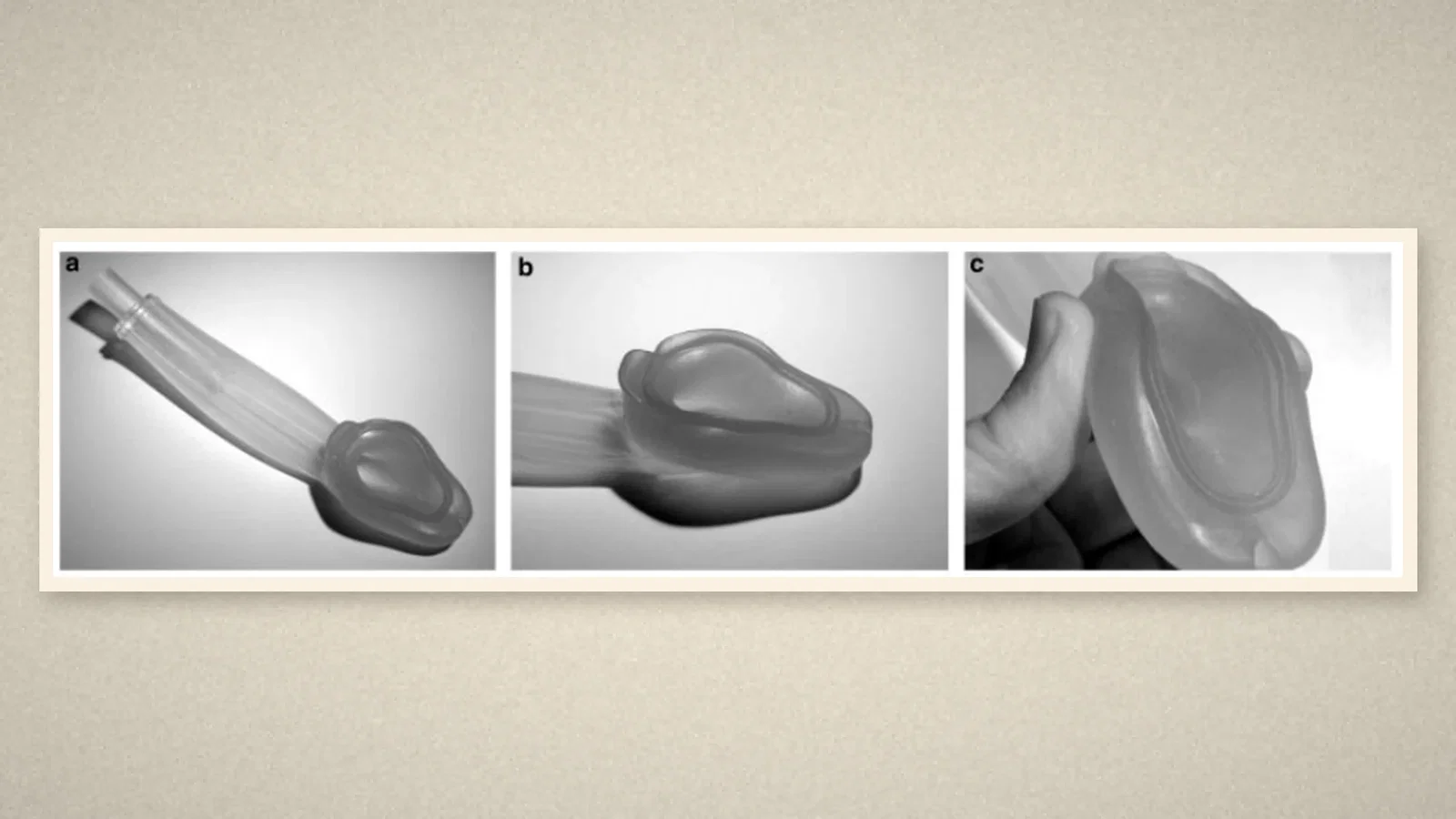
The I-gel, made by Intersurgical Ltd of Wokingham, UK, is moulded from a soft thermoplastic elastomer (SEBS) with "a gel-like feel". Its mask is designed to fit the perilaryngeal and hypopharyngeal structures without any cuff. A cuffless device, the authors suggested, might be easier to insert and use, carry less risk of tissue compression, stay stable after insertion because nothing is inflated, and be simpler and cheaper to make. It is designed for single use. [1, p. 1022]
Seeing where it settles
The study was approved by the University of Pennsylvania's review board and took place at the University of Maryland Medical Center, in a facility run by the Anatomy Board of the State of Maryland; all the bodies had been donated, or consented by families, for medical education and research. Sixty-five fresh, non-embalmed cadavers were used over five months. [1, p. 1023]
The authors looked from three directions. Endoscopy: after the lead author placed the I-gel, a malleable high-resolution optical stylet was passed down its main lumen, the view of the laryngeal inlet as it left the tube was recorded on video, and the second author scored it frame by frame by percentage of glottic opening. Dissection: 16 cadavers had neck dissections below the hyoid, at the cricothyroid membrane and at the upper trachea. Imaging: six had lateral soft-tissue radiographs. [1, p. 1023]
In 70 of 73 endoscopies part of the glottis was visible as soon as the stylet left the lumen, and in 44 the whole glottis was seen; in three the epiglottis blocked the view, though the opening at the base of the bowl was not occluded. In all 16 dissections the proximal bowl lay next to the epiglottis and the main cup covered the laryngeal inlet, and on repeated insertion the sides of the bowl could be seen bending slightly inward beneath the pharyngo-epiglottic folds. [1, p. 1023] A small ridge on the proximal bowl caught against the base of the tongue and stopped the device sliding upward. The flattened, firmer tube let it be guided along the palate by its proximal end, so "it was not necessary to insert fingers into the mouth", and in none of the 16 dissections did it catch on the tongue or the epiglottis. In all six radiographs the bowl lay over the laryngeal inlet with its tip in the cervical oesophagus. [1, p. 1024]
"Not the first", in the authors' own words
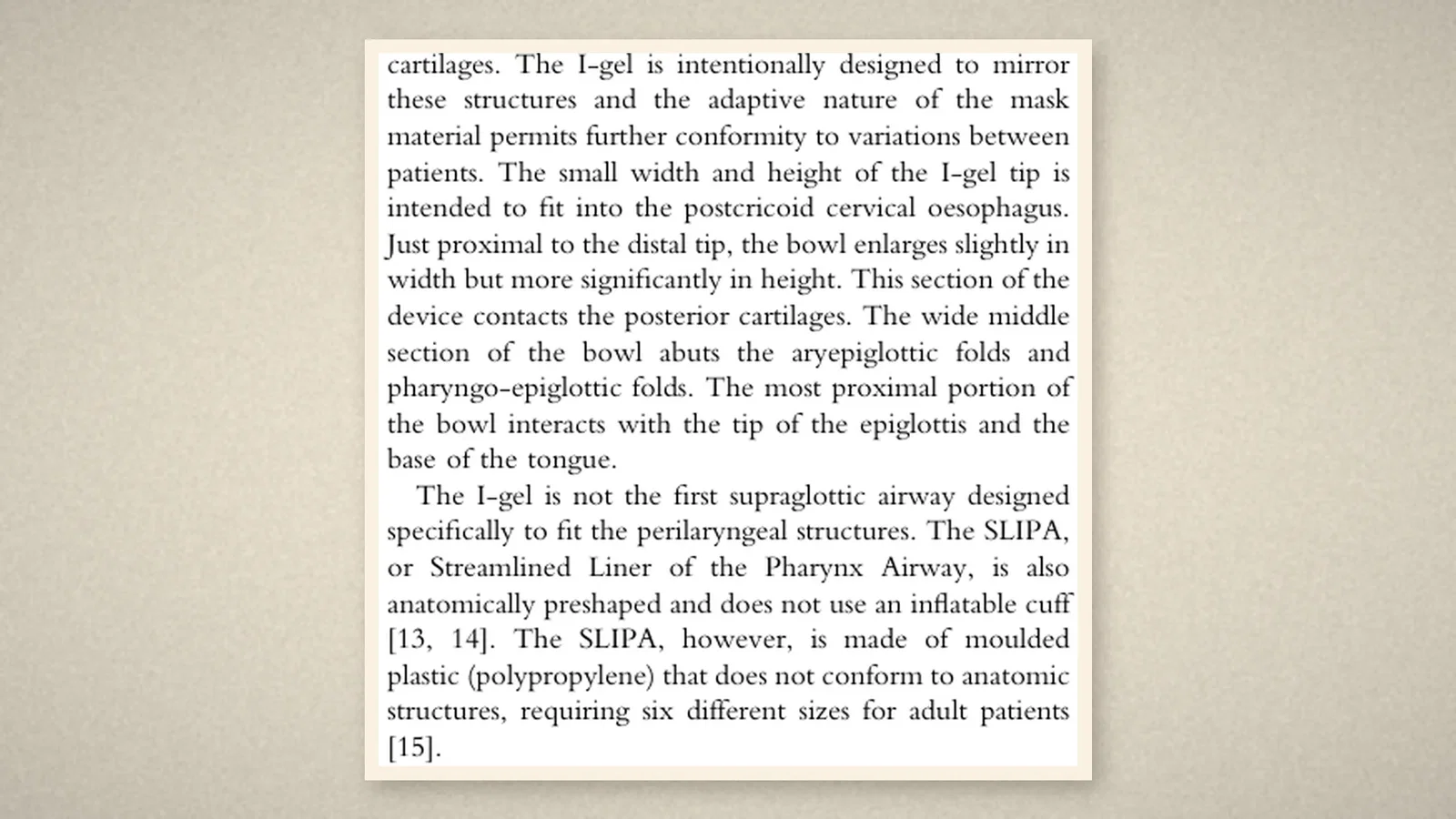
In the discussion the authors described the bowl's three-dimensional shape as deliberately mirroring the perilaryngeal anatomy, with the soft material adapting to differences between people. They were explicit that "the I-gel is not the first supraglottic airway designed specifically to fit the perilaryngeal structures": the SLIPA was also anatomically preshaped and cuffless, but made of moulded polypropylene that does not conform to the anatomy, and needed six sizes for adults. The I-gel has no aperture bars, which caused no problem in their endoscopies. [1, p. 1025]
They also set out the limits. The position and tone of the epiglottis and pharynx in cadavers are not the same as in anaesthetised patients; dissection disturbs the relations of the tissues; and the relatively rigid optical stylet may have moved the device. They saw the study as a foundation for research on ventilation and seal pressures in live patients. [1, p. 1025][1, p. 1026]
The acknowledgements state that Intersurgical supplied free samples and paid the costs of the study, including the cadaver laboratory fees, video tape and radiographs, and that the device's inventor, Dr Muhammed Nasir, and Mike Hinton of the company suggested aspects of the design but were not involved in data analysis or writing. [1, p. 1026]
What the record shows
The report records a turn in design thinking: instead of inflating a cuff to force a seal, shape the mask like the larynx itself, and then check in cadavers where it actually lands. The paper's conditions matter too: cadavers rather than patients, a study paid for by the maker, and authors who say plainly that theirs was not the first such device.
Sources and reading limits
Read: Levitan and Kinkle, "Initial anatomic investigations of the I-gel airway: a novel supraglottic airway without inflatable cuff", Anaesthesia 2005;60:1022-6 (the whole paper: summary, introduction, methods, results, discussion, acknowledgements and Figs 1-5; page images of pp. 1022, 1023 and 1025 checked). Obtained through institutional access.
Not covered: the ProSeal paper (Brain and colleagues, Br J Anaesth 2000); the file obtained under that citation turned out to be a 1994 congress supplement of the same journal and was not used. The SLIPA papers and the other works the authors cite, and clinical studies of the I-gel in live patients, were not read. The ASA timeline entries, spanning 1988 to 2015, were used only as leads.
Limits: the wider story of supraglottic airways runs from 1988 to 2015; this article covers only one device's cadaver study in 2005. As the authors say, cadavers differ from anaesthetised patients; the maker supplied the devices and paid the costs, and the inventor suggested aspects of the design but, the authors state, took no part in analysis or writing. Device sizes and dimensions are not repeated, and the Fig. 1 crop shows only the photographs, not the caption with sizes. The dissection photographs, endoscopic views, radiograph and videolaryngoscope image (Figs 2-5) are not shown.
Three illustrations are crops of Anaesthesia 2005 pp. 1022, 1023 and 1025 (title and summary, the Fig. 1 device photographs, a discussion paragraph). One is a text diagram drawn from the paper, with no people drawn.
- Levitan RM, Kinkle WC. Initial anatomic investigations of the I-gel airway: a novel supraglottic airway without inflatable cuff. Anaesthesia. 2005;60:1022-6. DOI
Continue exploring
Related reading connects shared questions and contexts; it does not by itself establish historical influence.
- 1985: Mallampati and Colleagues Propose a Pharyngeal Sign Predicting Difficult Intubation
- 1937: Leech's Pharyngeal Bulb Gasway for Closed-Circuit Cyclopropane
Anesthesia Epochs · The Source Room · About & Editorial Method
Published November 3, 2026. Sources and reading limits are stated above. Illustrations are labelled as original source images or AI-made. Historical accounts are educational; they are not current treatment instructions.