
The History of Anaesthesia Society records the founding of the Faculty of Pain Medicine of the Royal College of Anaesthetists on 2 April 2007, with responsibility for the FFPMRCA examinations. This article reads the College's own Regulations of the Faculty, preserved by the Internet Archive: in force from 2 April 2007, they define pain medicine as the relief or avoidance of acute, chronic or cancer-related pain, open Foundation Fellowship to College Fellows and other NHS doctors with a contracted clinical commitment to pain medicine, without conferring Specialist Register eligibility, and set an Initial Board appointed by Council, including a trainee and a lay member from the Patient Liaison Group, to give way to an elected Board over eight years.
Reading Library · Anesthesia Epochs · 中文版
Watch the education video (for clinicians)
2007: The Faculty of Pain Medicine — Royal College of Anaesthetists · Anesthesia Epochs Education Series
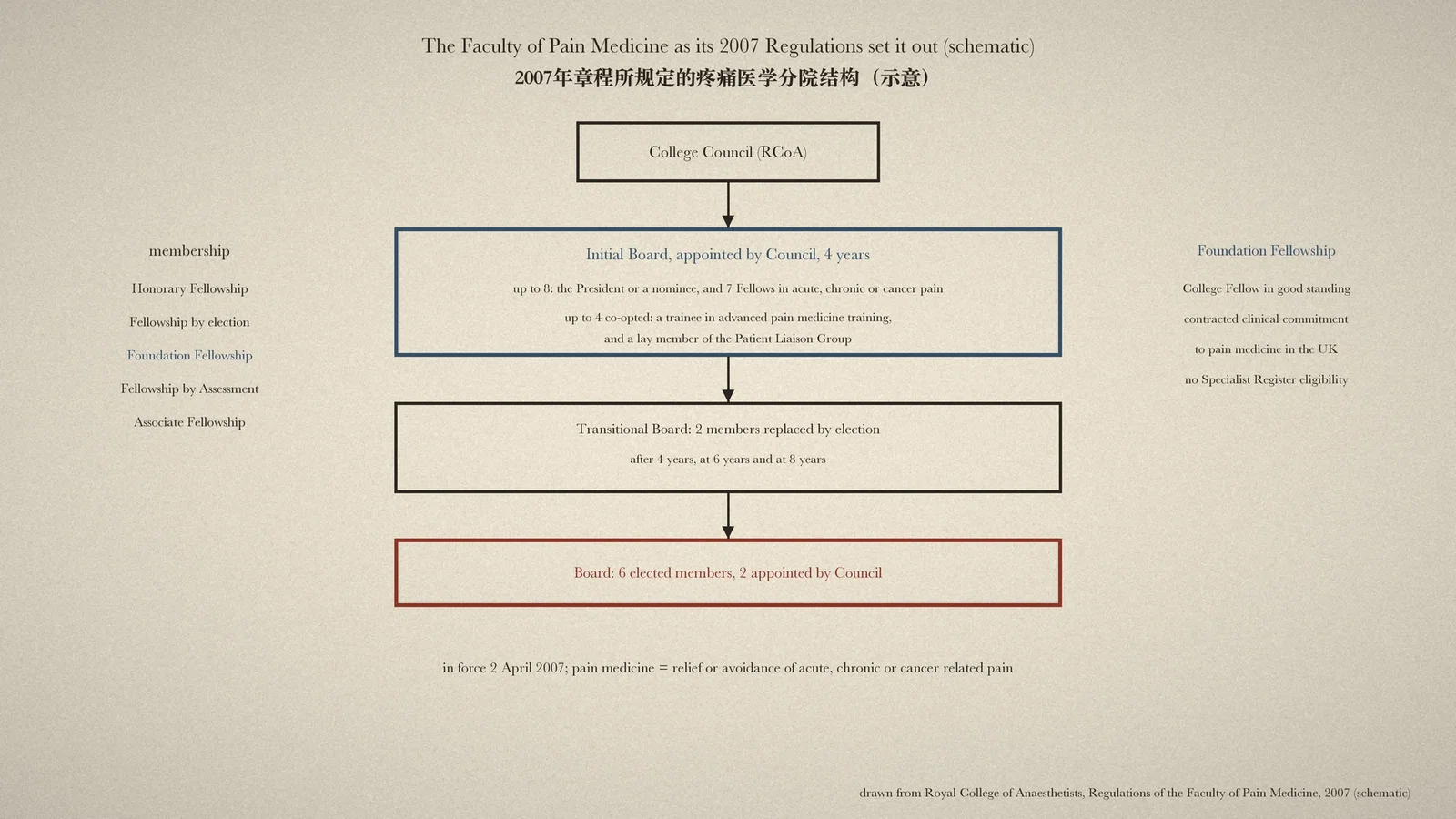
A specialty becomes an institution when it acquires rules: who may join, who governs, and how the governors are chosen. The History of Anaesthesia Society (HAS) timeline records that moment for pain medicine in the United Kingdom under 2 April 2007: the "Faculty of Pain Medicine of the Royal college of Anaesthetists is founded", overseeing the examinations for the Fellowship of the Faculty (FFPMRCA). [3]
This article reads the rules themselves. The Royal College of Anaesthetists (RCoA) posted the "Regulations of the Faculty of Pain Medicine" on its website in 2007, and the Internet Archive preserved the 29-page document in October of that year. [1]
Commencement and definitions
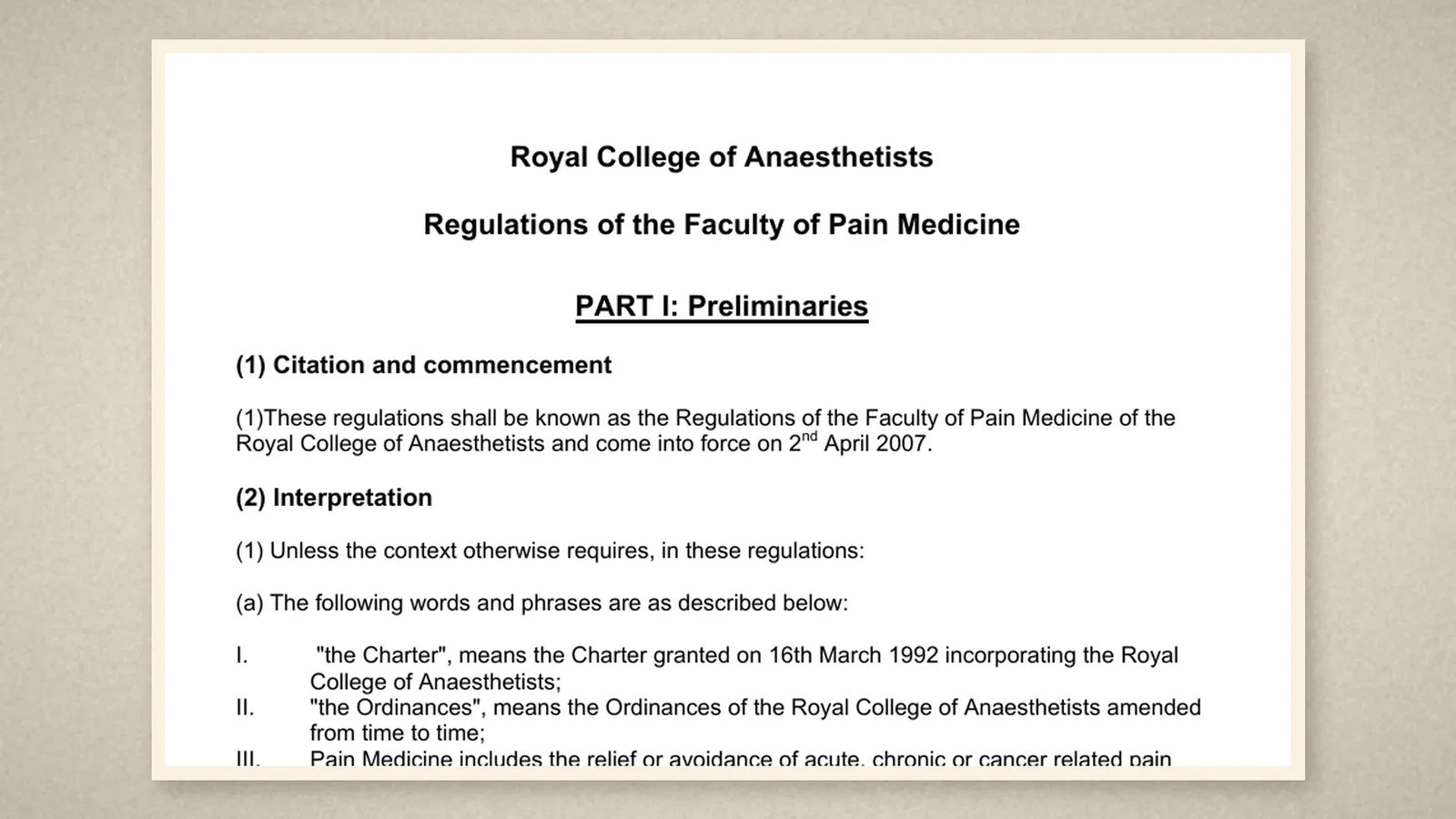
The first clause fixes the date: "These regulations shall be known as the Regulations of the Faculty of Pain Medicine of the Royal College of Anaesthetists and come into force on 2nd April 2007." The definitions that follow place the Faculty inside the College, whose Charter was granted on 16 March 1992, and define the field in one line: "Pain Medicine includes the relief or avoidance of acute, chronic or cancer related pain." Training means approved training "in the specialty of anaesthesia or critical care or pain management" towards a Certificate of Completion of Training. [1, p. 1]
Who could join at the start
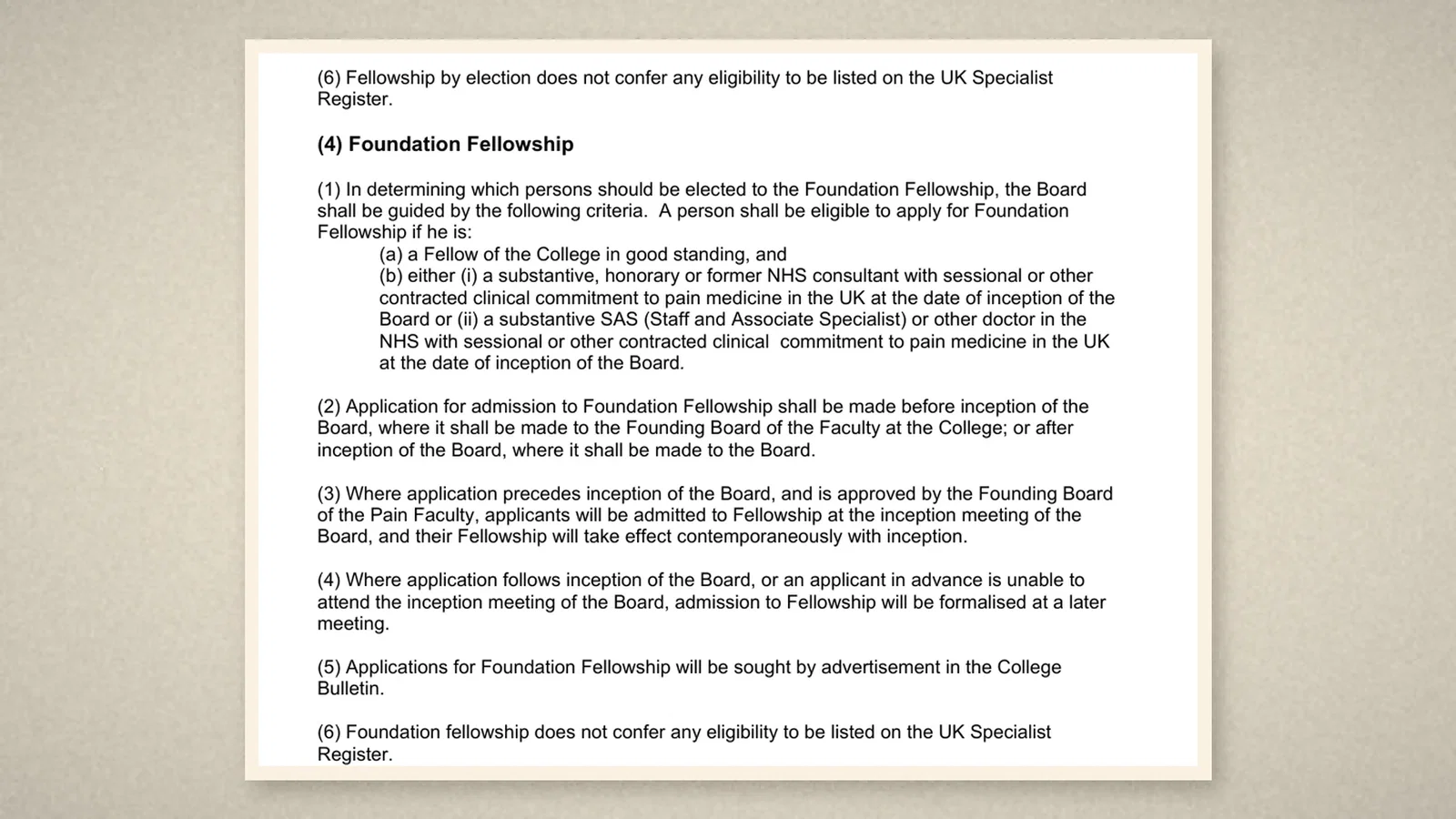
The Regulations set out several routes to Fellowship: honorary, by election, by assessment, associate, and a temporary route for the founders. Honorary Fellowship was for people of international repute "who have made outstanding contributions to the advancement of pain medicine". Foundation Fellowship was for those already doing the work. A candidate had to be "a Fellow of the College in good standing" and, at the date of inception of the Board, either an NHS consultant or a staff and associate specialist or other NHS doctor "with sessional or other contracted clinical commitment to pain medicine in the UK". Applications made before inception went to "the Founding Board of the Faculty at the College", and successful applicants were admitted at the Board's inception meeting, their Fellowship taking effect "contemporaneously with inception". Applications were to be sought "by advertisement in the College Bulletin". One limit was written in twice: Foundation Fellowship, like Fellowship by election, "does not confer any eligibility to be listed on the UK Specialist Register". [1, pp. 2-4]
Who would govern
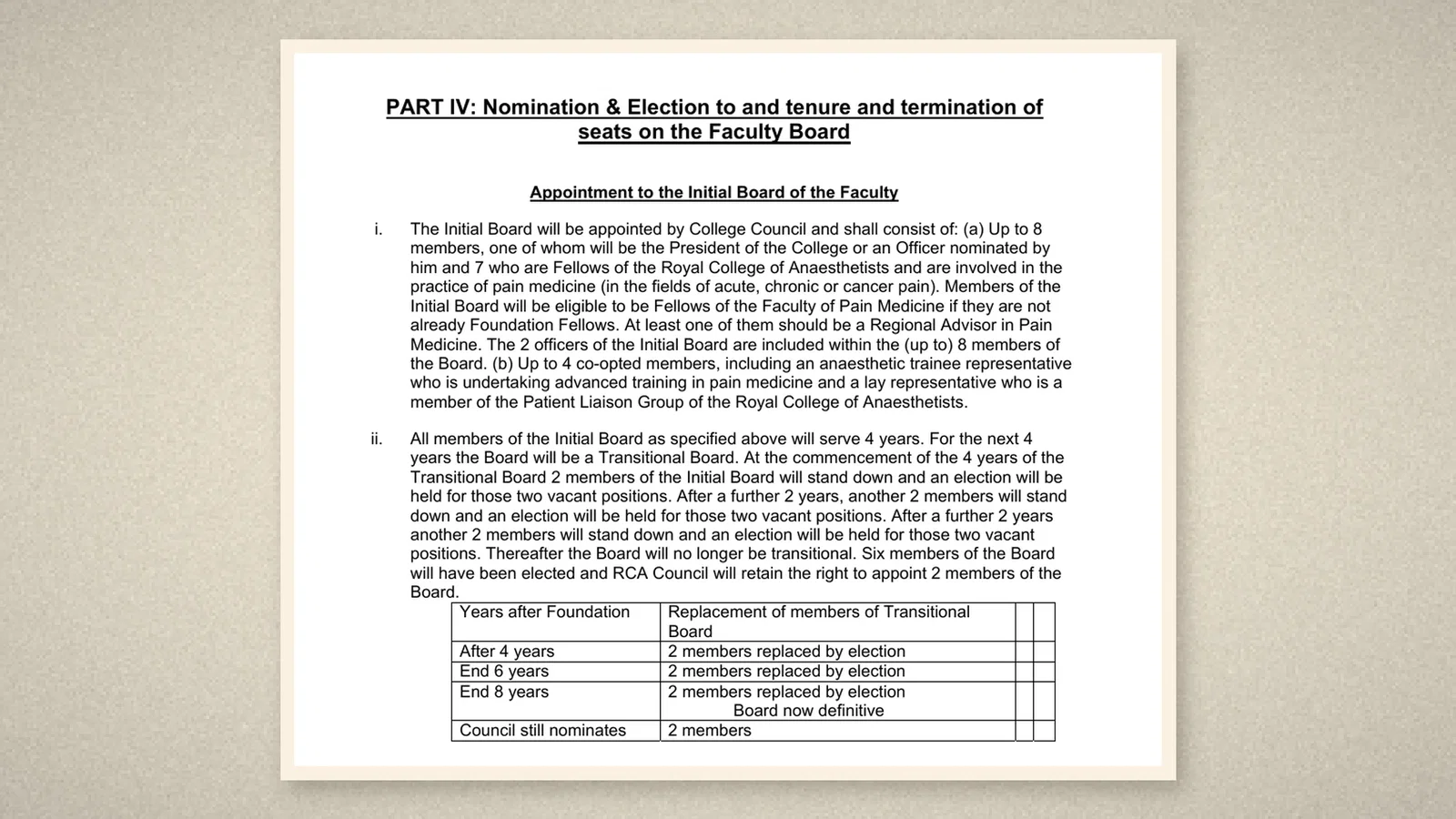
Part IV dealt with the Board. "The Initial Board will be appointed by College Council": up to eight members, one the President of the College or an officer nominated by the President, and seven Fellows of the College "involved in the practice of pain medicine (in the fields of acute, chronic or cancer pain)", at least one of them a Regional Advisor in Pain Medicine. Up to four co-opted members were added, among them "an anaesthetic trainee representative who is undertaking advanced training in pain medicine and a lay representative who is a member of the Patient Liaison Group" of the College. The Initial Board would serve four years; then, on a Transitional Board, two members would be replaced by election after four years, two more at six and two more at eight, until six members were elected and Council appointed two. Part V governed the election of a Dean and Vice Dean. [1, pp. 15, 19]
Six years on
The Faculty's homepage, as the Internet Archive captured it in January 2013, described the result: "The Faculty of Pain Medicine is the professional body responsible for the training, assessment, practice and continuing professional development of specialist medical practitioners in the management of pain in the UK. It supports a multi-disciplinary approach to pain management informed by evidence-based practice and research." [2]
What the record shows
The Regulations show how a clinical interest within anaesthesia was turned into a governed body. Membership began with the people already doing the work, without any promise of a separate specialist registration; governance began with appointment by the parent College and moved to election over eight years; and from the outset the Board was to include a trainee and a patient voice.
Sources and reading limits
Read: the Regulations of the Faculty of Pain Medicine (2007) in full, from the Internet Archive capture of the RCoA PDF (text layer, with page images of pp. 1, 4 and 15); the Faculty homepage as captured in January 2013; the HAS timeline entry for 2 April 2007.
Not covered: the 2007 announcement and reports in the RCoA Bulletin and the Faculty's own history page, which could not be obtained; the live Faculty website could not be accessed; the Foundation Fellowship application form of 2007; the membership of the Founding and Initial Boards; the later FFPMRCA examination regulations. No founders or officers are named here, because the documents read do not name them. The founding date rests on the HAS and on the Regulations' commencement date, which agree; the date of the Board's inception meeting is not given. The HAS's mention of the FFPMRCA is the HAS's. Quotations are from the English originals.
Three illustrations are crops of the Regulations (pp. 1, 4 and 15); one is drawn from them.
- Royal College of Anaesthetists. Regulations of the Faculty of Pain Medicine. In force 2 April 2007. Archived 9 Oct 2007. Internet Archive
- Faculty of Pain Medicine of the Royal College of Anaesthetists. Homepage. Archived 14 Jan 2013. Internet Archive
- History of Anaesthesia Society. Timeline. HAS
Continue exploring
Related reading connects shared questions and contexts; it does not by itself establish historical influence.
- 2010: Seven Colleges Create a Faculty of Intensive Care Medicine
- 1988: The Faculty of Anaesthetists Becomes a College
Anesthesia Epochs · The Source Room · About & Editorial Method
Published November 2, 2026. Sources and reading limits are stated above. Illustrations are labelled as original source images or AI-made. Historical accounts are educational; they are not current treatment instructions.